
#AtoZChallenge: Stress Assessments in a 15 Minute Clinic Visit

IMG_4479.JPG

In my practice, I focus a lot on stress management. Over the years I have developed a series of questions that facilitate an efficient and productive assessment of stress and its impact on health.  I share this approach here.


Meaning to Stress Ratio

  1. On a scale of 0 to 10, 10 being very high, how high do you rate the overall stress of your work?
  2. What are the sources of stress?
  3. On the same scale, 0 to 10, how high do you rate the overall meaning of your work to you? I mean personally, subjectively, regardless of how you think the world perceives your work, how much fulfillment to you yourself get from your work?
  4. What are the sources of meaning?

Examples of stress sources would be volume, hours, intensity, risk, pressure to perform, and toxic relationships. Examples of meaning sources might include contribution to society, providing for the family, mentoring, supportive relationships, creativity, and intellectual stimulation.

I started asking these questions to patients about seven years ago. I remember the first time I thought to use the trusty 0 to 10 scale to assess stress.  It made the conversation instantly faster and more focused.  Most people answer the first two questions easily, especially if stress is high.  A fair few, however, find the second two much harder.  They often get pensive for a moment.  This is when I know I might be cracking open an important door in a person’s consciousness—a door that, I believe, leads to important discoveries of self and overall health.

Everybody wants high meaning, low stress. But before we idealize ‘low stress,’ let us remember that all stress is not bad, and some stress is required for motivation, challenge, and productivity.

I soon realized, both for my patients and myself, that both the absolute values of stress and meaning, as well as their ratio, play significant roles in health. Let’s take a look:
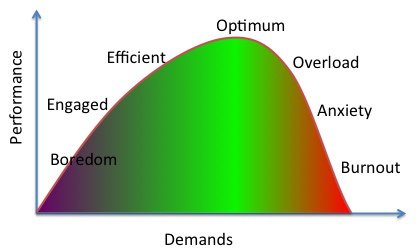
Low stress/low meaning : Boredom; disengagement.

High stress/low meaning: A different form of disengagement:  Burnout.

Low stress/high meaning: Restlessness: Lack of challenge, looking for something useful to do in service of a cause.

High stress/high meaning: This one is significant.  In my interviews, the people who are happiest in their jobs report this combination.  The key is that meaning must outrank stress—the meaning:stress ratio must be one or greater—and meaning itself must meet or exceed 6/10.  We can tolerate high levels of stress, even for prolonged periods, if we perceive intrinsic value in what we’re doing.  It moves the peak of the stress/performance curve to the right.  In other words, the stress has to be worth it.


The Three Awareness Questions

  1. When you are stressed or overwhelmed, where do you feel it in your body? For example, some people get headaches; others feel fatigued. Others get constipated or short of breath/palpitative. Still others notice mood swings and angry outbursts. While we all likely manifest each of these some of the time, most of us have a telltale sign or two that are specific to us.
  2. What are your existing resilience practices? What do you already do that keeps you from falling off the edge? What keeps you sane on a daily basis? We all have these practices, though it may take some contemplation to identify them. This awareness is important, though, so we may actively monitor. For so many people, exercise is a key stress reliever, and also the first thing cut out of the schedule when life gets busy.
  3. What are your de-escalation practices? When you feel yourself slipping off the cliff (the headache returns, your bowels grind to a halt), what do you do that brings you back from the edge? Examples here might be physical (running, boxing, or otherwise tantruming), verbal (journaling), or other.

When people make the connection between physical symptoms and subconscious stress, they can let go the fear and dread that often accompanies these chronic and often bothersome sensations. They can use them as smoke alarms—signals to take a step back, look around, and see what is out of balance, smoldering, or actually on fire.

Threat-Challenge-T&B Pie Graph

I previously referenced three major responses to stress here.  In summary:

  1. Threat stress: This is what we generally mean when we say ‘stress.’ It’s the fight, flight, or freeze response, when we sense a treat to survival, or we appraise that we lack the resources to cope with our circumstances. It’s mediated by cortisol.
  2. Challenge stress: We face a challenge that we feel at least somewhat qualified to tackle but it will be hard, test our limits. If we’re lucky, it’s something we care deeply about and we rise to the occasion—I’m thinking this could lead to a state of flow. This stress results in increases in DHEA and testosterone.
  3. Tend and befriend stress: This is the Mama Bear response. Under stress, we reach out and protect those around us.  We circle the wagons, bring in the kids, make sure everybody’s okay.  Oxytocin rises here.

If you were to draw a pie graph representing the proportions of these three stress responses in your work, home, or life in general, what would it look like? All three responses are natural, functional, and serve a purpose.  But when threat stress, in particular, becomes chronic and unrelenting, health suffers—we suffer.  Fortunately, there are strategies to convert threat stress to challenge stress.  Here are some resources for that, if you’re interested:

http://www.google.com/url?sa=t&rct=j&q=&esrc=s&source=web&cd=1&cad=rja&uact=8&ved=0ahUKEwjklePAq6jMAhUBZiYKHYjRAaMQFggcMAA&url=http%3A%2F%2Fwww.ascd.org%2Fpublications%2Feducational-leadership%2Ffeb14%2Fvol71%2Fnum05%2FConvert-Stress-to-Challenge.aspx&usg=AFQjCNEoBg56lNydHzXTJcXs-9WwoNxmRg&bvm=bv.119745492,d.cWw

https://www.google.com/url?sa=t&rct=j&q=&esrc=s&source=web&cd=4&cad=rja&uact=8&ved=0ahUKEwjklePAq6jMAhUBZiYKHYjRAaMQFggvMAM&url=https%3A%2F%2Fhbr.org%2F2011%2F06%2Fturning-stress-into-an-asset%3Fcm_sp%3DTopics-_-Links-_-Read%2520These%2520First&usg=AFQjCNGCm6kfdy2ElyCRFilRd__NQ3TX8w&bvm=bv.119745492,d.cWw

http://believeperform.com/performance/stress-appraisal-challenge-vs-threat/

This is now the framework with which I interview all patients about ‘stress’ and its impact on their health. It’s my favorite part of the patient encounter.  This is when I really get to know a person, and learn, from every encounter, how people experience life.  I’ve said it before and I’ll say it again: It’s a tremendous privilege to be allowed into people’s lives so intimately.  My job is to help people live their best lives.  In the hectic culture of the twenty-first century, we cannot underestimate the importance of stress management in that endeavor.

#AtoZChallenge: Opposition and Openness

be the change

Image from Google long ago; I can’t find the link anymore, sorry…

OH, this is a hard one.  Okay, Okay, I just have to write it.  And OMG, I am now two letters behind!

Oppose, Dictionary.com:

  1. To act against or provide resistance to; combat.
  2. To stand in the way of; hinder; obstruct.
  3. To set as an opponent or adversary.
  4. To be hostile or adverse to, as in opinion: to oppose a resolution in a debate.
  5. To set as an obstacle or hindrance.
  6. To set against in some relation, especially as to demonstrate a comparison or contrast: to oppose advantages to diadvantages.
  7. To use or take as being opposite or contrary.

There is so much Opposition in our world now.  I’m thinking specifically of politics.  Like many of my blogging friends here, I eschew writing about politics because it can have unintended consequences and distract from the intent of this blog.  I have alluded to it (Obtusely) here, and commented on another blog here.  Mostly, I don’t feel qualified to comment on politics.  But a Facebook post I wrote a few days ago keeps nagging at me to be shared, and I have struggled around the best way to present it.  So here goes.

When I look at the list of definitions of oppose, I feel tired.  When I think of the energy it takes to constantly stand against something, I feel listless and drained.  Fighting, resisting, combatting, Obstructing, standing in the way, hindering, disputing, dissenting, contradicting—it’s exhausting.  I think of times when I meet someone new and all they talk about are the things they hate, that they can’t stand, that they want changed.  I cannot wait to get away and find levity.  There are two main consequences of the oppositional mindset that put me off:

Polar Isolation

Oppositional mindset pushes people apart—to extremes.  I think now of my Facebook friends who post incendiary words and images.  They blame, shame, ridicule, mock, and degrade Others.  By others I mean those who do not share a common economic background, political ideology, religion, skin color, profession, or even parenting style.  When I see these, I conduct an internal debate.  Part of me wants to engage, to call my friend out for posting something Offensive, distasteful, unprofessional, or unkind.  I try only to be friends on Facebook with real-life friends, so I know these people are not offensive, unkind people in general.  But each time one of them posts something deriding a group to which I belong, I feel hurt.  So I want to ask them, what are they really thinking?  Would they say these things to me in person?  But I know that social media is a poor venue to hold these conversations.  So I almost always scroll over.  Every time, though, there is residue on my figurative shoe from stepping over these posts.  I have to work harder to think of my friend in the same positive light.  I wonder whether we really do share values like I thought we did—because one of my highest values is to be kind to others.  I feel a distance now that I have chosen deflection rather than engagement.  It feels sad and lonely.

This is not to mention the escalating verbal wars waged by our politicians today.  Suffice it to say, I have stopped watching the news and listening to the radio.  I curate my information in small doses and avoid sensational headlines.  Everybody is out to paint the Others as dangerous, untrustworthy, less than.

When all we hear from our Opponents is how much they hate us, how stupid they think we are, how they wish we would shut the f*** up, we will do one of two things.  We will disengage, or we will engage with acute and increasing hostility.  Either way, we push one another further and further apart, and we end up living in polar opposition.  And as we know, conditions at the ends of the earth are harsh.  It’s a desolate and heartbreaking way to live.

Rigidity, Immobility, and Stagnation

The other consequence of a singular focus on that which we oppose is a complete and total lack of progress.  Two examples come to mind:

My child is jumping on the sofa.  “Stop that,” I say, “don’t jump on the sofa.”  She stops momentarily, then starts again in a few minutes, moved by a spontaneous joy that I have long since forgotten.  I keep repeating, “Stop that, do NOT jump on the sofa!”  The focus remains on what I do not want.  I keep a lookout, and each time she repeats the unwanted behavior my frustration mounts.  I may employ negative consequences—the next time she jumps, I take away screen time, or a stuffed animal.  The stakes climb and everybody gets tense.

I hate my body.  I am 20 pounds overweight, I feel sluggish, none of my clothes look good, and it undermines my confidence.  I keep thinking, I don’t want to be fat, I don’t want to be fat.  So every time I’m faced with donuts that someone brought to work, every time I go out to eat with my friends, I brace myself to guard against behaviors that I know will make me more fat.  I succumb sometimes.  I feel shame.  I keep thinking to myself, What’s wrong with me, why do I keep doing things that will keep me fat, when I don’t want to be fat?

There is a saying, “Energy flows where attention goes.”  I don’t know who said it first.  When we focus on what we don’t want, there we remain.  Even when it’s what we oppose, if we continuously attend to it, precious little energy remains to spend on what we do want.  This constant vigilance and guarding keeps us preoccupied with the problem, and impairs our ability to develop solutions.  What if I changed my focus with my child, and let her know what I expect from her?  “The sofa is for sitting.  Can you please sit nicely on the sofa?  How long can you sit still?”  Now I’m generating movement toward something desirable.  I’m making it a challenge, it could even be fun.  Tension is diffused, and I might tap into that long lost joy a little.  My self-talk around weight could also benefit from a subtle shift.  The difference between I don’t want to be fat and I want to be healthy can be profound.  The former keeps me fixated on and entrenched where I am.  The latter helps me move toward a goal, gives me an aspiration.  What does a healthy person do?  She avoids the break room when donuts arrive, finds alternate routes to the bathroom.  She takes the stairs rather than the elevator.  She chooses salad more often than burgers.  I start to envision my best self, and I feel motivated to pursue it (me).

Letting go of my oppositional mindset allows my creativity to shine through, and a world of possibilities may Open up before me.


Open, Dictionary.com:

  1. Not closed or barred at the time, as a doorway by a door…
  2. (Of a door, gate, window…) set so as to permit passage through the opening it can be used to close.
  3. Having no means of closing or barring: an open portico.
  4. Having the interior immediately accessible, as a box with the lid raised or a drawer that is pulled out.
  5. Relatively free of obstructions to sight, movement, or internal arrangement: as an open floor plan.
  6. Constructed to as to be without cover or enclosure on the top or on some or all sides: an open boat.
  7. Having relatively large or numerous spaces, voids, or intervals: an open architectural screen; open ranks of soldiers.

Letting go of opposition means Opening ourselves to new possibilities of thought, engagement, Outcomes, and connection.  I believe my friends are kind and generous at heart.  I can still oppose their offensive expressions.  If I do it with an open heart, ready to hear their point of view, withholding judgment and honestly listening for understanding, then I can maintain our relationships, even deepen them.  If I can make them feel seen, heard, understood, accepted and loved, despite our differences, then they will be more likely to extend me the same courtesy.

Being open means being vulnerable.  Just because I Offer openness and understanding does not mean my counterpart will reciprocate.  I could be rejected, ridiculed more, hurt more.  These are the risks and costs of openness.

But what of the benefits?  What if my openness actually creates a space for communication and mutual understanding?  What if my friends and I can lead by example?  Could we start a movement toward taking time to hear one another, seeing different points of view, and holding multifaceted perspectives?  Humans and our experiences are complex.  We cannot easily be distilled into soundbites, headlines, cartoons, and labels.  We should not accept such oversimplifications—we should Oppose them.  And at the same time we need to stand Open to the validity of our fellow citizens’ experiences.  We need to remain Open to the possibility—the certainty—that we really do share common values, goals, and hopes.  We need to work harder to hold our hearts Open to one another, reach out and come in from the cold, polar regions, and strive together for a better world for all of us.  We cannot hold hands with clenched fists (another quote, no?).  I would rather hold hands.

***

Here is the video that triggered my Facebook post of April 15, 2016, and the actual post:

I love Bernie. Also, though, I am starting to notice that his severe criticism of ‘the rich’ and his characterization of them as greedy as a group, oversimplifies.  It does so IN THE SAME WAY AS DOES THOSE WHO CHARACTERIZE POOR PEOPLE AS LAZY.  There are greedy rich people. There are also lazy rich people. There are also greedy and lazy poor people.

I agree with Bernie’s core values and his consistently stated vision for our future. I understand that his proposed policies may be unrealistic and unattainable in the foreseeable future, or maybe even ever. But he gives me something deeply meaningful to strive for, and that is the kind of leader I will follow. Even if we never get there, I will happily trudge the path *in the direction* of said future, because it’s where I want to go.  I do not hear or see a clearly stated vision or aspiration from the Republicans.  Bernie inspires me to be a better person, to make my best contribution to society.

We all have a desire to make a contribution. Psychology research over literally DECADES tells us that human nature is wired to be both productive and connected. So these premises that some of us are innately lazy and live for handouts, and others of us are conversely inclined to accumulate wealth only for ourselves and for its own sake, are not only severely misguided, they are dangerous. These toxic assumptions are exactly what keep each side permanently entrenched in opposition. Assumptions turn into accusations, which then engender mutual defensiveness, then offensiveness. It’s no wonder we have devolved into the current political morass.

I want Bernie to soften his language and invite the rich into conversation, collaboration, innovation, and creativity around solving the problems of inequality and disparity.

I want Republican leaders to moderate the voices in their party who blame the poor as personal failures and the sole architects of their downtrodden situation.

I bet most rich people really do care about the poor, just like I believe most poor people really do want to work and be productive members of society.

How much more could we do, how much better could we be, how much movement could we achieve, based on these assumptions instead?

#AtoZChallenge: Never and Now

Fire swamp

Photo found at http://www.cinemablend.com/images/reviews/6079/main.jpg

Scampering into the Fire Swamp to escape Prince Humperdink and his cronies…

Buttercup: “We’ll Never survive.”

Westley: “Nonsense. You’re only saying Never because no one ever has.”


“I will Never pay more than $___ for a house.”

“I will Never be able to swing a 14kg kettlebell without hurting myself.”

“I will Never get through all 12 weeks of this TRX Force program.”

“I Never thought it would turn out this way.”

As we all know (“’to blave’ means to bluff…” and holy cow, if you don’t know, please stop reading this instant and watch The Princess Bride!), Westley and Buttercup make it through the Fire Swamp, albeit with a few bumps and bruises.  Despite Buttercup’s grim forecast, Westley leads her one step at a time: past the Flame Spurts, out of the lightning Sands, and in spite of the ROUSs, or Rodents Of Unusual Size.  Having believed him dead, then being rescued by him from a trio of bandits, tumbling down a mountainside after him, and following him through the Swamp, Buttercup learns a critical lesson in overcoming passivity and nihilism.  Okay maybe that’s a stretch, but whatever, this is my post.

We all have our Nevers. The ones above are just a few of mine.  I spent more than I ever planned on my house and regret nothing.  I can wing a 14kg kettlebell with confidence—I rather kick ass, if I do say so myself.  I Never could have predicted my life looking this way—the good, the bad, the gorgeous, the ugly—and yet here I am.  And it is, really, mostly good (as opposed to “mostly dead”).  I’m starting to see possibility around the TRX thing, but I still think, I’ll believe it when I see it.  No, actually, I look forward to it.  On any given day of the program so far, I have thought, No.Way. It wants me to do what?  I try anyway, just to see how far I will get, and lo, turns out I actually get through.  So who knows what I can really do?

What helps us overcome our Nevers? In Buttercup’s case it was clearly Westley’s courage and love.  For me, the kettlebells, and the TRX, it’s Melissa, my trainer.  She has completed the program herself, she knows what’s required, and she knows what I can do—better than I know myself.  As for the rest of my life, well, it’s everybody else—my family, friends, colleagues, mentors, patients, et al.  I’ve said and written it ad nauseam—it’s my relationships that hold me up and save me.  I have very few Nevers anymore, because I’m surrounded by people who give me the courage to try.

And, there is another important practice to overcoming the Nevers: Mindfulness, the practice of the Now.  Never is about the future or the past.  Often it’s a shadowy, catastrophizing perspective of things.  But we cannot predict the future, despite our arrogant human certainty.  And we cannot live every day to come based solely on what has already happened or not happened.  Circumstances and attitudes change.  Landscapes change—at times literally, and in an instant.  We evolve, we learn, we grow.  How can we be so sure that Never is real?

Mindfulness teaches us to redirect our attention to what actually is.  It invites us to let go of what and how we think things should be, or will be, or were.  We don’t have to like it, and we also need to be comfortable with, or at least accepting of, our dislikes.  When we practice mindfulness, we slow down.  We see and think more clearly.  Anxiety and depression loosen their vice grips on us.  Mindfulness liberates us from the constraints of Never.

We are better off thinking, speaking, and acting in the Now. It is the mindset of agency.  This is what I know Now.  This is what I can promise you Now.  My sincerity is real Now, and I ask you to trust me.  I will keep my eyes and ears open to the new Nows; I will roll with the punches.  Westley makes no guarantees.  He simply forges ahead with conviction, bringing with him all (and only) the knowledge, skills, and wit he has acquired until this moment, when he realizes the only way out of the Fire Swamp is through.  He is present to the swamp’s dangers, and also to the potential tools available to him in this harsh environment.  He has no idea what will happen, whether they will actually survive.  He only refuses to accept the Never, and focuses like a laser on the Now.

There may be some things to which we can truly apply the word Never. I think we need to reserve it for the truly deserving statements, and leave the rest of our minds open to possibilities and growth.

Still, most of me thinks I will Never try bungee jumping…