
Anchoring One Another

All I really have to know/ Is that you are here/ And I am not alone” — “Anchor Me

My friends, I have a new obsession: The Tenors! I have listened to their covers of Lean on Me and Hallelujah for months on my Spotify ‘Liked’ playlist, and something made me explore the rest of their music this holiday season. Now I’m hooked!

Check out their YouTube channel for heartwarming videos not just of their music, but tributes to their moms and dads, baking adventures during lockdown, and a touching farewell to their longest leading member. They sing with passion and love, driven by the deeply held belief that music heals. I agree, and of course it makes me think about how we relate through music.

So many people are having a hard time now. One friend’s dad recently died; another faces a toxic divorce. A third prepares for major surgery, and yet another finds herself suddenly estranged from her close friends. And oh my gosh the pain all around us in the world, how are we getting through any of it? Sometimes only music and song can convey the depths of emotion and need. The Tenors’ song “Anchor Me” feels like both a lament and a prayer. I find it incredibly hopeful, and also convicting. The first verse is a beautiful expression of pain that we have all experienced:

Oh my soul is troubled
Oh my will is worn
Tired and discouraged
Trampled on and torn
Every breath a battle
Every step a war
My heart a broken vessel
This night an angry storm

The chorus:

When sadness crashes like an ocean
When fear is deeper than the sea
When I am swallowed by the darkness
Will you come and anchor me?

Verse two goes deeper, laying bare the powerlessness and vulnerability of grief, sadness, depression, and disconnection, and the courage it takes to ask for the help we need:

I cannot see through this
Can you be my eyes?
I’m completely hopeless
Can you shine a light?
I have no more strength left
Can you stand and fight?
I’m dying in this doubt
Can you be my faith tonight?

And the bridge brings it all together; this is what we all seek in these times:

Hold me still and hold me close
Until it all passes away
I beg you not to let go
All I really have to know
Is that you are here
And I am not alone

… Who anchors you? Whom do you imagine singing, or sending, this song to?

I think first about my tribe, my pit crew. I call on them first, every time. I could not get through much without them, and I show up for them, too. It’s a boisterous lovefest in joyful times, and a swaddle of steadfast strength and love in grief. But sometimes the hole is deeper yet, and I must call on something bigger than us all. Call it God, Providence, cosmic forces. I can get still and commune with my own deep faith in galactic nature, in the eternal. And I can find spaces where I feel that communion more tangibly–in my favorite chapel, in the mountains, by the lake.

Sometimes I feel I can anchor myself. Through the years my tribe has reflected my own strengths, values, and purpose back to me. They coach me, remind me Who and Why I am. So on my own, I can recall their reflections, feel their love, and that holds me up even when I cannot reach them directly. So maybe it’s not me at all, rather it’s the gift of tribe and belonging, of cosmic energy that ties me, anchors me, like a belay.

And what about strangers? Are we ever truly strangers? The most loving and inclusive aspects of our faith traditions all share a teaching of communion with all of humanity, no? And haven’t we all had the experience of random kindness, offered by a random other, while we flail in the throes of despair, throwing us a line and tugging us back to somewhere solid and light? Where do these angels come from? Perhaps the cosmos sends them? Whatever we believe about it, wouldn’t it make everything better if we each resolved to participate in the giving, to be that kind and anchoring stranger whenever we can, in whatever way we can?

It may seem trite and cliché, but just making eye contact and smiling at ‘strangers’ on the street makes a difference. To acknowledge another person, to mark them with your presence, to exchange a mutual nod of existence, this is anchoring. It proves that we are visible, that our being is noted. Imagine walking down the street, never once meeting anyone’s eyes, never catching anyone’s awareness. Research shows that this–to be ignored by people we don’t even know–affects us deeply; it feels incredibly lonely and isolating. Harm occurs when we do this to one another.

“Do not pass by a man in need, for you may be the hand of God to him.” Memes of this quote atrribute it to Proverbs 3:27, but I’m not sure that’s correct. Regardless, the expression is instructive.

All I really have to know/ Is that you are here/ And I am not alone.

This can be any one of us, for any one of us. Maybe we can all try a little harder to help one another feel less alone, ya? Whom can I anchor today? On whom will I call, and/or who might just appear, to anchor me tomorrow? Everything goes around and comes around. We can make it better, help one another suffer a little less.

We can hold one another steady.
What Flavor Is Your Narrative?

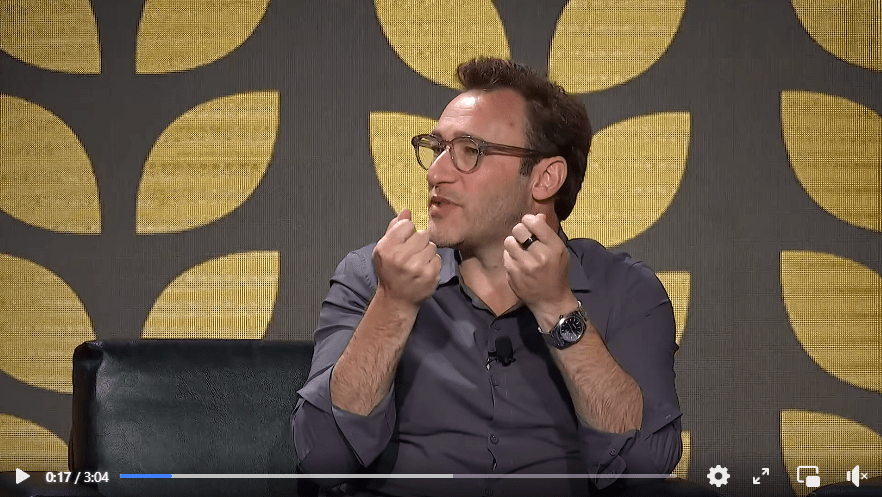
Simon Sinek describing narrative flavor

“Every day I get to ask people the most interesting questions I can think of, to help them know themselves better and live into their healthiest, most fulfilled selves.”

What if I answer this whenever someone asks me, “So, what do you do?”

How does this sound, feel, and taste different from if I just said, “I’m a doctor”? How interesting, to think of a narrative having a taste… What flavor do you assign my answer above, as you read it? Maybe I should add some toppings:

“I have the privilege and pleasure of doing work that stimulates both my thinking and feeling brains. I get to use all that I have learned throughout my life, both personally and professionally, in service of connecting with and serving other humans. I exercise deep expertise and knowledge, and am also humbled to learn something new every single day. I love what I do, I impact people’s lives, and it’s almost all ‘just’ by talking to people.”

Simon Sinek inspired this post when I watched the video clip of him describing why communicating through stories–narratives–is so important and effective. Thinking of narrative in terms of flavor–what a novel and elegant concept! It takes a totally different perspective on words, from thinking or feeling with emotions to putting it in our bodies. Smell and taste are a primitive sense, and highly associated with memory and emotion. It is literally visceral. So when we tell our stories about work, families, core values, realtionships, struggles–anything meaningful–what happens to that meaning when we correlate it all with a taste? Both for ourselves and those who hear/read our tales? How fascinating!

My first thought watching this video was ‘bitter.’ When I think of the deeply grooved, dysfunctional patterns in some of my relationships, I realize that my narratives—the biases and assumptions I make when interacting with (or even thinking about) certain people—set us up for conflict and discord from the outset in any given encounter. Yikes. For some reason, describing them as ‘bitter’, imagining the taste on my tongue, catches my attention, makes me stop and take notice, more than naming it all as resentment, anger, and grudges. It motivates me to change the narrative, to shift my perspective, make more generous assumptions, withhold judgment, and Give the A. Who wants to taste bitter all the time? I want to make these relationships sweet, savory, and refreshing.

How can we expand this metaphor beyond our own individual stories?

What is the story of your workplace culture? How do the mission/vision/values statements land on the workforce? How would you first describe it in the usual adjectives: restrictive, supportive, rigid, chaotic, backstabbing, upbeat? Then what emotions do you associate: happy, sullen, lighthearted, anxious, safe? What about bodily sensations: tense, relaxed, sleepy, wired, restless? And finally imagine a taste for it: bland, spicy, bittersweet, moldy, rancid, salty, aromatic? How does this exercise affect your perceptions/memories/thoughts/feelings about work? Does it move you to think, say, or do anything differently?

I have never before described my work in the exact words I used above. It feels liberating to find and articulate stronger language for my experience. And it did not take me long to land on ‘sweet’ (I often describe my job as ‘the sweetest gig’–funny how we use this phrasing for things that are just that good) and ‘umami‘ for its tastes. I love what I do. I crave it, savor it. I bask in not just the flavor, but the warmth (it’d definitely warm, not cold or hot) and the texture (rich, dense, smooth with bits of crunch and chew). OH this is fun! My work is the most satisfying meal: marbled, medium rare rib eye with a nice crust, roasted sweet potato, sauteed Brussels sprouts, tiramisu, and chai. Oh and there is some flower salt and pepper on the table.

I wonder how my patients would tell their stories of me and our relationships, and how they would translate those narratives into olfactory and gustatory experiences of us? Am I (are we) bran flakes, kale salad, mac ‘n’ cheese, burnt toast, chia pudding, meatloaf and spinach, blue cheese? The possibilities are endless! And it’s important to query and clarify our unique associations with the flavors we assign. I may think blue cheese is fragrant and lovely; my patient may mean it as putrid.

Now I’m thinking of employee engagement surveys. Wouldn’t it be fun, and actually engaging, to include novel questions like these? Surveyors could easily design questions to indicate whether responses are meant in positive or negative ways, and categorize different foods or meals to represent different aspects of work–breakfast as relationships, lunch as tasks, dinner as meaning, dessert as perks.

Okay that’s enough for now. What a fun diversion this was. Now I’m wondering about figures of speech that reference food and taste…what do we mean to evoke with this language? A post for another time, perhaps.

Onward in curiosity, novelty, learning, and connection, my friends!

Bask In the Wonder

Kelley Dallas Fine Art Photography, Facebook, 12-23-2022

If I ever get a tattoo, it’ll be a toss up between a little cartoon buffalo and the Colorado flag “C”. I was born in 1973, the Year of the Ox, bison thrive in Colorado, and my initials are CCC. …I’ll probably get some combination of the two… So there, I’ve just decided! I wonder if I can/will design it myself, or if Daughter will do it?

Here at the end of 2022, in the midst of a polar bomb cyclone gnarling much of the country, I’m happy and grateful to have some time off and a functioning furnace. The shortest day of the season has passed; everything gets lighter for the next 6 months now. So for this post, I share some light and wonder on my mind. Keeping it in my pocket for the still dark days ahead.

Designed to Survive

Driving west on I-70 from Denver, around the Genesee Park exit, I always look for the buffalo herd at the overlook to the north. I have yet to see them in the winter, and I slow down anytime they’re around. I just love these animals–so strong, resilient, and majestic. And HUGE. But the thing that amazes me most is how they can survive the brutal plains winters–their coat, holy cow (pun!)! Its thickness and structure insulates body heat such that snow and ice don’t melt on the pelt, even over such a vast surface area. I wonder if the circulation in their legs and feet have that countercurrent heat exchange anatomy that penguins have? Regardless, this is my spirit animal (sorry, moose). All hail, mighty buffalo.

https://www.noaa.gov/stories/how-do-snowflakes-form-science-behind-snow?utm_source=pocket_reader

The Beauty of Nature and Science

I have known for a while that ice takes up more space than water because of the obligatory orientation of oxygen and hydrogen in a frozen state. But it never occurred to me that this is also why snowflakes always have a hexagonal crystal shape. Thanks to NOAA and Scientific American, now I know–it’s still all about molecular structure! And depending on atmospheric conditions surrounding each individual flake as it forms while falling, the crystal takes on its ultimately unique configuration. I also learned that the flakes themselves occur when freezing water vapor interacts with solid particles in the air. Sky ice needs a nidus on which to form–a seed. So does that mean more snow falls in places with more pollution? I wonder how else pollution affects the properties of snow?

Ooo, what analogies can we make to humans here? How do our crystals form in life, and what particles in our environments facilitate what kinds of flakes we become/create? When are we light, airy powder, versus heavy, laden sleet? Fun and philosophical to consider!

Love Really Is All Around

Sister and Brother-In-Law were over last weekend, and we all watched Love Actually–again. It’s still as funny as the first time! And trope-y as it is, I continue to appreciate how the film depicts the various shapes, depths, and circumstances of love in all its forms. Romantic, platonic, parental, marital, fraternal, carnal, unrequited, or other, love and connection between humans are remarkably complex, and worthy of effort and reverence.

It seems like I’ve written every year on this blog how hard things are, how challenging and destructive we humans can be to one another. And it feels worse every year, no? I know this is only partially true. Thankfully, every year I also learn better how to hold the polarity of People Suck and We Are Awesome with more peace and balance. Holidays seem sometimes to amplify both tendencies, and yet reliably, I see connections outshine divisions at this time of year. Take the neighbor who strung Christmas lights from his own house to the lady’s across the street, because he knew she was having a hard time since the pandemic. Then the whole neighborhood started doing it, to the point where a couple who was thinking of moving decided to stay because the community had become so connected. Turns out, showing kindness to others improves our own happiness and well-being. Friend Donna Cameron knows this well, and we all benefit from her writings on it.

Empathy, compassion, and kindness, however, do not require us to give up our own needs–literal selflessness is not necessarily a vitrue. See Adam Grant‘s book Give and Take for an evidence-based treatise on why ‘otherish giving’, a balance of generosity and healthy boundaries, is optimal for relationships and health.

Lastly, props to Topher Payne for writing an alternate ending to Shel Silverstein‘s The Giving Tree. Instead of giving everything to her friend the boy over her lifetime, until there is nothing left of herself but a stump, Tree calls out his self-absorption and negotiates a more respectful, reciprocally loving and fulfilling relationship. I wonder how the world would be if we taught such crucial skills, explicitly, in formal education? I mean is it really less important to know how to take care of each other than how to do algebra?

https://lithub.com/somebody-finally-fixed-the-ending-of-the-giving-tree/

What light and wonder hold you this season? Please share here and everywhere!

May we all enjoy one another’s presence, openness, grounding, kindness, love, and connection, this holiday and well into the New Year.