November 6:  Caring For the Team Makes Me Better

IMG_2624

NaBloPoMo 2019

“How does he treat you?”

I don’t only ask this question of women whom I suspect of being abused at home.  I also ask my medical assistants.  Not about their domestic partners, but about our patients.

In my first practice, I sat/stood to the left of my medical assistant every day for six years.  It was a cozy (cramped) little counter space stacked with charts from end to end, with a couple of high-wheeley chairs.  Each chart stack had a laminated cover on top:  “For Cheng to Review/Sign,” “For Rose,” “Labs,” and “Messages.”  Charts journeyed from my left to my right/Rose’s left, to the bin under the counter to be filed.  It was incredibly efficient, actually.  I had a handwritten emoji system for indicating (dis)satisfaction with cholesterol and diabetes results.  Rose knew all of my patients and how to communicate sentiments and instructions clearly and lovingly.  She had been an MA since I was a kid; she knew what she was doing.  If a patient had a question on the phone, she could put them on hold and clarify with me, or I could just get on the phone and speak to the patient myself.  We were busy and happy, a well-oiled team-machine.

One day as I came up to my spot at the counter, I noticed an unusual sound next to me, like a distant, scratchy loudspeaker.  I turned and saw Rose holding the phone receiver about an inch from her ear.  The sound was my patient, yelling profanities at her so loudly I could hear his words from two feet away.  I can’t remember what the issue was, but he was obviously upset, and taking it out on her.  It surprised me because I had only known him to be sweet, respectful, and grateful.  Maybe he was just having a bad day?  I looked at Rose, who rolled her eyes and exhaled heavily.  I asked her to put him on hold so she could catch me up.  Apparently this had been going on longer than I knew, and she had not told me.  Had I not come upon it in real time, she may never have told me.  She would have simply tolerated it.

I picked up the call and declared myself.  He was the usual, respectful and calm patient I had always known.  I answered his medical questions.  Then I told him firmly that he did not have the right to treat anyone in my office the way he had just treated Rose.  I think there may have been some excuses and then an apology.  I made it clear that if he abused my team again, he would be discharged from the practice.  He agreed and apologized again.

That was my first opportunity to stand up for my team as an attending.  I will forever remember it.  I was a petite, young, Chinese woman doctor, speaking to a white man decades older than myself.  I stood up for my medical assistant, a woman of color and a couple decades older than me.  She had felt powerless to stand up for herself to his verbally vomitous abuse.  All I had to do was pick up the phone and say, “Mr. Soandso, this is Dr. Cheng.”  He never yelled at Rose or anyone in the office again, to my knowledge.  How could I have this much power, and why had nobody asked me to wield it in their defense before?  It was just accepted that patients could yell and scream at our staff, with no consequences?

IMG_2066

We recently discussed abusive patients during our regular doctors’ meeting at my current practice.  Immediately I thought, HELL NO.  The good news was that our team members feel safe reporting incidents to our managers and physicians.  My partners and I have all had to call patients to clarify our expectations of respect.  We understand that illness is stressful.  We understand that our healthcare system, especially at a large, bureaucratic institution, causes frustration, even rage.  However, none of that ever justifies or entitles a patient, or anyone, to belittle, dehumanize, or otherwise degrade another person, and especially not a team member who is doing their best to help–ever.  At this meeting, gratifyingly, we all voiced definitive confirmation that we fully support our team, and we will, without hesitation, educate and/or discharge any patient who violates our team’s right to a collegial and non-threatening work environment.

Even as I write this, I shake a little with rage and outrage at these patients’ behavior.  I can feel tightness and tension in my chest and abdomen, my breath quicker and shallower than its usual resting state.  I wonder if this triggers me because my mom is a nurse and I have seen how patients in the hospital abuse nurses.  I also know how women physicians are mistaken for nurses and thus ignored or dismissed, even by female patients.  I have known racism and sexism first hand.  But as a physician, I’m in a position to not have to tolerate it.  By virtue of two letters after my name, I have the power to protect my team, with authority.  And I work with other physicians who also recognize both this power and its attendant responsibility.

I hope our team feels protected, defended, and loved by us docs.  We may be the default work unit leaders, but they do the lion’s share of work that allows our practice to run as smoothly and successfully as it does.  They are who let me do my work as well as I do.  I depend on them every day.  So caring for them absolutely makes me better, makes us all better.

 

November 5:  Peer Coaches Make Me Better

bee bao

NaBloPoMo 2019

When you’re working through a challenge, who helps you?  What is it about them, how are they most helpful?  How not?

Through the years I have learned what I can get from certain people.  I know to call this person when I need validation, that person when I need a devil’s advocate.  I also know which people to avoid altogether—those who cannot be trusted with my vulnerability or confidence.

But when I need to hold space and tension with an issue, to patiently look at it from different angles and process the perspectives, I look to my peer coaches.  I feel gratitude and gladness for these friends today, after my LOH group had our monthly peer coaching call.  As we progress through our 10 month leadership training, we take tenets and skills home from each retreat to practice.  Monthly Zoom calls have no agenda, other than to reconvene, share, and mutually support.  Every time I come away appreciating just a little more how nothing in life—work, personal things, social context—can really be separated from anything else.

These friends are not my first or only coaches, however.  In 2005 I started working with Christine, my life coach.  Every session, 14 years later, is still transformative.  How is this possible?  Curiosity.  Christine coaches every call squarely and unwaveringly from this perspective.  It was not long before I realized how powerfully this method could alter my own encounters with patients.

10-22-19-2

The best coaches have no preformed or decisive answers.  They have the uncanny ability to ask the best questions–Open, Honest Questions (OHQs)–which then lead clients to their own best answers.  They help frame and reframe problems.  They point us to alternate perspectives and help us open our minds to narratives other than the ones we too often grip so desperately.  It was my second year in practice when I started asking coaching questions to patients, and I have never since feared any symptom, syndrome, or answer.  When there is no clear diagnosis or answer for someone’s distress, I can just keep asking until something helpful emerges.  Most often it’s not a single piece of information that gives clarity; rather, it’s the story that materializes.  Coaching skills help me help my patients find and tell their stories of health and wellness, illness and pain, agency and action.

Here are the tenets of true Open, Honest Questions, from the LOH syllabus:

  • The best single mark of an honest, open question is that the questioner does not know the answer and is not leading toward a particular answer.
  • Ask questions aimed at helping the other person come to a deeper understanding (help them access their own inner teacher).
  • Ask questions that are brief and to the point without adding background considerations and rationale—which make a question into a speech.
  • Ask questions that go to the person as well as the problem or story—for example, questions about feelings as well as about facts.
  • Trust your intuition in asking questions. Inviting metaphors or images can open feelings, new lines of thinking, and unexpected possibilities.
  • Try to avoid questions with yes-no, right-wrong answers.
  • Avoid advice disguised as questions.

My best friends are my peer coaches.  And now I have my LOH cohort-mates.  We make no judgments about one another’s circumstances, feelings, or experiences.  We make the most generous assumptions about our motives.  Our role in each other’s lives is almost never to give advice; rather it is to hold space, listen reflectively, offer moral support, hold up core values, and help one another query thoughtfully and honestly.

IMG_1918

Questions asked and reflective statements made on the call today:

  • If you left work tomorrow with enough money to be unemployed for 6 months, what would you do?
  • How does it feel to speak (your issue) out loud?
  • When you think about current state compared to past, how does it feel physically in your body?
  • Sounds like you’re working on a core tension.
  • What do I/you want now?
  • What’s roiling around in you?
  • Who around you can get creative with you?

We each bring diverse questions and challenges to each call.  But somehow we always relate deeply, and listening/querying helps us each learn from every other.  Today I saw central themes emerge around identity, contribution, voice, and meaning.

In the end, I think there are few things more important in life than meaning and connection.  These are the gifts from my peer coaches, and they always make me better, no question.

IMG_2645


November 2: Reading Makes Me Better

Mesler book window

NaBloPoMo 2019

Today I share a Facebook comment series I wrote in response to a prompt from a progressive friend, in its original form.  His post made me look up and read 7 additional articles, all of which I linked in my comments.  In the end I became more aware of my own biases, and recommitted to finding common ground with people who think differently from me.  So I think reading makes me better.  What think you?

wsj divided nation 2019

Friend’s post:  (Cathy):  I’d be interested in your perspective on this article in terms of your work to bridge divides and create civil conversations.   [Wall Street Journal slide deck describing the economic basis of party divisions in the US—it’s a fast click through which I recommend.]

My comments:

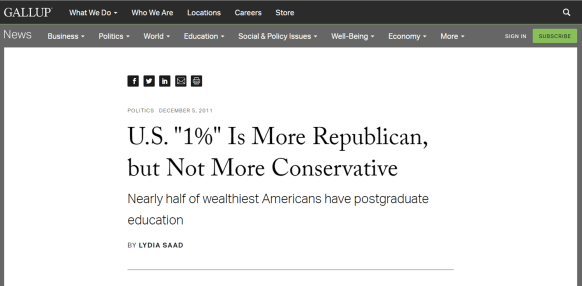
Thanks for sharing, (Friend)! Okay, I will take the time to make a long comment thread, as this is really interesting to me. Thank you for asking the question you did–I’ll get to it eventually! First: The information presented in this slide show is consistent with what I have read before. The facts presented are real. And they are incomplete. It looks at differences between districts, which is the best way to highlight division. I think this is a direct consequence of gerrymandering, which is designed exactly to create districts that will reliably vote one way or another. And we have all seen the US map showing blue clustered around big cities and red everywhere else. AND, this report ignores the glaring truth that despite the economic divisions by district and income, a much larger proportion of the top 1% is either declared or leans Republican than Democrat (though not necessarily more conservative):  https://news.gallup.com/poll/151310/u.s.-republican-not-conservative.aspx

Gallup 1% 2011

Second: The suburbs are where Reds/Blues live amongst one another, and this report ignores them, pretty much. That said, even without gerrymandering, we Americans have sorted ourselves ideologically. Bill Bishop wrote a fascinating book that details the economic and social evolution, _The Big Sort_ (listened to the whole book a year ago, I highly recommend it): http://www.thebigsort.com/home.php

I think suburbs are where work like Better Angels has the most potential to spark civil discourse, except that people are hesitant to engage, for fear of upsetting the tenuous and silent politeness that constrains their ability to talk openly about politics. That cultural noose is hard to untie.

Dem demographic 2019

[Below are a] couple of other links that have additional demographic information that gives context and texture to the WSJ slide deck. The point of all of this is that when we I read articles that start out with nihilistic, Vader-like proclamations of “America’s political polarization is almost complete,” I see an implicit agenda to actively contribute to that polarization for the good of the publisher. Brené Brown reminds us to beware of those who tell us things are absolute, either/or. Reality is almost never this dichotomous, and whenever we hear it is, we should look for who benefits from us thinking it is. Economic demographics of Democrats: https://www.debt.org/…/economic-demographics-democrats/

Economic demographics of Republicans: https://www.debt.org/…/economic-demographics-democrats/

Okay finally, to answer your question, on my “perspective on this article in terms of (my) work to bridge divides and create civil conversations”: My favorite visual is this table from the first article I linked to. In some ways we are ‘almost completely’ divided, as the Vader article posits. In other ways, we are not. I think of the surveys showing a majority of Americans being in favor of background checks for gun ownership, in agreement that abortion is generally not something we want happening all the time. I think of all of the conversations I have with pretty much any other human, and how we are all 90% more alike than different. But this article and 90% of the articles we see highlight the other 10% of differences, and worse, the most vehement and violent expressions of those differences. So my perspective on this article is that it contributes significantly, if not blatantly, to the division it reports. And it does not serve us in any way. And, I hope I would have the same response if it were published by the New York Times. 😉

top 1% demographics 2011

HANG ON. I just saw that this favorite article I cited is from 2011. I have found a couple of more recent ones; will review and continue the thread….

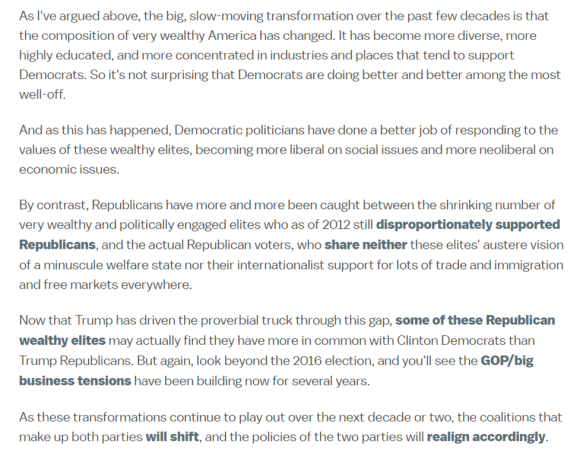
vox welthy dems 2016

Okay, here is an article from 2016 by a poli-sci expert who, [Bill Bishop-style], explains well the progressive evolution of the top 4%. Very interesting:  https://www.vox.com/…/6/3/11843780/democrats-wealthy-party

And hey, here is one from Forbes this year, which quotes the author of the Vox article, highlighting how a sizable number of Republicans actually align ideologically with Democratic policies:

“The fact that lower-income Republicans, largely known as the ‘basket of deplorables,’ support more social spending and taxing the rich was a key takeaway from this year’s report, says Lee Drutman, senior fellow on the political reform program at New America, a Washington D.C.-based think tank… ‘It is pretty striking that about a fifth of Republicans had views closer to the median Democrat than their own party,’ he says. ‘A lot of them actually want a sizeable social welfare state. It’s a little bit of a puzzle why they don’t vote for the Democratic Party, other than long-standing cultural ties maybe and other ballot issues. What we have here is just one of the two parties stands out to have a bunch of its supporters in opposition to some of the party’s economic platforms but still gives them their vote.’” https://www.forbes.com/sites/kenrapoza/2019/06/24/how-democrats-and-republicans-differ-on-matters-of-wealth–equality/#13e06ab8702f

More from the Forbes article:

“But when looked at closer, a plurality of voters (72%) across the spectrum said the government should provide tax credits for low-income workers. Some 60% are in favor of raising the minimum wage, and 58% were in favor of raising taxes for those families earning over $200,000 a year.

“Across party lines, Democrats were the ones who were most interested in a higher tax burden for the wealthy, though it is unclear if they considered themselves to be part of the income group that would be hit with higher taxation in a more progressive tax structure.

“An overwhelming majority (79%) of Democrats earning under $40,000 a year wanted to tax the rich more. Democratic Party voters earning over $80,000 were 83% on board with taxing higher incomes at higher rates. For Republicans earning under $40,000, 45% were in favor of taxing the rich. Republicans who earned over $80,000 didn’t like the idea. Only 23% were in favor.”

[In conclusion:]  Complexity does not make for headlines, sadly, and we should take this into account when we read and share. Thanks for posting on my page and asking the question, [Friend], you have made me think and thus made me better! 😀