The Importance of Peer Support

IMG_2151

What a privilege to present again to a group of smart, creative, fun, and engaging designers on Friday.  This time I was asked to address burnout, as so many folks are feeling overwhelmed and stressed.  I did my homework on stress and burnout in the creative fields, and found enough similarities in medicine to feel like a credible speaker.  “It’s not just a job, it’s a way of life,” seemed to capture how we see our respective vocations.

I presented a brief mini-lecture on self-care practices, including habit formation and maintenance in the 5 reciprocal domains of health, and narrative awareness.  The latter is always something we can do when we find ourselves in untenable circumstances:  Ask ourselves what story we tell about the situation, how that story compounds our suffering, and then tell a new story that does nothing to change the objective reality, but can dramatically improve our personal experience of it.  I have learned from work in physician burnout that people don’t just want to be told how to fix themselves.  They want someone to address the problems of the system that oppresses them.  So that’s where I tried to go next.

I started with an Appreciative Inquiry (AI) exercise.  In small groups, I asked participants to share team success stories, and listen for recurring themes around what’s already great about their teams, their work, and their organization.  Words like openness, flexibility, and “we have leaders, not bosses” made the Post-It easel list.  Then, in this headspace, I asked the groups to identify issues they wanted to address.  Instructions were to find important, urgent, and solvable challenges.  Guiding questions included, “Why will the organization be better if it’s addressed?” and “What does better look like?”

Similar to the AI results, common issues arose from multiple groups.  There was general consensus, reviewing the list at the end of 20 minutes, that overall work satisfaction would improve with less digital and more face to face communication, better project clarity, and taking better care of the shared spaces.  I would meet with team leaders and show them the list later in the day.

IMG_1939

When I opened the floor to questions, a self-proclaimed ‘Debbie Downer’ presented a query that I will ponder for many months as I prepare upcoming talks:  “When you ask someone how they’re doing and they say they feel like they’re drinking from a firehose, telling them to adjust their attitude is probably not helpful…  How can we change things that are not in our control?” The Universe had prepared me for this question by sending a new mentor who taught me to ask, “Who owns the things we don’t control?”  Thank you, my loving Cosmos.

I only partially answered Debbie’s question by suggesting she think about how she might influence the owner(s), how she might impact decisions being made in those spaces.  I segued too quickly, I’m afraid, to the question that I wanted to ask the group:  “When someone asks you how you are and you express that you are overwhelmed and drowning, what is a helpful response?”  I thought the discussion that ensued was productive…  It seemed to stimulate people’s intrinsic empathy and compassion.  We recognized the importance of feeling connected, that I’m not the only one feeling this way.  People recognized the relief found in just speaking aloud the list of stressors to a sincere and empathic listener.  We also talked about being prepared to hold space for any potential answer when we ask, “How are you?”  Even if we have no control over the flow out of the fire hose, maybe we can take turns holding the nozzle steady, and at a slightly oblique angle for each drinker, so it doesn’t have to knock us all over when we try to take a gulp.

I had a chance to talk to Debbie a little later (Cosmos offering me a second chance, Thank You Again), and we agreed that stress and burnout, in both medicine and design, are best addressed at both the individual and systems levels.  We can each start with personal accountability for our own experience of the system.  Then we can decide how we show up in the system each day.  We can choose, at any time, to either participate passively in the status quo (which is what we all need to do sometimes), or find a way, however small, to advocate effectively for change.

The latter is much better done with peers, with friends.  Take time to connect (no lunch meetings, let’s just eat together!).  Share stories.  What do we love about this work?  What’s already great?  How could it [realistically] be even better?  How can we help one another, including our leaders, envision and pave the way there?  Who else needs to be enrolled?

My meeting with the team leaders was less structured.  I worried that they left feeling disappointed because I did not offer more concrete advice on personal resilience practices for leaders, and ‘how to lead’ teams in burnout.  But over the hour, I felt no desire or need to lecture.  I queried various aspects of their self- and team awareness, personal resilience practices, and communication.  We briefly reviewed the issues list from the morning workshop, and I left with confidence that they would take it seriously.  It also occurred to me that these designated leaders were already supporting one another in their efforts to lead intentionally, effectively, and compassionately.  Maybe they have also felt overwhelmed sometimes.  Maybe it was also good for them just to talk it out with each other this day.  Maybe we can all do this for one another a little more often.
 

We Are Really Bad At This

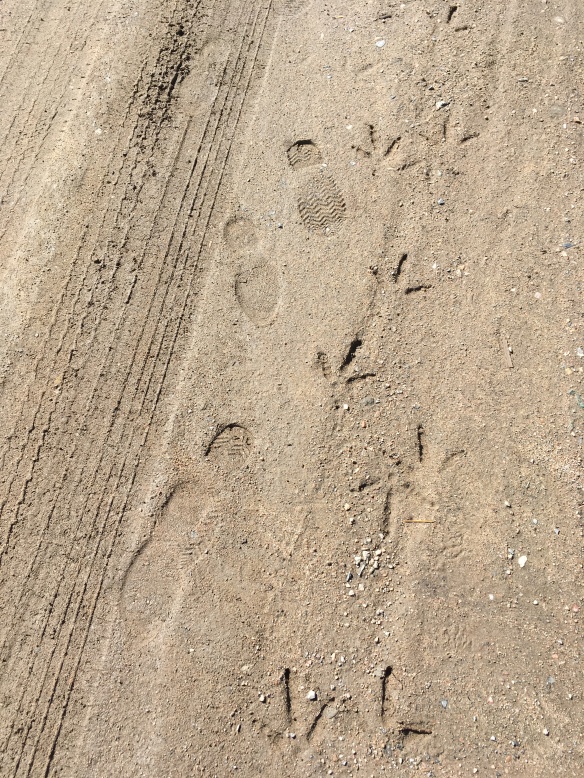
turkey human car tracks

Sylvan Dale Guest Ranch, Loveland, Colorado, March 2019

How many truly meaningful and fulfilling conversations do you have in a day?

How many such relationships do you have?

Though I wrote my Pit Crew post almost a year ago, its ideas recur regularly.  I have linked to it on multiple subsequent posts.  I share it with patients and reference it in conversations often.  My patients are leaders of large corporations and organizations.  My colleagues and I lead teams in the hospital, the medical group, and the medical school.  My friends lead their families and communities.  When I think about our health and its consequences, it’s about taking care of those for whom we are responsible, ourselves included.

Are you generally the one who always takes care of others?  How does this affect your style and effectiveness as a leader?

Who Takes Care of You?

I estimate that about 20% of the time when I ask this question, my patients say that nobody takes care of them; they do it themselves.  They don’t mean that nobody cares about them.  It’s that they don’t really depend on anyone for counsel and/or support.  They hold everything together themselves.  I always have mixed feelings when the conversation takes this turn.  On one hand I feel admiration and respect, especially when they seem generally healthy—apparently unaffected by physical, mental, and emotional dysfunction.  On the other, I get curious.  How do they sustain this Lone Ranger method?  And what does it cost them?  I believe we all need tight, vulnerable, and safe connections through which we can get raw and real, and work through life’s ultimately messy sh*t.  We need others, even if it’s only one or two, to help us truly hold it all together.  My default assumption is that if we don’t have such connections, we are not living into our full potential.

And today I feel cynical.  I think we are getting really, really bad at taking care of each other.

Driving to work this week I wondered to myself, why do we feel the dearth of mental health services so acutely these days?  Is it that more of us are living on the psychological razor’s edge of mental health and illness?  Are we not diagnosably mentally ill but simply, profoundly, stressed to our limits of sanity and function?  Is that why none of my patients can get in to see a psychiatrist or therapist for weeks to months?  Is that why physicians are increasingly leaving the profession and killing ourselves?  Why do we feel so hopeless?

It’s easy to blame social media.  And I do, partially.  The cruelest irony lives here.  My non-evidence based impression is that cyberbullying bears equally life-threatening consequences as face to face bullying.  If you know of evidence to support or refute this premise, please share.  Negative interactions on social media, which rage so easily like wildfires, are now understood to contribute significantly to the rise in loneliness across the country.  Worse, cultivating truly positive relationships via social media is much harder and more complex, even deceptive.   So on balance the risks and harms of social media may far outweigh the benefits.  There simply is no substitute for personal, physical contact, for sharing the same space, breathing the same air, experiencing another’s full presence.

Worse yet, too often we can’t even get that right!  Ozan Varol wrote about this in his last post, “3 Ways to Be Insufferable In Coversation.”  They are:  1. Always turn the conversation back to yourself; 2. Pretend to listen; and 3. Ask no questions.  How many people have you already met today who do this on the regular?  If you’re honest, how many times today have you committed these relational sins?  It’s okay, we all do it sometimes.  As GI Joe says, knowing is half the battle.  The other half is doing something about it!

IMG_1547

Smart Museum of Art, Chicago, July 2019

So what do we do?

First, Attend.  Pay attention.  How much time do I spend on social media?  What do I get out of it?  When does Fear Of Missing Out (FOMO) drive my scrolling?  Am I really connecting?  Or am I stalking, comparing, judging, flaming, agitating the echo chamber, and otherwise wasting time and energy?  How can I set alerts and redirect my routine?

Second, Intend.  What is the best use of my time?  If I want to see how my friends are doing, rather than check my Facebook feed, why not call them up?  Send a text, photo, or—gasp—a handwritten note just to say hi, I’m thinking of you?  It may cost you time, energy, and $0.55 in postage.  But aren’t your real friends worth the investment?  You can do it on social media too—if you slow down and think about it first.  Consider the return—brightening someone’s day, feeling that personal connection.  Dopamine drives FOMO, and is also associated with addictive behaviors.  Bonding behaviors elevate oxytocin, the hormone that mediates empathy, safety, and connection.  There is even evidence that higher levels of oxytocin correlate with increased longevity of romantic relationships, or even a person’s own life span (could not find a reliable, peer-reviewed source for this claim—I just believe it intuitively).

Third, Get Curious.  This was the first skill I (re)learned in life coaching, ‘way back in 2005, and it serves me well every single day.  If we let go of the competitive, scarcity-based thinking that surrounds us, what more could we learn?  What novel and inspiring stories could we hear from anyone we meet, or even our closest friends?  If we listen to understand rather than to reload and refute or one-up, what vexing problems could we solve, together?  Just wondering about it makes me feel lighter and more optimistic, what about you?

Subscribe to Ozan’s newsletter, the Weekly Contrarian, to get his list of solutions to conversation insufferability this Thursday, 9am Central Time (I have no financial interests in Ozan’s site; I just really admire his work and the community of critical thinkers he has convened).  And today, I challenge us all:  Monitor our attitudes and facial expressions.  Manage our self-absorption for a few minutes at a time.  Look strangers in the eye and smile as if they’re already our friends.  Ask a Facebook friend what they did this weekend that really made them feel alive and well.  Let’s all get our caring on, shall we?


The Loving and Entwined Life

IMG_4456

“Love and friendship dissolve the rigidities of the isolated self, force new perspectives, alter judgments and keep in working order the emotional substratum on which all profound comprehension of human affairs must rest.”

—John W. Gardner, Self-Renewal, 1963


How often do you take a breath, take a moment, and reflect on the deep, thick connections that hold you up?

I say over and again that our relationships kill us or save us.  But it’s not merely relationships that save us, it’s connection.  I named this blog honestly!  John O’Donohue writes in Anam Cara, “We need more resonant words to mirror this than the tired word relationship.  Phrases like ‘an ancient circle closes’ or ‘an ancient belonging awakens and discovers itself’ help to bring out the deeper meaning and mystery of encounter…  Two people who are really awakened inhabit the one circle of belonging.  They have awakened a more ancient force around them that will hold them together and mind them.”

Friends really do take you further.

This past week I finished listening to David Brooks’s latest book, The Second Mountain.  I highly recommend it.  He makes a critical and compassionate assessment of the current state of society, what he refers to as a severely torn social fabric.  We are dangerously, existentially disconnected.

David Blankenhorn and Bill Doherty, co-founders of Better Angels, see the same, and seek specifically to address our perilous political polarization.  Last Saturday I attended their workshop to help us depolarize from within our own political tribes.  The goal of the organization and each workshop is to depolarize, not to convert. The method is communication to connect, not to convince.  Both Brooks and Better Angels seek to strengthen our most meaningful ties to one another.  In Brooks’s words, about his new organization, Weave: “The Weaver movement is repairing our country’s social fabric, which is badly frayed by distrust, division and exclusion. People are quietly working across America to end loneliness and isolation and weave inclusive communities. Join us in shifting our culture from hyper-individualism that is all about personal success, to relationalism that puts relationships at the center of our lives.”

*****

On Tuesday I returned to my desk after a productive and gratifying work meeting, to read that Toni Morrison had died.  I was overcome with sadness, which surprised me.  I have never read any of her acclaimed novels.  I was not a follower, per se.  But I felt a loss as if I had known her personally.  I think it’s because she had a profound influence on one of the most important aspects of my life, early in my kids’ lives, with just a single verbal expression.

“When your child walks in the room, does your face light up?”

Morrison told Oprah in 2000:

“When my children used to walk in the room, when they were little, I looked at them to see if they had buckled their trousers or if their hair was combed or if their socks were up.  You think your affection and your deep love is on display because you’re caring for them. It’s not. When they see you, they see the critical face. But if you let your face speak what’s in your heart…because when they walked in the room, I was glad to see them. It’s just as small as that, you see.”

It’s so small and simple, and yet it alters the entire encounter, every time.  More and more I understand in my limbic brain, the part of the mind where we humans make meaning and where our decisions and actions originate, that it is how we are with people that matters, far more than what we say or what we do.  The majority of communication is non-verbal.  Morrison’s description of a parent’s facial expression, and the profound effect it has on a child, applies to all relationships and connections, or disconnections, for that matter.  It was not until she died that I realized how far her influence really reached in my life.  And it felt suddenly, unexpectedly, too late to thank her for it.

*****

So whose face lights up when they see you?

Whose presence awakens you and invites you to ‘inhabit the one circle of belonging’?

I recently made a list of these people in my life.  It is gratifyingly long, and growing.  It started with my mom.  I’m embarrassed that I did not notice overtly before now, and my gratitude cannot be adequately expressed in words.  I imagine she got it from my grandmother, one of the people I have admired most in the entire world.  I have met the others, my Counsel of Wisdom, my pit crew, throughout my life, from age 12 to only a couple years ago.  They are my Kalyana-mitra, or “noble friend”s, as O’Donohue describes them:  They “will not accept pretension but will gently and very firmly confront you with your own blindness.  No one can see his life totally.  As there is a blind spot in the retina of the human eye, there is also in the soul a blind side where you are not able to see.  Therefore you must depend on the one you love to see for you what you cannot see for yourself.  Your Kalyana-mitra complements your vision in a kind and critical way.  Such friendship is creative and critical; it is willing to negotiate awkward and uneven territories of contradiction and woundedness.”

In Self-Renewal, John Gardner takes this idea from the personal friendship to society:  “A tradition of vigorous criticism is essential to the renewal of a society.  A nation is not helped much by citizens whose love for their country leads them to shield it from life-giving criticism.  But neither is it helped much by critics without love, skilled in demolition but unskilled in the arts by which human institutions are nurtured and strengthened and made to flourish.  Neither uncritical lovers nor unloving critics make for the renewal of societies.”

David Brooks expresses the same in Second Mountain:  “Truth without love is harshness; love without truth is sentimentality.”  In her book Insight, Tasha Eurich suggests methods and exercises for engaging with our ‘loving critics,’ in service of improving honest and loving self-awareness, connection, and leadership.

Mesler book window

I have two goals this week on vacation:  Hike and read.

I brought Anam Cara by John O’Donohue, Self-Renewal by John W. Gardner, and What Moves at the Margins, a collection of Toni Morrison’s eloquent and important nonfiction writing.  Little did I know that the ideas in these books, read concurrently by cosmic accident (or more likely by divine inspiration), would weave in meaning with one another, as well as with my deepest and most meaningful life lessons to date.  How rewarding and awe-inspiring!

I pray today that my ‘soul’ and ‘noble friends’ know how much I appreciate their presence, guidance, support, and love; and that I may come even remotely close to serving them similarly.  May we all look to bless one another with our own souls every day.