Love You Into Being

IMG_4550

A couple of weeks ago I met my new medical students.  These 10-12 trainees will be my small group for the next two years.  We will meet monthly to discuss the soft stuff of medical training—hierarchy, tribalism, death and dying, medical errors, difficult patients, etc.  Some call it “third year medical student support group.”  This is my 6th year of the pleasure and privilege (I inherited my first group halfway through, when their previous preceptor moved out of state).

With each successive group I am ever more amazed at the students’ level of insight.  They articulate compassion, humility, and maturity that I don’t think I had at their level of training. Or maybe it’s because we did not have classes like this to explore such things when I came up (or maybe I don’t remember?).  More and I more I see my role as facilitator more than teacher.  I am not here to impart medical knowledge.  Rather, it is my job to stimulate exploration, conversation, and meaning.  It’s so freeing, really—there is no standardized test to teach to.  And yet I see it as my responsibility to help prepare these gifted young people to face the greatest challenge and reward of the profession: human relationships.

I feel no fear or trepidation.  We cannot ‘fail’ at this class, any of us.  Because the point of it is simply for everybody to participate, contribute, consider, and learn—myself included.  Each month the students are given questions to answer in the form of a blog post.  For example, “Recall an example of inspiring or regrettable behavior that you witnessed by a physician.  Describe the situation, and its impact on you, the team, and/or the patient.”  I read them all and facilitate discussion, tying together common themes and asking probing questions.  My primary objective is to help them maintain the thoughtfulness and humanity that led them to medicine in the first place.  Medical training has evolved in the past 20 years, for the better in some ways, not so much in others.  One way we do much better nowadays is recognizing the hidden curriculum, and shining light on its effects, both positive and negative, through classes like this.

We all have those teachers who made a difference in our lives—or at least I hope we all do.  I have multiple: Mrs. Cobb, 4th grade; Mr. Alt, 7th grade math; Ms. Townsend (now Ms. Anna), 7th grade English; Ms. Sanborn, 7th grade social studies; Mrs. Stahlhut, 9th grade geometry; Mrs. Summers, 10th grade English; Coach Knafelc, varsity volleyball; Dr. Woodruff, primary care preceptor; Dr. Roach, intern clinic preceptor; Dr. Tynus, chief resident program director.  My mom is one of these teachers, also.  She leads nursing students in their clinical rotations.  I have seen her student feedback forms—they love her.  And it wasn’t until I heard her talk about her students that I realized why they love her and what makes her so effective—she loves them first.  Teaching is often compared to parenting.  Our parents, at their best, see our potential and love us into our best selves.  They cheer us, support us, redirect us, and admonish us.  They show us the potential rewards of our highest aspirations.  If we’re lucky, they role model their best selves for us to emulate.

All of my best teachers did (do) this for me.  I’m friends with many of them to this day, and I still learn from them in almost every encounter.  I love them because I feel loved by them.  They held space for my ignorance and imperfections.  I always knew that they knew that my best self was more than the last paper I wrote, the last test I aced, or the last patient encounter I botched.  To them, my peers and I were not simply students.  We were fellow humans on a journey of mutual discovery, and they were simply a little farther along on the path.

This is my aspiration as a teacher, to live up to the example of all those who loved me into the best version of myself today.  This kind of love allows for growth and evolution, from student to colleague, to friend, and fellow educator.  This is not something attending physicians typically express to medical students, positive evolution of medical education notwithstanding.  But when I met this new group, I was overcome by love for them.  So I told them.  “If you take away nothing else from our two years together, I want you to have felt loved by me.  I wish to love you into the best doctors you can be.  That is my only job here.”  Or something like that.  It was impulsive and possibly high risk.  But it was the most honest thing I could say in that moment, my most authentic expression of my highest goal for my time with them.  I only get to see them once a month, and I want them to be crystal clear about what I am here to do.  We have lots to cover these two years, so much to learn and apply.  And love is the best thing I can offer to hold us all up through it.
Innocence, Indignation, and Idealism:  An Optimist’s Reconciliation

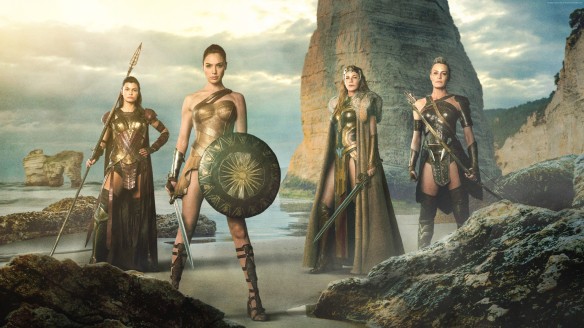
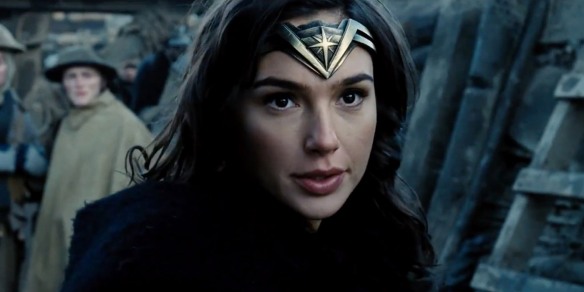
I took my daughter to see “Wonder Woman” last weekend.  I highly recommend it—such a strong, complex, and inspiring portrayal of humanity at its best and worst, with a hopeful ending.

Today I’m (somewhat) inspired in parallel by (some) politicians, three Republican senators in particular, calling for transparency in drafting healthcare reform.  I hereby present my attempt to integrate that exquisite Wonder Woman Experience with my current political outlook.

***WARNING*** THIS POST MAY CONTAIN SPOILERS FOR THOSE WHO HAVE NOT SEEN THE MOVIE.

Innocence

Diana of Themyscira grows up believing in the innate goodness of humans.  The Amazons are educated, independent, strong, and proud, and also collaborative, compassionate, kind, and sensitive.  When Diana learns of the horrific war waged by mankind outside of her paradise home, she relates it to the story of Ares, the God of War, who corrupts the hearts of men to commit acts of hatred upon one another.  So, naturally, she sets out to kill Ares and fix it.

We journey with Diana through challenge and triumph, as she learns that, of course, it’s not that simple.  She kills the man she thought was Ares, and nothing changes, the war rages on.  She must reconcile the possibility that the heart of mankind is not actually pure goodness.  Even without an insidiously corrupting God of War, humans are prone to their own malignant beliefs and actions.  Her innocence is pierced.

In the summer of 2009 or 2010, my best friend from college and his wife came to visit.  He, a molecular biology and political science double major and emergency medicine physician, and she, a worldly intellectual and future legal counsel for a major media outlet, were the first to burst my innocent political bubble.  For some reason, likely due to the tremendous inspiration of Barack Obama, I had gone from thinking all politicians were liars and performance artists, to seeing them as genuine public servants, working to advance their authentic ideas of how society functions better for all citizens.  I know, La-La Land!  My friends described an alternative, more realistic path to politics: Person succeeds at business, rubs elbows with regulators and influences them (with money or otherwise) to facilitate his/her business success.  Said person then realizes s/he could actually become one of those regulators and make a more permanent positive impact on these business interests, and so runs for office.  I still remember how deflated I felt, shoulders slumped, spine rounded, at this sudden and stark realization.

Indignation

As with everything, I’m sure political reality lies somewhere in the messy middle between pure altruism and blatant, self-serving avarice.  But these days, for someone who loved Obama and almost everything he stood for, it’s hard not to see the whole of our current political landscape as the latter.  I think, Really, WTF?  Can those in power really see nothing valid whatsoever in anything accomplished the past 8 years?  Do they really think that see-saw policy-making, each administration reversing everything from the previous one, replacing wise, experienced public servants with ignorant neophytes (my opinion), is the best way to govern?  OMFG, you have got to be kidding me.  I seethe.  But what can I do?

Ares reveals himself, and taunts Diana in her most vulnerable moment with his arrogant disdain for man’s weakness and corruptibility.  He also reveals that she is, in fact, the only one who can vanquish him—only a god can kill another god.  Diana, daughter of Zeus himself, possesses the power to Kick. His. Ass.  Yet he dismisses her out of hand, oblivious to her inner strength of conviction and compassion (I know, so much to expound on here, maybe in another post!).  Nope.  Righteous indignation rises.  She digs deep, finds that core courage, and obliterates him.  Fist pump.  He never saw it coming.

Idealism

In the end, Diana realizes that humans are a paradox: a big jumble of contradictions, perpetrators of horrific rage and destruction, and also fully worthy of love, forgiveness, and compassion.  She somehow finds peace in this enigma, loving the best of humanity and vowing to protect us against our worst selves, helping us to become better.

This resonates with the idealist in me.  This is how she helps us, and how we can help ourselves.

How Can We Help?

We can choose to fight against one another, and thereby focus on what we hate (about ourselves).

Or, we can choose to seek the good in one another, and focus on what we love— even better, focus on love itself.  We all want access to healthcare, and to be free from bankrupting medical expenses.  Everybody wants to be safe from gun violence.  We all want an efficient government that sets reasonable regulations, protects citizens’ constitutional rights, and spends money wisely and with accountability.  We all want to feel protected and free, loved and free to love.

The messy middle is the how.  That is where we negotiate.  That is also where the magic happens, as Brené Brown says, and that is where we must go, where we must persist.  We can bring our best selves to meet others’ best, in mutual respect.  It can be high risk, so we can enter slowly, strategically, with realistic expectations and a few trusted friends.

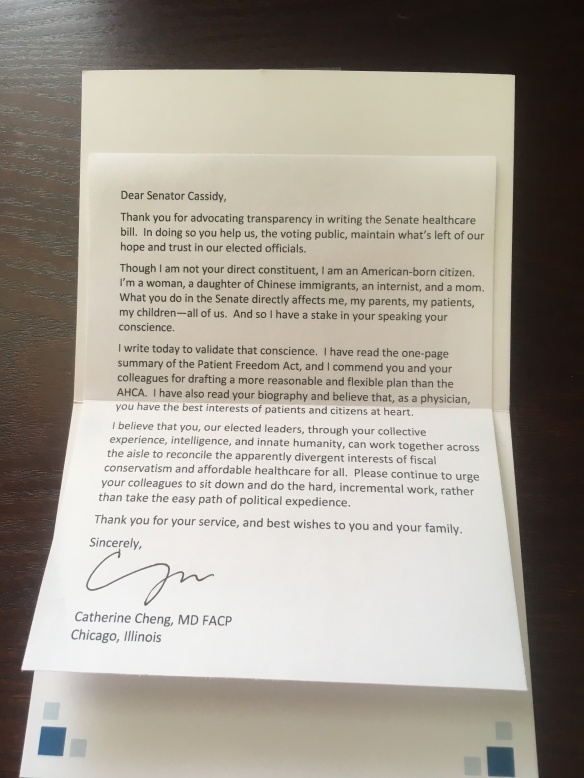
To this end, I will continue to seek out and hold up elected officials who call for more thoughtful political processes.  My friend Triffany and I have made a habit of writing thank you notes to Members of Congress to validate their cooperative acts.  We harbor no illusions about purity of intent, but we also know that positive reinforcement works.  We can be Diana to anybody’s Ares.

Focus on and fight for what we love: common goals and interests, shared humanity, connection, and one another.  It’s a lifetime’s worth of work, and well worth the fruits, if we can stick with it.

IMG_7023 (1)


Everyday Power and Influence

Wailea beach

If you wonder how physicians think and feel, about anything and everything related to medicine, healthcare, economics, parenting, relationships, and life in general, check out KevinMD, an expertly curated blog by physicians all around the world.  I recently read a heartening and important piece on gender equality in medicine.  A pediatrician husband wrote about the stark differences in assumptions about work-life balance for men and women, in “What Does Your Husband Think of You Being a Surgeon?”  Then I came across another article by a male cardiologist, whose wife is also a physician, entitled, “The Gender Gap in Cardiology Is Embarrassing.”  Both men’s wives delayed their medical training, and these husbands bore witness to our culture’s implicit gender bias against their life partners.  I strongly encourage you to read both pieces; they are short and poignant.

—- Please click on the links and at least skim the articles, before continuing here. —-

Now, consider how much more weight and influence these pieces carry, simply because they are written by men.  If you find this difficult, imagine your internal response if they had been written from the women’s perspectives.  Which position is more likely to evoke, “Hmm, interesting,” as opposed to, “What are these women whining about?”

When we consider advocacy, it’s fair think of it as those with more power and influence using these advantages to champion those who have less.  Sure, the less powerful and influential can and do advocate for themselves, but without allies among the advantaged, the message and movement stall and stutter.  Consider slavery and the Civil Rights Movement.  If it were only ever black people advocating for themselves, what would the American racial landscape would look like today?  Think about women’s rights.  There is a reason the United Nations launched the HeforShe campaign.  Self-advocacy is required, but sorely inadequate, to lift people out of oppression.  And let’s be clear: oppression takes many forms, which we often fail recognize or acknowledge.

I have a fantasy about patients advocating for physicians.

I imagine Sally and John*, two friends communing at their favorite coffee shop, one of their regular meetings of mind and soul.  The conversation veers toward healthcare, and Sally starts ranting about how physicians don’t care about patients anymore.  They’re only in it for the money, having sold out to pharma and industry, and they think of themselves as second only to God him(her)self, exercising control over patients’ lives with little regard or actual caring.  In this coffee shop scenario, I as physician have no power or influence.  If I sat there with them, trying to explain how ‘the system’ drives wedges between us doctors and our patients, about how on average doctors spend twice as much time on administrative activities as patient care activities, how 50% of us report burnout, and how our suicide rate is up to 4 times that of the general public, I estimate that I’d likely be seen as whining and making excuses.  In this scenario, facing a (rightfully) prejudiced audience, my voice counts for very little.

Although physicians still enjoy a fair amount of respect and deference in society, our struggles, personal and professional, are still poorly understood by the general public.  I think people are even less cognizant of the insidious and profound detriment that physician burnout and depression have on patient care and the economy at large.  But when doctors describe our adversities to patients, I think we still come across as whining.  Knowing that I write this as a physician, what is your reaction?  Is it closer to, “You live at the top of the food chain, what are you complaining about?” Or rather, “Wow, what’s going on that so many doctors feel so badly, and how could we all help one another?”

Lucky for doctors everywhere, John is my patient and we have a longstanding, collaborative relationship.  He empathizes with Sally’s perspective, as he knows what she has been through medically.  He has also inquired about my work, and understands the systemic frustrations that physicians face in all fields.  Because they are such good friends, John feels comfortable challenging Sally’s skewed assertions.  He describes what he has learned from me, and explains earnestly that all doctors are not, in fact, swine.  Because he is her trusted confidant, she believes him.  Her attitude opens ever so slightly, and she is more likely to acknowledge how physicians and patients alike suffer from our overall healthcare structure.  John is, in this case, the strongest advocate for me and my ilk.

Whenever one of us stands up as a member of a group, and speaks up to our peers on behalf of another group—white people for black people, men for women, Christians, Jews, and Muslims for Muslims, Christians, and Jews, liberals for conservatives, physicians for patients, and vice versa in each case—we are all elevated.  Our mutual compassion and humanity are called forth to heal our divisions.  This is how personal advocacy, how everyday power and influence, works.

As a patient, you have more power than you may realize.  I bet most people don’t necessarily feel adversarial toward doctors.  But they probably don’t necessarily feel allied, either.  What can you, as a patient, do to bridge this gap?  How else could we all, physicians and patients alike, create that essentially healing inter-tribal connection?

*Hypothetical friends