
For International Women’s Day: From the Archive (Late Entry)

Hello from Rome, friends! Late to post this week as I traveled yesterday and could not get my act together to write this in advance–and it’s not even that much writing! Better late than never, though, right?

Saturday, March 8 was International Women’s Day. I saw so many messages on my social media feeds encouraging and uplifting women.

By far the most moving came from AJ, also known as @ajthisway on Instagram. AJ creates audio erotica on the Quinn app, among many other things, and will donate all of the proceeds from his audios this month to HeForShe, the United Nations Global Solidarity Movement for Gender Equality. Watch his reel explaining why this cause resonates with him and his fan community here.

It reminded me of a post I wrote referencing HeForShe, and when I looked back on the blog, it was almost ten years ago. Then I recalled other posts I have written about gender and allyship, and I thought this would be a great opportunity to gather a few in one place. I’ll list them here with some brief exerpts. I will continue to write about relationship in general, and maybe more on men and women in particular in the coming year. For now, please enjoy (or remember!) ideas that have appeared among the 680 posts on this blog to date.

How have your ideas, opinions, biases, words, and actions around gender and equity evolved in the last ten years? I have not spent time to really answer this question; maybe I’ll think about it this week on vacation, as I soak up Rome with Daughter. So much history, a fantastic city where our past, present, and future intersect! Onward, my friends!

He for She, We for Us, October 27, 2015
“As women, in our conscious minds, we know our worth and our contribution.  We know we have an equal right to our roles in civilization.  And, at this point in our collective human history, we feel the need to defend those roles, to fight for their visibility and validity.  More and more people now recognize that women need men to speak up for gender equality, that it’s not ‘just a women’s issue,’ but rather a human issue, and that all of us will live better, more wholly, when all of us are treated with equal respect and opportunity.  The UN’s He for She initiative embodies this ideal.
“We all matter, and we all have a unique role to play.  Nobody is more important than anyone else, and nobody can do it alone.
“We need to take turns leading and following. That is how a cooperative tribe works best.  It’s exhausting work, challenging social norms and moving a culture upward.  And we simply have to; it’s the right thing to do.”

Even the ‘Oppressor’ Deserves Safety and Support, July 6, 2020
“The more I think about it, the more I wish everybody had this kind of safety and support—this loving learning lab and community—to acquire scary new skills that, when practiced, benefit many more people than just us learners.
“I imagine this may be what participants in the White Men’s Caucus feel. Read all about it in Four Days to Change, which I started and finished in about three sittings… It provides a unique and profoundly important perspective on the true meaning of inclusion, that is, white men absolutely need to be included in leading and benefiting from systemic change for equity, not just passively doing the changing for others’ sake. During the Caucus retreat, white men are both challenged and supported to dig deep into their own privilege. Inescapable mirrors of truth and profound discomfort, and also of love and compassion, surround them for four days. They are expected to feel tremendous guilt and shame, both natural emotions that occur on the path of self-discovery and humility. But rather than weaponizing these feelings, facilitators love the attendees through them, shepherding them through the emotional (shit)storm to a place of self-compassion and forgiveness. This is where their outward humility, openness, and sincere advocacy for inclusion and diversity take root—because they experience it first hand from their teachers and peer learners. Leadership is hard enough, but leading initiatives in diversity, equity, and inclusion is a whole other dimension of complexity. How can we expect any leader, white male or otherwise (but white males especially), to do it well alone, without a core peer group willing to hold their feet to the fire with both love and conviction?”

White Male Allies, Please Do This, March 10, 2024
“So men: how are you helping?
“It’s more effective if you come alongside rather than come at. Berating, lecturing, or shaming fellow men to take a hard left from their stereotypes, implicit biases, and internalized misogyny hardly ever works. Rather, use your influence more quietly. Lead by example with your words and actions to the slow off-ramp of self-awareness, self-regulation and movement toward gender equality. Be gentle. Plant the seeds. Water, water, light, fertilize, water, light, water.. and eventually we can repot.
“Scale your influence by connecting with other exemplary leaders. Culture change occurs mostly from the top down, and CHCWMs [cis-het Christian white males] are the CEOs of American culture.”

The Complexity of Allyship, March 13, 2024
“Allyship carries cost. The first costs of thoughtful, intentional allyship are emotional and mental.
“The next costs are relational, and then reputational, financial, professional–myriad. The more visible we are, the greater the potential risks of taking a stand, staking a position. If we hold a designated or implicit leadership role in the community (and I would argue that we all/each lead in some way, know it, like it, want it or not), our choices and their potential consequences are that much more complex. For someone whose livelihood depends on maintaining relationships despite conflict, costs can be high in multiple ways. Choosing between one’s ethics and paying the bills never feels good, and we never know when someone may be in that situation. We must all decide for ourselves, in real time, the risks and costs we can bear. Not everyone stands in a position to decline work or dissent safely. Conscience and context often conflict. We each make our own decisions, and in the end, we must live with ourselves—our choices, our relationships, our regrets. Judging others for doing differently from us serves no useful purpose.”

Holding Allyship, November 17, 2024
–Hey, turns out I did a curation of my allyship posts recently! This post includes the posts above, and others:
“Google’s AI overview of the term:
Allyship is a social justice activism term that describes the actions taken by people in positions of privilege to support marginalized groups: 
Definition: Allyship is a lifelong process of building relationships with marginalized groups based on trust, consistency, and accountability. It’s an active practice of unlearning and re-evaluating one’s own privilege and working to operate in solidarity with marginalized groups. 

“I have written about allyship before, and I have another post drafting for later. Tonight I pull the existing catalogue together from 2016 to 2024, so I have it consolidated to reference hereafter. I imagine my own allyship posture and movements will evolve over time, as everything does. Looking back helps to frame where I came from and where I’ve been, and hopefully shows me where I still need to learn and improve.”

Holding Allyship

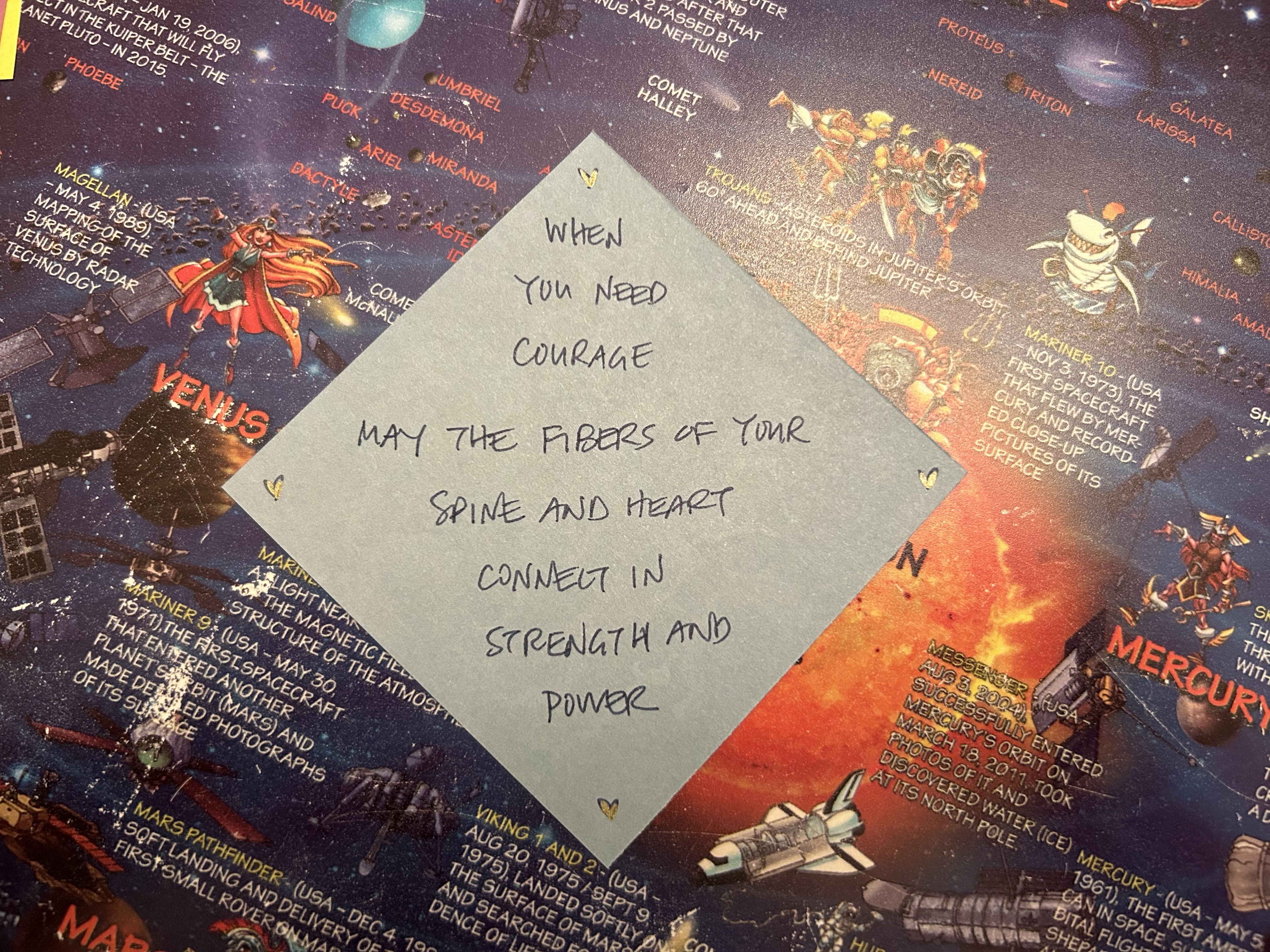
Image text: “When you need courage May the fibers of your spine and heart connect in strength and power”

Chengerism, as quoted by Daughter: “OMG Mei, I have the BEST friends!”

Wonderful New Friend had me over to her house yesterday. She offered to go out for lunch, and all I wanted was to be together and talk. We could have eaten cheese and crackers and I would have been happy. So I sat at her kitchen island and she proceeded to pull together the most delicious and satisfying lunch I had all week. We chatted about the kids, the holidays, and our respective homes’ oscillating states of livable pigsty. When we moved from island to sofa, we got into it: “So, the election. Let’s talk.”

OH there was so much! We both vote Blue, and joke that we are the same person: eldest daughters of immigrant engineer dads and nurse moms. Healthcare professionals. White-adjacent women of color. Paper and journal and pen fanatics. And we share many of the same political views, but not all. In the three hours we spent together yesterday, two invaluable insights emerged for me:
1. I really do have the best friends–people who can challenge my assumptions and make me think harder about everything, all in love and to help me grow
2. Part of my role and contribution to political discourse may be to advance healthy allyship.

Google’s AI overview of the term:
Allyship is a social justice activism term that describes the actions taken by people in positions of privilege to support marginalized groups: 
Definition: Allyship is a lifelong process of building relationships with marginalized groups based on trust, consistency, and accountability. It’s an active practice of unlearning and re-evaluating one’s own privilege and working to operate in solidarity with marginalized groups. 

I have written about allyship before, and I have another post drafting for later. Tonight I pull the existing catalogue together from 2016 to 2024, so I have it consolidated to reference hereafter. I imagine my own allyship posture and movements will evolve over time, as everything does. Looking back helps to frame where I came from and where I’ve been, and hopefully shows me where I still need to learn and improve. …Wow, there are many more than I realized! Titles and brief exerpts, for my benefit more than yours below. Rereading tonight, I still stand by each piece, and I’m glad I have written it all down through the years.

I Hold Allyship for Us because when we ally with one another, we can do great things.
“The only way out is through.” The best way through is together.

Thank you for reading! Onward, friends!

Holding the Space: Beyond ‘Agree to Disagree’, or, A Discussion of White Male Privilege
Once we agree to disagree, what then?  Where do we go from there?  I still believe strongly in the existence of white male privilege, and [my friend] still strongly does not.
Let’s assume that both he and I—indeed most of us—are, in fact, kind, decent, compassionate, and intelligent people. Let’s assume also that we all seek productive and positive relationships with others.  What, then, are the best and worst manifestations of our respective beliefs?  I think it’s an important question.  How could we Hold the Space for the answers?

The Status of Women, 1999-2019
What happens for men when women speak Feminism?
I intend to ask this question to more men in my life from now on.  What do you hear as Feminism?  Where do you think it comes from?  What do you think women are trying to accomplish by talking about equity and representation?  What moves a man to ally with women in this movement?  What keeps him from doing so?  What are the risks, costs, and benefits for us all when he does and does not?

What I’m Learning About Equity
Another new WEL friend, Dr. Dawn Sears, has already taken this idea to heart and made an impact in her community, elevating women’s and men’s awareness of gender disparity in medicine, and helping them fight it together.  Check out her powerful presentation to colleagues here, full of evidence as well as unsettling personal stories.  In it she directly and kindly addresses the men in the audience, informing and inviting them to join the fight, for all our sakes.  She names the contrarian men who have held her up on her professional journey, defying gender bias and paving their own HeForShe way for others.  She includes men in order to enroll them in the movement.  I encourage all to view the talk—find out how you, as colleague, patient, and all around good citizen, man or woman, can help improve the system for us all.

Sexism and Apologies 2020
What I have learned (perhaps again) in this time, however, is that relationship discord, even just the possibility of it, is what distresses me the most.  How will I be perceived for voicing my concerns, for advocating for my peers and teams?  How will a negative perception undermine my effectiveness?  Will it cost me my seat at this table or others?
Does any man ask himself these questions?

This Is the Work
We are all called to face our discomfort head on, to stand up and take responsibility.  We can no longer escape the harsh reality of choice that we all must continually face:  Do what’s Right or do what’s easy.  Let’s assume for a moment that it really is that simple—all qualifications moot.  It may be unrealistic to expect ourselves to choose Right every time…because qualifications.  But aaaaarrrgh we do not do it nearly, nearly enough.  Nothing will change without a critical mass of us choosing Right, much more of the time, for a very long time to come.

Challenging the Cisgender White Christian Male Default
[On the book Four Days to Change by Michael Welp:]
…the ‘core threads of the fabric of white male culture in the United States’ (how do they land on you?):

  • Rugged Individualism
  • Low Tolerance of Uncertainty
  • Action over Reflection
  • Rationality over Emotion
  • Time Is Linear & Future Focused
  • Status & Rank over Connection

After discussion with participants he notes, “’Notice that the guys who bring the skills less emphasized in the culture can more quickly identify how the culture works against them.  You might imagine the same experience for women and people of color.’  …It’s even more critical in today’s global world that we as members of the dominant group understand our water.”  I can’t wait to keep reading and see hearts broken open, as Parker Palmer says, to the power and potential of inescapable interconnectedness.

Even the ‘Oppressor’ Deserves Safety and Support
During the [White Men’s] Caucus retreat [led by Michael Welp, author of Four Days to Change], white men are both challenged and supported to dig deep into their own privilege. Inescapable mirrors of truth and profound discomfort, and also of love and compassion, surround them for four days. They are expected to feel tremendous guilt and shame, both natural emotions that occur on the path of self-discovery and humility. But rather than weaponizing these feelings, facilitators love the attendees through them, shepherding them through the emotional (shit)storm to a place of self-compassion and forgiveness. This is where their outward humility, openness, and sincere advocacy for inclusion and diversity take root—because they experience it first hand from their teachers and peer learners. Leadership is hard enough, but leading initiatives in diversity, equity, and inclusion is a whole other dimension of complexity. How can we expect any leader, white male or otherwise (but white males especially), to do it well alone, without a core peer group willing to hold their feet to the fire with both love and conviction?

Why Identity Matters
“You have a Chinese face,” my mom said to me.  I was ten years old, maybe twelve.  I can’t remember how it came up.  But the message was twofold and clear:  1. What makes you different from almost everybody around you is visible.  You cannot hide it, you cannot escape it.  2. People will judge you for it, so like it or not, to them, you represent us—your family, your ethnicity, all people who look like you.
Once again I find myself in this strange, middle, white-adjacent space, considering how I can and should use my unique identity for the greater good.  How does an anti-racist message land differently/better/worse when I express it?  How do my white colleagues hear me differently/better/worse from/than my Black and other underrepresented minority colleagues?  Do I have a bridge role to play here?  Or should I keep my head down and my mouth shut (this is unlikely)?

White Male Allies: Please Do This
Advice from the doctor carries more weight and influence than from the spouse. Teen peer more than parent. And fellow Cis-Het-Christian-White Male (CHCWM) more than anyone else. So men: how are you helping?
It’s more effective if you come alongside rather than come at. Berating, lecturing, or shaming fellow men to take a hard left from their stereotypes, implicit biases, and internalized misogyny hardly ever works. Rather, use your influence more quietly. Lead by example with your words and actions to the slow off-ramp of self-awareness, self-regulation and movement toward gender equality. Be gentle. Plant the seeds. Water, water, light, fertilize, water, light, water.. and eventually we can repot.
Scale your influence by connecting with other exemplary leaders. Culture change occurs mostly from the top down, and CHCWMs are the CEOs of American culture.

The Complexity of Allyship
So, what are the questions to ask when we consider upstanding and allying?
How does this affect me directly? Indirectly?
How do I feel about it?
What do I think about it (because these are different)?
How does this affect people I care about, whom I respect and admire?
How does this affect all of our relationships, professional, personal, financial, and other?
What do I not know?
What core values of mine, of the community, are violated here?
How can I best uphold and live into those values in this context?
What other questions do I need to ask?

Holding Wholeness

When was the last time you judged a whole person, dismissed them, or put them on a high pedestal, knowing only one thing about them? They’re a Chinese-American doctor. They’re a black man in jail. They’re a white male CEO. Their body shape is at least as thick as it is wide. They think exactly the way you do about something really important to you. They think the opposite, and loudly.

“Mamala and the Senator”

Most of us probably know Kamala Harris more as the senator, the attorney general, and the district attorney than the maternal figure to her stepchildren, the avid home chef, and the joyful, laughing woman among friends. How do we reconcile these divergent aspects of her humanity? What does this bring up for each of us? What biases does her wholeness as a person trigger?

Some of us want to see women mainly as maternal, domestic figures. We value the feminine as nurturer and caregiver, the personal glue that holds individual family units together. Others of us also cheered when we watched Senator Harris in action, interrogating hearing witnesses with firey eye contact and direct language, not letting them deflect, obfuscate, or gaslight. Some of us cannot reconcile these divergent sides of a woman, cannot imagine their synergistic integration embodied and applied in leadership, especially at the highest level. That’s too bad, because any leader–man, woman, or otherwise–must own all parts of themselves to lead to their full potential. The strong and the soft, the masculine and the feminine, the committed and the flexible, the differentiated and the attuned–these polar and balancing aspects of our nature make us whole humans. People who live in their wholeness lead by example, by inspiration, by resonance with the wholeness of those they lead. They are leaders because we are moved to follow them; we feel their integrity and want it, aspire to it for ourselves.

Democrat, Republican, Libertarian, Independent. Name a professsion. Name a state, a generation, an eye color, and all of its associations in your mind. It’s okay to think of stereotypes. The brain operates on pattern recognition and shortcut heuristics; we could not live effectively without these automatic systems in place. We just need to guard against leaning on them so heavily that we oversimplify and overgeneralize our fellow humans.

What a narrow, uninteresting, and unfulfilling life when we only see people as categories. Red, Blue, old, young, rich, poor, male, female. What happens to our heuristics when we encounter contradictions? Maybe gay people should not be conservative? Asians should not be loud and demanding? How do we react to the unexpected, the new, the unknown? Too often we fear it. It’s perceived as a threat–to our own expectations, identities, and emotional security. Fear can then sublimate to denial, anger, blame, exclusion, and violence.

What happens when we hold space for one another’s incongruous, confounding, enigmatic, vibrant, and distinctive wholeness, ourselves included? Maybe then we can say, “I don’t fully understand us, and I choose to see us–all of us–anyway, and be with the parts I don’t yet get, because the longer I’m with us, either it will get clearer or I’ll just accept what I cannot know and figure out how to live in civility, if not harmony, with the whole of us.”

None of us is defined by only one aspect of our identity. And yet we so easily identify others this way. What a disservice to one another’s full humanity. Even when it’s positive–“You’re a doctor, wow, you must be the smartest person!”–it’s still reductive. And when it’s negative–“All Trump supporters hate women and people of color”–it is destructive, no question, even when we think we protect and defend the good.

Holding wholeness means getting and staying curious. It means being honest with ourselves and holding ourselves accountable to our biases and how they manifest in thought, perception, words, action, and relationship. It means practicing self-compassion for all of this, and extending empathy and compassion to others struggling with their own self-honesty and -delusion.

May we endeavor to see one another’s full humanity in every encounter. May we withhold judgment, even for a moment, a breath. May we move through the world with an attitude of ‘together’, all of me with all of you, inextricable, interdependent, ad infinitum.

I Hold Wholeness for Us.