
Polarity Management

Yes, AND.

This is the central tenet of polarity management. It’s about holding divergent and apparently opposing ideas or positions at the same time, understanding that their relationship is actually complementary and mutually strengthening rather than perpetually conflicting. Masculine/feminine, individual/collective, conservative/progressive, strong/soft, diplomacy/candor, top down/bottom up–what else? Can we frame any two antagonistic ideas in an infinity polarity loop of inextricable relationship? I say yes. Because it puts us into novel perspectives, prompting a mindshift into possibility, creativity, and connection.

I am waiting on permission to use a seminal image from Polarity Partnerships, the organization founded around the idea that in any polar dichotomy, there is a dynamic flow and balance between the advantages and disadvantages of focusing energy and action on either pole. When we can maximize the benefits and minimize the costs of each pole, then leadership and organizations thrive. It’s much easier to show than tell; fingers crossed I’m allowed to share the image; check out their homepage and you will see what I mean.

13 November 2023: Here it is!
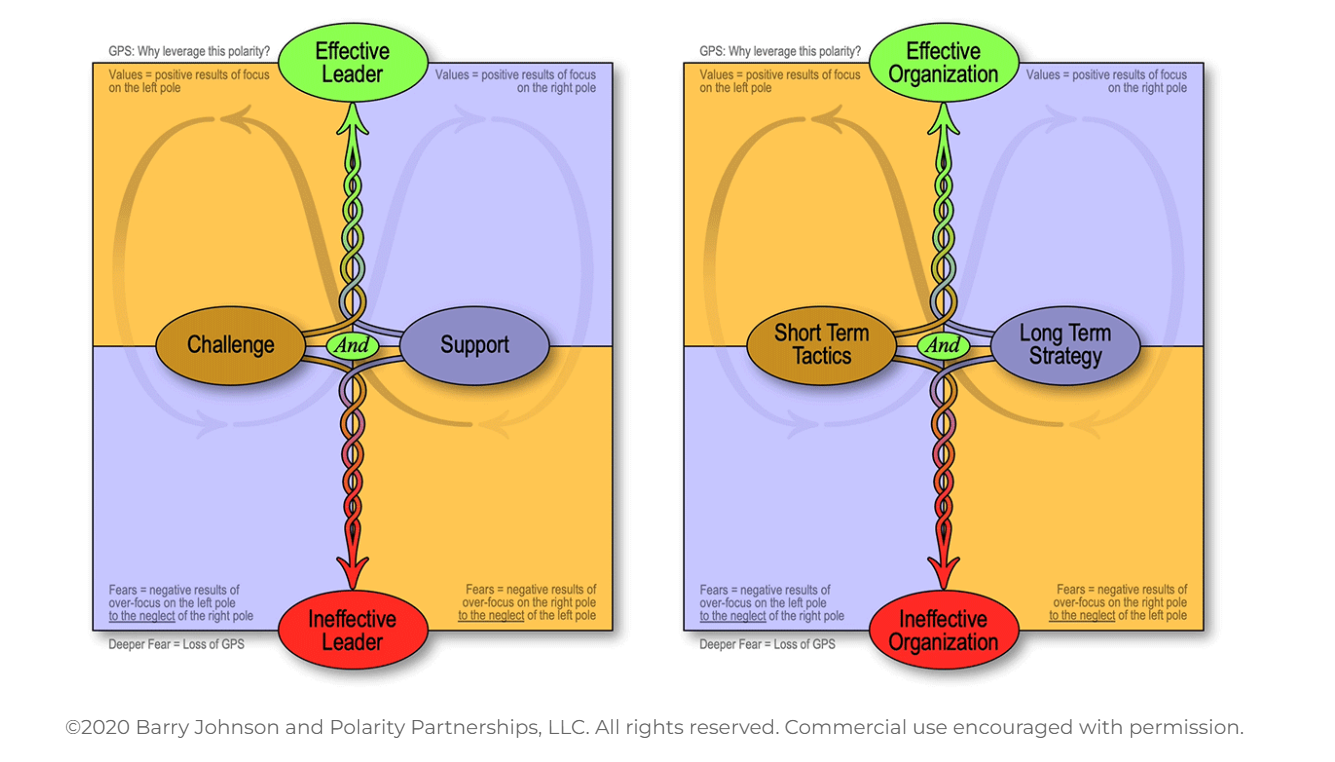
Polarity Map® is a registered trademark of Barry Johnson & Polarity Partnerships, LLC. Commercial use encouraged with permission.

How do I already manage polarities well?
–Since I learned the concept during leadership training in 2019, I now think easily in complementary polarities. I was primed c.2000 when my residency classmate introduced me to “Yes, AND”. She took an improv class and invited me to play a game in the workroom. Thanks, Carol! Now whenever I feel an initial resistance or opposition to something, I look for the juxta(op)position that gives that two-sided coin perspective.
–Polarity management and trade-offs feel related to me. I think in terms of the latter more and more, also since 2019, when I read Being Mortal by Atul Gawande. At the end of an elderly life, there is often tension between independence (goal of the elderly) and safety (goal of their family), and a peaceful end of life usually means compromises on both sides. Increasingly as I counsel patients on habit change, I acknowledge that trade offs will be necessary, and only they can define and decide which are and are not worth making, based on their values and goals. I find that approaching behavior in this way eliminates judgment, and also opens the door for flexibility and evolution without (or with less) regret. It is simply flow and growth.
–I definitely parent better from an integrated polarity perspective. Mostly it’s about letting go and hanging on, advising and commanding, that delicate and heavy handed balance. I tend toward a laissez faire parenting style, which risks the kids feeling neglected if I lean too far into my default. I’m getting better at seeing the pitfalls, and I still have some work to do.

How could I manage polarities better?
–Some people in my life prioritize their values and goals very differently from me. I sometimes sit in rigid judgment of this, dismissing their perspective as inferior in some way. I can do better at recognizing the benefits of having these people around to balance and bend my hard biases.
–I will look for strong polarity integration around me and call it out/forth. I will reinforce and amplify it. I will do my part to make both/and thinking, speaking, and leading visible, and move it into mainstream mindset.

How do we already manage polarities well as a society?

We don’t.

How could we do it better?

Where do you see successful, collective, Yes, AND in action?
I can think of two organizations that walk the talk.

Polarity Partnerships.
“In today’s world of increasing interdependency and complexity, it is vital to utilize problem solving AND both/and thinking to address your most strategic challenges and opportunities. The research is clear – leaders, teams and organizations that leverage Polarities well outperform those that don’t. Discover how to leverage your most strategic Polarities (AKA paradox, wicked problems, chronic tensions, dilemmas, etc.) to become more innovative, agile, profitable and competitive immediately and over time.”

Braver Angels.
“Our mission: Bring Americans together to bridge the partisan divide and strengthen our democratic republic.”
“We state our views freely and fully, without fear.
“We treat people who disagree with us with honesty, dignity and respect.
“We welcome opportunities to engage those with whom we disagree.
“We believe all of us have blind spots and none of us are not worth talking to.
“We seek to disagree accurately, avoiding exaggeration and stereotypes.
“We look for common ground where it exists and, if possible, find ways to work together.
“We believe that, in disagreements, both sides share and learn.
“In Braver Angels, neither side is teaching the other or giving feedback on how to think or say things differently.”

Every once in a while I read an article that does it well–not only describing two poles but explaining why each is/both are necessary and good relative to the other, and the importance of balance and flow between them. It’s pretty rare.

For practical application and guidance, I highly recommend Navigating Polarities by Brian Emerson and Kelly Lewis.

Like so many life practices I consider this month, polarity management and navigation is transformational and liberating. I had not realized it so starkly until now. When I get out of either/or, “Yes, BUT,” and “You suck,” accept what is and look for mutually complementary balancing points, new and useful insights almost always follow. My way out of conflict emerges faster and more clearly, and my relationships get stronger along the way. Very cool.

Loving Lessons from Saint by Sierra Simone

My dear friends, thank you for tolerating the continuous gushing about my romance immersion, 12 months now and still going strong! This post is about more than just the smut, I promise.

Disclosure: Spoilers!

My review of Saint by Sierra Simone on Goodreads (MM = male/male):

“Only my second MM romance. Captivating. So empathically and compassionately written, descriptions of the intrinsic experiences of mental illness, moral conflict, honest self-exploration and accountability open listeners’ minds and hearts to the depth of our fellow humans’ emotional, spiritual, and relational lives–with self as well as others. Sierra Simone‘s voluminous and passionate love of and attention to history shine so brightly, and her writing is both utterly sophisticated and completely relatable. Again, as in Sinner, social commentary is rendered gently, if clearly. This book could be read/heard and thoroughly enjoyed simply as sexy, contemporary romance. And with just a little more contemplation, its meaning and impact become so clearly and importantly much, much more.
Jacob Morgan‘s and Sean Crisden‘s performances move and resonate. Morgan’s accents bring us to Belgium and France with vocal ease. The narrators’ expert acting proves that voice alone is enough to convey all we need to know and feel another’s experience.”

OK SO: Sierra Simone. O.M.G, a QUEEN of language and expression, holy cow! Of all the romance authors whose work I have now consumed (and there are so many more, I will not know them all in this lifetime), her voice stands out, rich and vibrant. “…utterly sophistocated and completely relatable”–maybe I aspire to be so, hence my zealous admiration–because while I cannot think of better words to decribe her work, I know she can.

I have now listened to all three full length novels in the Priest Collection and I highly recommend them all. Jacob Morgan narrates with others, and his voice acting is simply superb, so honest and real. Inspired to listen by the Facebook Shaneiaks group live chat with Sierra and Shane East, once again I cannot thank this community enough for broadening my exposure, experience, and insights from fiction! Sierra is known for her explicitly erotic writing, and she describes in the chat how she came to commit, BOOBS OUT you might say, to writing spicy (‘ghost pepper’ level) romance for her own creative fulfillment. It so happens that doing this resonates deeply with readers and listeners everywhere–such a shining example of the far-reaching ripple benefits of open and audacious authenticity. I was moved to tears by Sinner and to deep thought by Saint, to the point of ordering the latter in print to annotate–only the second print romance I own so far.

The thoughts and feelings evoked by these stories almost escape verbalization. Journaling to untangle it all, I could only list the broad topics approached, addressed, probed, and articulated, individually and all intersecting: Racism. Religion. Spirituality. Grief. Blame. Conflict. Paradox. Love. Lust. Intimacy. Self-delusion. Fear. Shame. Communion. Self-love. Self-compassion. Honesty. Reconciliation. Peace. Commitment. Flexibility. AND. Reformation. Relationship, omg: Parental. Fraternal. Platonic. Romantic. Intimate. Carnal. Spiritual. Intellectual. Multidimensional. Eternal. It’s all an intense, existential jumble, yet conveyed wholly and elegantly in a couple hundred pages of writing, through only dialogue and narrative. Amazing.

The Catholic Church. Simone notes at the beginning of Priest: “I spent the majority of my life in the Catholic faith, and while I’m no longer Catholic, I still have the utmost affection and respect for the Catholic Church… That being said, this novel is about a Catholic priest falling in love. There is sex, more sex, and definitely some blasphemy. (The fun kind).” Her attitude toward the church is respectful, even reverent, as she clearly acknowledges its flaws and failures. Her criticism is loving, never disparaging or rude. How would our world be altered if more of us could take this approach to change and justice?

I think I liked Saint in particular because of the courageous and difficult journey Aiden takes toward integration–to know that he may carve a unique and unprecedented path to being wholly devoted to God without sacrificing any part of himself. I wanted so much for him to embrace that infinity loop of polarity navigation–self-acceptance and independence from dogma and wholehearted communal spiritual participation. Simone’s portayal of church leaders, always local and in personal relationship with the heroes, is so empathetic–they exemplify the ideal spiritual leaders and pastors–helping people through their personal conflicts and crises with love, compassion, humility, and non-judgment.

Characters on journeys to becoming their whole selves, loving each other in the process, helping each other self-actualize–is that what moves me? Isn’t that what heals? In the context of a social structure that has so much of its own paradox–such profound benefits of faith and community and also radically high risk for severe dysfunction, omg… Is there an institution other than religion, that harbors such gaping potential for both healing and harm?

Simone shows how to maintain a loving, open perspective, accepting both poles of the Church, by writing how three brothers in one family react to the same trauma (sister sexually assaulted by priest, later dying by suicide)… Her books do not generalize, dehumanize, demonize, or judge anyone or anything in broad strokes. She does not throw anyone or anything away, nor does she dismiss, excuse, minimize, or deflect. The novels don’t necessarily explore deeply–or I should say explicitly? They are not political or sociological commentary at their core. But through the characters’ struggles and stories, we get to consider myriad gray areas and dig, if we wish, patiently and lovingly, into deeper meaning, both collective and individual, shared and private. The characters’ relationships bridge diversity of race, gender, sexuality, and other aspects of humanity; their moments of epiphany, empathy, and connection emerge in gentle starkness, drawing readers/listeners into vicarious, second hand emotional education.

The ancillary characters all play important roles–obvious and blatant in message–necessarily. They remind me of my own role as physician: I get to observe you, my patient, and your life, as a third party. I am not in your life with you, for the most part. I get to stand and walk next to you when you come to me; I witness. I can know you, and you get to control (much of) that. I can only pry so much; you can choose to withhold. And I may still, if I pay attention, see you. Because our relationship is low-stakes and imbalanced (my role is only to survey and advise, much like the mentors, teachers, and pastors in these stories), I have the freedom to speak frankly, objectively, and lovingly… You may receive my advice more openly than from loved ones because of my credentials and the nature of our relationship. What a fascinating and meaningful privilege.

I wonder how people reject these stories–what do they object to, what are the emotions, triggers, rationalizations, and other factors? To me, these stories can be taken as lessons in honesty. Maybe that’s why I love them so much, because honesty is important to me, and barriers to honesty and self-relection can be formidable in the context of such strong, dogmatic social norms as in the Catholic Church, so heavily steeped in ritual, tradition, and institutionalization. Maybe I see these stories as exemplary works for culture change–fiction as vehicle for social movement–duh-HA! Does anyone expect that from romance? It’s unexpected and, I think, deliciously subversive. Such artful integration, BRAVA. More, please.

God bless Sierra Simone and authors everywhere and in all times, who make us think, feel, and connect, to be and do better.

How Business As Usual Is Killing Us

Surf & turf and a side of asparagus, lobster bisque, smashed potatoes, and an unlimited bread basket, with cocktails and wine, and tiramisu if there’s room.

Most people don’t eat like this all the time, but how many restaurants are filled every night with rooms full people eating exactly this? Many of my patients may eat like this (or something very similar) multiple times a week.

If you want to drastically increase your risks for gout, acid reflux, severe sleep disruption, brain fog, stress intolerance, high cholesterol, high blood pressure, weight gain, and diabetes, there could hardly be a better recipe than the typical business dinner. Here’s the physiology: 1. Red meat, shellfish, alcohol and asparagus are high purine foods that elevate uric acid levels in the blood, increasing the risk of gout, a painful inflammation of joints, especially the first joint of the big toe. 2. High volume, high fat, and alcohol: All of these delay gastric (stomach) emptying, and may loosen the lower esophageal sphincter, making it easier for stomach acid to escape upward, causing heartburn, chest pain, even shortness of breath. 3. Late and prolonged eating: with an already sluggish stomach, finishing a meal within two hours of going to bed makes it even more likely that the stomach will still be relatively full when lying down, sloshing acidic stomach contents right up against that loosened sphincter in the horizontal position, causing painful night time waking, disrupting sleep and negatively affecting mood. 4. Alcohol itself causes neurologic changes that interfere with sleep, even though it may feel initially sedating. It also increases nocturia (getting up at night to pee), can worsen sleep apnea, and is a mood depressant in itself. Taken together, the compounding consequences of the business dinner make it a formidable enemy of health for many executives.

Now add frequent and often international travel with chaotic jetlag, the stress of high pressure, high stakes business transactions, responsibility for whole workforces of people, and disconnection from family, plus emails, voicemails, text messages, and all manner of 24/7 media demanding attention, energy, and time, all finite and precious human resources. It’s a wonder I don’t witness more heart and panic attacks than I do.

Despite these risks and challenges, though, many of my patients actually do and feel fine. They report high meaning in their work, enjoyment from connecting with colleagues (though nobody tells me they love those dinners). They find time to exercise on the road and at home, manage healthy eating, and get good enough sleep in other ways.

Or so we all thought, until the pandemic hit.

My practice closed along with the rest of the country for about 2.5 months in spring of 2020, and the rest of the year and beyond, most of my patients worked from home. Not surprisingly, and also a little shockingly, many of them showed marked improvements in standard objective biometrics when they came for their annual exams that year. BMI, body fat, blood pressure, and cholesterol fell, often precipitously. All of a sudden healthy behaviors that required heroic effort became almost as easy as rolling out of bed. With their long daily commutes eliminated, people could now make–had–time to exercise…and they wanted to because they weren’t mentally exhausted all the time. They could pace about their home office while on Zoom, maintaining energy and engagement. No more international travel, no more business dinners. Their environment and circumstances suddenly and significantly eliminated all kinds of friction on the path to healthy habits. And more importantly, they felt so much better, because they were sleeping more and better, rushing less, and spending more quality time with people they loved. It’s not rocket science–they had their lives back. [Note: I understand that I’m writing about an extremely privileged population. Please know that this awareness is not lost on either my patients or me, and we talk about it candidly.]

Today, frequency and distance of business travel approaches prepandemic levels. Typical work practices are resuming, with some consideration as to their net benefit, but maybe not a lot of action to experiment with or create new, more optimal models of workflow and interaction. In my office, I see patients’ stress levels rising again, weight coming back on, and an overall sense of bewilderment and resignation at it all.

As I write this, I feel a dense tangle of frustration, exasperation, empathy, impatience, protectiveness, and an urge to throw or slam something. Really I feel kind of rageful, actually. Existing disparites of access to resources, autonomy, security, and overall health and well-being widened and intensified dramatically through the pandemic. It makes me ashamed of humanity. How is it that my patients and I–people with agency, autonomy, knowledge, and power–can feel, and actually be, so powerless to change the systems that make us all, privileged and not, so f*ing unhealthy??

I have no concrete or actionable suggestions for how to make things better.

Sometimes I fantasize about going to these business dinners with my patients, like a chaperone. But rather than policing their choices, the point would be to make it safe for everybody to admit that they don’t necessarily want to be there, doing this conventional thing that social norms dictate. Based on years of conversations in the privacy and intimacy of the physician-patient interview, I feel peer pressure operating at the same intensity, and with just as high social consequences, as when we were all adolescents. It’s fascinating and depressing, like a black cloud that everybody feels, nobody acknowledges, and everybody suffers from in collective isolation.

What would it take for these deeply rooted cultural norms, ones that harm us all, to shift even a little? It’s a question I ask myself every day, in multiple domains. I get agitated and hyperventilate at the glacial pace of change. And then, usually, I can take a deep breath. I call on wiser voices than mine to get through.

I know there are people out there bucking the norm, challenging the status quo. I look for that spark in my patients, and I try to fan it, ignite it further. That’s the little good I can do, I guess. Maybe our little fires will one day light the way to bigger change.