Perspective

“Tribe.”

What is your perspective on this word? I’m feeling a little defensive tonight, and also holding mind space to consider different perspectives, while clarifying my own in the process. I have used the word to describe my ‘found family,’ people with whom I share a deeply meaningful bond, my innermost circle and closest confidants. Including unpublished drafts, a search of ‘tribe‘ on this blog yields 105 posts.

Recently I have heard that using the word ‘tribe’ could be offensive to Native Americans. My initial reaction is divergent. Yes, I can see why. And, really? Does this group hold the exclusive right to use this word to describe something meaningful to them? Is its use in other contexts offensive to all indigenous people? Has it always been?

Four sources of perspective:

On the etymology of the word ‘tribe’: “In the Biblical sense, which was the original one in English, the Latin word translates Greek phyle “race or tribe of men, body of men united by ties of blood and descent, a clan” (see phylo-). Extension to modern ethnic groups or races of people is from 1590s, specifically “a division of a barbarous race of people, usually distinguishable in some way from their congeners, united into a community under a recognized head or chief” [Century Dictionary], but colloquially of any aggregate of individuals of a kind. also from mid-13c.“

“What is a Tribe?” “True, “tribe” is a troublesome word, bearing the weight of decades of anthropological study that privileged Western civilization over all other traditions. But let us rescue it here, pare it down to its simplest meaning, as a name for the first human communities that formed beyond the primal bonds of kinship — the beginnings of the great experiment we call society, which taught us to be human.”

“A teen recently told me that using the phrase “find your tribe” or using the word “tribe” is offensive to Native Americans.” “For Indigenous people, tribal identity is important. So when non-Native people say “find your tribe” or “tribe” to describe groups of shared interest, it is offensive because it erases the significance of Tribal sovereignty, identity, and people. Instead, we can use words like: group, crew, friends, or circle.”

Tribal Leadership, Dave Logan et al. From a sociological point of view, using the word as a reseach group defines it academically: “The success of a company depends on its tribes. The strength of its tribes is determined by the tribal culture, and a thriving corporate culture can only be established by an effective tribal leader.” This book has influenced my perspective on leadership and culture very deeply, hence my reluctance to stop using the word altogether.

How do I do perspective well already?
–My perspective taking skills are strong. This has to do with empathy, attunement, effective question formation and expression, and active listening. I have trained to be slow to judgment and opposition. I can engage with openness, calm, and patience.
–I understand that my Asian-American cis-het-monogamous-married woman physician parent identity gives me a certain perspective that is not shared by everyone I meet. I try to remember this, especially when I engage with people whose identities do not overlap much with mine.

How could I do it better?
–It’s easy to feel confident and competent about my skills when I only practice in easy situations. I can look for situations and practice when it’s hard–really train my openness and curiosity. I don’t mean to pick fights with people, rather simply attune to divergent opinions and perspectives around me, and choose more mindfully to engage with that divergence, even if it’s only in my own head.
–Also do it out loud, or in writing. Tonight’s post was prompted by my Facebook post and its comments. I plan not to engage in a complex exchange on social media, and this post will not be my last writing on perspective.

How does society to perspective well already?

Information. This is a tricky one. We can basically find ardent examples of and support for any perspective we want on the internet. So on one hand, it’s really easy to find a diversity of perspectives to explore, process, and deepen understanding and connection. On the other hand….

Groups who lead by example. See the November 9 post on polarity management; organizations like Polarity Partnerships, Braver Angels, and the Aspen Institute all have programs to help us open our minds to broader perspective taking, more effective communication, and better relationships.

How could we do better?

Long form: Conversations and reading. My friend, intending to be helpful, dropped the link for the third perspective piece above as a comment on my Facebook post tonight. There was no accompanying writing or explanation. So far there has been a brief exchange in which she suggests that since the word may be offensive to some people, I should avoid using it (in the context of my post). It made me think more, but rather than engage there, I decided to write out my thoughts here. I’m grateful to her for prompting me to search and read more. Depending on the topic and participants, social media may not be the best place to exchange perspectives, but we can always use it ourselves as a springboard for our own inner and outer work. That work, in my opinion, requires more words, more time, and more real, in person connection.

“Count higher than two”. This article introduced me to David Blankenhorn, co-founder of Braver Angels, a group I admire deeply for its efforts to help people from opposing American political groups de-escalate political discussions. “Sometimes an important phenomenon actually does divide naturally into two and only two parts or sides, between which one all-or-nothing choice must be made. But in most cases, this way of thinking about the world is not only polarizing, it is highly simplistic and leads mainly to pseudo-disagreements as opposed to real ones.” This idea reminds me of the ABC exercise (Adversity-Belief-Consequence), which basically asks us to tell multiple plausible stories to explain adversity to unglue ourselves from our most kneejerk and often dysfunctional assumptions and their subsequent thoughts, words, and actions.

For tonight, I have decided that I can still use the word ‘tribe’ mostly as I have been–with reverence. I am now more aware, however, of the potential drawbacks of using it casually, the impact that may have on people for whom the word has specific and deep meaning. This perspective exercise tonight reminds me to continue practicing mindfulness, respect, and intention in my language. And when I offend someone inadvertently, I can own and correct my ignorance while discerning what’s mine to account for and what’s not.

Here on day 16 of NaBloPoMo 2023, we could choose to see these posts as banal and redundant. I’m feeling more that they mutually reinforce some central tenets of effective relationship, which is my WHY. My net of interconnected practices, their importance, and their mutually upholding properties, strengthens and tightens with each post. My motivation to write it all more coherently and inspiringly in the BFHP also grows daily. AND I’m still gettng to bed on time most nights! HALLELUJAH, FRIENDS!

Ooooo, Leadership tomorrow. Bring it.
Polarity Management

Yes, AND.

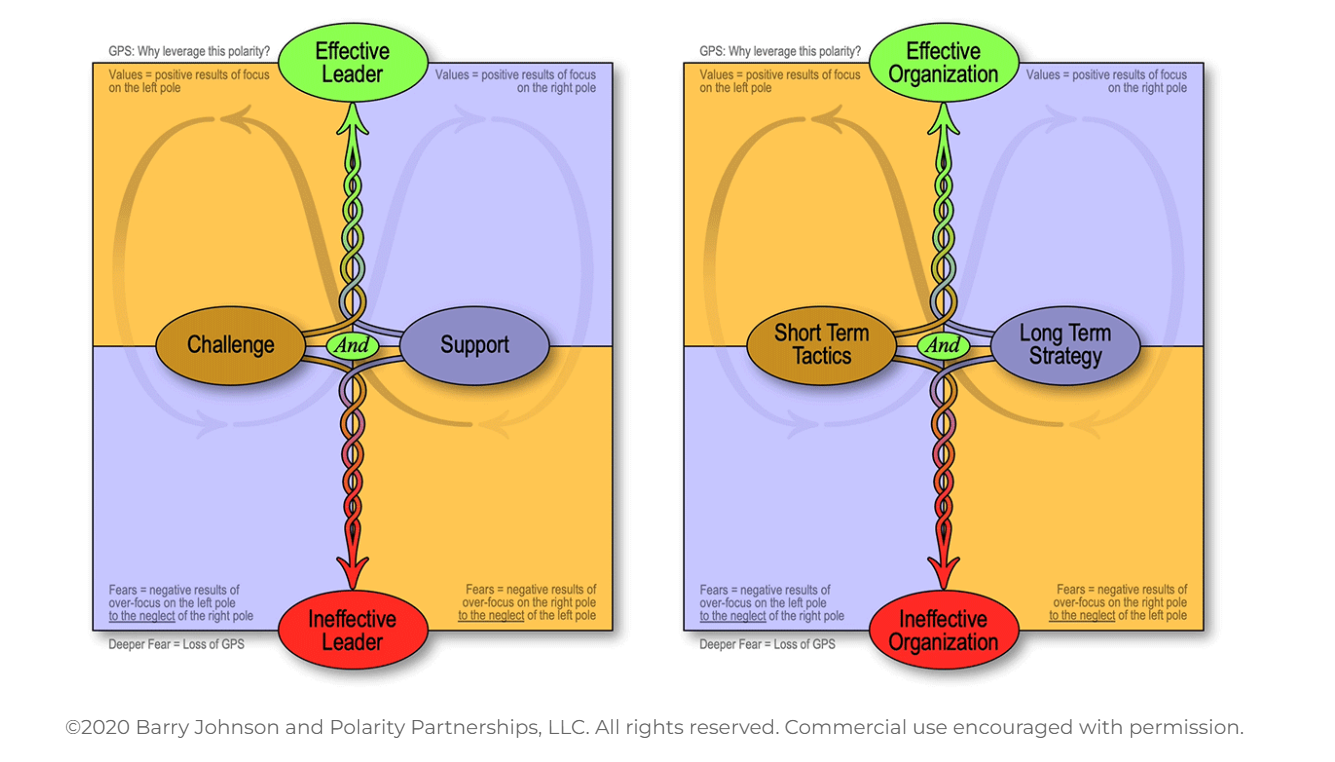
This is the central tenet of polarity management. It’s about holding divergent and apparently opposing ideas or positions at the same time, understanding that their relationship is actually complementary and mutually strengthening rather than perpetually conflicting. Masculine/feminine, individual/collective, conservative/progressive, strong/soft, diplomacy/candor, top down/bottom up–what else? Can we frame any two antagonistic ideas in an infinity polarity loop of inextricable relationship? I say yes. Because it puts us into novel perspectives, prompting a mindshift into possibility, creativity, and connection.

I am waiting on permission to use a seminal image from Polarity Partnerships, the organization founded around the idea that in any polar dichotomy, there is a dynamic flow and balance between the advantages and disadvantages of focusing energy and action on either pole. When we can maximize the benefits and minimize the costs of each pole, then leadership and organizations thrive. It’s much easier to show than tell; fingers crossed I’m allowed to share the image; check out their homepage and you will see what I mean.

13 November 2023: Here it is!

Polarity Map® is a registered trademark of Barry Johnson & Polarity Partnerships, LLC. Commercial use encouraged with permission.

How do I already manage polarities well?
–Since I learned the concept during leadership training in 2019, I now think easily in complementary polarities. I was primed c.2000 when my residency classmate introduced me to “Yes, AND”. She took an improv class and invited me to play a game in the workroom. Thanks, Carol! Now whenever I feel an initial resistance or opposition to something, I look for the juxta(op)position that gives that two-sided coin perspective.
–Polarity management and trade-offs feel related to me. I think in terms of the latter more and more, also since 2019, when I read Being Mortal by Atul Gawande. At the end of an elderly life, there is often tension between independence (goal of the elderly) and safety (goal of their family), and a peaceful end of life usually means compromises on both sides. Increasingly as I counsel patients on habit change, I acknowledge that trade offs will be necessary, and only they can define and decide which are and are not worth making, based on their values and goals. I find that approaching behavior in this way eliminates judgment, and also opens the door for flexibility and evolution without (or with less) regret. It is simply flow and growth.
–I definitely parent better from an integrated polarity perspective. Mostly it’s about letting go and hanging on, advising and commanding, that delicate and heavy handed balance. I tend toward a laissez faire parenting style, which risks the kids feeling neglected if I lean too far into my default. I’m getting better at seeing the pitfalls, and I still have some work to do.

How could I manage polarities better?
–Some people in my life prioritize their values and goals very differently from me. I sometimes sit in rigid judgment of this, dismissing their perspective as inferior in some way. I can do better at recognizing the benefits of having these people around to balance and bend my hard biases.
–I will look for strong polarity integration around me and call it out/forth. I will reinforce and amplify it. I will do my part to make both/and thinking, speaking, and leading visible, and move it into mainstream mindset.

How do we already manage polarities well as a society?

We don’t.

How could we do it better?

Where do you see successful, collective, Yes, AND in action?
I can think of two organizations that walk the talk.

Polarity Partnerships.
“In today’s world of increasing interdependency and complexity, it is vital to utilize problem solving AND both/and thinking to address your most strategic challenges and opportunities. The research is clear – leaders, teams and organizations that leverage Polarities well outperform those that don’t. Discover how to leverage your most strategic Polarities (AKA paradox, wicked problems, chronic tensions, dilemmas, etc.) to become more innovative, agile, profitable and competitive immediately and over time.”

Braver Angels.
“Our mission: Bring Americans together to bridge the partisan divide and strengthen our democratic republic.”
“We state our views freely and fully, without fear.
“We treat people who disagree with us with honesty, dignity and respect.
“We welcome opportunities to engage those with whom we disagree.
“We believe all of us have blind spots and none of us are not worth talking to.
“We seek to disagree accurately, avoiding exaggeration and stereotypes.
“We look for common ground where it exists and, if possible, find ways to work together.
“We believe that, in disagreements, both sides share and learn.
“In Braver Angels, neither side is teaching the other or giving feedback on how to think or say things differently.”

Every once in a while I read an article that does it well–not only describing two poles but explaining why each is/both are necessary and good relative to the other, and the importance of balance and flow between them. It’s pretty rare.

For practical application and guidance, I highly recommend Navigating Polarities by Brian Emerson and Kelly Lewis.

Like so many life practices I consider this month, polarity management and navigation is transformational and liberating. I had not realized it so starkly until now. When I get out of either/or, “Yes, BUT,” and “You suck,” accept what is and look for mutually complementary balancing points, new and useful insights almost always follow. My way out of conflict emerges faster and more clearly, and my relationships get stronger along the way. Very cool.

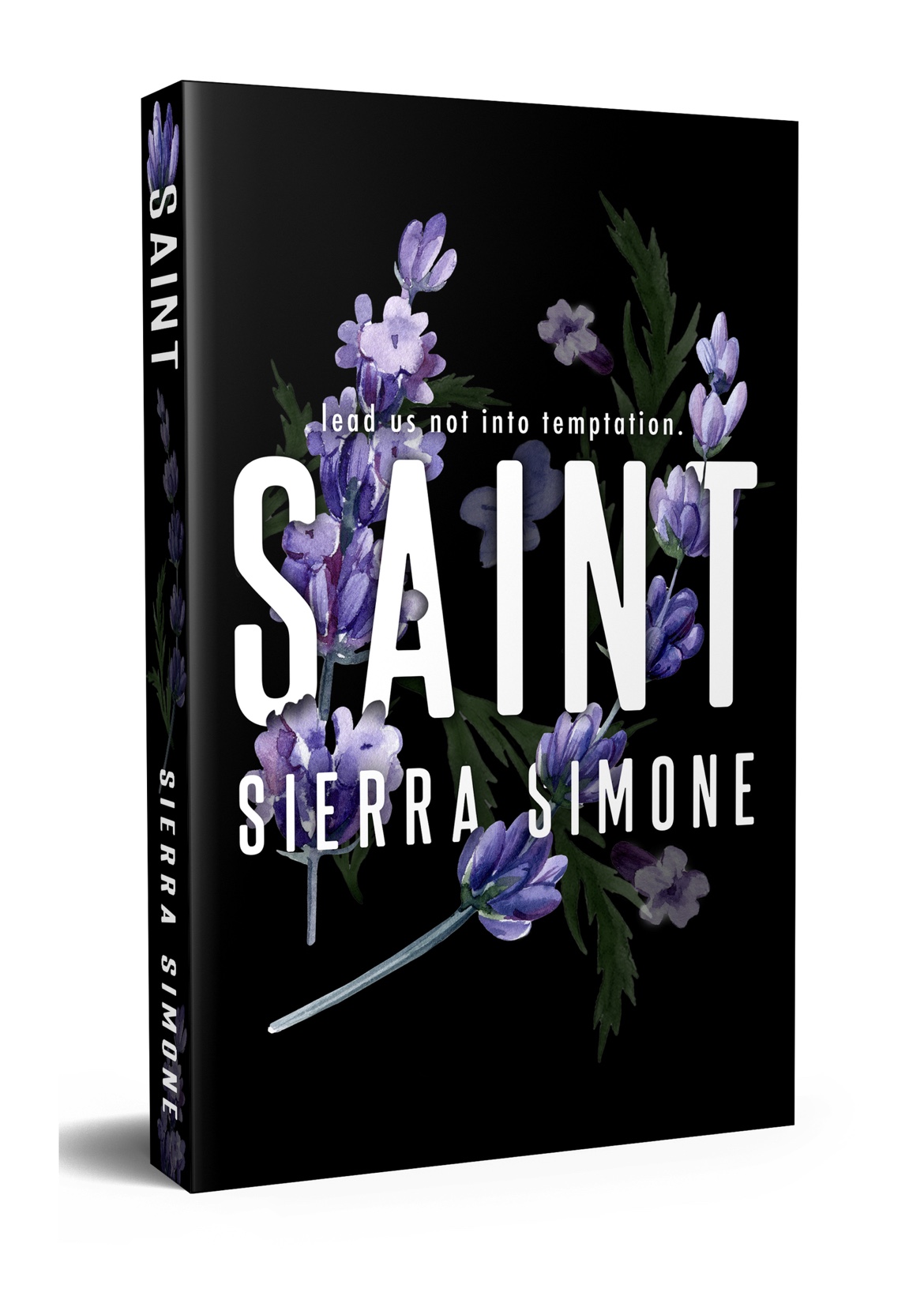
Loving Lessons from Saint by Sierra Simone

My dear friends, thank you for tolerating the continuous gushing about my romance immersion, 12 months now and still going strong! This post is about more than just the smut, I promise.

Disclosure: Spoilers!

My review of Saint by Sierra Simone on Goodreads (MM = male/male):

“Only my second MM romance. Captivating. So empathically and compassionately written, descriptions of the intrinsic experiences of mental illness, moral conflict, honest self-exploration and accountability open listeners’ minds and hearts to the depth of our fellow humans’ emotional, spiritual, and relational lives–with self as well as others. Sierra Simone‘s voluminous and passionate love of and attention to history shine so brightly, and her writing is both utterly sophisticated and completely relatable. Again, as in Sinner, social commentary is rendered gently, if clearly. This book could be read/heard and thoroughly enjoyed simply as sexy, contemporary romance. And with just a little more contemplation, its meaning and impact become so clearly and importantly much, much more.
Jacob Morgan‘s and Sean Crisden‘s performances move and resonate. Morgan’s accents bring us to Belgium and France with vocal ease. The narrators’ expert acting proves that voice alone is enough to convey all we need to know and feel another’s experience.”

OK SO: Sierra Simone. O.M.G, a QUEEN of language and expression, holy cow! Of all the romance authors whose work I have now consumed (and there are so many more, I will not know them all in this lifetime), her voice stands out, rich and vibrant. “…utterly sophistocated and completely relatable”–maybe I aspire to be so, hence my zealous admiration–because while I cannot think of better words to decribe her work, I know she can.

I have now listened to all three full length novels in the Priest Collection and I highly recommend them all. Jacob Morgan narrates with others, and his voice acting is simply superb, so honest and real. Inspired to listen by the Facebook Shaneiaks group live chat with Sierra and Shane East, once again I cannot thank this community enough for broadening my exposure, experience, and insights from fiction! Sierra is known for her explicitly erotic writing, and she describes in the chat how she came to commit, BOOBS OUT you might say, to writing spicy (‘ghost pepper’ level) romance for her own creative fulfillment. It so happens that doing this resonates deeply with readers and listeners everywhere–such a shining example of the far-reaching ripple benefits of open and audacious authenticity. I was moved to tears by Sinner and to deep thought by Saint, to the point of ordering the latter in print to annotate–only the second print romance I own so far.

The thoughts and feelings evoked by these stories almost escape verbalization. Journaling to untangle it all, I could only list the broad topics approached, addressed, probed, and articulated, individually and all intersecting: Racism. Religion. Spirituality. Grief. Blame. Conflict. Paradox. Love. Lust. Intimacy. Self-delusion. Fear. Shame. Communion. Self-love. Self-compassion. Honesty. Reconciliation. Peace. Commitment. Flexibility. AND. Reformation. Relationship, omg: Parental. Fraternal. Platonic. Romantic. Intimate. Carnal. Spiritual. Intellectual. Multidimensional. Eternal. It’s all an intense, existential jumble, yet conveyed wholly and elegantly in a couple hundred pages of writing, through only dialogue and narrative. Amazing.

The Catholic Church. Simone notes at the beginning of Priest: “I spent the majority of my life in the Catholic faith, and while I’m no longer Catholic, I still have the utmost affection and respect for the Catholic Church… That being said, this novel is about a Catholic priest falling in love. There is sex, more sex, and definitely some blasphemy. (The fun kind).” Her attitude toward the church is respectful, even reverent, as she clearly acknowledges its flaws and failures. Her criticism is loving, never disparaging or rude. How would our world be altered if more of us could take this approach to change and justice?

I think I liked Saint in particular because of the courageous and difficult journey Aiden takes toward integration–to know that he may carve a unique and unprecedented path to being wholly devoted to God without sacrificing any part of himself. I wanted so much for him to embrace that infinity loop of polarity navigation–self-acceptance and independence from dogma and wholehearted communal spiritual participation. Simone’s portayal of church leaders, always local and in personal relationship with the heroes, is so empathetic–they exemplify the ideal spiritual leaders and pastors–helping people through their personal conflicts and crises with love, compassion, humility, and non-judgment.

Characters on journeys to becoming their whole selves, loving each other in the process, helping each other self-actualize–is that what moves me? Isn’t that what heals? In the context of a social structure that has so much of its own paradox–such profound benefits of faith and community and also radically high risk for severe dysfunction, omg… Is there an institution other than religion, that harbors such gaping potential for both healing and harm?

Simone shows how to maintain a loving, open perspective, accepting both poles of the Church, by writing how three brothers in one family react to the same trauma (sister sexually assaulted by priest, later dying by suicide)… Her books do not generalize, dehumanize, demonize, or judge anyone or anything in broad strokes. She does not throw anyone or anything away, nor does she dismiss, excuse, minimize, or deflect. The novels don’t necessarily explore deeply–or I should say explicitly? They are not political or sociological commentary at their core. But through the characters’ struggles and stories, we get to consider myriad gray areas and dig, if we wish, patiently and lovingly, into deeper meaning, both collective and individual, shared and private. The characters’ relationships bridge diversity of race, gender, sexuality, and other aspects of humanity; their moments of epiphany, empathy, and connection emerge in gentle starkness, drawing readers/listeners into vicarious, second hand emotional education.

The ancillary characters all play important roles–obvious and blatant in message–necessarily. They remind me of my own role as physician: I get to observe you, my patient, and your life, as a third party. I am not in your life with you, for the most part. I get to stand and walk next to you when you come to me; I witness. I can know you, and you get to control (much of) that. I can only pry so much; you can choose to withhold. And I may still, if I pay attention, see you. Because our relationship is low-stakes and imbalanced (my role is only to survey and advise, much like the mentors, teachers, and pastors in these stories), I have the freedom to speak frankly, objectively, and lovingly… You may receive my advice more openly than from loved ones because of my credentials and the nature of our relationship. What a fascinating and meaningful privilege.

I wonder how people reject these stories–what do they object to, what are the emotions, triggers, rationalizations, and other factors? To me, these stories can be taken as lessons in honesty. Maybe that’s why I love them so much, because honesty is important to me, and barriers to honesty and self-relection can be formidable in the context of such strong, dogmatic social norms as in the Catholic Church, so heavily steeped in ritual, tradition, and institutionalization. Maybe I see these stories as exemplary works for culture change–fiction as vehicle for social movement–duh-HA! Does anyone expect that from romance? It’s unexpected and, I think, deliciously subversive. Such artful integration, BRAVA. More, please.

God bless Sierra Simone and authors everywhere and in all times, who make us think, feel, and connect, to be and do better.