
Holding Perspective

What is your relationship with buses?

The pick up truck in front of me let a city bus into traffic the other day. I was already in a great mood, driving to Ethos, excited to see my friends and move my body. That this big white monster truck did not try to compete with the bigger white striped monster bus somehow gave me hope for humanity.

More and more drivers flout traffic law these days–do you notice? It’s the same way I see passengers ignoring the fastened seat belt sign on planes. We just don’t care about rules anymore? Or each other? I see it as discourteous, self-absorbed, and generally rude. It makes me annoyed and angry, then sad. I try not to let it poison my attitude toward humans in general. The man who stands up during the plane’s ascent to rummage through the overhead bin is the same man who offers to help me get my carry-on down when we land (which I politely decline because I go to Ethos, thank you very much!). What is up with us lately?

This clear, crisp morning heading westbound on Belmont, a pleasant surprise of vehicular civility made me think. How often do I let buses into traffic in front of me? Not as often as I’d like to declare. Why is that? I generally drive peacefully: I leave two to three seconds between myself and the car in front of me. If you signal, I will absolutely slow down and let you into my lane. If you let me in, I will wait until I can see you in my rearview mirror and wave enthusiastically. I make eye contact with pedestrians and gesture to them to cross in front of me. But with buses, I intentionally speed up to get in front before they cut me off. Huh.

Is it tit for tat? Bus drivers can be pretty aggressive, I have to say. And they almost never wave back, even if eye contact is made. I never realized before that morning how adversarial I feel toward them. Whoa. I wonder if they get this from all of us car drivers?

I took the bus all the time as a student. I spent an hour and a half by train, train, and buuuuus to visit Hubs when he started med school a year before me. The trade off at rush hour was that there were more buses to catch, and also more buses and cars on the road in traffic; no time of day was faster. I controlled nothing; it was a practice in patience and relinquishing agency in a lot of ways.

This perspective came rushing over me all at once as I rolled through the intersection behind the pick up truck, behind the bus, so leisurely, listening to my favorite music in my SUV, all warm and cozy, water bottle at my side. If I encountered an accident or needed to stop for something, I could change my route ad lib. I had at least partial control of my time, my path, and my choices. Not so the people on the bus. They were captive unless they got off, and then they’d have to pay more in time, money, and hassle to change buses, routes, or mode of transport.

My perspective broadened suddenly and unexpectedly: I am not just in relationship with the bus driver(s). I’m in relationship with everybody on a given bus–the people who don’t get to pick their seat, if they get to sit at all; the people who had to get up that much earlier, leave their families, to allow for the extra time on public transit; the people who may not get enough sleep or have time to exercise because their commute takes so long.

Bus drivers are road advocates for their passengers–asserting themselves and their charges into the morass of the rude rest of us–getting their people where they need to go. They have a schedule to fulfill, navigating tight turns and oblivious drivers looking at our phones, ignoring stop signs, and running red lights. I wonder how they think of themselves? I will think of them this way from now on, and give them the space and deference to ferry their passengers with one less obstacle in their way. I’ll wave and smile more, too.

I Hold Perspective for Us, friends. It opens our minds to new points of view, to learning, to insight and epiphany–to connection. It lightens the burden of competition and scarcity. It protects us against mutual isolation and social disintegration.
Where could you benefit from some new perspective this week?
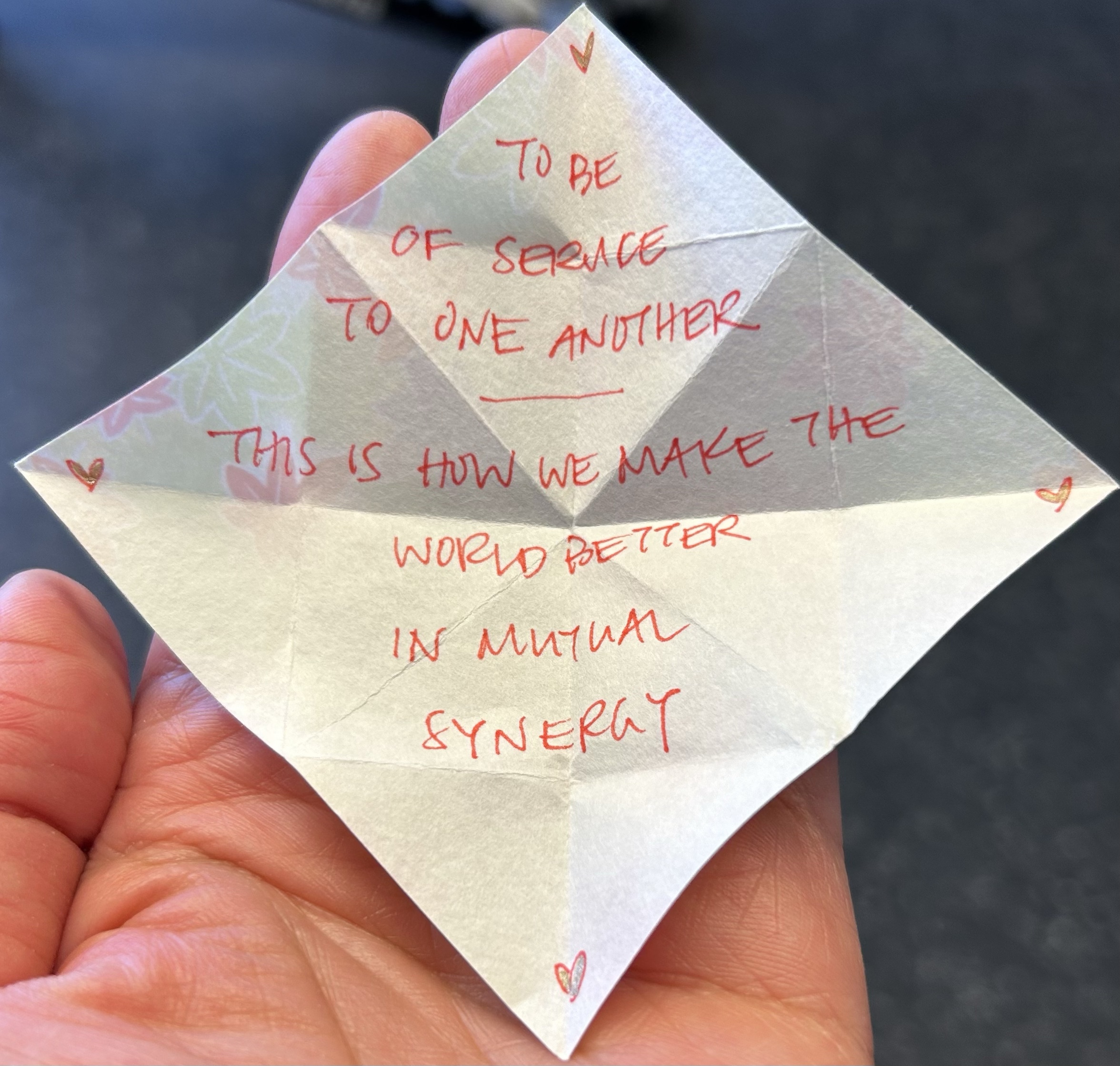
Holding Connection

“It’s a beautiful day in Chicago.
“Gratitude stands in front today, sadness pressed right up behind. They hold each other like twin toddlers: Intimate. Knowing. *Connected*.
“Holding.”

If you follow me on Instagram, you know I post photos of a mug by my laptop every weekend. Normally this gives the page a semi-coherent aesthetic of mug shots alternating with blog posts, with occasional other stuff sprinkled in. This month I’m inserting a mug picture when I think of it, to break up the daily blog tiles. The caption above emerged spontaneously today. *happy sigh*

Had a leisurely morning before and after dropping Daughter off at school. Got some work done, then made it to Ethos for the start of a new training block (barbell front foot elevated split squats and pull ups, oh yeah!). Did my first class with Coach AriannaROCK STAR. Caught up a little with lovely friend James, then had a wonderful lunch with dear Jacob. Chatted with the beautiful Kasey, picked up a little jar smile for myself on the way out, and felt a good little tingle. I generally do not cry easily, but tears verged more than once on the drive home. Gratitude in front, sadness right behind. I write ad nauseum about the community at Ethos–I promise they do not pay me. It’s just a unique community where relationship is a core value. It is their ethos, expressed right there in their tagline: TRAIN. RECOVER. CONNECT. And let me tell you, they (we) walk the talk. I drive up to 45 minutes each way, three times a week, to commune with these amazingly generous and kind people who hold me in my strengths, my vulnerabilities, my weirdness–in my wholeness.

Today my friends held me in my sadness. They held my heart close and tight. They were so present. I am not happy about a second Trump administration, not at all. But I could accept it on Wednesday. I am confident in our institutions at the moment and I see the slow groundswell of collaborative efforts across the aisle in credible party leaders to uphold them. I see popular legislative efforts across the country to protect the rights I care about. Policy will always be a give and take, one and two steps forward and back ad infinitum. The sadness set in only after seeing repeated expressions of vehement relationship rupture and abandonment, of harsh judgment with complete lack of curiosity and empathy. I see it on both sides (nobody is asking relationally meaningful questions), and more from the left. I understand and empathize with the intense emotions–the shock and disappointment, the outrage, even the hopelessness. I share some of them. But above all, it’s the active, volitional relational desertion, collective or individual, that distresses me most.

In the afternoon I spoke to Jon, my high school classmate, a conservative. We last met at our ten year reunion, 23 years ago. We have stayed connected on Facebook, mainly to discuss our divergent political views. It has always been respectful and loving. He messaged me on Wednesday to ask how I was. He is the friend I wrote about who hugged his tearful colleague after Trump won in 2016. We spoke for an hour and agreed on many more things than we disagreed on–mostly relational, behavioral, and pragmatic things. We held space for the really complex issues. We agreed strongly and wholeheartedly that in the most emotionally charged, most intense disagreements of identity and personal beliefs, that is when and where we must exercise the most attunement, kindness, empathy, and humility–basically the opposite of what we actually do.

So grateful. So sad.

I am okay. I am not surprised or disillusioned, necessarily. I am not hopeless. We are human, and this is how we do under severe stress. Relationship ruptures can be repaired. It is a choice. That does not mean it is easy, and wounds leave scars, some large and disfiguring.

“You got hurt,” Dear Friend said to me so lovingly once, after I attempted to connect to someone and missed. Yes, I got hurt. That can happen when we risk connection. It was worth it. My friends showed me today that every time I have taken this risk, the reward has consistently far outweighed any cost or pain. There is so much pain right now, my friends–it rolls over us like the darkest thundercloud. And it will pass. Throwing away our relationships now will not make it pass any faster, nor make the light any brighter afterward–quite the opposite, I’m convinced.

I Hold Connection for Us, my friends. I hold it like our lives depend on it.
Because they do.

Holding Regret

What are your best and worst regrets? What is the difference?

If we pay attention, regret is inevitable. Living life with ‘no regrets’ is unrealistic at best, oblivious at worst. I’ve thought and written about this a lot, as evidenced by my birthday post in 2022 and the 12 (now 13) times I have tagged it subsequently.
How does regret feel? In my body it feels tight at the neck, shallow in breath. My head hangs, my lips purse. I avoid eye contact–don’t want to be seen–that’s shame, right?

“I would rather regret being too kind than not kind enough.”

I have said this for some years and now, in this moment of writing, I know why. As I realized and wrote in 2022, my worst regrets are relational–times when I have caused a rupture, especially when repair was incomplete or impossible. I could easily substitute honest, empathetic, compassionate, generous, humble, and forthright for ‘kind’. These memories still sting, and I will carry them forever. Thankfully, I pack them better now. They occupy a smaller, more condensed compartment of my life baggage, less damaging when they leak.

Holding regret well, I have learned, requires both accountability and self-compassion. Accountability makes me reflect, learn, and commit to doing better in the future. Self-compassion helps me step out of shame (I’m such a bad mom/friend/doctor/person), and stand instead in guilt (I did a bad thing). The difference: Shame seizes; guilt activates.

Brené Brown wrote yesterday on Instagram:

My research and my life have taught me that regret is one of our most powerful emotional reminders that reflection, change, and growth are necessary. In our research, regret emerged as a function of empathy. And, when used constructively, it’s a call to courage and a path toward wisdom.

The idea that regret is a fair but tough teacher can really piss people off. “No regrets” has become synonymous with daring and adventure, but I disagree. The idea of “no regrets” doesn’t mean living with courage, it means living without reflection. To live without regret is to believe we have nothing to learn, no amends to make, and no opportunity to be braver with our lives.

In our work, we find that what we regret most are our failures of courage, whether it’s the courage to be kinder, to show up, to say how we feel, to set boundaries, to be good to ourselves, to say yes to something scary. Regret has taught me that living outside my values is not tenable for me.

Regrets about not taking chances have made me braver. Regrets about shaming or blaming people I care about have made me more thoughtful.

Sometimes the most uncomfortable learning is the most powerful.

Discomfort: What actions do we take to avoid it? When does this lead to regret down the road, and which of these discomforts would we choose, if we had it to do over? Vulnerability is extremely uncomfortable–a risk of variable magnitude, depending on context. The reward, however, can be transformative. I regret causing others discomfort with my vulnerability; I’m better at attuning to that risk as I age. I regret when my vulnerability is met with dismissal, invalidation, or minimization. Still, deep human connection cannot occur without real vulnerability, risks and all. Since I live for connection, I have a very high tolerance for the discomfort of vulnerability. Expressed alongside kindness, honesty, and humility, likelihood of connection rises and regret declines. How lovely.

What regrets would you rather carry forever?

I Hold Regret for Us that shows us our core values, that keeps us honest and accountable. I also hold love, compassion, and deep connection that lightens regret’s perpetual load on us all. We walk on, my friends, all on the path, all doing our best.