November 9:  Steady Pacing Makes Me Better

IMG_2620

NaBloPoMo 2019

*sigh*

I’m not a swimmer or a runner, but isn’t there something in these athletes’ training about breathing, pacing, and strategies for long distance endurance?   The last 22 days have felt like a physical, mental, and emotional marathon of sorts.  I’ll spare you the list of meetings, engagements, and tasks—you may have already read about them!  Looking back, I realize I have had to live every day in acute mindfulness, attending to whatever was right in front of me in the moment, including the unexpected.  Prioritizing was key, completing one task/event/conversation before moving onto the next.  I had to put my head down for some parts, come up for breath and a brief aerial view, then dive deep again.  Today I crossed a finish line, and I feel proud.

I started my journey with Better Angels in May of this year, at a skills workshop.  Since then I have attended two additional workshops, one that was featured on the Van Jones Show.  I committed to moderator training, and today I led my first skills workshop.  I had the honor of working with the three Wonder Women who ran the workshop back in May.  They prepared me so generously, so kindly, and I am forever grateful.

There was a hiccup, though.  When we initially arranged with the Wilmette Public Library for the event, we mistakenly told them the event would last two hours.  The workshop is designed to last 2.5 hours.  We could not change the website or registration, so we meticulously shaved 24 minutes from the schedule.  We warned participants of our impending heavy handedness on time, and dove in.  Mande and I set timers on our phones for each segment.  Mary Lynn gave me hand signals from the back of the room (though I did not always look or see).  I had the handy timeline that Sharon typed out for us all.  We ran ahead at times and behind at others, and ended right at 4:06pm, as planned.  We kept pace.  Engagement and discussion was lively, and attendees gave overwhelmingly positive feedback.  Many people stayed afterward to talk more, explore ways to get involved, and exchange information.  We were invited to present at other organizations.  Overall we felt it was a wild success.
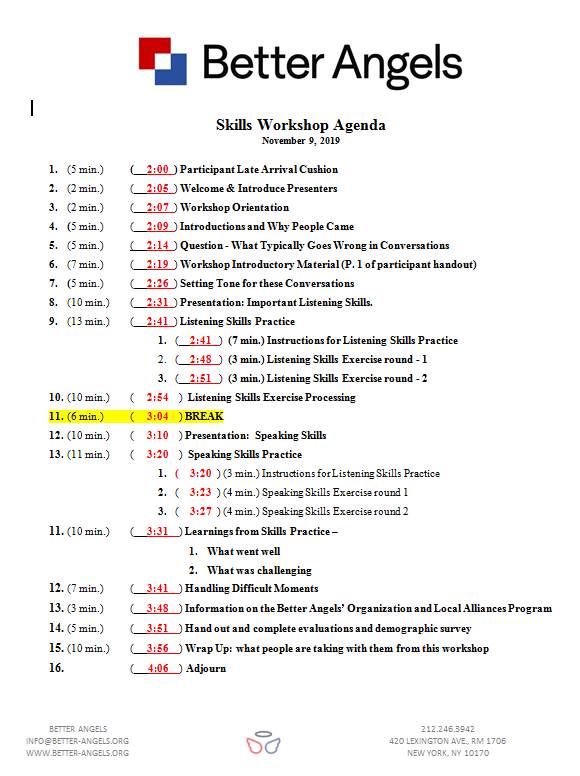
Workshop timeline 11-9-19

Everything was a group effort these last three weeks. Each meeting, workshop, video call, or presentation, whether for the American College of Physicians, my clinical practice sites, or Better Angels, required a team of people, each with delegated and specified roles and task lists.  We all had to agree on timelines and deadlines.  Text, email, Zoom; more email and text—it felt like running through a Venn diagram of relay races, passing batons in and out of each circle as I crossed from one to another.  I had to pace myself, and also match the pace of others as I came alongside.

Having a calendar with everything written in one place definitely helped.  I keep a checklist of every task, no matter how small, and carry it with me everywhere.  Excellent hydration is key for optimal mental and physical performance—I’m always reminded when I forget.  Timely, frequent, and clear communication—need I say more?  All of these practices help me plan and maintain a steady pace, checking off the list, completing each day, each trip, each week, slowly, surely, and competently.

Now I can slow down, breathe deep, and tread more lightly for a little while.  Every athlete, even an amateur, requires rest and recovery between races.  Once again I dedicate this month of daily blogging—a quintessential practice in steady pacing—to all those who go before me, showing me how it’s done.  Thank you.


November 6:  Caring For the Team Makes Me Better

IMG_2624

NaBloPoMo 2019

“How does he treat you?”

I don’t only ask this question of women whom I suspect of being abused at home.  I also ask my medical assistants.  Not about their domestic partners, but about our patients.

In my first practice, I sat/stood to the left of my medical assistant every day for six years.  It was a cozy (cramped) little counter space stacked with charts from end to end, with a couple of high-wheeley chairs.  Each chart stack had a laminated cover on top:  “For Cheng to Review/Sign,” “For Rose,” “Labs,” and “Messages.”  Charts journeyed from my left to my right/Rose’s left, to the bin under the counter to be filed.  It was incredibly efficient, actually.  I had a handwritten emoji system for indicating (dis)satisfaction with cholesterol and diabetes results.  Rose knew all of my patients and how to communicate sentiments and instructions clearly and lovingly.  She had been an MA since I was a kid; she knew what she was doing.  If a patient had a question on the phone, she could put them on hold and clarify with me, or I could just get on the phone and speak to the patient myself.  We were busy and happy, a well-oiled team-machine.

One day as I came up to my spot at the counter, I noticed an unusual sound next to me, like a distant, scratchy loudspeaker.  I turned and saw Rose holding the phone receiver about an inch from her ear.  The sound was my patient, yelling profanities at her so loudly I could hear his words from two feet away.  I can’t remember what the issue was, but he was obviously upset, and taking it out on her.  It surprised me because I had only known him to be sweet, respectful, and grateful.  Maybe he was just having a bad day?  I looked at Rose, who rolled her eyes and exhaled heavily.  I asked her to put him on hold so she could catch me up.  Apparently this had been going on longer than I knew, and she had not told me.  Had I not come upon it in real time, she may never have told me.  She would have simply tolerated it.

I picked up the call and declared myself.  He was the usual, respectful and calm patient I had always known.  I answered his medical questions.  Then I told him firmly that he did not have the right to treat anyone in my office the way he had just treated Rose.  I think there may have been some excuses and then an apology.  I made it clear that if he abused my team again, he would be discharged from the practice.  He agreed and apologized again.

That was my first opportunity to stand up for my team as an attending.  I will forever remember it.  I was a petite, young, Chinese woman doctor, speaking to a white man decades older than myself.  I stood up for my medical assistant, a woman of color and a couple decades older than me.  She had felt powerless to stand up for herself to his verbally vomitous abuse.  All I had to do was pick up the phone and say, “Mr. Soandso, this is Dr. Cheng.”  He never yelled at Rose or anyone in the office again, to my knowledge.  How could I have this much power, and why had nobody asked me to wield it in their defense before?  It was just accepted that patients could yell and scream at our staff, with no consequences?

IMG_2066

We recently discussed abusive patients during our regular doctors’ meeting at my current practice.  Immediately I thought, HELL NO.  The good news was that our team members feel safe reporting incidents to our managers and physicians.  My partners and I have all had to call patients to clarify our expectations of respect.  We understand that illness is stressful.  We understand that our healthcare system, especially at a large, bureaucratic institution, causes frustration, even rage.  However, none of that ever justifies or entitles a patient, or anyone, to belittle, dehumanize, or otherwise degrade another person, and especially not a team member who is doing their best to help–ever.  At this meeting, gratifyingly, we all voiced definitive confirmation that we fully support our team, and we will, without hesitation, educate and/or discharge any patient who violates our team’s right to a collegial and non-threatening work environment.

Even as I write this, I shake a little with rage and outrage at these patients’ behavior.  I can feel tightness and tension in my chest and abdomen, my breath quicker and shallower than its usual resting state.  I wonder if this triggers me because my mom is a nurse and I have seen how patients in the hospital abuse nurses.  I also know how women physicians are mistaken for nurses and thus ignored or dismissed, even by female patients.  I have known racism and sexism first hand.  But as a physician, I’m in a position to not have to tolerate it.  By virtue of two letters after my name, I have the power to protect my team, with authority.  And I work with other physicians who also recognize both this power and its attendant responsibility.

I hope our team feels protected, defended, and loved by us docs.  We may be the default work unit leaders, but they do the lion’s share of work that allows our practice to run as smoothly and successfully as it does.  They are who let me do my work as well as I do.  I depend on them every day.  So caring for them absolutely makes me better, makes us all better.


November 5:  Peer Coaches Make Me Better

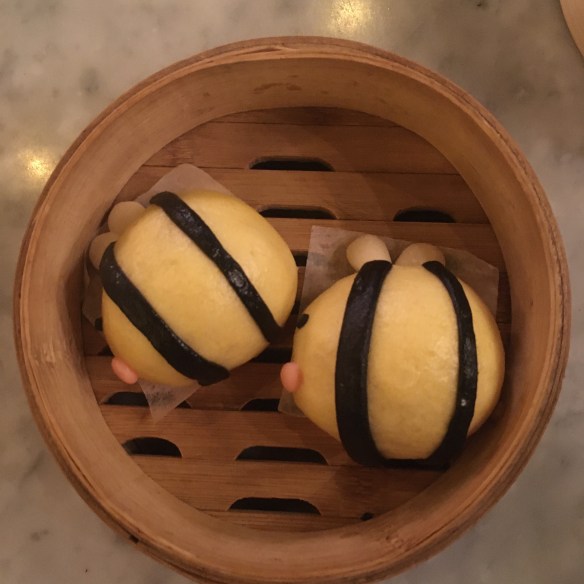
bee bao

NaBloPoMo 2019

When you’re working through a challenge, who helps you?  What is it about them, how are they most helpful?  How not?

Through the years I have learned what I can get from certain people.  I know to call this person when I need validation, that person when I need a devil’s advocate.  I also know which people to avoid altogether—those who cannot be trusted with my vulnerability or confidence.

But when I need to hold space and tension with an issue, to patiently look at it from different angles and process the perspectives, I look to my peer coaches.  I feel gratitude and gladness for these friends today, after my LOH group had our monthly peer coaching call.  As we progress through our 10 month leadership training, we take tenets and skills home from each retreat to practice.  Monthly Zoom calls have no agenda, other than to reconvene, share, and mutually support.  Every time I come away appreciating just a little more how nothing in life—work, personal things, social context—can really be separated from anything else.

These friends are not my first or only coaches, however.  In 2005 I started working with Christine, my life coach.  Every session, 14 years later, is still transformative.  How is this possible?  Curiosity.  Christine coaches every call squarely and unwaveringly from this perspective.  It was not long before I realized how powerfully this method could alter my own encounters with patients.

10-22-19-2

The best coaches have no preformed or decisive answers.  They have the uncanny ability to ask the best questions–Open, Honest Questions (OHQs)–which then lead clients to their own best answers.  They help frame and reframe problems.  They point us to alternate perspectives and help us open our minds to narratives other than the ones we too often grip so desperately.  It was my second year in practice when I started asking coaching questions to patients, and I have never since feared any symptom, syndrome, or answer.  When there is no clear diagnosis or answer for someone’s distress, I can just keep asking until something helpful emerges.  Most often it’s not a single piece of information that gives clarity; rather, it’s the story that materializes.  Coaching skills help me help my patients find and tell their stories of health and wellness, illness and pain, agency and action.

Here are the tenets of true Open, Honest Questions, from the LOH syllabus:

  • The best single mark of an honest, open question is that the questioner does not know the answer and is not leading toward a particular answer.
  • Ask questions aimed at helping the other person come to a deeper understanding (help them access their own inner teacher).
  • Ask questions that are brief and to the point without adding background considerations and rationale—which make a question into a speech.
  • Ask questions that go to the person as well as the problem or story—for example, questions about feelings as well as about facts.
  • Trust your intuition in asking questions. Inviting metaphors or images can open feelings, new lines of thinking, and unexpected possibilities.
  • Try to avoid questions with yes-no, right-wrong answers.
  • Avoid advice disguised as questions.

My best friends are my peer coaches.  And now I have my LOH cohort-mates.  We make no judgments about one another’s circumstances, feelings, or experiences.  We make the most generous assumptions about our motives.  Our role in each other’s lives is almost never to give advice; rather it is to hold space, listen reflectively, offer moral support, hold up core values, and help one another query thoughtfully and honestly.

IMG_1918

Questions asked and reflective statements made on the call today:

  • If you left work tomorrow with enough money to be unemployed for 6 months, what would you do?
  • How does it feel to speak (your issue) out loud?
  • When you think about current state compared to past, how does it feel physically in your body?
  • Sounds like you’re working on a core tension.
  • What do I/you want now?
  • What’s roiling around in you?
  • Who around you can get creative with you?

We each bring diverse questions and challenges to each call.  But somehow we always relate deeply, and listening/querying helps us each learn from every other.  Today I saw central themes emerge around identity, contribution, voice, and meaning.

In the end, I think there are few things more important in life than meaning and connection.  These are the gifts from my peer coaches, and they always make me better, no question.

IMG_2645