Some time ago a high school classmate suggested on Facebook that we all post daily gratitude for the month of November. Many of us participated, and I liked it. The first year of this blog, I did “November Gratitude Shorts” for 30 days, my first NaBloPoMo. In 2019 I wrote a thank you message a day for the whole year, whether by hand, email, or in some other medium. It was meditative and grounding.
In this month of recording my most heartfelt adulting skills for mindfulness and posterity, how has it taken me this long to write about gratitude? I noticed the deficit about a week ago. Maybe it seems trite? I mean in November, blog about gratitude, meh. It’s not that I don’t feel it. I do feel it, deeply, every day. And it holds me up.
I come down the stairs in the morning, in this house we bought just before Daughter was born. It’s where the kids have grown up. It’s messy and wonderful, I love it, and I pinch myself that I get to live here. I go home to my parents’ house, where I grew up. That Ma and Ba are healthy and living a happy, connected life fills me with pride and joy. We all go to the mountains, a place of meaning and memory for all three generations now. We have roofs over our heads, food in the fridges and pantries, funds to travel, and places to go where people love and welcome us—how could we feel anything but deep gratitude? *sigh*
Friends. Extended family. Education. Nature. Technology. Work. Science. Art. Music. So much, so much.
Ya. Much to be grateful for, today and all days… Even—maybe especially—in crisis…
My prayer: May this feeling, this deep knowing of wholeness and connection in thanks, live at the front of consciousness for us all, holding hands with love, leading us always toward one another.
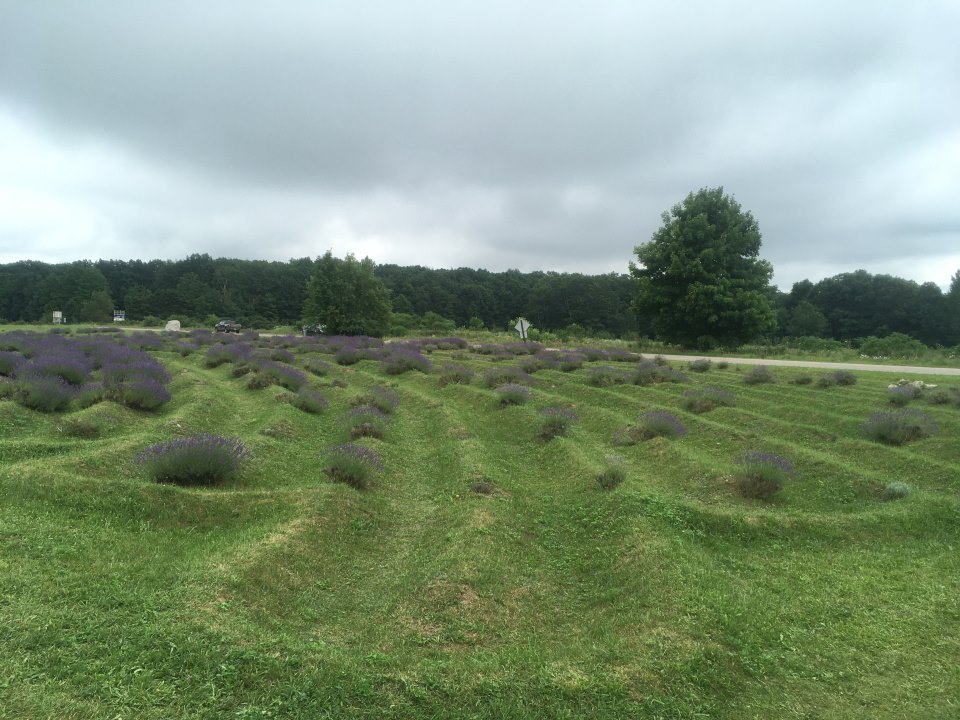
The lavender labyrinth at Cherry Point Farm and Market, Shelby, MI
NaBloPoMo 2021: Do Good, Kid
“You don’t have to decide right now.”
These words usually cause me relief. Maybe because I’m a procrastinator at heart? And maybe because I just don’t like to be rushed into things, and for sure I do not like to be told what to do, no sir. I will make up my mind when I am damn well good and ready, thank you very much. Yes, that’s definitely part of it.
But for many people, putting off decisions (or actions) incites anxiety, no? Maybe you need a plan, and to feel secure that you know what will happen, where you’re heading? I think this comes up a lot in medicine, when doctors and patients share decisions on plan of care. Cancer screening and diagnostic testing protocols seem cookbook on the surface, but in order to make the best decisions for individuals in a large, complex system, we often need to think harder about what to do and when.
In the Knowledge Project podcast episode with Bill Ackman, he considers the utility of putting off decisions. Just because you can make a decision now, does not mean you should. Instead, assess and decide when you will need to make the decision. The question to ask here, he says, is, “When will the risk picture change, and how?” Basically, how much time from now until it’s do or die? What factors should I monitor, and what are/will be my options now, compared to then?
What will we do with the information from any given diagnostic test? What are the possible/likely results, and how reliable will they be? Which results will answer our most important questions (what are those questions, anyway? What are our primary goals?), and which will provoke more questions, thus complicating the picture for no benefit? Screening and diagnostic tests are one way doors—once done, they cannot be undone. The information revealed, reliable or not, actionable or not, is now forever discoverable and requiring explanation. Many a wild goose chase are instigated based on benign, irrelevant, incidental findings from unwarranted and excess testing (my opinion). My minimalist bias stems from a deep aversion to wasting resources—time, energy, and access as importantly as dollars. In our quest for certainty, sometimes we get exactly the opposite.
That said, the suites of risk that matter most to you, me, or anyone else are both unique and overlapping, no? Their weight and prioritization evolve in constant fluidity over time, and non-linearly, which I think we don’t attend to enough. At the end of many elderly folks’ lives, they prioritize independence and quality of daily life now. But their loved ones may prioritize safety now and longevity later. Grandma may be willing to sacrifice months or years lived for staying in her house, and she might also change her mind multiple times before the actual end of life. She may have a very different framework for deciding when/what/how to do things, compared to Son and Daughter-in-law. You may be completely willing to risk finding colon cancer at a later, less treat/curable stage, because the intrinsic costs of the prep, sedation, or whatever else about the test are just that high for you. Or you may be willing to have multiple breast biopsies, risking pain, bleeding, infection, scarring, and increasing likelihood of future abnormal mammogram findings, just so you can be assured every year that you do not have breast cancer now.
As loving family members and conscientious healthcare teams, we must always negotiate for optimal outcomes, subjective as well as objective. May we all approach ourselves and one another in respect, peace, love, and mutual support, and hold space when and where appropriate.

 Healing Through Connection