
Ya kinda had to be there, my friends.
And it was all my friends who came to my first ever wellness presentation at Ethos today. For two easy and loving hours ten of us engaged in openness, curiosity, reflection, thought, and connection. After outlining the general themes and objectives of my past wellness presentations, General Manager Elena landed on ‘self-efficacy’ as the all-encompassing concept when we discussed our plans earlier this year. It felt immediately right. This was to be the first of four sessions throughout the year.
Self-efficacy: “an individual’s belief in their capacity to act in the ways necessary to reach specific goals.” (Bandura, 1977, 1986, 1997)
I have presented to academic surgeons on national stages and judges of the Federal Circuit Courts. Still, speaking to the Ethos community made me a little nervous. There would be fitness experts in the audience–what could I ‘teach’ them on the topic of exercise? This was a new and potentially very diverse group; one that did not necessarily know my credentials or professional expertise. My highest goal was for all of us to leave the session feeling inspired, empowered, connected, and thought-provoked. My intent was not to simply lecture or convey, rather to offer, invite, and receive in fluid exchange and mutual engagement. I had to give msyelf pep talks all week, calling forth my confidence in attuning, listening, asking good questions, reflecting, paraphrasing, as well as presenting.
What a real-time practice in self-efficacy, no? Walk the Talk, Chenger!

I planned today to introduce my ‘5-3-5’ framework of health: 5 domains, 3 core practices, and 5 atrributes. It’s a work in progress, which makes it a fun and high-potential foundation for discussion with any audience. After sharing our respective thoughts and experiences of self-efficacy, we explored how it applies in health and wellness.

“What are important domains of health?” I have written about ‘the five domains of health’–sleep, exercise, nutrition, stress management, and relationships–on patient action plans and this blog for many years. It’s relevant, reliable, and comprehensive for the purposes of an annual physical exam. But I wanted to learn from this audience how they see ‘domains of health’ in life as we live it. The brainstorm and discussion that ensued showed us all how layers of complexity and interconnected relationships at both individual and collective levels impact our experiences of both health and un-health.

Self-awareness, self-regulation, and effective communication: in my mind, these are the three core life practices that help us assess, adjust, and adapt to whatever life brings. The group’s suggestions of key health practices, we could argue, could all fit under one or more of the three. And it also emerged today that there may be a missing element of movement–that to be healthy we must not only attune inwardly, but act–we must both be and do–or not–there’s something here about intention and volition, about agency, I think. I invited. My friends offered. We noodled, played, exchanged, and documented. And now I have so much more to mush around with, to dig into and mine for treasures!
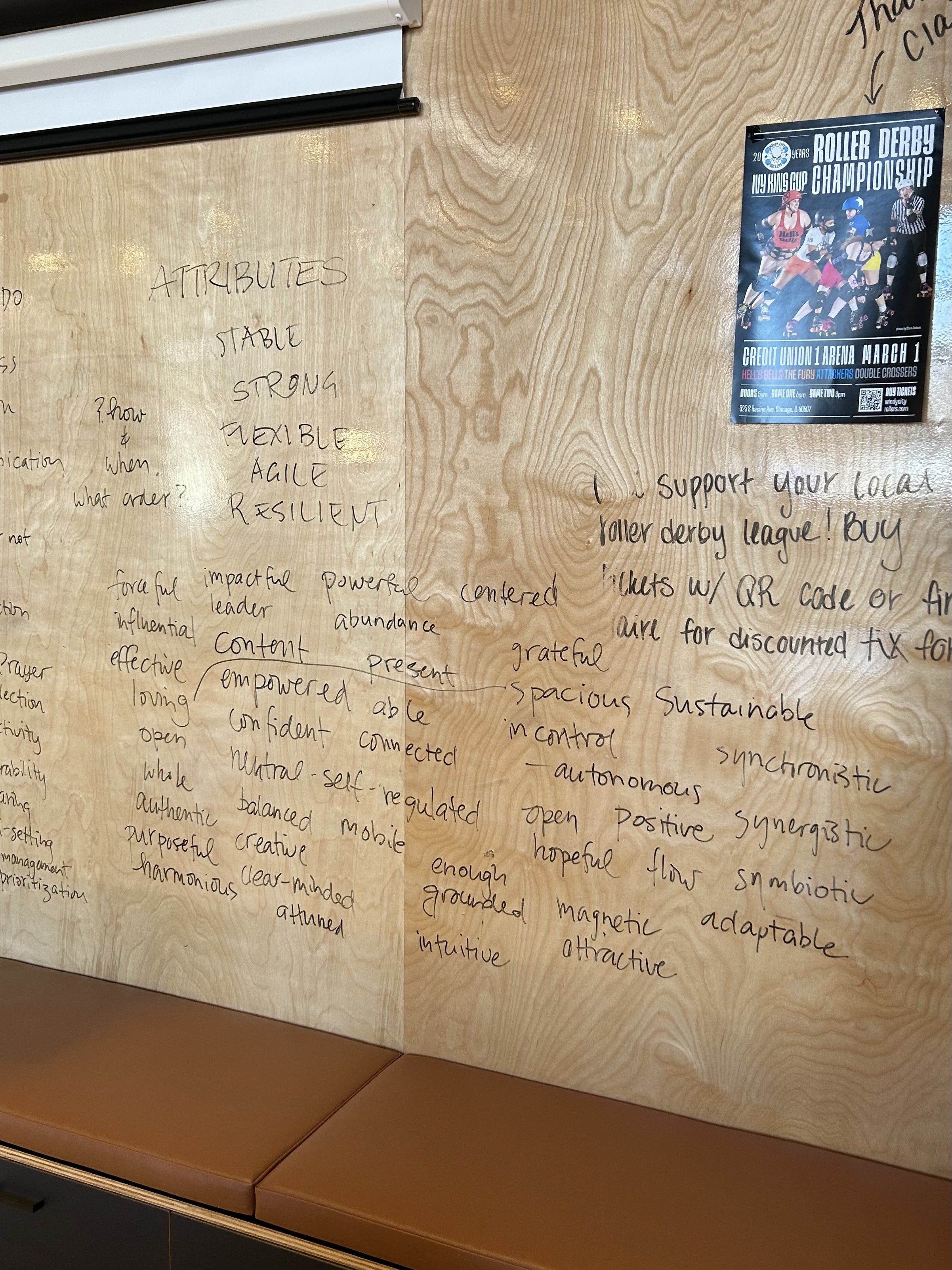
“When I am healthy, I feel…”
By now folks had caught on. I ask the open-ended question, record the responses, and when one of my own words comes up, I write it under the heading. Brother-in-law Kinnier compared the process to playing Family Feud and we all laughed. When I think of how I want us to feel in health–in body, mind, spirit, work, and relationship–these five words top my list today: Stable. Strong. Flexible. Agile. Resilient. The words my friends offered in this section represent sensations, emotions, and states of being, among other things. What words would you add? How besides words would you express/explain what it means to you to be healthy?
When I look at the ‘after’ state of the board (I did not take a picture of the whole due to glare, but I wish now that I had), I feel so gratified. I successfully offered my framework for health, developed organically and in collaboration with patients, colleagues, friends, and fellow life journeyers over decades of medical practice and living. We agreed at the end that next time we can include non-verbal expressions such as emojis, diagrams, symbols, and pictograms, to further deepen our exchange and discourse on these ideas.
*sigh*
The openness, curiosity, safety, warmth, connection, and love I felt today, friends. Ohmygoodness. I had to encourage myself in advance, reassure myself that I had what was needed to lead a discussion, to facilitate this opening, and invite and allow all of our wisdom to emerge and mingle. The energy in the Den vibrated today. It had a temperature, a depth. We all both contributed and benefited (I think), offered and received. The outcome felt elevated and synergistic–immensely greater than the sum of its individual parts.
This presentation series is part of my project to broaden my reach, to expand my contribution in health and wellness to more audiences, and to facilitate engagement, empowerment, and agency for individuals and organizations. Elena and I had orginally planned four quarterly sessions this year. Today’s session lasted thirty minutes longer than scheduled, and many of us wanted to keep the energy flowing, to continue the conversation sooner than three months from now, as we looked at the ‘after’ state of the board and saw so much possibility for future conversations!
YES. THIS. This is what I live for, my friends!
I write this summary so those who could not attend today might get a feel for what it was like. But I could only capture here a fraction of just my own experience. There is just something about a gathering, an intentional meeting when and where we choose to spend (give?) our time, energy, and resources together in service of lifting ourselves and one another.
There are simply not enough words to express my gratitude and appreciation for my friends who showed up today. Their unwavering presence and love made it safe for me to be BOOBS OUT, all me, all in, open and honest, curious and confident. We agreed today to all go home and let it sink in, to saturate in the connection, and see/feel what emerges that calls us to gather and commune around next time.
I. cannot. wait. Hope to see you there!


 Healing Through Connection