A Joyous and Synergistic Convergence

Screenshot

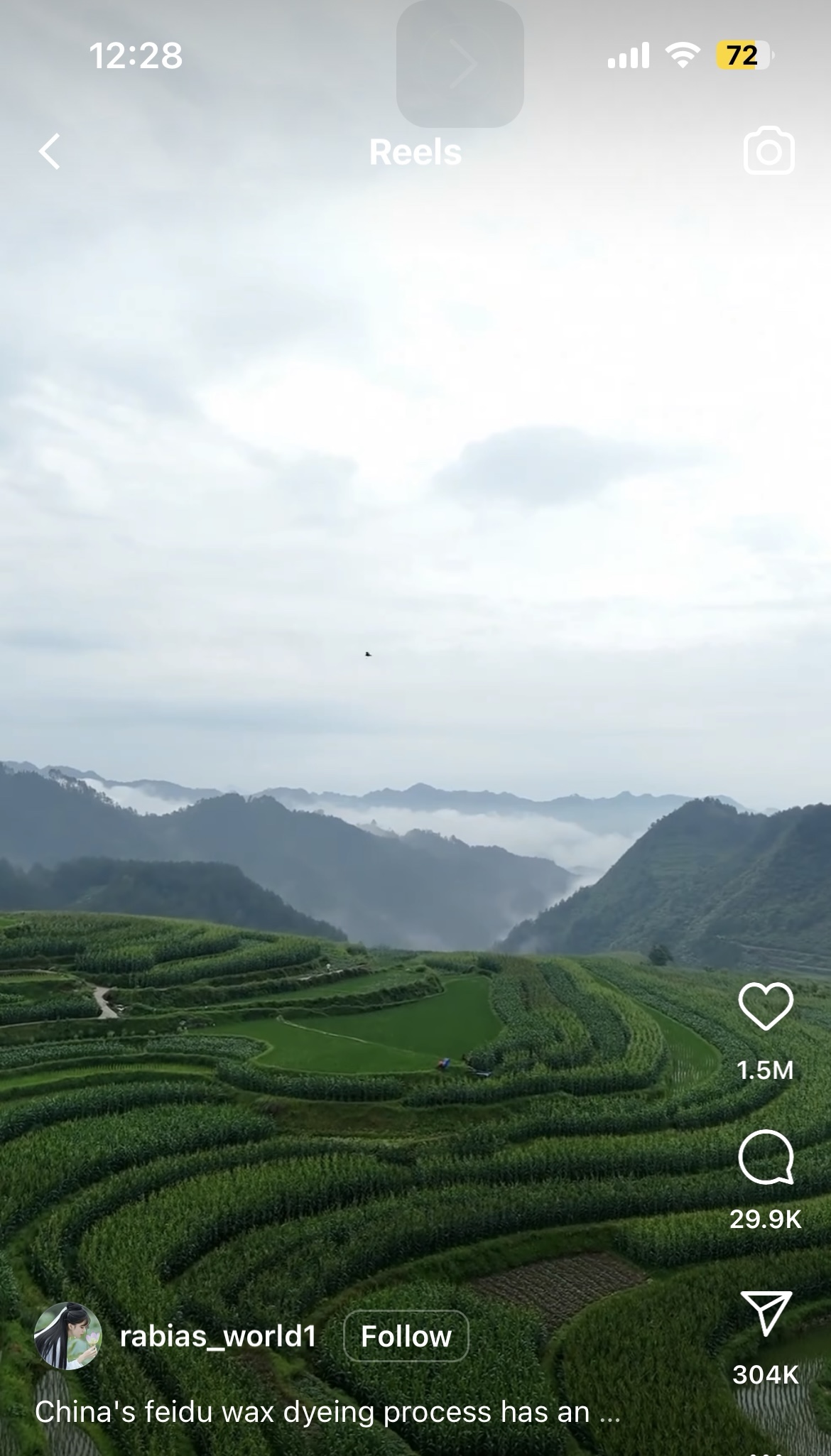
Sometimes I come across something that simply overtakes my senses, moving me to giddy stillness and awe. Today it was this video on Instagram, showing a lone woman demonstrating a traditional wax resist dyeing technique. It was unusually long for an Insta video, and mesmerized me for the entirety. I sent it to multiple people with the message, “Friends–the art, and the FITNESS!”

With a serene and joyful expression throughout, the woman squats to harvest two large baskets of leaves from the ground. She hoists the baskets connected with a bamboo pole onto her shoulder and transports them on foot. After transferring them to large vats to soak, she dead lifts large rocks to weigh them down in the water to make fabric dye. I realize this may not be how it’s really done–a single person doing all of this work. Still, the functional movements here strike me. Modern urban life has relegated us to sit for hours at desks deep indoors, and the most we may ever do is walk a few feet at a time, unless we formally train or travel. Putting my carry-on in the overhead bin approximates a dead lift, lat pull, and shoulder press in series, and that is nothing compared to what these artisans do in their daily lives.

We know how physical activity benefits the body–thickening brain networks required for neuromuscular coordination, sustaining clear cognition with age, and maintaining cardiovascular, muscular, and bone strength and resilience. And to do it outside–with this view every day–imagine how this feels, body, mind, and soul! Watch the whole video–can you not sense the energy of it move something deep within you? What does it inspire?

Screenshot
Screenshot
Screenshot

Imagine the patience it takes to be a maker like this–any artists reading this must be rolling their eyes, duh. While the dye ferments, she draws the entire phoenix pattern and applies wax by hand with fine implements. It reminds me of the parable of two cathedral bricklayers, one who resents the back breaking work because he focuses on what is, and the other who relishes it by imagining what could and will be. Once again I marvel at the dedication, perseverance, and commitment shown in this woman’s painstaking work.

Screenshot
Screenshot
Screensho
Screenshot

How motivating, when you start to see your creation emerge in its intended form? These days we are spoiled by instant gratification of digital photos on our phones, carried in our pockets and available in seconds. Remember film cameras? To take 24 photos, retract the entire roll, submit it for development, and not know for weeks whether any turned out the way we wanted, with no chance to repeat the shots… that wires our brains differently. How can we train for this kind of delayed and enhanced gratification in modern life? We appreciate and value of things more the harder we work to acquire or acheive them; we take less for granted. And that makes us humble, generous, and slower to dismiss. We live deeper lives, I think, and this video reminds me.

Screenshot
Screenshot

Consider how far most of our daily lives occur from nature. Imagine if your work required you to step into white waters, hang onto your creation lest the river sweep it away, and work in collaboration with the earth to bring forth your art for the world? When our creations depend on the natural environment, it broadens our perspective, teaches us how little we control. How humbling and also inspiring, to participate with nature in making something new?

Screenshot
Screenshot

This video ignites something strong for me–at once cognitive, limbic, and visceral. Epic vistas, resonant music, and a lone human both lifting heavy loads and creating grand art all conspire to incite a deep sense of awe and appreciation for all that we are capable of–Earth and humans alike. It feels like a simultaneous dopamine and serotonin hit, moving me to share immediately with friends, thus also giving me that surge of oxytocin I so live for.

Screenshot

The woman in the video does everything apparently alone. But we know this production required a team in community, from the planters of the field to pavers of the path, to makers of tools and appliances, to filmmakers. Let us all remember that as much as we may think and feel we operate independently from others, this is rarely the case. Nature always interacts, always intersects, overlaps, merges, and moves in both confluence and opposition. Life is a dance of it all. How literally and figuratively moving!

As we enter autumn, the season of exhalation and shedding of layers, preparing for contraction and rest, let us draw near to that which nourishes us, body, mind, and spirit. This includes art, fitness, and connection in all forms.

Wishing all in the US a happy long holiday weekend! Thank you, friends, for continuing on this journey of discovery and reflection with me all this time.

Screenshot

Many thanks and much love to friend Kasey McKenney for helping me think through the turning of seasons from a Traditional Chinese Medicine perspective.

Uninhibited

I effuse.

Anyone who knows me will tell you so. They will describe my facial expressions, gesticulations, profanity, and hyperbole. I feel strongly and express accordingly. I posted yesterday about how it’s all elevated and amplified (though still regulated) recently: I hug stronger and longer. I praise freely. I call people ‘love’ with accelerating frequency. And I talk about love, sex, and relationships a lot more. I attribute much of this to my now two year-old romance audio immersion.

American culture is such a paradox. At the same time that we hypersexualize both men’s and women’s bodies from a young age, we also harbor a collective and insidious Puritanical streak that shames sexuality in general, and for women in particular. I thought I had overcome the latter years ago. But these two years of spicy romance consumption have shown me my blind spots, for which I am eternally grateful.

Early in my career I met a woman patient who was very open about her sex practices. She had both male and female partners, sometimes multiple at a time. I can’t remember whether her practices were protected or not, but she had no active sexually transmitted infections while I knew her. Looking back, I’m sure my words centered around health risks and relationship safety. But if I’m honest, I judged her. I was young in career and life and could not relate to her behaviors and practices. I am sure she felt my negative moral vibrations, and I regret that to this day. Somewhere along the way I let go that judgment and have since made intentional efforts to make it safe for patients to tell me anything. As long as it’s consensual, lucid, and mutually satisfying, I want you to do whatever you want and enjoy your sex life as fully as possible! There is no standard, and my wish is for all partners to feel maximally fulfilled.

Romance novels have opened my eyes to diverse practices and experiences that I did not know to consider before: polyamorous, dominant-submissive, and asexual, among others, and all of the social, emotional, and relational implications thereof. I have shared my transformations of awareness and openness with patients and friends, and the response has been overwhelmingly positive. Both men and women get curious and then share their own experiences–desires, inhibitions, disconnects, accommodations, sacrificies, epiphanies/discoveries, etc. These days I talk even more openly than before and with anybody about libido, erectile (dys)function, emotional and carnal connection and their intersection, menopause, penile implants, and anything else that matters to someone’s sexual health. I thought I was uninhibited before and Whoa Nelly, watch me now. Based on conversations with fellow spicy romance enthusiasts, my experience is anything but unique.

Romance narrator Victoria Connolly addresses American purity culture, growing up in and now healing from it. She has invited listeners to share their stories; the voluminous response reveals the prevelance of experience and the value of acknowledging and naming it. See her Instagram post and comments c. August 12, 2024: “‘It wasn’t until I started reading primarily spicy romance that I finally got fed up/brave enough to ask him if it’d be okay if I touched myself or used a vibrator during sex because I’d like to come too.’ | If your story sounds like this, you’re in the right place. | Just share the book in the comments that rewired you forever. The one that made you believe you deserved pleasure.”

I mentioned the Quinn app in my recent Women Elevating Women post. Quinn describes itself as “a mobile app and website where you can listen to audio erotica… spicy audio stories, guided masturbation, dirty talk, and more. The audios on Quinn are designed to help you get there, but they also involve fun and interesting plots.” The New York Times reports, “Apps like Dipsea and Quinn have become popular destinations, particularly for some women who find them safe spaces to explore their sexuality.” Hallelujah!
Readers of this blog know my deep admiration for romance narrator Shane East and his strong allyship of women. His second ever Quinn audio dropped two days ago and has already been played more than 3500 times. Asked, “What inspired the move to create on Quinn?” he answered, “[Quinn] came to me after hearing my work. After discussing things with them and checking things out on the site, seeing what I would like to put out there and gathering a script and audio crew to help me do that, I decided to go for it. I’m all for anything that enables women to own their sexuality without the judgment or shame that can be handed out by others. I’m here of course for everyone being free to own their sexuality and desires in a judgment free, safe and accepting way; however and with whomever they like. Speaking of women specifically though, historically they have been repressed by societal restraints and patriarchal ideology for so long that I think it’s wonderful to be part of something — be that romance books or something like Quinn— that utterly goes against that and gives women (in particular) ownership of what they want. I think it’s fantastic to have the[m] out there.”

*sigh*

This is all such a good thing, all of us embracing our whole, wonderful, beautiful, sexually awake and aware selves–every person of any gender, both individually and in community. Life is simply too short to repress such important and fundamental aspects of identity and connection. Fiction in general and romance in particular help us receive perspectives (as opposed to taking them, as David Brooks writes) other than and different from our own, and empathize with the full scope of human emotional and relational experience.

Inhibitions are not empirically harmful. Restraints can serve us sometimes. And when they outlive their usefulness, shedding them elevates us, frees our spirit, and allows our whole selves to emerge in full glory and actualization. I hope this evolution of collective openness continues. The more we can eliminate shame and empower everyone to own their sexuality, foster deep and meaningful connections fully in mind, body, and spirit, and simply embrace all that makes us our whole human selves, the better all of our lives will be.

Questions for Connection

What excellent question have you asked or been asked lately? How did it affect your relationship with the person asked/asking?

Ever since I started working with my life coach in 2005, I have practiced asking more and better questions in any encounter, in all life domains. The returns on this investment of presence and curiosity–idea generation, heightened conversation, and deepening connection, among others–far outweigh the costs of occasional awkward pauses and uncomfortable deflection.

I wonder, however, if I give enough time or energy to answering the interesting quesitons I ask?

Why, for instance, do I behave so differently with people in and out of my family? I feel like the same person in both contexts, and everybody knows the same me; yet I know I show up not the same at home as outside. Fascinating.

Today was Day 190 of my morning pages practice. Looking back, much of the journaling consists of lists, plans, recollections, and reflections. The same questions arise recurrently, mostly centered around behavior and relationships, and I attempt to answer overtly about half the time. Also fascinating! I feel comfortable with this state of things, as the simple act of writing them down and letting them sit on and below my consciousness day to day allows me to consider them slowly. Persistent questions point me to my core values, purpose, and goals. I feel no rush to formally answer these existential, identity-related, philosophical inquiries. I tell the story that simply marking their re/o-ccurrence pins them to some level of awareness where I can return regularly, like periodically adding brushstrokes to paintings that live in various rooms of my mind, heart, and life, when I happen to walk by. These rooms are bright and airy, each equipped with a sturdy easel, thick canvas, rich color palette, and full set of implements to create and revise, ad lib. I feel calm and focused, reassured that whatever is happening on any given day, I have time and energy set aside to process and digest, coming to clarity organically and as needed, all in good time. My morning pages facilitate insights and understanding regularly, and I see this practice sticking for the foreseeable future.

What I really relish, however, is engaging in questions, exploration, and discussion with other people! I wonder if this is how I make friends, actually? It does not matter if I just met you or I’ve known you my whole life; if you’re willing to dive with me like humanities nerds in a submersible to plumb the depths of open and honest questions and wild ideas of possibility–about anything from language to muscle physiology, human nature to politics, phylogeny to music–I might soon profess my undying love for you and chase you for more of that energizing connection. It is most often with friends, in those small, relaxed, meandering, sometimes calorie-laden gatherings, where nascent and novel answers to delightful questions so beautifully emerge and bloom. I carry my journal everywhere, to capture these pearls when they drop, as though gifts from the gods of sentience and relationship.

People crave deeper connection desperately now, in our increasingly chaotic, impersonal, and globalized world. I see references to the 2015 New York Times article “36 Questions That Lead to Love” regularly (that’s probably the algorithm, right?). If you cannot access it, see the original research article by Arthur Aron et al, “The Experimental Generation of Interpersonal Closeness: A Procedure and Some Preliminary Findings” with the questions listed at the end. Organized into three sets of increasing intimacy, the exercise invites us to ask our conversation partners questions such as, “What would constitute a perfect day for you?” “What is your most treasured memory?” and, “Complete this sentence: ‘I wish I had someone with whom I could share …'” From NYT: “The idea is that mutual vulnerability fosters closeness. To quote the study’s authors, ‘One key pattern associated with the development of a close relationship among peers is sustained, escalating, reciprocal, personal self-disclosure.’ Allowing oneself to be vulnerable with another person can be exceedingly difficult, so this exercise forces the issue.” I have the article bookmarked on my phone, and have yet to invite anyone to answer with me–maybe I’ll set an intention to do so on my upcoming friend dates? Part of me thinks I’m doing fine connecting on my own, and you never know, this could be truly next level.

Renowned psychologist Esther Perel created a similar game in 2021, Where Should We Begin, now in its 2nd edition. This query is how she historically initiates therapy sessions with clients. Questions in the game include, “I can’t believe I got away with…” “My latest crush is…” and, “My favorite love story to tell…” The box includes questions that range from lighthearted to serious, to sexual and beyond, which positively tickles me–because it’s all just life. In this age of polarization and easy mutual disdain and disconnection, games like this can help us all recognize our shared humanity.

I have purchased yet a different box of questions for connection, How Deep Will You Go? Its creators describe it as “a game of deep conversation without worrying what to ask, to feel closer in a way you never felt before.” Three levels of questions are labeled Ice Breakers (“What motivates you in life?”), Confessions (“Why have you kept going?”), and Getting Deep (“What is something you don’t tell most people?”). Reading the cards, I imagine with whom I’d want to delve. It depends on the question(s), of course, and also context and mood. I can picture a small friend group setting for the playful ones, and core belief/value ones as actual ice breakers for purposeful group work, such as a Braver Angels workshop. For the more intimate questions, though, I picture a one on one meeting, with plenty of preface and mutual agreement to actively engage in deepening personal connection.

Of course, interpersonal closeness is an iterative process: Other than the most superficial queries, the willingness to ‘go deeper’ requires some level of established trust and safety. That can take a while, depending on a multitude of factors. But once that foundational rapport is achieved, subsequent connection facilitated by these questions, one by one, may unfurl like the slow and steady inflation of a hot air balloon from the ground, lifting us gently together to affinity and affection we could never achieve where we started.

Connection decks like Where Should We Begin and How Deep Will You Go? make me so optimistic. I have loved and tried to ask questions like this for years, and now I feel validated. What if we all opened up to one another just a little bit more, just a little more often? What if we held one another’s hopes, joys, struggles, regrets, dreams, and confidences with a little more respect and reverence? What if we approached one another, friends and strangers alike, with the assumption of caring and mutual well wishes, looking to hold one another up, rather than with suspicion and wariness? And what if we rewarded such unearned generosity of spirit with reciprocal kindness?

The practice of mindfully asking deeper, more personal, loving, and intimate questions could go a long way to bridging our seemingly insurmountable differences; we all need this right now. It’s not appropriate in every encounter, of course. We must attune to context and opportunity, and act (ask) with confidence and humility. And that’s also the point, isn’t it?

The more present we are to one another’s vibrations, our moods and energies, the more likely we are to connect in earnest, regardless of what questions we choose to ask or not.

Understanding, validation, belonging, closeness, intimacy–we humans thrive when we feel these often and deeply. I still have hope that we can do it better.