#AtoZChallenge: Applying Zen And Zeal

IMG_4473

Here we are, friends, the sprint to the end!! If I get this up by midnight that will be 5 posts in 2 days, a personal record!  I shall carry that pride for a while yet.  Many thanks to all who have visited from the A to Z Challenge this month, to all those who supported me through it, to the regular readers, and to the writers whose work I have had the distinct pleasure of reading.  We made it!!  And now, the last…

Webster’s Ninth New Collegiate Dictionary, again:

Zen:  a Japanese sect of Mahayana Buddhism that aims at enlightenment by direct intuition through meditation. [On this last post I interject my own connotation for this word, as synonymous with peacefulness and thoughtful serenity.]

Zeal:  eagerness and ardent interest in pursuit of something: fervor, syn(onym) see passion.

Today listening again (still) to Amy Cuddy’s book, Presence, I learned a new relationship between cortisol and testosterone, in terms of power and behavior.  Cortisol rises under threat, when we feel powerless.  Testosterone rises when we feel confident and powerful.  But they are not mutually exclusive, and just like meaning and stress, they can coexist in variable amounts.  By Applying Zen and Zeal, I mean to describe what it looks and feels like when we think and act in the combined state—a low cortisol, high testosterone milieu:  Confident, strong, calm, powerful, and proactive.

One more time, through the alphabet:

Attitude.  Peaceful passion.  Confidently Aspiring to higher goals.

Behavior.  Measured, less impulsive.  Intentional, purposeful.

Conduct.  Consistent.  Steady.  Forthright.

Demeanor.  Welcoming, friendly.  Inviting.  Quietly exuding a mission.

Effect.  Inspiring.  Aspiring.  Cohesive, motivating.

Focus.  Clear, directed, sharp.

Goals.  Meaningful, worthy.

Happiness.  Derived from within, determined by Honoring core values.

Influence.  Stirring, benevolent, collaborative.

Judgment.  Wise, responsible.

Kinship.  With all of humanity, transcending skin color, ideology, rhetoric.

Lessons.  Lifelong Learning in humility, applied with grace and gratitude.

Mantras.  Expressive, centering, grounding.  Ideas to foster engagement with the world.

Narrative.  Analytical, honest, ongoing.

Objective.  Peace in action.

Pursuit.  Integrity, fairness, equality.

Query.  Self-awareness, withholding judgment, telling new stories.

Rest.  Respected, taken in intervals.  Recharging, never slothful.

Strength.  When collaborating with others—Synergistic.

Timbre.  Deep.  Resonant.  Moving.

Universe.  Vast, inclusive, mystical.

Vibration.  Stimulating.  Multi-synchronous.

Wealth.  Deep connection.

Xanadu.  World peace.

Yield.  World peace.

Zenith.  World peace.


Peace to all.
#AtoZChallenge: Xerophyte People

Webster’s Ninth New Collegiate Dictionary

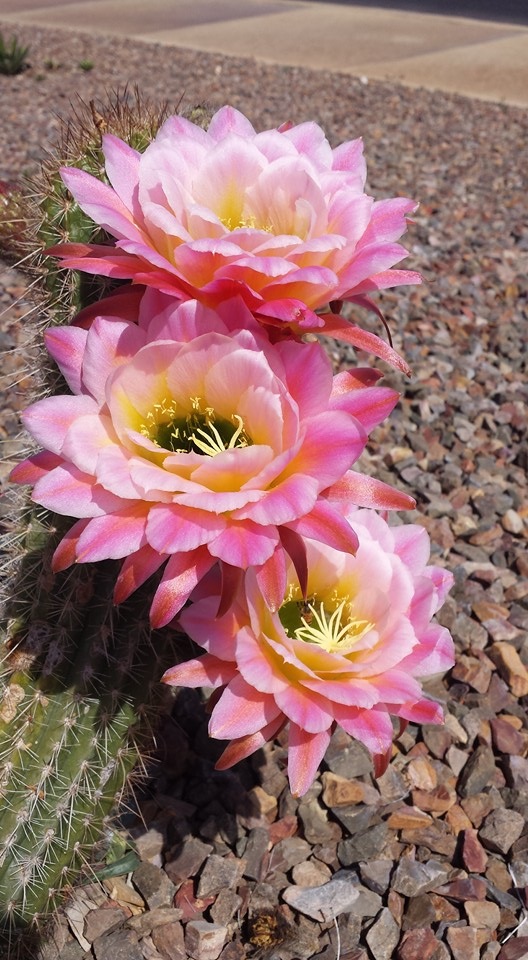
Xerophyte: a plant structurally adapted for life and growth with a limited water supply esp. by means of mechanisms that limit transpiration or that provide for the storage of water.

AC cactus 2016

Photo courtesy of Cyndie Abbott, Green Valley, Arizona, 2016


Water is essential for growth and survival—of plants and animals alike. So how is it that some plants can not only survive, but thrive and even reproduce, with so little water?  On top of that, they also provide beauty, habitation, and even sustenance for others.  Their short-lived flowers splash color onto monochromatic landscapes.  Regional animals are adapted to live nestled among some xerophytes’ barbs.  Survival programs tell us to seek these plants as a source of essential hydration when stranded in the dessert.

Humans share many of these tough flora’s adaptive qualities. We evolved as omnivores, able to eat most things that grow in nature.  Our big forebrains allowed us to cultivate plants to eat.  We learned to capture, then herd, animals for our own use.  We have come so far as to alter and control our environments, in order to live in places where nature may never have intended.

But the more interesting parallel between xerophyte plants and Xerophyte People is resilience.  If we consider metaphorical water for human life, many things come to mind: joy, security, connection, purpose, meaning, love.  Think of all the people who live with little or none of these things.  Think of those who once had these things, and then had them forcibly taken away, often indefinitely—by war, abuse, illness, death.  In medicine, we witness this kind of suffering regularly.  Our hearts break alongside those of our patients and their families.  But it’s not always forever.  In primary care, where I have the privilege of knowing patients over long periods, I have also celebrated remarkable reversals.  New relationships, revelations, births, treatment innovations—you never know what will happen to turn the tide.

So what keeps us hanging on? Like plants, maybe we figure out ways to prevent further loss—limit transpiration.  Thick skin and prickly spines keep us protected.  Only the very persistent or the specially equipped can penetrate our defenses.  But more important, we have adapted to store what we need.  Even if we cannot readily identify or articulate it, something keeps us going.  Maybe it’s hope, remembrance, or some core value or aspiration we have yet to realize—some inner pilot light that never goes out.  Some might call it the human spirit.  Whatever it is, I stand in reverence of its mystery, its utterly saving presence.

To all the Xerophyte People in our world, I say as Glennon Doyle Melton does:  Carry On, Warriors.

IMG_1680.JPG

Tent Rocks National Monument, New Mexico, June 2015

#AtoZChallenge: Withhold Judgment

403532_3541039079225_1032738700_n

My brain is so tired. All month I have racked it trying to figure out what to write next, how to render it most authentically, and finally get it out looking close enough to how I intended.  On top of that, I have also engaged in multiple exchanges on Facebook around gender identity, public restroom use, vaccine rationale, and presidential politics.  It really has been shang nao jin, as we say in Chinese—literally wounding the mind.  I realize these are all activities that I choose, and none of them have significant bearing on the world at large.  And, I would do it all again.  My mental exhaustion is the hurt-so-good kind, like the muscle soreness after a particularly strenuous workout, when I know I have pushed myself to my limit and maybe extended it a little.  The writing and conversations are ways that I engage with my world and practice what I preach—open-mindedness, curiosity, and cultivating connection.

After all of this exploration, conversation, debate, research, and observation, once again I conclude that one of the most important practices for inner peace is to Withhold Judgment. Not all judgment, and not indefinitely, but much and for a while.  Here are some illustrations from the past week:

I shared this post on my Facebook page on Saturday.  I agree with the author’s sentiments, basically that discrimination is wrong and we should open our minds and bathrooms to all people.  I also thought her writing was cogent and forceful.  One of my friends pointed out her name calling, as she labeled supporters of the North Carolina HB2 legislation, and people who boycott Target as a result, as hateful.  He then asserted that the left “can’t argue a point without calling people who disagree with them hateful,” or at least they choose not to. At once I see both sides generalizing in ways that preclude any possibility of meaningful mutual understanding.

After this I became more sensitive to name calling in articles I read. Even ones with relevant data and useful information can be tainted, as I found here, in which the writer calls bigots the same people that the previous author called hateful.  Why must we stereotype and label like this?  Is it just to get published, for attention?  Can we not convey our message just as effectively without all this vitriol?

Finally I read and shared this article, in which the author does not call anyone names directly, but writes a brilliant and searing piece of satire that also inflames and incites.  I suppose that is the point of satire, after all?  It was the comments on this last article that really drove home to me the perilous state of assumptions and judgment that drive many of our interactions these days.  If you support this law, you’re hateful.  If you oppose it, you’re irresponsible.  Perform one act that is, superficially, inconsistent with your professed beliefs, you are forever a hypocrite.  Commit one lapse in judgment and you are instantly unworthy of respect, now or in the future.  Snap judgments can degenerate our encounters to a series of sound bites of rhetoric and aggression.  They seriously inhibit, if not completely destroy, our connections, and they consign us to echo chambers of isolation.

The doctor who rushes me through my 15 minute appointment for a sinus infection, after making me wait 30 minutes already, is uncaring and just wants to make more money. Actually, she just spent the last 45 minutes telling her patient of 10 years that he has metastatic cancer and answering his questions, and she is anxious to get to her son’s school play tonight, his first lead role.

The woman who yells at the receptionist and makes a scene with the nurse is just another angry, entitled patient. Actually, her son was killed by a drunk driver last year, she lost her job and her home, and her mother is dying.

Fellow blogger and talented artist Jodi posted this beautiful piece today, including these words:

Skip the religion and politics,

head straight to the compassion.

everything else is a distraction.

— talib kweli

It really spoke to me, because compassion lives at the core of human connection. If we can remember compassion for one another more often, no matter our circumstances and state of mind otherwise, we can probably also remember to Withhold Judgment and listen for the rest of the other person’s story.  Listening more, yelling less, moving slower to the keyboard, showing up in person, asking more questions for understanding—these are the practices of Withholding Judgment.  Please, let us make the effort; it may save us all.