
The Jar of Smiles

Who doesn’t need a tiny love note once in a while?

The ‘jar of smiles’ idea came across my Instagram feed some months ago and, though it’s not new, this time it moved me instantly. I could buy a jar of notes online, or I could simply write my own! I have stacks of origami paper left over from past obsessions with the kids–perfect. And since I also save glass jars like a true hoarder, I was all set.
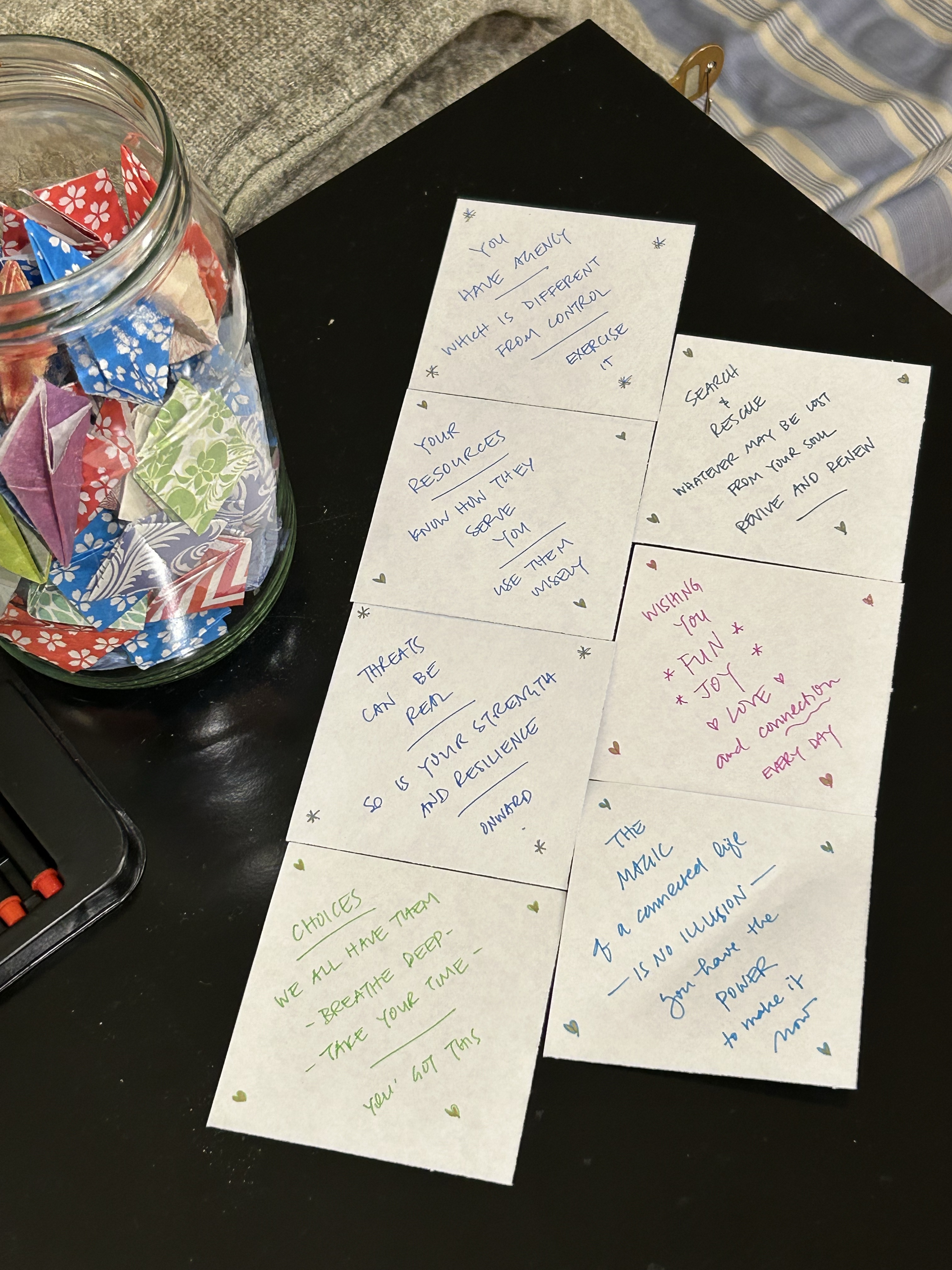
The first two jars went to friends going through hardships. I think of these amazing sisters often and try to text them in real time, and this is another way for them to feel loved by me, but at moments of their own choosing.

Daughter suggested I write a jar for my friends at Ethos, my beloved gym–brilliant! After moving to a beautiful new space 2.5 times bigger than the original and expanding team and services with ambition and gusto, I knew the transition–for all of us–would be a challenge. And it was daunting to consider writing enough smile notes for a whole community. When the gym re-opened last month, the elevated energy was palpable. Every fear or worry I had about the culture not translating was allayed immediately. People’s auras and vibrations pulsed with excitement, light, and possibility. I would not have imagined that the love shared among my gym friends could get better, and here we are–the commute can take up to twice as long now, and I drive it happily just to bask in the light and connection while I train my body. So of course I could pour all that love into a Jar of Smiles!

Turns out, well wishes are easy and fun to write. While listening one night to Beastly Beauty by Jennifer Donnelly (another book I highly recommend; check out my review on Goodreads), the inspiration flowed. Any word from any given passage that crossed my consciousness could evoke something positive. Most messages apply to myself also–reminders of how I want to approach any day or challenge. Music lyrics, books, conversations, memories, items on my desk–once I’m in the love note mindset, each smile message emerges spontaneously and practically writes itself, alternating between affirmations, admonishments for self-compassion and self-care, interesting questions, and cheerleading.

What I had not expected was how uplifted I would feel myself after writing them. Each note is an original thought, occurring to me in real time and sometimes morphing as it emerges, as I run out of space in a line or leave out a letter. But the sentiment and intention remain steadfast–to connect, even anonymously–because we are all human, we are all here doing our best, and our core needs for feeling seen, heard, understood, accepted, and loved are the same. It reminds me of when I write my patients’ action plans at the end of their full day physicals, after consulting with me, the dietician, and the exercise physiologist. The team and I have the luxury of long interviews, when we have time to ask deeper questions and really know people. Our annual health summary acknowledges people’s persistent self-care efforts and serves as pep talk for the year to come. I see you. This is what you mean to your colleagues and loved ones. This is what I wish for you.

My smile jar messages feel like little love darts–the Nerf suction cup kind–shot joyfully at my friends, aiming to bestow mini hickies of encouragement. Maybe a small note will lift someone and make them more likely to lift someone else, because we are always more likely to shine on others when we feel light ourselves. If the effect only lasts a moment, even one subsequent interaction, that’s enough! It’s like dropping grains of sand on a dune (an analogy my mentor taught me), one at a time. Most land uneventfully–the receipient gets a transient oxytocin hit that passes. Once in a while a few grains cause a small slide along the dune face–people start to hold doors for one another, let others into traffic, say hello and start friendly conversations in the check-out line. And over time, with enough grains steadily deposited, ridges and knolls change shape–we start assuming the best instead of the worst in each other, get curious before applying judgment, and seek connection more than division.

Love notes have the power to transform.
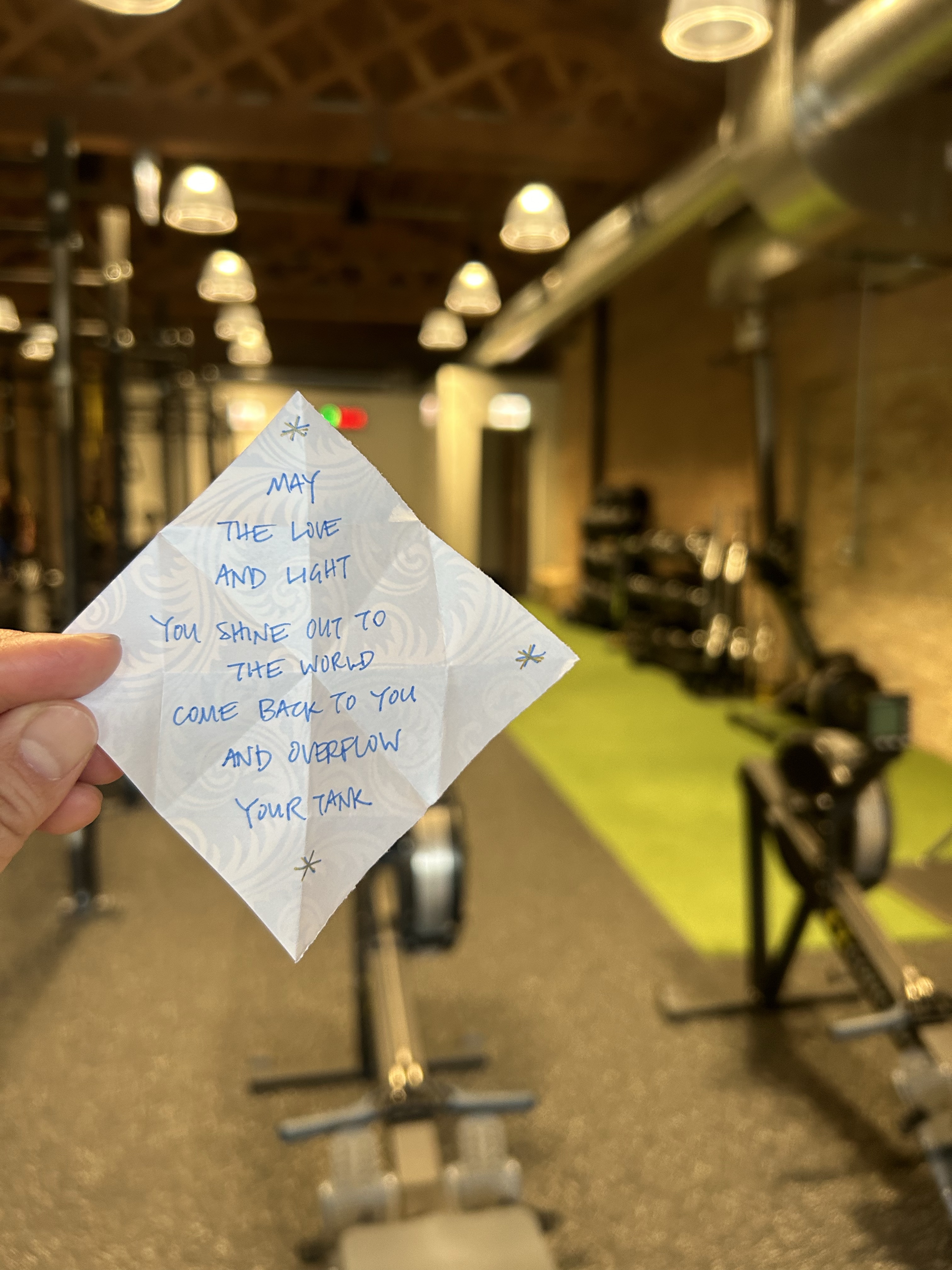
I have a 4-inch stack of 3-inch origami squares, a set of rainbow pens, and a box full of glass jars at the ready. I have a list of recipients and occasions, and of course a set of refill smiles for the jar at Ethos. I hope people keep plucking the little squares out regularly, and I hope they do get a good, real smile from each. They are written with love, and I smile myself, rereading as I fold them. It’s meditative and uplifting, and that is my wish for anyone who opens one.

Onward in love and light, my friends. Please share yours, no matter how small–love given away multiplies rather than diminishes–the world needs every grain and every message of love we can muster right now.

Giving the A

What grades do we give one another in life?

It seems like a silly question, right?  I don’t often think in these terms.  Maybe we give ourselves and our loved ones A’s, our professional rivals and competitors C’s, and folks in opposing political parties F’s?

I wrote recently that I have gifted The Art of Possibility to multiple friends lately.  I just did it again this week.  One of you, dear readers, started reading it because of that post, and invited me to a self-development book club to discuss!  I am so honored and grateful, thank you!  This post is inspired by you and our ongoing Instagram conversation—thank you again!

I thought I had well and truly integrated this practice already.  As always, there is still room to learn and grow, and I just love how this continuing discovery emerges from sharing the book with people!

Giving the A is:
“an enlivening way of approaching people that promises to transform you as well as them.  It is a shift in attitude that makes it possible for you to speak freely about your own thoughts and feelings while, at the same time, you support others to be all they dream of being… An A can be given to anyone in any walk of life—to a waitress, to your employer, to your mother-in-law, to the members of the opposite team, and to other drivers in traffic.  When you give an A, you find yourself speaking to people not from a place of measuring how they stack up against your standards, but from a place of respect that gives them room to realize themselves.  Your eye is on the statue within the roughness of the uncut stone…  This A is not an expectation to live up to, but a possibility to live into.” (paperback, page 26)

It’s a practice akin to making the most generous assumptions about people—a priori–that we are all here doing our best, that we are not out just for ourselves, that we want one another to do and be well.  And it’s also more than that.  It’s more active, takes more initiative on behalf of the other person.  Giving the A assumes not just that people are doing their best, but also that their best can be something great.  I think of it as approaching people as if the light of the world shines within all of us, and all we must do is uncover it for one another.  It is a way of being together that unlocks the greatest potential for us all to be our best.

New Friend and I compared encounters we had standing in line at a lunch place and checking out at the grocery store.  We shared how we caught ourselves feeling annoyed, defensive, and judgmental (not giving A’s to our respective strangers), and were able to shift our attitudes and put down our judgments and negative assumptions.

Something made me think about those assumptions—the default settings in which we walk mindlessly through life.  If I like you, admire you, and want you to like me, I will likely give you an A automatically.  I am primed to see everything you do as golden.  If I dislike you, then I’m likely to judge any behavior of yours negatively.  Whatever default I automatically set for you, confirmation bias reinforces that original grade I gave you, the label I assigned. So, is the ‘grade’ we give someone (or any given group) simply based on our existing relationship with them?  What if we have no relationship, as with strangers?  I think we grade people then based on heuristics—mental shortcuts that may include stereotypes, prejudices, and other biases.  Consider the risks here, and the harm this can do to us all.

I also think the grades we give can be fluid.  I messaged New Friend that they depend on “so many things–intersecting variables—our baseline relationship, its context, the circumstances of any given encounter, our mind state at the time… So mindfulness, as it so often does, comes back to me over and over as the practice on which to center myself. If I’m present in the moment, I’m more likely to notice what grade I’m giving the other person, and to myself as well.”

Aaah, the grade(s) I give myself–my default self-beliefs and -talk!  Off the top of my head:
As parent: B, maybe B+ overall… but in my high stress moments, C-… Or maybe it varies between certain aspects of parenting? I blame myself for many of the kids’ struggles–F! I have written that my greatest regrets in life are all relational; if I’m honest, they all occur in my closest relationships.  When I think of my ‘grade’, it’s a judgment.  And that is not the point of the practice.

The ‘grades’ we give, both to ourselves and others, are limbic, subconscious, automatic, and context driven.  But what do they really mean; how do they affect our relationships?  I think of them now as markers of possibility—ceilings of potential connection.  The letter ‘grade’ simply expresses concretely the abstract, insidious limitations we unconsciously put on one another’s potential as fellow humans.  It’s not that we go around actually assigning grades to people we know and meet.  ‘Giving the A’ is a mindfulness practice—an intentional way of being that honors maximal relational connection potential in and among all people, ourselves included.  So, when I think of myself as parent, giving myself an A does not mean I think I’m perfect or infallible.  It is not meant as a judgment of performance.  It means I give myself the grace to continually attend, assess, adjust, and show up by best; it holds loving space for my aspirational self to emerge and blossom, without pressure, obligation, or requirement.  I feel physical relief just realizing this distinction. 
Where do you need to give yourself an A?

Why practice Giving the A?  I do it to live in peace with myself and other humans–to see us as we all wish to be seen–with kindness, compassion, acceptance, and love.

When I give myself the A, I show up to you differently, and I’m more willing to give you the A. My energy is light, open, welcoming, inviting, accepting, validating, encouraging, and connecting.  When you feel that from me (and it is a feeling–intuitive, subconscious, non-rational), it affects how you show up to me, also.  It is both subtle and profound, incidental and transformative.  Our interaction and dynamic goes a certain way, any one of myriad possibilities, depending on what we each bring in the moment.  And it can change in a heartbeat–hard left, deep dive, instant bond or severance–if we’re not paying attention.  Maybe the hard times and disconnect happen more when we’re mindless, and the loving, connecting times when we are mindful?  Or maybe it’s just that we see the potholes coming and can navigate around them more easily in the latter.

Imagine if we saw one another as loving works in progress, every one of us, no matter what our circumstances, past experiences, and fears?   What if we held mutual possibility for all of us to step into our own full potential in any domain?  That’s a world I’d like to inhabit, and practicing Giving the A makes it a lot more likely.

Me with Ben Zander, 2009

What Do You Protect?

What does this question mean to you?
What comes to mind first?

Voice actors I admire post about vocal rest and nasal/sinus care regimens, hydration, and air purifiers. Of course this makes sense; they protect the source and tools of their livelihoods.

It comes up with my executive patients often. Of all of their habits in the 5 reciprocal domains of health (Sleep, Exercise, Nutrition, Stress management, and Relationships), which are the keystone practices that hold them up and make it possible for them to handle the myriad pressures and responsibilities they shoulder? Exercise often emerges as a primary method of protecting their mental health as much as physical, so they may continue to withstand the demands of a work culture that actively threatens their health and well-being.

After some particularly insightful exchanges with patients and friends this week, I asked myself the question. What do I need to protect? With the next heartbeat, the answer was my empathy. Fascinating! This also makes sense–as a primary care doctor, I function best when I am fully present and attuned to the person in front of me, listening to their stories and concerns, doing my best to understand their subjective perceptions and experiences. Without empathy, I am both less effective and less fulfilled, both in my work and outside of it.

So what are my keystone habits, and how does protecting and strengthening them affect my ability to attune and empathize?

Sleep: This one is easy; I am a very good sleeper. It’s even easier now that I have decreased my weekly caffeine use by about 85%, thanks to 116 days of a new morning routine. I’m even getting close to seven hours of sleep a night now, much better than before (no more 1:00am blog posts!). I don’t think this directly elevates my empathy, but it definitely improves my mood and mental resilience.
Exercise: I have now maintained a regular and challenging exercise program for 10 years, well documented among the 600+ posts here. Strength, core, and cardio training make me more knowledgeable advising patients on their programs, and earns me credibility. I can empathize with the multiple adverse consequences of injury and the emerging limitations of aging bodies, and advise as both physician and fellow athlete.
Nutrition: This is definitely my achilles heel, my most vulnerable health domain. But maybe this makes me uber-empathetic to my patient’s struggles? Because is there anything our society shames and judges more than how we eat, while simultaneously surrounding us with the least healthy food options in gargantuan portions? We struggle together, my patients and I.
Stress management: Today I can confidently say that I lead by example in this domain, thanks to so many teachers, role models, and books. I can engage in almost any conversation with calm confidence, even when conflict is high. I can tolerate adversity and the attendant difficult emotions with far less agitation than even a few years ago. I recover quickly now. Even when a patient screams profanities at me, I can maintain both my composure and my empathy for their distraught state of mind. And then I can respectfully and diplomatically discharge them from my practice.

Relationships: I have said for a while now that the four domains above serve this one. Self-care habits indicate our relationship with self. How we care for and nurture ourselves influences how we show up to the people in our lives, both personally and professionally, and in public. Our behaviors in all of these realms also indirectly impact relationships between other people in our sphere of influence, know it, like it, want it or not. Without question, it is my relationship practices, internally and externally, that most uphold my empathy.

Quality time and contact in deep connection with my people are absolutely what hold me up, so that I might hold up others. It’s the best self-sustaining cycle, really. I have felt so joyful, so euphoric, so absolutely uplifted for so long but the past year in particular, because I attend to my relationships with intention and dedication. I schedule time to write, call, meet, share, and commune. Every encounter is meaningful and nourishes me, body, mind, spirit, and soul. Even meeting someone for the first time, I can bypass meaningless small talk and easily engage in conversation that connects. Who knows what I might discover about anything just by talking to someone, anyone? With this confidence, every stranger has the potential to be my next good friend, and it makes me practically giddy. As I moved from narrator to narrator at Readers Take Denver, I’m still floored at how effortlessly each conversation, even if brief, dropped into heartfelt resonance and mutual uplift. I will forever remember that day and that event as a shining example of the immense possibility of human connection.

My relationships feed my empathy, compassion, presence, openness, curiosity, and learning, and these practices then strengthen all of my relationships, new and old alike. It is the most rewarding positive feedback loop. I take pride in my emotional presence and observational and psychological synthesis capacities in clinical encounters. My friends also admire these skills that I exhibit, and I hope I model them for the kids. The world needs our best relationship skills now more than ever.

So the important question is not only what do you protect, but why?

What are our functional layers of protection, and what do they serve? In the end, how does it all align with our core values and life purpose? What good does it all do? What contribution does it help us make?

What we protect and why indicate what matters most to us, no?

Of course this could all be one giant rationalization on my part. It’s a very new question to me, and I will ponder it further. Thank you for pondering with me.

What else does it bring up, and where will the next questions take you?