The last two posts were a bit long and heavy. So tonight I’m going light.
When was the first time you ever heard this expression? Mine was during this video–long live Jimmy Fallon! Watching again tonight, these 8:35 minutes made me laugh just as hard as the first time, to the point of tears. If you have time, check it out–if it doesn’t brighten your mood by an order of magnitude, you may be dead. Fallon and Kerry Washington complete a Mad Lib at the desk. Staff create cue cards based on the answers, then the duo acts out the scene in costume and on set. If you don’t have time to watch the whole video (but really, invest 8 minutes in your day’s joy, eh?), catch ten seconds, 1:20-1:30. Just their expressions in this moment could lift you! Then share it–spread the joy!
According to English-Grammar-Lessons.com, “Not today, Satan!” is “something people say when they overcome something particularly challenging. If someone is faced with something that they should not be able to do, but they do it anyway, they may comment, ‘not today, Satan’, meaning that even such powerful forces as Satan himself [were] not going to stop that person from achieving that thing. It is also commonly used to express resistance to an action, thought or idea.”
Can you guess its origin?
Apparently it was first uttered by Bianca Del Rio, in the final episode of the sixth season of RuPaul’s Drag Race in 2014, which she won. Urban Dictionary entered a definition for the phrase in 2015. I have only superficial exposure to the world of drag on TV, and I love it! I think it’s bold and fun, and the irreverent and vibrant challenge to traditional social norms makes me laugh and want to raise my hand, point, lower my chin a little sideways in respect and shout, “You GO, girl!” I think we’ve come a long way since Victor/Victoria.
Here’s a fun challenge: Let’s all look for and take opportunities this week to exclaim, “Not today, Satan!” Tell the story in a comment below!
Is there another expression that you love, that we can also try on/out? Let us know, and let’s have some fun, shall we?
[Note: this post discusses only binary, cis-gender, heterosexual romance, as that is the genre I currently consume.]
Buckle up, friends, we are taking a ride!!
Okay so never in a million years would I have guessed or predicted that I would binge romance audiobooks, and yet here I am. I have finished 46 books in 8 weeks–omg that’s almost one a day, holy cow! And that does not count the ones I have repeated!
Every year I have a brief period when I get a little tired of intellectual non-fiction. Here in 2022 it happened about 3/4 of the way through A Republic, If You Can Keep It by Neil Gorsuch. I finished eventually, and highly recommend it–he reads it himself; you can kind of space out during the pedantic parts, and still get to know him (a little) and his jurisprudence (at least a little). I especially recommend it for my progressive friends; but that is for another post.
During these cerebral time-outs, I scroll around on my Audible account for fun books included in my membership. For whatever reason, The Fix-Up by Kendall Ryan caught my interest this time, and it all started there. “Every reader deserves a hot hero and a happy ending,” her website says. Hallelujah, I say!
One of my favorites, and my first recommendation to many friends–great reviews so far! And Blakely’s novels are generally lighthearted and fun!
Around book #4 my book club met. I debated whether I should tell my new friends what I was doing (how fascinating)–I, the fiction shunner. Then, cosmically, one of them started talking about how she skips over the sexy parts in romance novels she reads, clearing the path for me to share–openly–because I most definitely do not skip the sexy parts! That night I learned a few things: 1. All of my book club friends have enjoyed romance novels; 2. A novel cannot be shelved as romance unless the ending is indeed ‘happy’; 3. There are ‘closed door’ romances, wherein sexual activity is implied, and ‘open door’ ones, which describe it all in detail (my books’ doors swing wide open). Since then, sharing with more and more friends, I have also learned: 4. Romance may be the best-selling book genre; 5. Almost all of my women friends have read them, but we don’t talk about it (still fascinating!); 6. Almost none of my friends can name any cis-het romances written by cis-het men; and 7. None of us know any such men who have read or would read romance.
“Brain Candy.” That’s how one of my friends describes it. It’s pure entertainment, total vicarious escapism. I agree! That’s why we seek it, no? How better and farther to get away from the mundane and stressful grind of responsible, daily adult life? That’s definitely what I wanted.
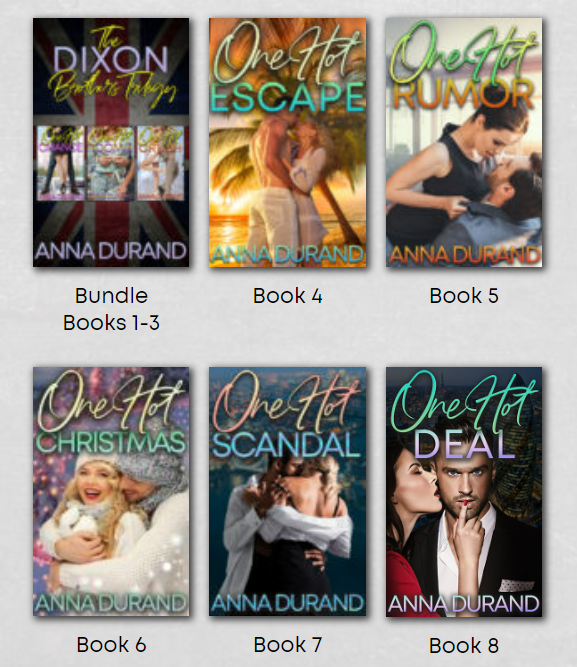
Finished all but Book 8; highly recommend–short, fun books that don’t take themselves too seriously.
It’s all so predictable and formulaic, which I love, because I can just relax and enjoy. The stories all follow roughly the same arc: Immediate attraction. Some obvious, primary barrier to togetherness (distance, prior relationship wounds, age gap, coworkers, some other made up reason). Supportive friends and family who “knew all along you two were meant for each other, duh.” By about 20-30 minutes left you’re home free, no more conflict, just happy ever after. I had never heard the word kismet before now, and it comes up everywhere in this genre. And there is an entire romance novel language–for body parts, sex acts, desire in all its forms! The best books hook you right away with witty banter, engaging premise, or just hot sex. My favorites have smart, sassy, free-spirited heroines, lots of cheeky dialogue, and fun plot twists.
All of these books are stand alone novels, and it’s also fun to read them in series. I loved this set, too.
These books have really refreshed my outlook on life and relationships–that was a total surprise! They remind me what it was like to be in love–that optimistic, impetuous, idealistic promise of a bright future, that whatever comes, we can face it together. It’s us against the world, baby! At book #29 I journaled notes for this post: “…stories that remind us of how we all want/long to love and be loved.” These 8 weeks of romance consumption have, remarkably, cracked the mortar of my cynical emotional turrets, and loosened some heavy armor I did not realize I had accumulated. Yahoooo!
Working my way through these (listening first to all of the ones read by Shane East).
I have shared these epiphanies with two male friends–dear brothers on the thoughtful, relational, self-reflective journey of life. They were so supportive and loving, listening as I marveled and waved my hands. Their eyes widened along with mine when we asked ourselves, what would it take for men to also be able to enjoy these fun, erotic stories that get us women so (energized), and then be able to share about it safely [insert gobsmacked emoji here]?
Because here is what I think makes these novels so important, and why we should all consume them (I highly recommend listening, especially if they are read by Shane East):
Contemporary romance novels celebrate and validate, unequivocally and unapologetically, two things that our culture and society insidiously shame us for:
Women’s libido and erotic sexual desires
Men’s intrinsic need for deep emotional connection
They do this by writing from both partners’ perspectives, describing their honest emotions, inner conflicts, self-delusions, and fears. But since these books are mostly written by women and consumed by women (as far as I know–to my cis-het male readers–do you read [write!?] romance?), I wonder if the male characters I read resonate with men who read them? Hence my query for romance novels written and/or consumed by men…
And they exist, hooooraaaaaaayy!
Turns out, authors Leigh Greenwood, Jessica Blair, Emma Darcy and others are men writing under female pen names (huh–more to unpack there, eh?). Now I have to get my hands on their books–will I relate to their female characters? Many have also pointed me to Nicholas Sparks, so he’s on my list, too. And guys, there’s even an article that lists 7 romance novels to gently set you and your gender on the romance path! “The best thing about romance is that love is for everyone!” it proclaims, and I wholeheartedly agree! What will it take for you to dip (or dive) in? What’s the best thing that could happen?
So there you have it, my unexpected, uncharacteristic (or not?), utterly awesome and ongoing journey into romance audio novels. I’ve never consumed this many books in one year in my life, by a long shot, and I could not possibly be happier about it. Not sure when I’ll get back to the other stuff… (she smirks)
You never know when creativity will strike or, more importantly, be called forth.
This weekend I’ve been feeling particularly melancholy, what with, you know, the world.
Thankfully Dan Rather et al over at Steady send a weekly email entitled “Smile for a Saturday”. I needed a smile this morning, so I opened it and watched a video of Brazilian pianist Elaine Rodriguez conducting an impromptu performance in flexibility and good humor, when one of her piano pedals malfunctions. I learned a bit about the literal mechanics of moving pianos; but more importantly, I saw how expertise, humility, and connection can save us in adversity.
While crew rushed to change pianos on stage, Ms. Rodriguez spoke to the audience. She explained what was happening, got help, and continued to play music that did not require the pedal while she and the audience waited. She chose pieces that sounded appropriate for the circumstances. She looked into the audience and made eye contact, engaging them throughout. She gave everybody, including me, the sense that we were all in it together. Nobody knew what would happen next, how long it would take, and how the evening would turn out. But I’d bet money that every person was glued to their seat, happily in it for the duration.
“We get to invent it!” This may be one of my favorite sentences, and I have exclaimed it more often in the past two years than possibly in my whole life. We thought we could not include telehealth in regular medical schedules. We thought teams always had to meet in person, in the office, all the time to function. We thought executives’ work necessarily required them to travel internationally over 50% of the time to lead effectively. Maybe so, and maybe not. COVID forced us all to reassess our default assumptions and practices. Some served us well and proved their value through lockdown and beyond. Some not so much, and now we get to invent how to be and do differently. Faced with adversity, we can play different songs.
My nascent idea and title for this post had just formed when YouTube autoplay began the next video, of Ben Folds composing a new song, on stage at the Kennedy Center for the Performing Arts in 2017. Friends, you’ gotta watch this!! He literally invents a song and leads the National Symphony Orchestra through its impromptu performance, beginning to end, in ten minutes. Stop reading now and watch, and let’s debrief below, shall we? I’ll wait. 😉
See if you agree that this improvisation parallels our pandemic experience:
A Minor Key
First, the MC accepts an audience suggestion of A minor as the key for the piece. Minor keys have a somber and ominous feel compared to major keys. They grab my attention, make me slow down, listen more slowly and mindfully. This makes sense because most music we hear is composed in major keys; it’s the default. Okay, now I’m prepared for the Darth Vader theme (in case you’re wondering about the difference between major and minor keys, hear the Imperial March in a major key, and Chariots of Fire in minor). This is the first constraint placed on Folds’s new composition: Invent a song that everybody expects to sound solemn, foreboding, and sad. Stay home. Wear a mask. Curtail your travel. No more team lunches, boondoggles, water cooler chit chat. Stress, stress, stress. A minor sounds like the right key for inventing a song in the Age of COVID.
Upbeat!
Next, the MC asks the audience what tempo they want to hear, ballad or upbeat? Immediate and loud spontaneous consensus: “Upbeat!” What a fantastic challenge, how will this work? As leaders, culture and morale start with us. We get to choose how we show up, no matter the circumstances. Maybe this correlates with taking a minor key and making an upbeat song—knowing to start slowly, from a serious, thoughtful place, AND choosing to uplift. Minor key does not necessarily make a song sad, plodding, or a slog. Rather, it makes our upbeat-ness necessarily more intentional. To see and amplify the positive in a negative situation does not mean ignoring, repressing, or dismissing the bad. It means accepting and embracing it, naming it, navigating it, making the most of all that is, and then moving forward with it all, in concert. This is what leaders are called to do.
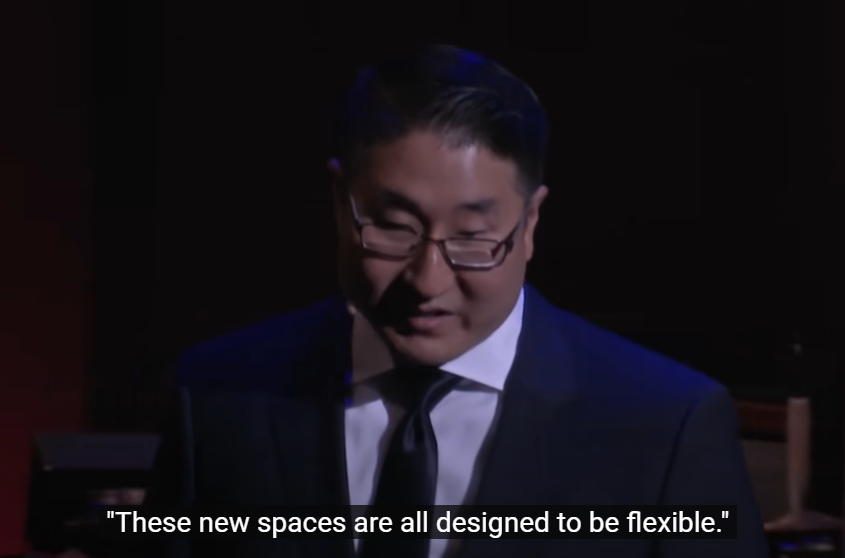
“These New Spaces Are All Designed to Be Flexible.”
The MC asks for a ‘an interesting sentence’ from the program book, perhaps as the unifying theme for the upbeat song in A minor—the mission, purpose, direction—the cause. I kid you not, this is the sentence that emerged. How cosmically prescient, this video, I have goosebumps.
“We Get to Invent It!” In the wake of Battleship COVID, we now get to design our spaces to be flexible—all spaces! That includes physical work spaces, spaces in our own minds for how and what to be, and spaces between us in relationship, whether at home, in college dorms, at work, at the grocery store, at concerts, or in traffic—everywhere, all the time!
Folds sits at the piano and starts noodling. He smiles. You can imagine his integrated brain gears turning, changing position while staying in contact, engaged and rotating for optimal efficiency and torque. He hits a little rut and resets, still smiling. He knows exactly what he’s doing, understands and embraces the process of creation, the necessary messiness and disorganization of initiating something meaningful. He also has no idea what he’s doing; the product is not yet formed. He is inventing in real time. Isn’t that what we are all doing now? What expertise and skill sets can we ground ourselves in, as individuals and collaborative (or competitive!) teams, that give us the confidence to invent? How do we orient ourselves for maximal power to accomplish our goals?
Think and tinker. Use your knowledge, expound on theory, do the thought experiments. Then take the experiments from thought to piano, to conversation, to teamwork. Try stuff out. Pilot–thoughtfully. Exercise both humility and confidence at once: Go all in, get all out quickly if it doesn’t work, repeat.
Collaborate
Over the next several minutes he tinkers with baseline, progression, melody. He starts sounding out with the cellos, then winds, then violins, violas, and finally basses and drums. At each stage, he invents something, tries it, integrates with the previous section, and assesses. Does it work? “…Just to make sure I don’t suck…sorry, this takes a second to create a whole song.” The song evolves in front of our eyes and ears, passing through organic adjustments of timing, notes, combinations of sounds and participation. “…Let’s hear it all together, make sure it’s not crazy…” The orchestra conductor follows attentively, providing seamless ancillary direction and guidance to the group.
Is this not what any team in transition needs? Leaders recognize material constraints and requirements: A minor key, upbeat tempo, These New Spaces Are All Designed to Be Flexible. They take the first steps, feeling things out, listening. They check in with the team at all levels—how does it sound for this group? What about when we add other groups? How’s the harmony? Is it working for the whole? If not, what do we need to change?
Revel in the Awesomeness
The performance climaxes after all parts have rehearsed, integrated, and repeated. Folks are comfortable in their brand new learned nerve pathways. Now they get to really play together, to have fun, improvise, and enjoy their accomplishment. What would happen if we celebrated our successes, even the smallest ones, more often and loudly (“fivetissimo”)?
—
It occurs to me here that this performance works because of certain fundamental premises: 1) Everybody agrees to participate, and to follow Ben Folds’s lead. 2) Everybody speaks the same language. Real time communication occurs cleanly and efficiently, with immediate feedback. 3) The leader trusts the team to do what they do best, giving appropriate instruction according to roles. 4) The task is brief, the goal is clear and simple, and the leader takes responsibility for the end product.
This video is neither a perfect nor a complete metaphor for creating optimal post-COVID environments and relationships. Still, it inspires and activates me. It provokes thought and creativity, and spurs me to enroll others in new ideas, experimentation, and shared accountability for our collective outcomes.
Really, if you have not already watched, please take ten minutes. You can even just listen. I bet you won’t regret it, and it may even inspire you.





 Healing Through Connection