Questions for Connection

What excellent question have you asked or been asked lately? How did it affect your relationship with the person asked/asking?

Ever since I started working with my life coach in 2005, I have practiced asking more and better questions in any encounter, in all life domains. The returns on this investment of presence and curiosity–idea generation, heightened conversation, and deepening connection, among others–far outweigh the costs of occasional awkward pauses and uncomfortable deflection.

I wonder, however, if I give enough time or energy to answering the interesting quesitons I ask?

Why, for instance, do I behave so differently with people in and out of my family? I feel like the same person in both contexts, and everybody knows the same me; yet I know I show up not the same at home as outside. Fascinating.

Today was Day 190 of my morning pages practice. Looking back, much of the journaling consists of lists, plans, recollections, and reflections. The same questions arise recurrently, mostly centered around behavior and relationships, and I attempt to answer overtly about half the time. Also fascinating! I feel comfortable with this state of things, as the simple act of writing them down and letting them sit on and below my consciousness day to day allows me to consider them slowly. Persistent questions point me to my core values, purpose, and goals. I feel no rush to formally answer these existential, identity-related, philosophical inquiries. I tell the story that simply marking their re/o-ccurrence pins them to some level of awareness where I can return regularly, like periodically adding brushstrokes to paintings that live in various rooms of my mind, heart, and life, when I happen to walk by. These rooms are bright and airy, each equipped with a sturdy easel, thick canvas, rich color palette, and full set of implements to create and revise, ad lib. I feel calm and focused, reassured that whatever is happening on any given day, I have time and energy set aside to process and digest, coming to clarity organically and as needed, all in good time. My morning pages facilitate insights and understanding regularly, and I see this practice sticking for the foreseeable future.

What I really relish, however, is engaging in questions, exploration, and discussion with other people! I wonder if this is how I make friends, actually? It does not matter if I just met you or I’ve known you my whole life; if you’re willing to dive with me like humanities nerds in a submersible to plumb the depths of open and honest questions and wild ideas of possibility–about anything from language to muscle physiology, human nature to politics, phylogeny to music–I might soon profess my undying love for you and chase you for more of that energizing connection. It is most often with friends, in those small, relaxed, meandering, sometimes calorie-laden gatherings, where nascent and novel answers to delightful questions so beautifully emerge and bloom. I carry my journal everywhere, to capture these pearls when they drop, as though gifts from the gods of sentience and relationship.

People crave deeper connection desperately now, in our increasingly chaotic, impersonal, and globalized world. I see references to the 2015 New York Times article “36 Questions That Lead to Love” regularly (that’s probably the algorithm, right?). If you cannot access it, see the original research article by Arthur Aron et al, “The Experimental Generation of Interpersonal Closeness: A Procedure and Some Preliminary Findings” with the questions listed at the end. Organized into three sets of increasing intimacy, the exercise invites us to ask our conversation partners questions such as, “What would constitute a perfect day for you?” “What is your most treasured memory?” and, “Complete this sentence: ‘I wish I had someone with whom I could share …'” From NYT: “The idea is that mutual vulnerability fosters closeness. To quote the study’s authors, ‘One key pattern associated with the development of a close relationship among peers is sustained, escalating, reciprocal, personal self-disclosure.’ Allowing oneself to be vulnerable with another person can be exceedingly difficult, so this exercise forces the issue.” I have the article bookmarked on my phone, and have yet to invite anyone to answer with me–maybe I’ll set an intention to do so on my upcoming friend dates? Part of me thinks I’m doing fine connecting on my own, and you never know, this could be truly next level.

Renowned psychologist Esther Perel created a similar game in 2021, Where Should We Begin, now in its 2nd edition. This query is how she historically initiates therapy sessions with clients. Questions in the game include, “I can’t believe I got away with…” “My latest crush is…” and, “My favorite love story to tell…” The box includes questions that range from lighthearted to serious, to sexual and beyond, which positively tickles me–because it’s all just life. In this age of polarization and easy mutual disdain and disconnection, games like this can help us all recognize our shared humanity.

I have purchased yet a different box of questions for connection, How Deep Will You Go? Its creators describe it as “a game of deep conversation without worrying what to ask, to feel closer in a way you never felt before.” Three levels of questions are labeled Ice Breakers (“What motivates you in life?”), Confessions (“Why have you kept going?”), and Getting Deep (“What is something you don’t tell most people?”). Reading the cards, I imagine with whom I’d want to delve. It depends on the question(s), of course, and also context and mood. I can picture a small friend group setting for the playful ones, and core belief/value ones as actual ice breakers for purposeful group work, such as a Braver Angels workshop. For the more intimate questions, though, I picture a one on one meeting, with plenty of preface and mutual agreement to actively engage in deepening personal connection.

Of course, interpersonal closeness is an iterative process: Other than the most superficial queries, the willingness to ‘go deeper’ requires some level of established trust and safety. That can take a while, depending on a multitude of factors. But once that foundational rapport is achieved, subsequent connection facilitated by these questions, one by one, may unfurl like the slow and steady inflation of a hot air balloon from the ground, lifting us gently together to affinity and affection we could never achieve where we started.

Connection decks like Where Should We Begin and How Deep Will You Go? make me so optimistic. I have loved and tried to ask questions like this for years, and now I feel validated. What if we all opened up to one another just a little bit more, just a little more often? What if we held one another’s hopes, joys, struggles, regrets, dreams, and confidences with a little more respect and reverence? What if we approached one another, friends and strangers alike, with the assumption of caring and mutual well wishes, looking to hold one another up, rather than with suspicion and wariness? And what if we rewarded such unearned generosity of spirit with reciprocal kindness?

The practice of mindfully asking deeper, more personal, loving, and intimate questions could go a long way to bridging our seemingly insurmountable differences; we all need this right now. It’s not appropriate in every encounter, of course. We must attune to context and opportunity, and act (ask) with confidence and humility. And that’s also the point, isn’t it?

The more present we are to one another’s vibrations, our moods and energies, the more likely we are to connect in earnest, regardless of what questions we choose to ask or not.

Understanding, validation, belonging, closeness, intimacy–we humans thrive when we feel these often and deeply. I still have hope that we can do it better.


The Jar of Smiles

Who doesn’t need a tiny love note once in a while?

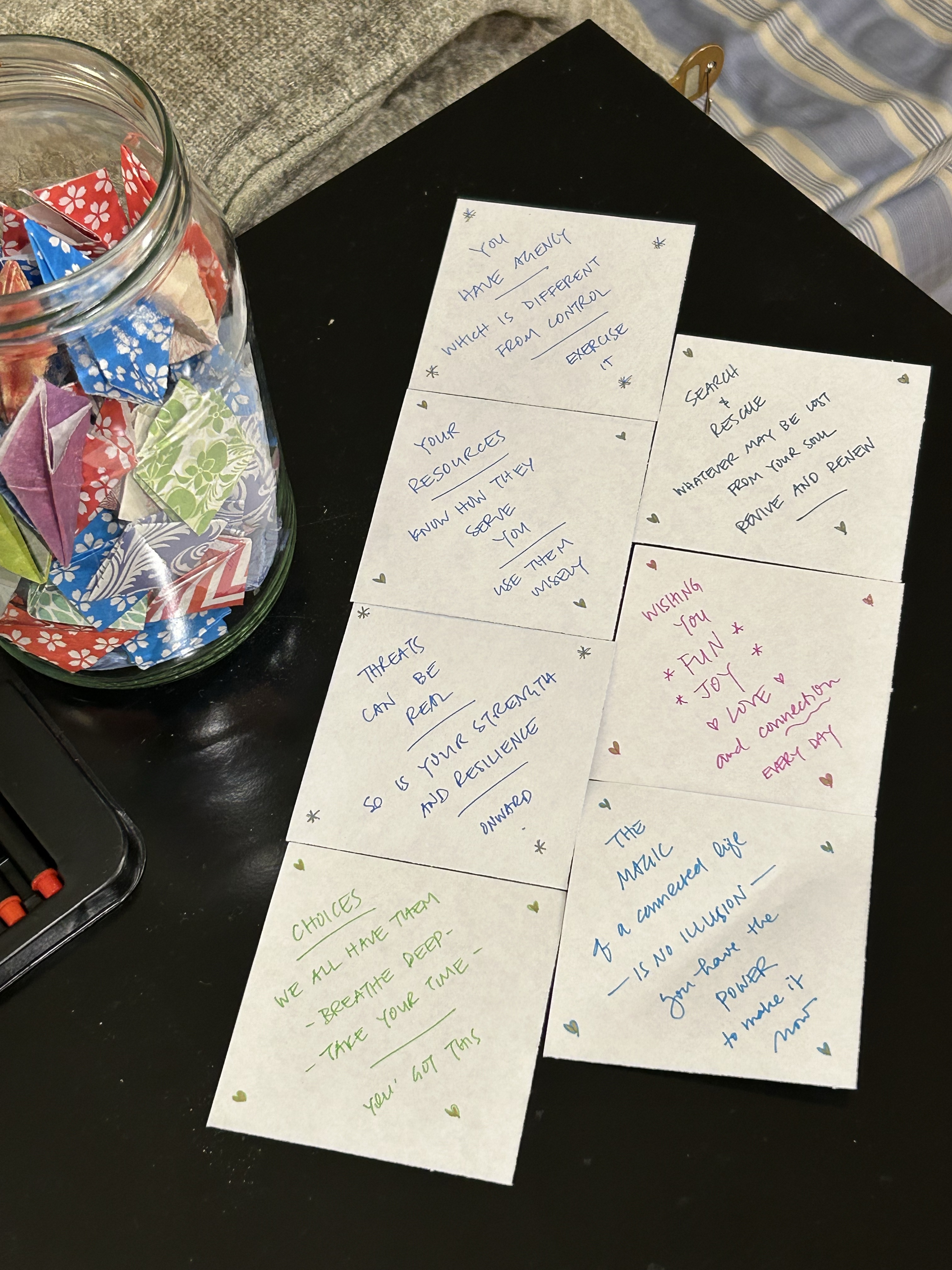
The ‘jar of smiles’ idea came across my Instagram feed some months ago and, though it’s not new, this time it moved me instantly. I could buy a jar of notes online, or I could simply write my own! I have stacks of origami paper left over from past obsessions with the kids–perfect. And since I also save glass jars like a true hoarder, I was all set.

The first two jars went to friends going through hardships. I think of these amazing sisters often and try to text them in real time, and this is another way for them to feel loved by me, but at moments of their own choosing.

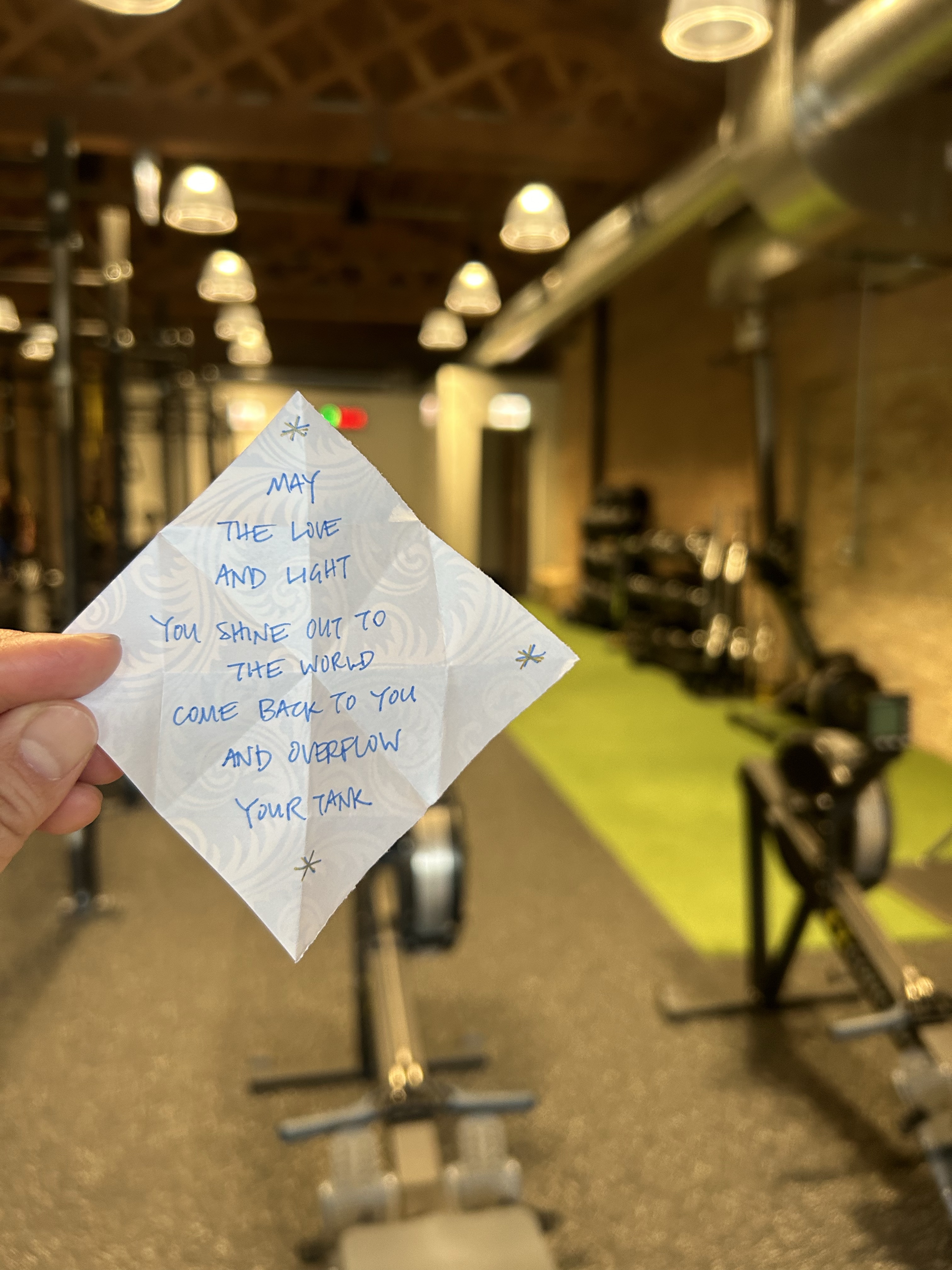
Daughter suggested I write a jar for my friends at Ethos, my beloved gym–brilliant! After moving to a beautiful new space 2.5 times bigger than the original and expanding team and services with ambition and gusto, I knew the transition–for all of us–would be a challenge. And it was daunting to consider writing enough smile notes for a whole community. When the gym re-opened last month, the elevated energy was palpable. Every fear or worry I had about the culture not translating was allayed immediately. People’s auras and vibrations pulsed with excitement, light, and possibility. I would not have imagined that the love shared among my gym friends could get better, and here we are–the commute can take up to twice as long now, and I drive it happily just to bask in the light and connection while I train my body. So of course I could pour all that love into a Jar of Smiles!

Turns out, well wishes are easy and fun to write. While listening one night to Beastly Beauty by Jennifer Donnelly (another book I highly recommend; check out my review on Goodreads), the inspiration flowed. Any word from any given passage that crossed my consciousness could evoke something positive. Most messages apply to myself also–reminders of how I want to approach any day or challenge. Music lyrics, books, conversations, memories, items on my desk–once I’m in the love note mindset, each smile message emerges spontaneously and practically writes itself, alternating between affirmations, admonishments for self-compassion and self-care, interesting questions, and cheerleading.

What I had not expected was how uplifted I would feel myself after writing them. Each note is an original thought, occurring to me in real time and sometimes morphing as it emerges, as I run out of space in a line or leave out a letter. But the sentiment and intention remain steadfast–to connect, even anonymously–because we are all human, we are all here doing our best, and our core needs for feeling seen, heard, understood, accepted, and loved are the same. It reminds me of when I write my patients’ action plans at the end of their full day physicals, after consulting with me, the dietician, and the exercise physiologist. The team and I have the luxury of long interviews, when we have time to ask deeper questions and really know people. Our annual health summary acknowledges people’s persistent self-care efforts and serves as pep talk for the year to come. I see you. This is what you mean to your colleagues and loved ones. This is what I wish for you.

My smile jar messages feel like little love darts–the Nerf suction cup kind–shot joyfully at my friends, aiming to bestow mini hickies of encouragement. Maybe a small note will lift someone and make them more likely to lift someone else, because we are always more likely to shine on others when we feel light ourselves. If the effect only lasts a moment, even one subsequent interaction, that’s enough! It’s like dropping grains of sand on a dune (an analogy my mentor taught me), one at a time. Most land uneventfully–the receipient gets a transient oxytocin hit that passes. Once in a while a few grains cause a small slide along the dune face–people start to hold doors for one another, let others into traffic, say hello and start friendly conversations in the check-out line. And over time, with enough grains steadily deposited, ridges and knolls change shape–we start assuming the best instead of the worst in each other, get curious before applying judgment, and seek connection more than division.

Love notes have the power to transform.

I have a 4-inch stack of 3-inch origami squares, a set of rainbow pens, and a box full of glass jars at the ready. I have a list of recipients and occasions, and of course a set of refill smiles for the jar at Ethos. I hope people keep plucking the little squares out regularly, and I hope they do get a good, real smile from each. They are written with love, and I smile myself, rereading as I fold them. It’s meditative and uplifting, and that is my wish for anyone who opens one.

Onward in love and light, my friends. Please share yours, no matter how small–love given away multiplies rather than diminishes–the world needs every grain and every message of love we can muster right now.

The Code of Us: Opening Mind and Heart to Difficult Possibility

Spoilers likely, dear readers!
_______________________

The best books make me both feel and think deeply. The Code of Us by Liv Evans has done so to such a degree that I will not do it justice in this post–I’m still hung over! But processing the story must start somewhere, and if I can move someone here to read or listen to it and discuss, then it will be worth the effort.

Mia, a dedicated neuropsychologist, researches artificial intelligence. Her husband, Arden, creates beautiful sculptures out of things people throw away. Their devoted love story serves as the steadfast anchor for a novel that throws into question everything we may think we know about cognition, memory, technology, relationship, and evolution–about how we think and feel about humanity itself.

Arden agrees to serve as Mia’s alpha subject for her ‘replicated intelligence’ project, meant to preserve and enhance human memory in service of improving people’s quality of life–eventually, when the product is fully developed. When a traumatic brain injury renders him essentially brain dead and on the brink of actual death, she and her two colleagues and close friends rush to implant Arden with a chip that brings him back to life, body and mind, with the still nascent but fully functional technology. Told in alternating present day and flashback, a complex journey of loving intentions, ethical dilemma, grief and loss, unintended consequences, and social implication unfolds.

While the plot engages, stimulates, and challenges me intellectually, it’s the emotional and relational evocativeness–the human(e) relatability–that makes this book an instant treasure in my library. In a mere 188 pages (5:37 hours, narrated by the multitalented Jodie Harris and Steve West), Evans examines–presciently, brilliantly–myriad potential complications and consequences of artificial intelligence–intellectual, social, legal, psychological, and corporeal, among others.

To ground the exploration in an unwavering love story, though, centers readers’ attention on the relational implications, which speak directly to my raison d’etre. Of all the questions that emerged in 10 pages of journaling on this book, the one I most wish for us all to consider is, “How does AI, in any given space, uphold and protect the humanity of all whom it touches?” I almost dismissed it as too difficult a question to attempt answering. But the more I consider the complexity, inevitability, and acceleration of this technology, the more I feel convicted that we, the human creators and consumers of AI, must step up to ask and answer exactly such challenging and overwhelming questions. We are called to be more thoughtful, considerate, inclusive, and complexity-tolerant than we have ever been, by a long shot.

Whatever we do will always be imperfect. There will always be unintended benefits and harms, and our attempts to weigh, compare, and justify it all will always leave many unsatisfied and frustrated. So how do we proceed? How do we show up to engage with the most complex adaptive problem that many of us can ever fathom? What mindset(s) will minimize the risk of nefarious, greedy, and inhumane forces overtaking the altruistic, humanitarian, and egalitarian ones?

Last fall was the first time I thought and wrote in any depth about how AI will change medical practice. Since then I open more and more to the potential benefits, led by my astute and altruistic colleagues in primary care, who model thoughtfulness, compassion, and critical (neither blind nor cynical) appraisal and application.

As my own learning progresses, some key concepts emerge that I will hold in front. They will evolve, obviously, and I ground them always in the commitment to enhancing human to human connection, no matter what tool is considered.

Acceptance with conditions

Humans innovate. We create. We aspire, imagine, and push boundaries. It is the greatest gift of our intellect, and also a potentially fatal flaw. What’s done cannot usually be undone. I accept it all in iterations, fear and trepidation giving way slowly to cautious possibility. That said, nobody should be given carte blanche to advance technology unfettered. Banning development only drives it underground, where the presence and risk of nefarious forces increases, in my estimation. Thus, we must accept and embrace our discomfort with the unknown and uncertain, ask the hard questions, and grapple with the ardent persistence of true infinite game masters.

Transparent and mindful accountability

Ethics committees are a good start. Checks and balances on the runaway flaws of primarily capitalist ventures must be established and maintained. Open source data and outcomes sharing will be key for minimizing harm, I think. That conflicts directly with the competitive financial drivers of innovation, I know. So we must, somehow, wrestle earnestly, honestly, openly, and in good faith with the novel humanitarian complexities and problems that AI creates. We must do accountability better than we ever have which, sadly, is not saying much.

Agile and adapative commitment

There are no words better than exponential acceleration to describe the march of modern technology. We have built this kite that flies ever higher and faster, and if we hope to influence its path at all, it will take more than the string and gym shoes we started with. We must invent the tethering, weighting, and conveyance materials, structures, and vehicles in real time. The faster and more fully we accept the inexorable progress of AI, the more effectively we may flow with it rather than against, to move swiftly and smoothly to manage its ethical, humanitarian, and social implications and consequences.

Critical hope and optimism

Be warned: The Code of Us is not a romance novel, despite its love story core. The book does not end happily, though the end of the book is not necessarily the end of the story. It took a few days for me to identify all of my emotions, led by sadness in depth and intensity. Liv Evans summons, with incredible economy of language, a viscerally, if not cognitively coherent (and thus quintessentially human) cacophony of feelings that at once proves the undeniable shared humanity that fiction evokes, and yet wholly defies full articulation. I don’t think I have ever journaled ten pages about any book, and I’m still intellectually, emotionally, and existentially entangled. Surprisingly, it feels light rather than heavy. This book teaches me a lesson that recurs: With every degree of acceptance, I gain a commensurate measure of liberation. Despite so many egregious examples to the contrary, I still believe humans can transcend our most self-serving, collectively self-destructive tendencies. I believe we have the capacity to collaborate for the common welfare. We just don’t readily exercise it. I have called myself a cynical optimist. Today I choose critical optimist, because we simply must proceed. We must hold onto that kite and not allow ourselves be dragged. In medicine we learn critical appraisal skills: how to evaluate data and evidence for validity and application. When the data is good, we accept it and apply, until new and better data shows us otherwise.

My opitimism is not blind. It is realistic and evidence-informed, if not fully evidence-based. I will deepen my acceptance, demand transparency and accountability, and train for adaptive cognitive and emotional agility. I intend to run with rather than get dragged or trampled.

We humans may destroy ourselves in the end, and that will be what it will be.
Until then, however, I still have hope that we may yet save ourselves.