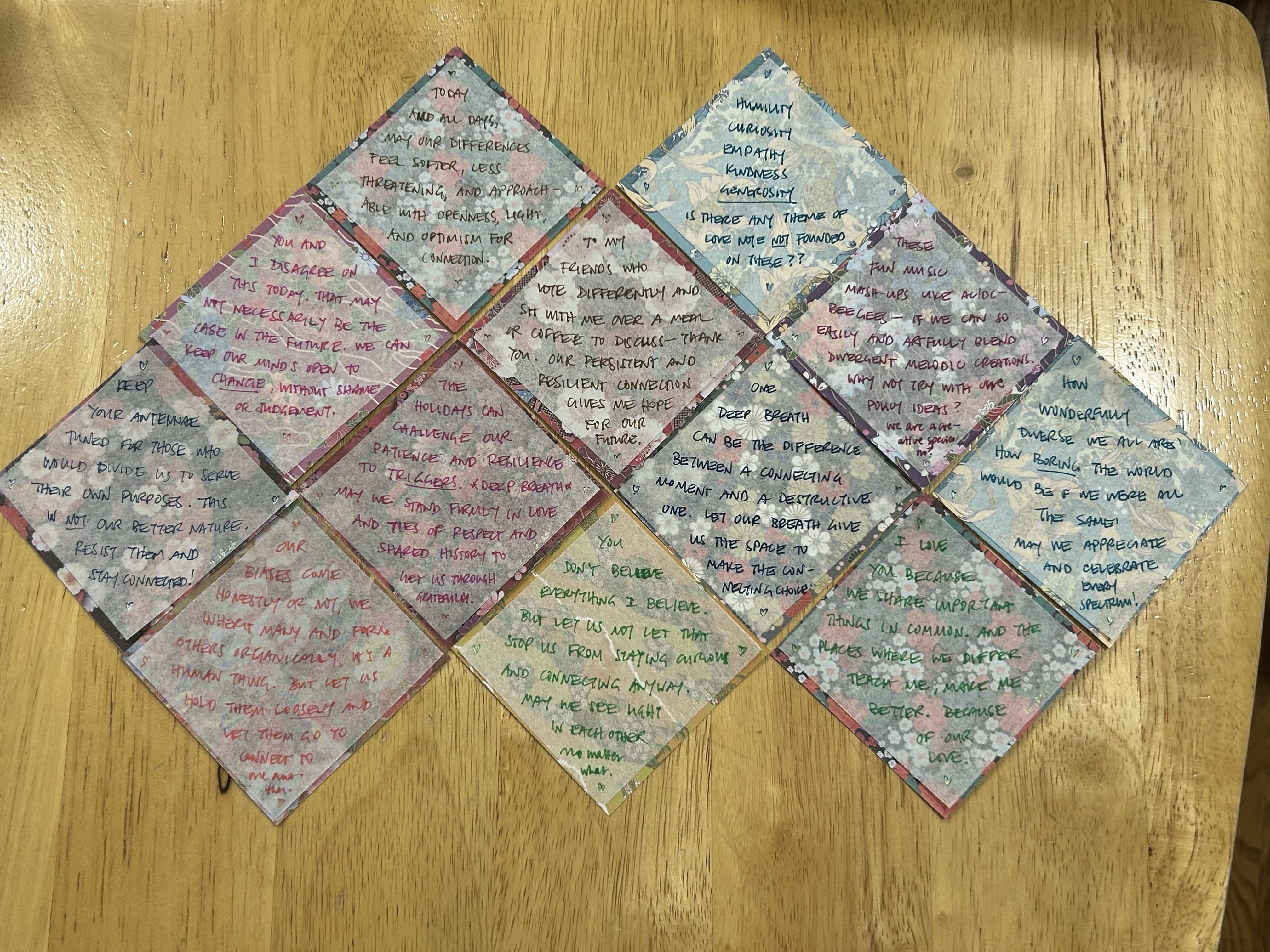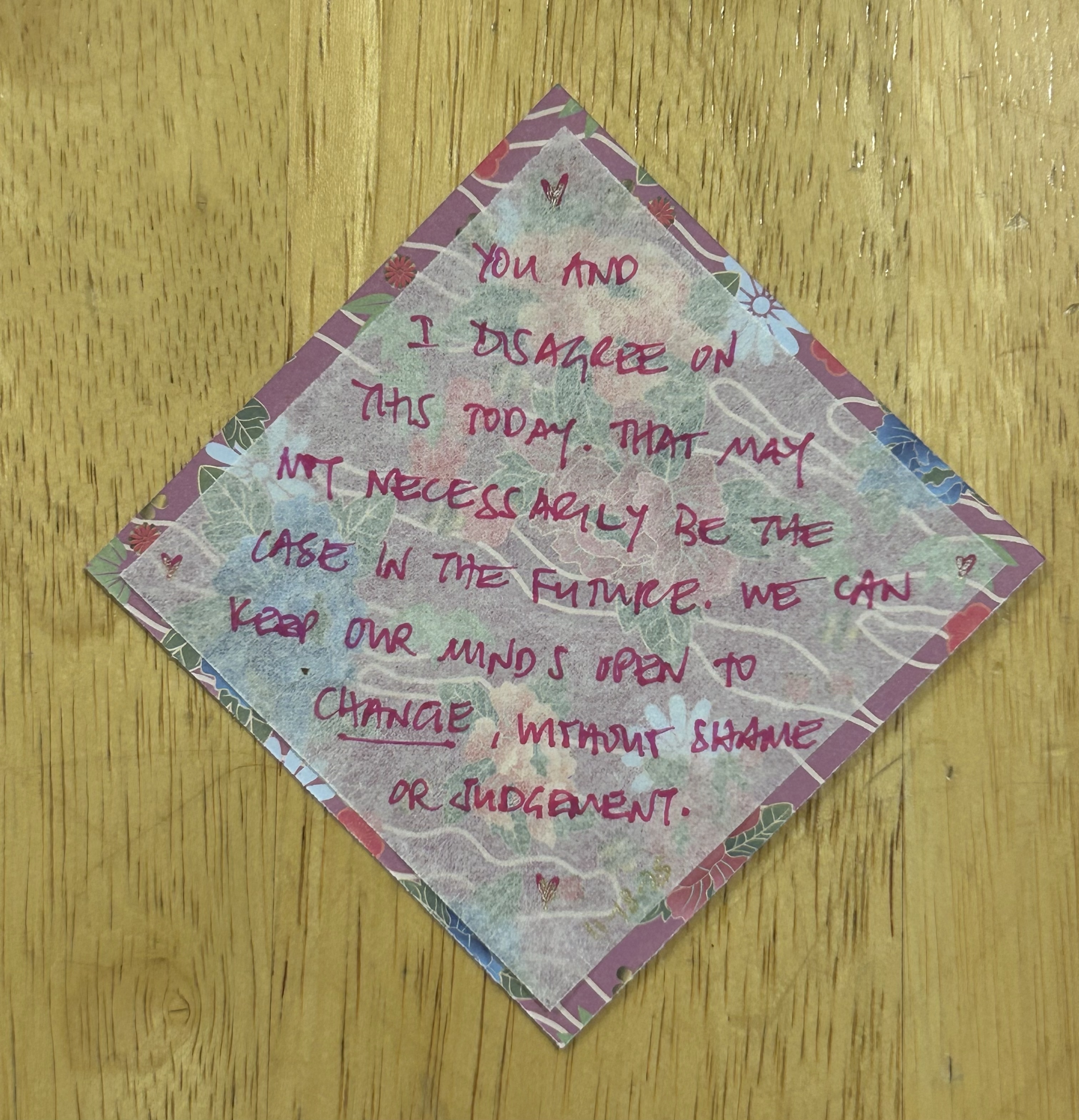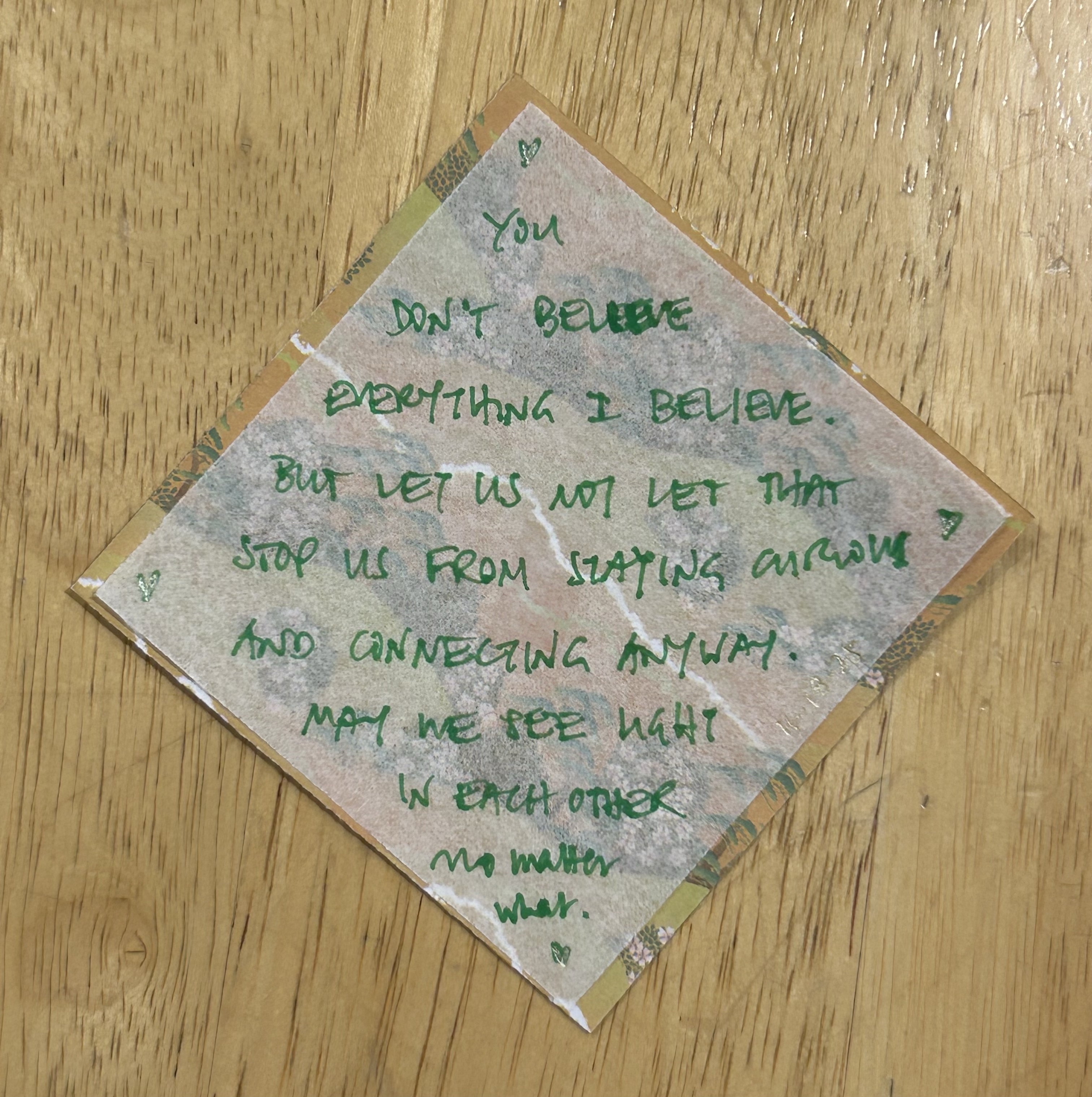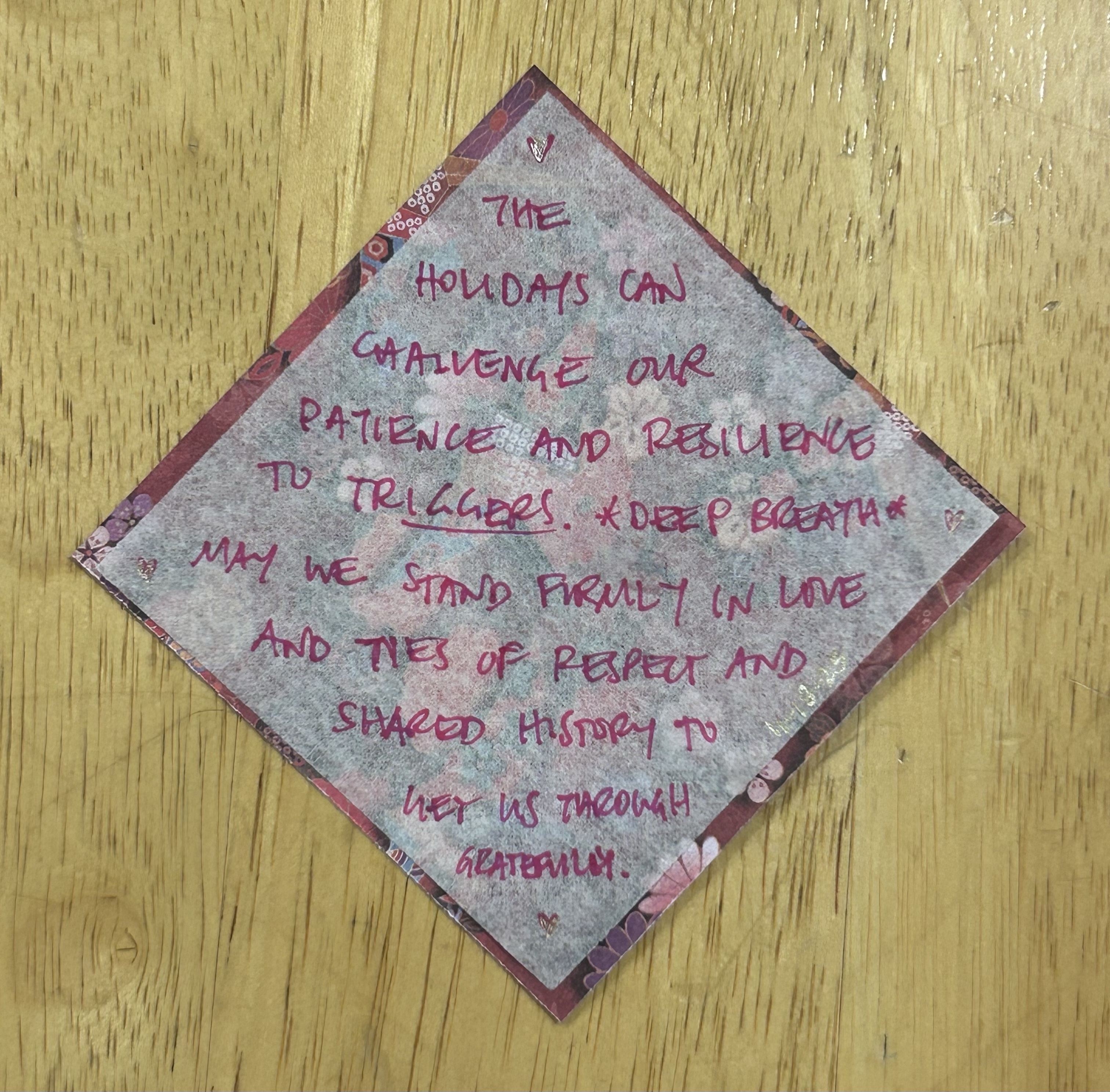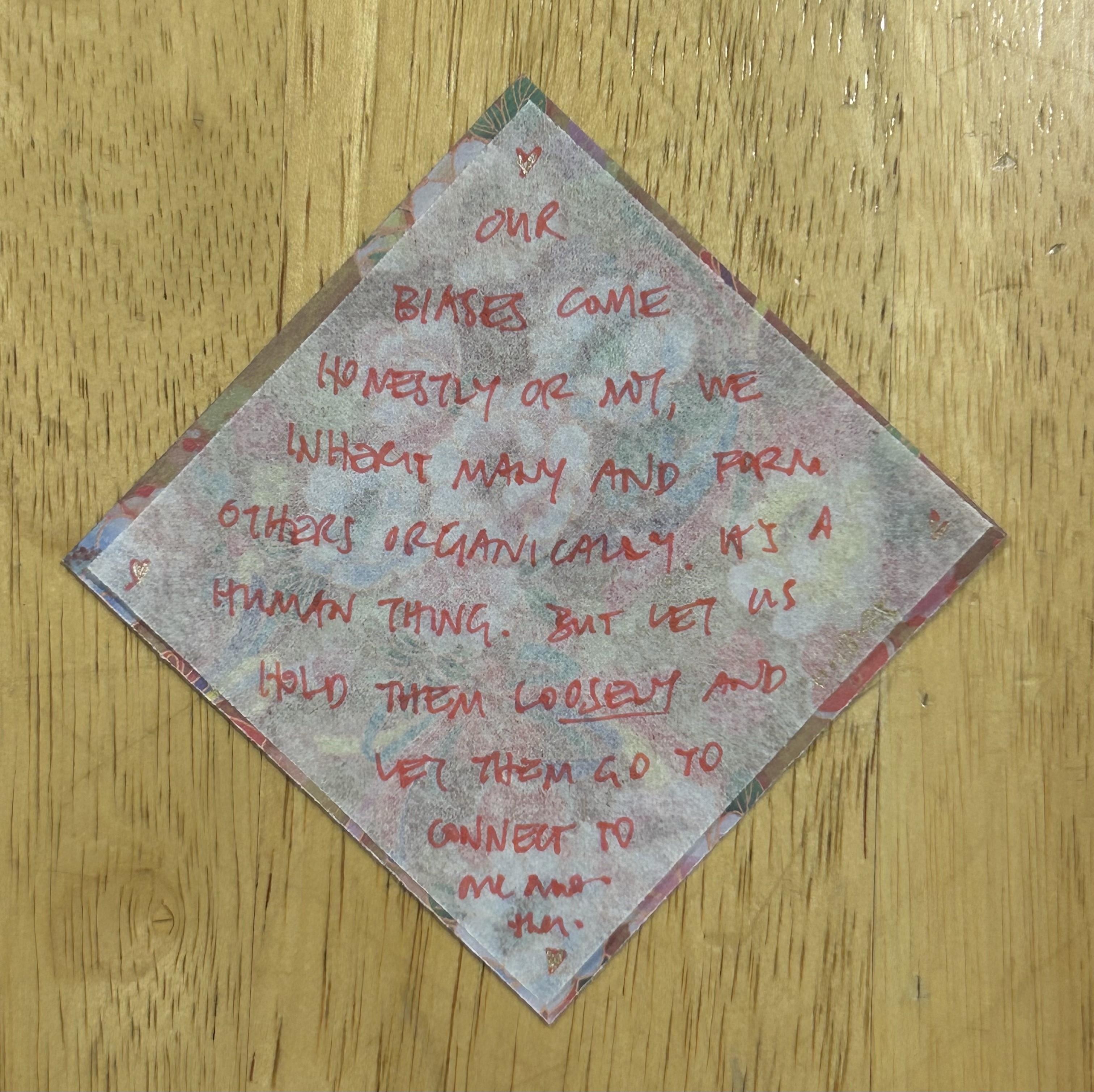
Self-Efficacy, Ethos Session 1

Ya kinda had to be there, my friends.

And it was all my friends who came to my first ever wellness presentation at Ethos today. For two easy and loving hours ten of us engaged in openness, curiosity, reflection, thought, and connection. After outlining the general themes and objectives of my past wellness presentations, General Manager Elena landed on ‘self-efficacy’ as the all-encompassing concept when we discussed our plans earlier this year. It felt immediately right. This was to be the first of four sessions throughout the year.

Self-efficacy: “an individual’s belief in their capacity to act in the ways necessary to reach specific goals.” (Bandura, 1977, 1986, 1997)

I have presented to academic surgeons on national stages and judges of the Federal Circuit Courts. Still, speaking to the Ethos community made me a little nervous. There would be fitness experts in the audience–what could I ‘teach’ them on the topic of exercise? This was a new and potentially very diverse group; one that did not necessarily know my credentials or professional expertise. My highest goal was for all of us to leave the session feeling inspired, empowered, connected, and thought-provoked. My intent was not to simply lecture or convey, rather to offer, invite, and receive in fluid exchange and mutual engagement. I had to give msyelf pep talks all week, calling forth my confidence in attuning, listening, asking good questions, reflecting, paraphrasing, as well as presenting.

What a real-time practice in self-efficacy, no? Walk the Talk, Chenger!

Dry erase before: “Of health and wellness: Domains, Practices, Attributes”

I planned today to introduce my ‘5-3-5’ framework of health: 5 domains, 3 core practices, and 5 atrributes. It’s a work in progress, which makes it a fun and high-potential foundation for discussion with any audience. After sharing our respective thoughts and experiences of self-efficacy, we explored how it applies in health and wellness.

“What are important domains of health?” I have written about ‘the five domains of health’–sleep, exercise, nutrition, stress management, and relationships–on patient action plans and this blog for many years. It’s relevant, reliable, and comprehensive for the purposes of an annual physical exam. But I wanted to learn from this audience how they see ‘domains of health’ in life as we live it. The brainstorm and discussion that ensued showed us all how layers of complexity and interconnected relationships at both individual and collective levels impact our experiences of both health and un-health.

Self-awareness, self-regulation, and effective communication: in my mind, these are the three core life practices that help us assess, adjust, and adapt to whatever life brings. The group’s suggestions of key health practices, we could argue, could all fit under one or more of the three. And it also emerged today that there may be a missing element of movement–that to be healthy we must not only attune inwardly, but act–we must both be and do–or not–there’s something here about intention and volition, about agency, I think. I invited. My friends offered. We noodled, played, exchanged, and documented. And now I have so much more to mush around with, to dig into and mine for treasures!

“When I am healthy, I feel…”

By now folks had caught on. I ask the open-ended question, record the responses, and when one of my own words comes up, I write it under the heading. Brother-in-law Kinnier compared the process to playing Family Feud and we all laughed. When I think of how I want us to feel in health–in body, mind, spirit, work, and relationship–these five words top my list today: Stable. Strong. Flexible. Agile. Resilient. The words my friends offered in this section represent sensations, emotions, and states of being, among other things. What words would you add? How besides words would you express/explain what it means to you to be healthy?

When I look at the ‘after’ state of the board (I did not take a picture of the whole due to glare, but I wish now that I had), I feel so gratified. I successfully offered my framework for health, developed organically and in collaboration with patients, colleagues, friends, and fellow life journeyers over decades of medical practice and living. We agreed at the end that next time we can include non-verbal expressions such as emojis, diagrams, symbols, and pictograms, to further deepen our exchange and discourse on these ideas.

*sigh*

The openness, curiosity, safety, warmth, connection, and love I felt today, friends. Ohmygoodness. I had to encourage myself in advance, reassure myself that I had what was needed to lead a discussion, to facilitate this opening, and invite and allow all of our wisdom to emerge and mingle. The energy in the Den vibrated today. It had a temperature, a depth. We all both contributed and benefited (I think), offered and received. The outcome felt elevated and synergistic–immensely greater than the sum of its individual parts.

This presentation series is part of my project to broaden my reach, to expand my contribution in health and wellness to more audiences, and to facilitate engagement, empowerment, and agency for individuals and organizations. Elena and I had orginally planned four quarterly sessions this year. Today’s session lasted thirty minutes longer than scheduled, and many of us wanted to keep the energy flowing, to continue the conversation sooner than three months from now, as we looked at the ‘after’ state of the board and saw so much possibility for future conversations!

YES. THIS. This is what I live for, my friends!

I write this summary so those who could not attend today might get a feel for what it was like. But I could only capture here a fraction of just my own experience. There is just something about a gathering, an intentional meeting when and where we choose to spend (give?) our time, energy, and resources together in service of lifting ourselves and one another.

There are simply not enough words to express my gratitude and appreciation for my friends who showed up today. Their unwavering presence and love made it safe for me to be BOOBS OUT, all me, all in, open and honest, curious and confident. We agreed today to all go home and let it sink in, to saturate in the connection, and see/feel what emerges that calls us to gather and commune around next time.

I. cannot. wait. Hope to see you there!

The Flow of Friendship

30 years this October.

Janet and I met at our white coat ceremony in 1995, sat two seats apart, alpha by last name. Walking home from school days later, I learned her family lived in Denver for a while when we were kids. We exchanged parents’ names and went home to call our respective ones. And get this: Her dad was my grandfather’s student, and stayed at the Cheng family home in Tainan, Taiwan one summer while studying engineering. He was one of Yeh-yeh’s favorites. We went to their house for dinner once (neither Janet nor I remember). When Ba recounted the evening, he got most animated about the concrete foundation that Janet’s dad had laid for the playhouse in the backyard (both dads are civil engineering PhD’s).
Positively. Cosmic. Sisters.

We were joined at the hip in school. We sat at the back of lecture halls, Janet doing crosswords and I writing letters. As anatomy partners we created mnemonics with gestures to remember the cranial nerves and their exit points from the brain. We learned interviewing and physical exam skills together, went to the gym, cooked, and basically grew up together in the final stages of adult brain development. Some of our teachers could not tell us apart. We rotated on pediatrics together when she met her now husband, an intern then, eating French fries and drinking ginger ale on call every fourth night. We attended each other’s weddings (I got to stand up in hers). Our kids are similar ages.

As an executive health internist and academic neonatologist, our professional worlds overlap little, yet we still speak multiple languages in common (including American English-accented Mandarin). As we, our parents, and our children have all aged these three decades, contact has fluctuated and our bond remained intact. This weekend Janet came to Chicago and we spent three days together cooking and yapping, our longest in-person time in fifteen years. We made a menu in advance and headed to the grocery store on her arrival. These three days we cooked Vietnamese spring rolls, green onion pancakes, fried rice, potstickers, and curry beef pastries, all steeped in nostalgia and yumminess. Doctoring, momming, daughtering, wifing, teaching, leading, citizening–we covered it all while mixing, rolling, wrapping, frying, steaming, baking, and of course eating.

Our class stays connected on a What’s App chat and we are impressive, I must say, many of us leaders in our fields, making an impact. And yet when we gather, we still meet as the people we knew then: eager, optimistic, young students. We reach out with news, requests, and just to say hi. That easy connection is just so special. How have 30 years passed already? Will we still be around to celebrate another 30? It’s possible, and I will revel in every year we get with one another in the interim.

Dear readers, I wish for us all to have friendships like this–the ones that persist with easy and steadfast confidence, that we trust implicitly, that validate and support, that endure and mature in mutual respect, admiration, growth, and evolution. It’s these meaningful relationships that will hold us up in life, no matter what happens.

Isolation and Public Scrutiny

What aspects of your work do you share with other professions?

I have presented on health and wellness to members of the judiciary for some years now, and the more I learn about judges’ work, the more I admire. How humbling to be invited to speak to this audience; I think judicial work is severely misunderstood and thus unfairly judged (bad pun) by many. Imagine serving as the sole arbiter in complex cases at the multilane intersections of human behavior, relationship, and the law. Legal rules and regulations constrain process and thus outcomes that you may advance, and hardly anyone outside your profession understands any of it. In your lawyer days you had close colleagues with whom to confer, commiserate, and confide. As a judge it’s just you; your built-in community has suddenly and largely disappeared. On top of that, you are a public figure whose words and decisions are subject to scrutiny by anyone and everyone, who may all feel entitled to opine on your work and even you as a person from any perspective, informed and educated or not. And in this world of echo chambers that so easily incite violence, your and your family’s personal safety are now also potentially threatened.

I have reviewed academic and clinical resources to help judges address these risks to health in their work. That body of knowledge and support has grown significantly of late.
Then it occurred to me recently that my author and voice actor friends may also cope with isolation and public scrutiny, albeit in different ways from judges. So I queried them for reflections, insights, advice, and solidarity.

The response absolutely bowled me over in its immediacy, kindness, thoughtfulness, generosity, and discernment. One artist even offered to Zoom and we talked for 2.5 hours, with a future date to continue the conversation already on the books. Wow.

How wonderful when we can share human experiences across domains? My query post reads: “This feels like a great thing to crowd source! To see and understand similar challenges of divergent professions makes us more open, curious, and empathetic. And that makes the world better, no?” I attempt here to compile and synthesize my friends’ wisdom and add my own reflections. My deepest thanks to all who responded. I have quoted with permission and otherwise paraphrased with care and respect.

I hope this post may serve as documentation, reference, and solace for anyone who feels weighed down by isolation and public scrutiny.
May my friends’ and my words help lighten your load:

Connect Proactively
Physical and social isolation are a fact of life for folks with solitary jobs. You may need to initiate contact more often with both colleagues and friends, as the rest of us take for granted that we see one another in our default environments. Attend conferences, schedule dates, keep up with your hobbies. Set boundaries on time alone and honor them–honor yourself and your needs for connection in this way. And practice self-compassion for your imperfect efforts. If these are new skills, they will take time to establish. How can you recruit help? Connection means not doing things on our own. Even the Lone Ranger had at least one reliable and loyal companion. I ask patients at least every year about their emotional support network. We need that sense of security that when we reach out, whether for a joke, a jog, or acute and serious assistance, someone will reach back without hesitation and sit, stand, walk, and be with us in unflinching solidarity. This kind of deep and steadfast relationship requires active and attentive cultivation, and if it takes overcoming circumstantial isolation to achieve it, then that’s what we must do. The investment yields priceless returns.

Talk Shop, Then Step Away
We all need people who speak our language, with whom connecting is as effortless as it is meaningful. Confidentiality regulations limit judges’ speech more than most professions. And still I have to imagine, as in medicine, we can discuss case scenarios in lieu of specific cases; we can commune with colleagues around the experience of the work, if not the details. The cognitive, emotional, and relational stressors of any case (medical or legal) can weigh heavily because we engage with and affect, sometimes profoundly, the lives of our fellow humans. Folks who live the work first hand don’t need confidential details to relate to our experience. They empathize already. Their immediate presence and understanding soothe us in uniquely needed ways. “I’m having a hard time with…” “I’m feeling the weight of…” When we hear our esteemed colleagues utter these words, we stop what we’re doing, listen, and care.

That said, collective navel gazing has pitfalls. Fresh perspectives from outside our usual circles broaden our minds, challenge our assumptions, and make us deeper, more considerate thinkers and professionals. I asked authors and narrators about their experiences, intending to relate them to that of judges, and found myself relating, too.
The outside perspective can both enliven our work and provide a much needed escape from it. How often do we stumble upon insights and solutions randomly, while engaging with activities and people in completely unrelated contexts? The most innovative, creative, and revered professionals in any domain practice consciously stepping away from the deep work intentionally and regularly, freeing mind and soul to receive the EUREKA– or not. It’s okay and healthy to just hang out and have fun, too.

Discern the Voices That Matter
On the subject of public scrutiny, many thanks to Will Watt, voice over and performance artist, for your wisdom:
“The first thing to acknowledge is that you cannot escape scrutiny. Whether it’s personal or professional, it’s a fact of life. It is not a mark of judgement, although it can feel like it. There will always, always be someone with a dim or contrary view of you or your work, and that’s okay. When it comes to who you are as a person, in a professional environment, it’s important to try to disengage the personal from the professional. It’s easier said than done…
“When it comes to your work itself, scrutiny is important and should be expected. Nobody is ever 100% right 100% of the time. That’s why we have due process and peer review. Again, what’s important is that separation of person and profession. It can feel tedious or disheartening to get professional blowback for something you worked on in earnest, but that blowback should be seen as an opportunity for growth. We learn from mistakes, and we learn from exchange. It’s not a faux pas to get something wrong. It is a faux pas to be surly or bullheaded in the face of getting something wrong. Being proven wrong is like drawing a dead-end on a treasure map. It’s helpful. It gives you – and others – direction and purpose. It helps you for next time.”
“Sublimate,” my friend and writing mentor says. “Try to see whether the criticism has some basis… ignore the often hurtful feelings, and learn from it.”

Here again, context and perspective count. Whose scrutiny and criticism actually matters? I see an important paradox here. Every voice matters to some degree, and even the most innane or ignorant expression may yield important insight, however inadvertently. Most opinions also carry some degree of projection and bias, which needs parsing–it’s often not about us at all. Multiple writers and actors impressed upon me the importance of not taking things personally, even (especially) the ad hominem attacks. “Check the facts,” as the dialectical behavior therapists say. If someone’s opinion–positive or negative–affects me disporportionately, what is that about? Understanding our own patterns of reaction to scrutiny is half the battle of navigating it more easily.

In the end, we all must decide which voices deserve space in our consciousness. Authors and actors, and even physicians don’t read or internalize every consumer and patient review. Every opinion is not equally valid, relevant, or useful.

Practice Integrity, Accountability, and Humility
Does the work you do–your output–align with your Why for doing it? Is it consistent with your professional oath and ethos? Can you stand behind it with your head high, shoulders back, and defend it with integrity? If so, how do you know?

Those close colleagues can tell you. If you’re connected well enough, they see you, know you. And if you care about one another, they will tell you honestly (and hopefully kindly) when you need to reset perspective, stop deluding yourself, or get a grip. What Will said about separating the personal from the professional is important. I would also suggest that it cannot be a complete and total separation. We are who we are in both our personal and professional–in all aspects of our lives. The most meaningful work, I believe, is an expression of ourselves, no matter the domain. So assessing the relevant scrutiny, acknowledging mistakes and missteps, learning from them, and maintaining a growth mindset are all part of living an accountable life, professional and otherwise. This robust root system of integrity and accountability, in turn, makes the isolation and public scrutiny more tolerable.

So often my writings return to the same ideas. Here I land on confident humility. Whether we are doctors, lawyers, judges, writers, or actors, we have trained. We are experts in our fields of study and work. And yet none of us knows it all. There will always be more to learn. However we are right, it’s always only partially. Humility, in addition to integrity and accountability, liberate us. They keep our minds and hearts open to what we don’t yet see, know, or understand. They keep us connected to our fellow humans, no matter where we’ve been or what we do.

The other recurring idea in recent years is goals and trade-offs. Whatever line of work we choose, assuming we choose it, we must decide for ourselves what we want out of it. Then, what are we willing and not willing to do, to sacrifice, to get it? I think this assessment should be made regularly and frequently. Goals and trade-offs can change over time; we learn, grow, and evolve over a life. If we feel isolated, and/or if public scrutiny feels heavy and restrictive or threatening, we can ask first, are we okay with it the way it is? Are the rewards worth the risks and costs, to us and our loved ones? If not, then what needs to change, and how? That question feels like an invitation to me, an expression of possibility.

If we can move our focus from isolation and public srutiny to community and relevant appraisal, then I believe we will suffer less and live more joyfully in our lives, both professionally and personally.