Posted on Facebook, in rapid response to my friend’s share of an Alzheimer’s Awareness Week message:
More and more of my patients seem to live in fear of dementia, and rightly so. I see it as my job to hold that fear, validate it, and also monitor for its immediate effects. Constant fear that looms over us like a black cloud is threat stress, and that has significant negative health consequences in itself, both immediate and long term.
How can we get to peace with our inevitable end, however it may occur? I was just thinking about it this morning, as I have written about it often the past 8+ years on the blog. Today I believe that if I were to die tomorrow, and I had five minutes at the end to relfect, I could be at peace. But who TF knows? I could be a thrashing rage case at the end of my life, depending on the circumstances. But I realized this morning that this may be an excellent example of a Useful Delusion. Because I feel, however irrationally, at peace with my own death today, I can live more peacefully now, freed from that particular fear. Maybe. That’s the story I tell.
Of note: None of us can actually control our future health and death. But we have so much agency to influence risk and likelihood. Thankfully, all of the behaviors that help prevent heart disease also lower the risk of everything else: cancer, diabetes, obesity, and dementia. None of us can be perfect in all of our health habits; some are easier than others for each of us. But if we focus more on goals and trade offs, acting intentionally and mindfully as much as possible, assessing and adjusting often, I think we will have less to regret at the the end, no matter what happens.
—————
Someone once said when you love someone with Dementia you lose them more and more everyday. When they are diagnosed, when they go through different stages, when they need treatment and when they die. This is called “Ambigua Loss.”
I wouldn’t wish Dementia on anyone. As the brain slowly dies, it changes physically and eventually forgets who their loved ones are. They can end up lying in bed not moving and not eating or drinking.
There will be people who will scroll by this post because Dementia has not touched them. They may not know what it’s like to have a loved one who battled or is fighting Dementia.
To Raise Awareness of this Cruel Disease, I’d like my Friends to Put this on their Page Today.
Hold Finger on Post to Copy and Paste to Your Timeline.
A Special Thank You to All Willing to Post This On their Timeline for Alzheimer’s Awareness Week
What is your morning routine? Do you run it, or does it run you?
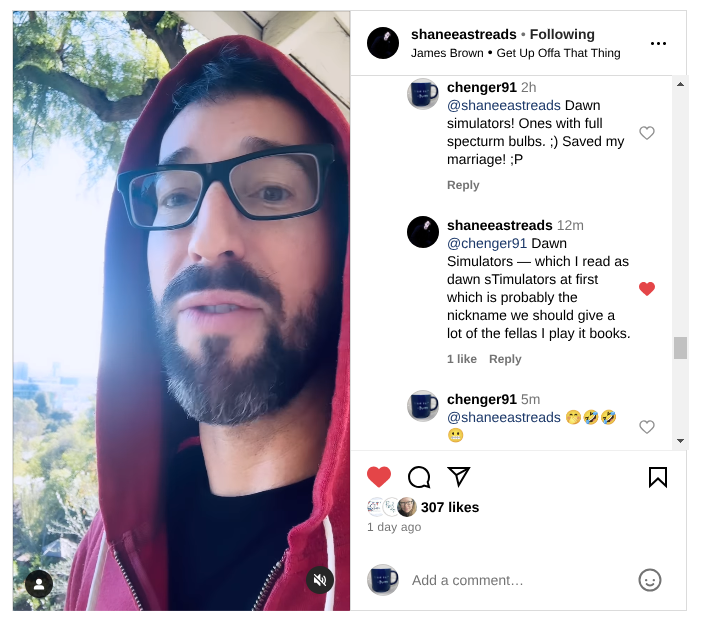
In the video post of the screen shot above, my romance narrator heroShane East reports on some morning advice he heard on a podcast on New Year’s Day (Huberman?), and invites followers to try it with him: 1. Upon waking, get sunlight for at least several minutes before getting on any screen 2. Delay caffeine intake for at least 45 minutes after waking For the second, he describes the relationship between caffeine and adenosine, the neurotransmitter that promotes sleep drive. Simply, caffeine is an adenosine antagonist: when it sits on adenosine receptors in the brain, which normally slow cellular function and promote sleep, it has the opposite effect, promoting wakefulness instead.
I dived into the rabbit hole that yielded the articles linked above, trying to understand the rationale behind that second recommendation. My takeaways: 1. Transition from sleep to full wakefulness takes time; better to let the body do it naturally by drinking water (we get dehydrated overnight) and getting light (preferably full spectrum sunlight, but get what you can that’s not a screen) on the retinas before doing anything else. 2. Caffeine can prolong and/or amplify effects of morning norepiniphrine and cortisol, which have stimulatory effects on heart rate, blood pressure, and other systems of the body. It can interfere with physiologic adenosine recycling in the brain and, depending on dose and interval, disrupt our intrinsic sleep-wake patterns. Introducing caffeine later after waking, when adenosine levels are lower and more stable, can mitigate this disruption. 3. None of this matters nearly as much as simply getting enough sleep (both quantity and quality) as many nights a week as possible, to obviate the need for stimulants in general. But caffeine and adenosine are not my point in this post.
Rather, why am I suddenly so motivated, almost giddy, to act on this advice just because Shane said so? Really? Not when I heard it in Why We Sleep, not when I have ever read it elsewhere. Not because I’m a doctor and I know it’s good for me and I want to walk the talk. No. My book hero got up on the third day of this new year, made a 00:01:03 extemporaneous video sharing something cool he had recently learned, invited us fans to try it with him, and that lit one of the biggest behavior change fires under my butt since I joined Ethos nine months ago.
Readers of this blog may know my night owl tendencies. I have been known to post at 1:00am, then get up at 7:00 for work. That hasn’t happened in a while, because I’m working on it! And yet, habit change is hard. I have wanted for years to get up early to write Morning Pages, a creativity and wellness practice that calls to me. But before last week, I slept through all the calls. On a good day, if I left on time for work, I’d write in the car after turning off the engine, before walking from the parking garage to the office. For seven consecutive days now, I have risen with my alarm rather than snooze it. I sit up, turn on my full spectrum bedside lamp (the bulb came with my dawn simulator years ago, and has survived its associated device), grab my journal and write three pages, stream of consciousness, so I have something to distract me from my phone and keep my eyes open to light while I wait for my caffeine. I only look at my phone to turn off the alarm and get my writing playlist going. Win-win-win-WIN! By the end of three pages, here are my consistent findings so far: 1. I feel alert. 2. My mood is excellent. 3. I’ve gotten out ideas that marinated overnight, or maybe worked out some question I had gone to bed with the night before. Or maybe I uncovered addtional questions yet to ponder. Regardless, I have just spent 15 minutes doing something I love, first thing in the morning! That’s all pretty amazing.
I have known about the benefits of drinking water in the morning for years. I keep a water bottle at the bedside. But it wasn’t until last week that I started chugging in the morning, while I write. And because I’m getting up earlier and spending more time awake and out of the kitchen, my morning coffee consumption now automatically occurs at least 45 minutes after waking. It all feels almost easy.
And bonus: This new practice seems to have created space for insights and ideas to emerge throughout the day. I’ve made entries in the book journal almost every day this week, and momentum grows toward writing actual chapters and a proposal. I have also realized this week that since ideas so frequently occur as I drive to work (I often grab notebook and pen, scribbling while stopped at lights–hence the parked car journaling), I will now forgo the input of audiobooks (ugly cry face) on the morning commute to facilitate my own original output in that naturally creative time. And I attribute all of this to Shane.
What is with this phenomenon?
Normally I would cogitate long and hard, analyzing the psychology of motivation, cross referencing counseling practices for behavior change, looking back at my own past patterns, etc. Not this time. Today, I’m satisfied to wonder at it all a little while, marvel at the minor miracle of it, and then chalk it up to the utterly irrational nature of human behavior. I love and admire Shane as a person. I see him as trustworthy. I appreciate that he shared this advice, prompting me to search and learn more, nudging me toward my better self. I want to report to him that I accepted his invitation and it helped me.
Because that’s one of the best relational rewards, right, when someone tells us how we help them, how we make their lives better? Isn’t this why I’m a physician? My fondest, most loving memories throughout my career are patients and trainees telling me how I have helped them–yes, it’s my job and still, any amount of validation, no matter how small, matters. It’s even more meaningful after we have gone through multiple trials in their lives or training together. The more we acknowledge this bond, the stronger it gets, the more we trust, mutually.
Patients and students absolutely influence me. Because they trust me and consider my advice, I want to be worthy of it. Trust is built slowly, earned with time, energy, and effort. How better to honor that trust than to practice what I preach, visibly, right alongside my charges? Maybe this is why Shane’s video resonates? He’s getting in the boat with us fans, acknowledging the challenge, inviting us all to journey together, do our best, and see what happens. Had he said, “Hey, I learned this cool new thing, you should try it! Good luck, tell me how it goes!” I would have a very different response.
Trust and influence. They are irrational, driven by our qualitative, ineffable, limbic and sometimes labile sense of connection. I think of trust like an oak tree–grown over many years, strong and sturdy, and also susceptible to irrevocable damage in a single breath–a broken branch never grows back. There is no substitute for the attention and nourishment, cultivated through relationship, required to maintain strong trust and real influence.
Though my energy for this new habit is high today, change is still hard. I have significantly altered my daily routine, counter to what I consider to be my innate tendencies, which is not what I usually recommend. We will see how/whether I can sustain it. Maybe it will help that I was already approaching the threshold, and Shane’s video feels like just the little nudge I needed to push me over to the next best version of myself? Fingers crossed! Lasting change is most often incremental and iterative, requiring multiple trials. So I won’t be too hard on myself if by this time next week I am back to snoozing until the last possible minute to rise, rushing out the door 30 minutes later having written nothing and gulped a good portion of my coffee already. I can forgive myself the lapse and commit to trying again–maybe on days I don’t see patients? Something is usually better than nothing. We’re all here doing our best.
Anyway, Shane, if you read this, thank you. You have made my life better for a while, and now again, and given me more things to write about, for the past week, at least. I have two more blog drafts inspired by reflections on your video. I think of them as I walk to work, and I get Resting Peace Face from the gratitude I feel for the possibilities that have opened in my life because of you being you.
And now it’s late (but not too late). Temperature is -6F outside and I need to get up even earlier tomorrow to write, hydrate, and make sure the car starts. So it’s off to bed for me. I look forward to my Pages tomorrow morning–who knows what may come of this new habit? I’m sure I’ll let you all know as it emerges.
On the sidewalk In the hospital At the mall In the grocery store aisle
In the elevator At the dentist’s office In the waiting room Standing in line
Making eye contact Ready to smile wide At the cute baby And their exhausted and attentive mama
Inviting greetings Inciting connection Noticed for how different It feels to see and be seen
In a world that can feel so cold So distant, lonely, and isolating
The Resting Peace Face Our peaceful presence In any space, among any humans Could mean more than we can imagine
as seen on Instagram
Been basking in the love of friends and books lately. Walking around with a noticeable half smile, even more than usual. Waving every day to the crossing guard by Daughter’s school, and the homeless dude by Lake Shore Drive. Just *feelin‘* it, y’all–reveling, soaking it up.
Not sure if smiling can actually beget happiness Or if it’s only the other way around. Does it matter? How can we get more of it all, regardless?
I know that when someone smiles at me, I automatically smile back, and it feels good. So why not do the world around me this little bit of good, wherever I am? Costs me nothing. And I (we all?) gain so, so much.
Onward, my friends. Life is short. Connect and heal. One smiling Peace Face encounter at a time.


 Healing Through Connection