

The Best Thing That Could Happen

IMG_3222

What do you think is the best thing that could happen out of the COVID-19 pandemic?

I think it’s Connection.

How ironic, as the current best solution to mitigating illness and death is physical (not really social) separation.

Connection won’t come easily, though.  Today I felt all kinds of yuck:  Conflicted.  Unsettled.  Angry, Cynical, Fearful, Guilty, Annoyed, Confined, Enraged.  Not exactly connecting emotions.  The people going about their usual routines, disregarding distancing guidelines, and claiming it as their right to ‘live free’ agitate me the most.  When they get sick, and after they have infected numerous others, some gravely, my colleagues and I will care for them the same as for those who followed the guidelines and acted unselfishly for the greater good.  We will put ourselves in harm’s way, and more of us will pay with our lives for their false freedom.  Because when your ‘right’ to ‘live free’ puts others’ lives at risk, that is not freedom.  That is negligence.

That said, I’ve not lost all hope.  Through Facebook, Zoom, email and snail mail, I am now better connected with some folks than before, and I’m grateful.  They have helped me consider and envision the best possible New Normal on the other side of COVID-19.  I share my wish list below, as well as links to my favorite articles from the past week.

Also, join me this Wednesday, April 8, at 6pm Chicago time for an Instagram live chat.  Owners Tim and Victoria at Ethos Training Systems will host a fireside-style session on COVID-19.  You can join by finding me, chenger91, or Ethos, at the time above.  Please know that I do this public event as a friend of Ethos, and not as a representative of my employer or any medical professional society.  I claim no expertise in infectious disease or epidemiology; I’m just one doctor doing my best to share relevant information and practical advice.

IMG_3635

To Create Our Best Post-COVID Future, Let Us:

Continue to connect earnestly with people near and far.

Advance toward universal healthcare in some form, and shore up our social safety nets.

Reclaim our collective mindset—temper extreme individualism with more altruism and empathy.

Slow down—maintain more flexible work schedules, better childcare options.  Generate less pollution, decrease unnecessary production and consumption.

Live more mindfully and in the present:  Enjoy the good more and dwell less on the bad.  Increase both awareness and appreciation of all that is well in life.

Hold rigorous science and medicine far above opinion and ideology.

Practice Learning, Flexibility, Agility, and Resilience, in all domains, large and small, individually and as a collective.

Recognize our shared humanity, maintain that recognition, and act consistently from that recognition—bake it into our cultural norms henceforth.

IMG_3595

Pieces that helped me the past week:

An excellent review of the evolution of and rationale for universal masking:  https://www.vox.com/2020/3/31/21198132/coronavirus-covid-face-masks-n95-respirator-ppe-shortage?fbclid=IwAR237JXMUy94AcI_4uigdP3ZZUfoNd1c_4tyRDi-A8u2BYm7YZmSJ0f3ii8

A summary of current knowledge of SARS-CoV-2 and COVID-19, written accessibly and with practical recommendations, by my teacher and colleague, Dr. Alex Lickerman:  https://imaginemd.net/blog/coronavirus-april-2020-part-5/?fbclid=IwAR20m7QfOSUlZlAZuTaytKDaw210j_wWuqd6xgGBeTbIHAEfZeASfDnYTac

Dr. Lickerman doing a similar review as a guest on a podcast, also excellent: https://www.larryweeks.com/ep-36-coronavirus-qa-with-dr-alex-lickerman-m-d/?fbclid=IwAR077iOtNkCGcyjJdjVWZWKW6RWgtNhVgdN7cYvrnd2bQcbaStrRvTjdqAE

From Maria Shriver’s Sunday PaperBut today is Palm Sunday, and Easter Sunday is a week away. This week is the beginning of Holy Week, a time of spiritual renewal and rebirth. So, I’m taking that as a sign that we aren’t meant to go back to what was. We are meant to go forward both individually and collectively. Each of us will come out of this time a different person, a changed human being. How could we not?
What a double tragedy it would be if we went back to the way we were. To a time when we didn’t care for our planet. To a time when we were so mean to one another. To a time when we were so divided in every way. To a time when we didn’t know our neighbors. To a time when so many only cared about themselves and saw others as the “other.”

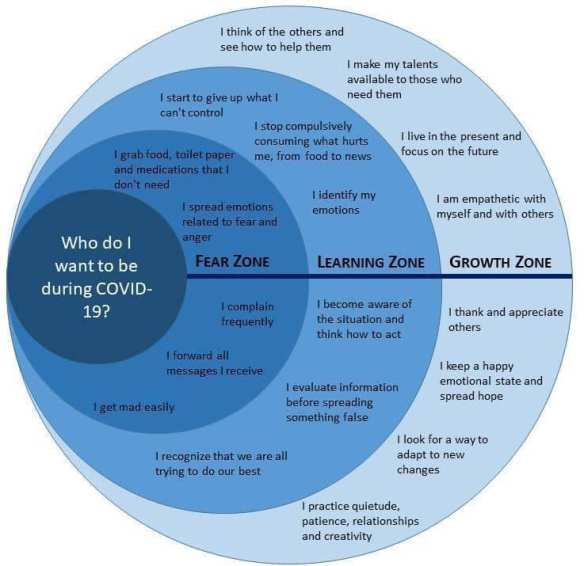
A diagram shared on social media of our human responses to the crisis (I don’t know who created it—if you do, please give credit in the comments and tell them thank you).  I think it’s normal that we should find ourselves doing things in each of the nested circles every day.  We can exercise compassion for ourselves and others at the same time:
covid nested circles

Finally, a poem, also from Maria Shriver’s Sunday Paper, shared by her niece, who died with her 8 year-old son the very same day:

covid after poem maria shriver niece maeve

Things will likely feel worse for at least a few weeks before they feel better, my friends.  Hold tight to those you love and who love you.  Count your blessings.  Take perspective.  Consider deeply our inextricable and undeniable interconnectedness.  Be kind.

Finding Peace in the Morass

IMG_3338

Friends, how are you feeling and doing today?

Three weeks ago workouts and bedtime went to hell for me, as it became clear that coronavirus would soon turn our lives upside down and inside out.  I could not read fast or widely enough.  At the end of that week I posted three times in four days, discharging all that I was learning, attempting to convince anybody I could that the tidal wave was coming.  I felt like Chicken Little.

The last two weeks saw myriad conference calls, reorganizations, virtual team huddles, sleepless nights, workflow changes, text threads, mood swings, mass emails, sporadic workouts, and also moments of connection, both personal and professional.  In an effort to stay informed, I put Facebook back on my phone, to keep up with the medical COVID groups sharing information and experience.  It’s exhausting.  As of this moment that app is once again deleted.  I need a better new normal.

I’m not doing my usual in-depth, in person interviews and exams with patients.  I really miss it.  But my phone conversations have been no less meaningful.  I hear about my patients’ cough, fatigue, fevers, headaches, and sore throats.  Some have diarrhea.  Some can get tested for coronavirus, others cannot.  We work through it day by day.  I also hear anxiety, confusion, frustration, fear, and uncertainty.  I do my best to be objective and evidence-based, as well as compassionate and empathetic.  I always wish I could do more.

I think it’s uncertainty that people fear the most.  When we don’t know what will happen, especially when the possibilities are as divergent as COVID-19 outcomes, everything is nebulous and scary.  What can we expect?  How should we prepare?  If we choose one path, what if it turns out differently, and we did the wrong thing?  How will we cope?  All this social distancing and sheltering in place—it’s decimating the economy.  Those voicing concern over this must not be dismissed.  Meanwhile, what do we do?

If I feel sick, am I infected or not?  Am I contagious or not?  I can’t get a test.  What should I do?

*****

Over the holidays I read Being Mortal by Atul Gawande, my favorite physician writer.  His eloquent and accessible writing on aging, illness, and the American end of life experience should be required reading for every physician, and really every adult.   After finishing the book, I decided that in order to die at peace, we must live in peace.  And peace must be cultivated.  It’s not something you can invoke in the midst of crisis, unless you have practiced.

IMG_3339

Let Your Breath Lead You

I learned about box breathing at the International Conference on Physician Health in 2016.  It resonated because I had already attempted a mindfulness meditation practice for some years, with varying success.  Inhale, hold, exhale, and rest, each for a count of four.  This is not a normal breathing pattern.  So it’s both a mental (attention) and a physical (parasympathetic stimulus) practice.  It lowers blood pressure and heart rate, and eventually cortisol levels.  It is also known as tactical breathing, as soldiers train for combat with this very practice.  The objective is focus and calm at the same time.  I have practiced since 2016, also with varying consistency and success.  These three weeks I have pulled on this technique as a matter of course, and it has saved me.  When the mind is full and chaotic, we can call on the body to lead us to peace.

Accept and Embrace Paradox

Human nature is to overgeneralize and oversimplify.  We seek simple, compartmentalized solutions to complex problems, often in binary form:  black or white, open or closed, good or bad.  But much of life is simply the opposite of simple (ha!), especially during a pandemic of a novel virus.  What we need is a way to tolerate the inherent ambiguity and uncertainty that life will always bring.  Here I must credit “The Big Bang Theory” for teaching me about Schroedinger’s Cat.  It’s a physics thought experiment in which a cat inside a box with a toxic radioactive substance can be thought of as, paradoxically, simultaneously alive and dead until the box is opened and its true state revealed.  In the case of coronavirus:  If you have had an exposure and you feel fine, or if you feel sick but it’s not that bad, and you cannot be tested, your true state is either infected or not infected.  But since we cannot know, we can consider you to be both.  So what should you do?

  1. Be grateful that you are not gravely ill.
  2. Act like you’re healthy, and live your life.
  3. Act like you’re infected, and don’t do things that will infect others.
  4. Practice, with deep, box-like breaths, the skill of accepting and embracing paradox.

Make a Choice

Even as I advocate vociferously for people to stay home, I understand the economic consequences of this intervention.  Rock, meet hard place.  For a while I asked myself  which I would regret more:  Executing defensible drastic measures in response to those who warned us for months, and then having it be ‘not that bad’ (because we all already know it will be some version of BAD), or doing less than was recommended and having it be unfathomably bad, like it has been in Italy, and what New York City already is?  Lives will be ruined either way, and deaths will escalate, directly from the virus and indirectly from all kinds of other things.  But I could not live in good conscience if we knowingly chose the latter path; I personally would regret that more, and I think our leaders and my profession would be crucified.  Because there are very few ways to prevent the direct deaths now—we missed the boat of containment.  Now our only hope is to slow the spread so as not to overwhelm our hospitals.  But there are myriad options to prevent and mitigate the indirect suffering and death, economic and otherwise.  That is where we can still exercise agency, creativity, collaboration, and innovation.

IMG_3448

Nobody knows what lies on the other side of this morass.  Life will never be like it was before—but that has always been the case.  Make no mistake though: we are all in it together, like it or not, know it or not, want it or not.  At no other time have we seen more clearly how the actions of one affect the outcomes of the many.  In another example of paradox, each of us is both victim and agent at the same time.

So how can we achieve peace?  Look for the helpers, as Mr. Rogers’s mom advised.  Be a helper, as much as you can.  Breathe through the anxiety; connect with those who help you.  Let go false dichotomies and breathe some more.  Plan and execute your small and significant contribution to maintaining and rebuilding the economy.

And please, please—for now—stay home.


Sexism and Apologies 2020

IMG_3811

“If you say, ‘Yeah, there was sexism in this race,’ everyone says, ‘Whiner!’ If you say, ‘No, there was no sexism,’ about a bazillion women think, ‘What planet do you live on?’”

That is how Senator Elizabeth Warren answered a reporter when asked whether she thought gender played a role in her suspending her presidential campaign.  I recommend watching the whole video clip.  In case anyone wonders: if the question even needs to be asked, then yes, gender played a role.  But Senator Warren rightly called out the question for what it is: a trap for any woman running for high elected office.  Her statement summarizes it succinctly; she knows what’s what, and she names it without apology.

I was more upset than I expected when Aunt Eliz Crusader ended her campaign.   Megan Garber expressed the story of my profound disappointment eloquently in her piece for The Atlantic:  “America Punished Elizabeth Warren for her Competence”.  Basically she elaborates the apparently inevitable social equation for women:

Competent  +  Vocal  +  Unapologetic   =   “Strident”  +  “Shrill” +  “Condescending”

The past two weeks I have had a series of encounters wherein I find myself voicing opinions and positions more firmly than I might have in the past.  I feel confident and grounded in my knowledge and expertise.  I am professional and respectful.  I apologized for writing a long email, even though the words were necessary and clear.  My strong woman mentor reminded me to save apologies for when I actually commit a transgression.

What I have learned (perhaps again) in this time, however, is that relationship discord, even just the possibility of it, is what distresses me the most.  How will I be perceived for voicing my concerns, for advocating for my peers and teams?  How will a negative perception undermine my effectiveness?  Will it cost me my seat at this table or others?

Does any man ask himself these questions?

Given that I was already knee deep in vulnerability and self-doubt around these encounters, the Atlantic piece poked my fears and prodded them to the surface.  It shook me.  It also made me angry that here we still are, in 2020, unable to accept, let alone embrace, competent, vocal, and unapologetic women in leadership.  And it’s not just men; countless women also disavow their sisters.

I vented my disappointment on Facebook (of course):

“So it is down to three Old White Men.  Very disappointing.”

A friend tried to make light of the situation, pointing out that Donald Trump is the youngest of the three.  This attempt at levity (from the Right) felt like a nemesis rubbing salt in my fresh wound.  Twice I rebuffed; twice he persisted.  Finally I (voiced):  “I feel ignored and dismissed when I express distress and you make light of it.  Perhaps my distress is not clear to you, because you only know me through social media [we were friendly acquaintances in high school]; you may not know how upset I am.  But after two replies by me rejecting your attempt at humor, to have you schooling me [that humor is a ‘primary’ way] of dealing with [politics] just makes me more angry.”

Turns out he had mistyped; he’d meant to write that humor is one of his primary ways of coping with the absurdity of politics.  He apologized to me.  It felt sincere.  I was consoled, and I thanked him.

Competent and vocal.  Confident and unapologetic.  Respectful and humble.

We need all of these qualities and more to be true leaders.  Women, arguably, must work harder than our male counterparts to prove that we possess all of them.  Then we get punished when the proof proves irrefutable.  How sadly ironic.  The truth is we need many more of our leaders, men and women alike, to own, exude, and model these virtues.  The last two are not weak, though they may feel profoundly vulnerable, which is not the same thing.

I feel urgent impatience at the state of sexism in America.  But I know how to soothe and manage myself; I can reclaim the patient urgency of fierce optimism at my core.

I will persist.

Aunt Eliz has shown me how.