Friends, every once in a while I have moments of relative wisdom and avid connection. Often it comes while responding to patient questions, sometimes on the phone, sometimes on email or portal messaging, and very often over text. So many posts on this blog started as these little, ‘bit’ insights. I marinate them, stir them around, turn them like a Rubik’s cube, until they’re so convoluted that it takes another, longer period to unravel them again to be ‘worthy’ to post.
So tonight I’m trying something new: the Bit Post. When moved, after brief and thoughtful enough consideration, I give myself permission to post these small notes, as is and with just enough background, just to share, in case they resonate with anyone. I feel an urge to engage here on the blog more frequently and lightheartedly, with less perfectionism and self-doubt. So we will see how this goes!
I sent the message below after a dear patient apologized for some behaviors that appear to have led to suboptimal blood test results. They made a self-judgmental comment about their life. I could feel their guilt and maybe some shame. So I replied honestly, as I wrestle with many of the same challenges. The example I give happened just last night.
So we go together, my patients and I. We are all here doing our best!!
Onward, my friends—ODOMOBaaT!
“Your life is what it is. Your choices are what they are, influenced by many circumstantial factors that vary day to day, moment to moment. No need to apologize to me—I’m not you! “I have a rapidly evolving perspective recently on how I counsel people on habit and behavior change anymore. “I’m here to inform and advise, not to judge. All of our choices are trade offs made in real time. I overeat tonight because I’m with friends and enjoying the food and that is more important to me in this moment than losing weight. I may regret it later and I’m not consistent at slowing down and asking myself when the weight later becomes equally important to me as dessert now. You see? “We just have to own both our choices and their consequences. “My goal is to have the fewest possible regrets when I die. I wish that for you too, but only you can know what choices will get you there. “Makes sense?”
Okay friends, this is a fun post with some lighthearted existential philosophy. It also talks about sex, so consider yourself warned.
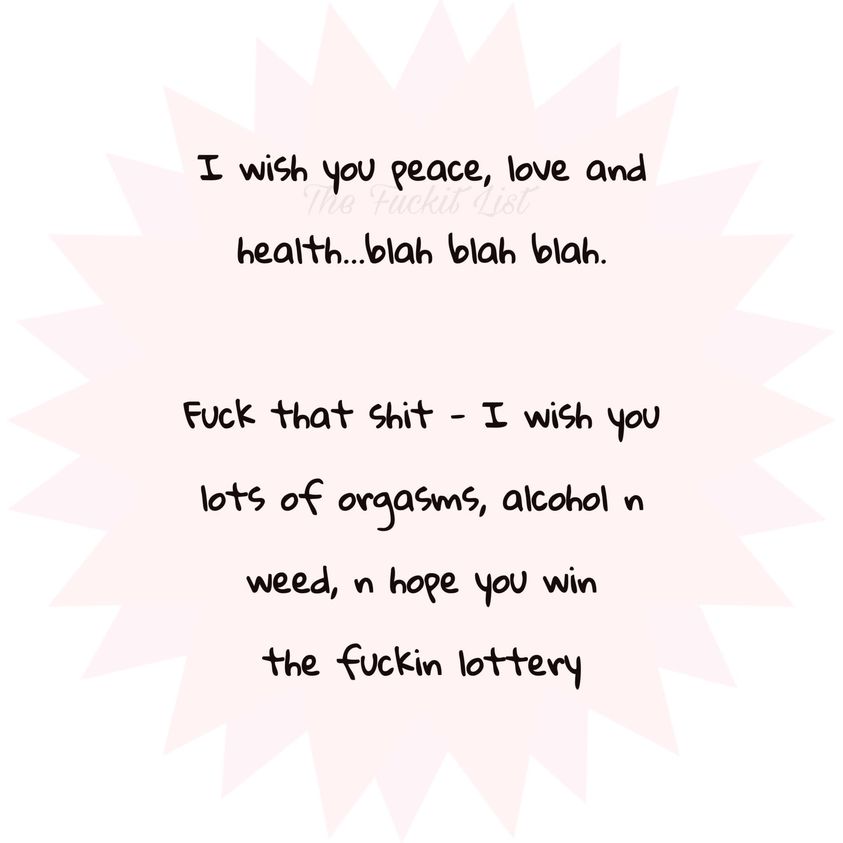
I really do wish everybody peace, love, and health (usually joy, also). People who receive emails, texts, and snail mail from me will all tell you. I also love a cheeky, irreverent expression sometimes, and this one showed up before the New Year:
From The Fuckit List page on Facebook
I shared it immediately with all my friends who would appreciate it, including a brilliant and pragmatic cardiologist. I added ‘etOH [ethanol] and weed in moderation, and the rest–yeah!’
The ensuing email thread between us:
Friend: 😂😆 no orgasms in moderation?!?!
Me: Some things you just cannot get too much of. No risk. 😉😆
Friend: i’ve never heard a physician say “no risk” – only “low” “moderate” “high” risk. so i’m happy to go with no risk!!!!
Me: Teeheehee / It just occurred to me—YOU are the cardiologist!! IS there a risk?? 😱 / I cannot lead people astray here… / I suppose MI [myocardial infarction–heart attack] during sex does occur, right? / So shit, there is a risk! 😣
Friend: i suppose as a cardiologist, it’s always a risk-benefit ratio. risk is very very low. benefit is likely there every time. plus there’s the added cardiac benefit of ischemic pre-conditioning [training the heart with exercise] in those with significant CAD [coronary artery disesae] wherein you can develop angiogenesis [growth of new blood vessels] and collateral formation [bypass blood flow around blocked arteries] in the context of regular sexual/exercise activity. so it’s a big yes to orgasms!!!!
Me: Omg YYYAAAAAAAYYYYY!!! 💃🏻🎉🥳❤️ / And ENDORPHINS, yes? 😄
Friend: ah, yes, sympathetics. you know there is a hypothesis (totally unproven) that you are born with a certain # of heartbeats and once you use them, your life is over. if that is the case, endorphins, sympathetics and (eek) orgasms are probably no good for us. but again, that hypothesis is totally unproven and the more “exercise” you do, the slower the resting heart rate and the longer (observationally) the life. so probably, all in all, better to stick with the orgasms than to avoid them!!!
Me: Ooooo, fascinating!! I bet there is some vague, partial and flexible truth to that theory? Like yes, any given heart has a finite number of future beats left at any given time.
AND, there are likely many things we can do throughout our lives that give it more or fewer remaining beats—like a bank account that we deposit to and withdraw from… 😜 OH I just LOVE this idea!!
Deposits:
Diet: fiber, healthy fats, lean protein, moderate naturally occurring sugars (Food Rules by Michael Pollan: Eat food, not too much, mostly plants)
Relationships (I would bet anything this is proportionally the DENSEST, highest value heartbeat reserve elevator): love, meaning, connection…
Of course withdrawls are the opposites of these… I wonder whether bad sleep or toxic relationships are the greatest heartbeat extinguishers? My money’s on relationships—maybe not even toxic ones—rather the lack of them altogether. It makes total and complete sense to me that loneliness is a better predictor of mortality than smoking (I think it’s actually phrased that it’s a bigger mortality risk than smoking but I bet it’s a better predictor, too—if you look at the data a certain way?)…
OMG this totally aligns with my framework of the 5 reciprocal domains of health!! 😄 ❤️ ❤️
Ok so my mom told me that her dad told her that we are each born with a finite amount of prosperity in life. So the idea is to be frugal with spending, consumption, partying etc in your youth, so you have enough to spread out over a longer lifetime. I do like that idea. It feels akin to humility and generosity to me… So I wonder if there can be a pooling effect among one’s tribe—that we all spend/consume/share over a lifetime and extend/improve all of our lives??
OH thank you for telling me about this, I will think more (and possibly write) on it!! 😄 xo …And maybe my gong-gong’s theory is also flexible like a bank account, too.
I think we get to invent it, since it’s all made up to help us feel better about how we choose to live life anyway! 😄
THANK YOU for stimulating such fun thinking tonight! 😄
Ok more soon, big hugs!!! xo
//
All of these thoughts and ideas poured out between us from 4:44 to 7:22pm on 12/28/2022. I’m not sure more writing is required at this point? I thought about doing the math–for each episode of exercise, how many more beats, and does it even out with a resulting lower resting heart rate over a lifetime…? Nah. It was a fun and thought-provoking conversation between two friends which, for me at least, tightened connection and elevated joy. I am definitely heart-healthier for it.
Hope 2023 is off to a peaceful, loving, and healthy start for you all, my friends, if not a moderately buzzed and high, frequently orgasmic, and suddenly wealthy one. 😉
Another day of threaded media to reinforce my personal biases. Thought I’d share since it feels so cosmic. 😉
Often I find myself with an acute urge to connect with one or a few of my friends. I have long since learned to act joyfully on these urges; in college I wrote letters on pretty stationery and mailed them with confetti (100 in my first year alone). As life got busier that evolved to cards and postcards. And now it’s often an email or text, these days with attached memes or songs, and most recently the 8 minute phone call… I still indulge in the luxury of snail mail often, though.
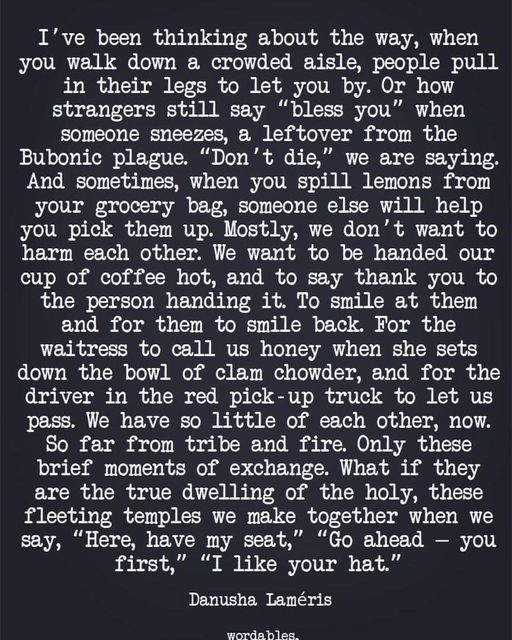
Today I looked for something touching to share. Scrolling through photos, cartoons, and memes on the phone and laptop, nothing felt quite right. Then this appeared on my Facebook feed:
So unassuming yet poignant, down to earth and still profound. Perfect. I sent via email and also saved the image for myself, before sharing on my own FB page. The more I read it the more it resonated. “Mostly, we don’t want to harm each other… We want…For the waitress to call us honey… We have so little of each other, now…” So I shared with a few more friends–ones who I know practice making the “fleeting temples” (whom I admire and wish to emulate) and ones for whom I wish to meet and feel deeply the “true dwelling of the holy.”
One of my friends then shared the image on her own page, and one of her friends commented on the significance of “So far from tribe and fire,” before referencing a recent gathering of exactly ‘tribe and fire.’ YES. Tribe members take turns tending the fire that keeps us warm, leads us home, holds us together, connects us. So I had this lovely and loving idea swirling around my consciousness all day.
Sarai left her eloquent comment on my last post, reinforcing that anchoring–tribe-and-firing–is a reciprocal activity, between ourselves and those we know, both intimately and apparently not at all, though in reality I am convinced that we all know one another on a cosmic level. “I like your hat.” I must call her soon and relight our shared fire. It’s been a long time, and I’m confident that the embers still glow.
Then I came across Daniel Pink’s post on the book The Good Life, which is now on my 2023 wish list. “Friends are medicine.”
Again, YES! I feel validated asking every patient, every year, about the strength and depth of their emotional support network. It’s not my job to help them cultivate it, the way I advise on ways to lower blood pressure and cholesterol. But I point it out so it’s on our radar, to reinforce the paramount importance of this aspect of whole person health.
A fellow physician mom posted on the FB book club group page about Chasing the Scream by Johann Hari. The Amazon page references his viral TED talk years ago on how wrong we are about addiction, which rang a bell, so I watched it again. It’s only 14:33, well worth your time and attention. We think substances themselves are the problem. Turns out, it’s context. Loneliness and disconnection are far stronger drivers of addiction–to substances and other things–than the things themselves. Hear about ‘rat park’ at 3:30 where rats with toys and friends do not prefer drug-laced water when given a choice, compared to their stimulus- and companion-deprived research counterparts. Continue watching to learn about the unintended human drug addiction study that was the Vietnam War, where only 5% of the soldiers who used heroine in company relapsed upon returning home. His lovely conclusion: “For 100 years now, we’ve been singing war songs about addicts. I think all along we should have been singing love songs to them, because the opposite of addiction is not sobriety. The opposite of addiction is connection.“
Recently I started asking patients to categorize their alcohol use patterns among three overlapping motivations: social, self-medication, and habit. That middle one is a flag, though it’s often camouflaged by the other two. Identifying, accepting, and addressing our demons may be one of the scariest things we do in life. No wonder we avoid it so desperately–even more so when we feel we must do it alone.
Our relationships kill us or save us, I often say. More and more I think it’s not actually the toxic relationships that kill us, not if we have other strong, loving, thick relationships, communities, connections, and meaning to hold us up. No, it’s the lack of relationships, that absence of connection, that kills us. It doesn’t have to be many friends or connections, it just has to be enough–close enough, deep enough, tight enough.
Who’s on your mind today? Why not reach out and let them know?