
November 19:  Board Review Makes Me Better, For Sure

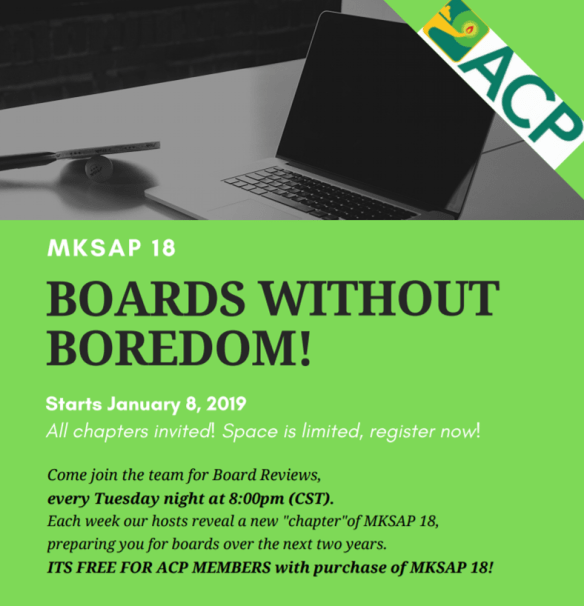
MKSAP flyer

NaBloPoMo 2019

Are you required to do continuing education for your work?

Since 2013, the Illinois Chapter of the American College of Physicians has run a weekly internal medicine board review webinar, MKSAP Live Online Study Hall.  We use questions that ACP publishes through the Medical Knowledge Self-Assessment Program, covering topics in general medicine and its subspecialties, including cardiology, pulmonary, infectious diseases, and rheumatology.  Every Tuesday night at 8pm Central time, two of us moderators and one webinar organizer get online and review about 14 questions, SAT-style.  We interact with audience members through a chat function on GoToWebinar, and we poll some of the questions each session.

I love this program for multiple reasons.

First, I was there when it started.  Gathered around then Governor Dr. Marie Brown’s dining room table, a handful of local ACP members brainstormed and created what is now an international, comprehensive internal medicine board review webinar series.  After some playful, off-topic, post-prandial banter between Dr. Sean Greenhalgh and me, our colleague across the table said wryly, “I’d watch that for an hour.”  Hence the dual-moderator, morning radio DJ style webinar was born.  That was in the fall of 2012, and the Study Hall is now halfway through its third two-year cycle.

Second, I get to hang out with my doctor friends online.  Besides Marie and a couple others, I did not know any of the dozen folks involved in the project before that night at her house.  We did improv workshops at the beginning to form our team and ease our communication skills.  Since then we have all become friends—a clique, even.  We have followed kids’ graduations, births of babies and grandbabies, and some personal challenges as well, all while getting together every few weeks to talk shop for an hour online.  We have even become celebrities of sorts—first at Illinois Chapter meetings and now sometimes at ACP National, people come up to us to say how much they like the program.  We’ve become a fixture in some colleagues’ lives.  We feel pretty proud and special about that.

The best thing about the Study Hall, though, is that just in the space of one hour on a Tuesday night, I am consistently humbled by the sheer volume of knowledge there is to absorb, just in internal medicine.  This is only one specialty of the whole medical profession!  And it’s not just the volume—it’s the complexity, the context, and the ever-evolving research, diagnostic and treatment development, and guidelines.  MKSAP publishes a new set of comprehensive questions every two years, and I do not envy the writers their colossal task of keeping us all up to date.  Without fail, every session I learn something that I will use the following week in clinic.

As this month of daily posts progresses, I feel increasing awe and gratitude for all of the people and opportunities in my life.  Thanks to all my colleagues, leaders, family and friends who make this life so full and loving.

November 18:  Relentless Curiosity Makes Me Better

IMG_4440

NaBloPoMo 2019

“Be patient toward all that is unsolved in your heart and try to love the questions themselves, like locked rooms and like books that are now written in a very foreign tongue. Do not now seek the answers, which cannot be given you because you would not be able to live them. And the point is, to live everything. Live the questions now. Perhaps you will then gradually, without noticing it, live along some distant day into the answer.”
― Rainer Maria Rilke

Tonight, in the month of gratitude, I feel deeply thankful for Coach Christine.  I might have been a curious person all along, but it was not until I got a life coach that I learned the vast and profound value of curiosity in every realm.  As I wrote earlier this month, standing always in curiosity liberates my mind.  It relieves me of unnecessary urgency for an answer.  I can exercise professional creativity in forming better and better questions, and the answers (often multiple, intertwined, and intriguing) emerge more easily and artfully than if I chase them demandingly.

The business of medicine is to solve problems, to heal, to cure.  So we assume that the faster we get to answers, the better.  And they had better be the right ones, because lives are at stake here!  It’s always interesting to me when patients talk about my work as ‘saving lives.’  I can’t remember a time when I could actually make that claim, at least at all directly.  But to my colleagues—emergency medicine and critical care docs, trauma surgeons, suicide hotline counselors—thank you, you really do save lives every day!

I love primary care because I usually have the luxury of ‘(living) the question.’  When patients present with new problems, as soon as I know they are stable, I get really excited.  I’m liberated to get deeply curious, ask as many questions as they will tolerate, paint the big picture together.  I follow the standard physiologic and diagnostic process initially, which often yields a straight forward answer and plan of care.  But life and work would be pretty boring if that were always the case.  When the usual suspects are all acquitted and the mystery persists, that’s when things get fascinating.  This is when I really get to know a person.  When I ask truly open, honest questions—the questions I don’t know the answers to and that are not meant to lead anywhere—I never know where the conversation will go.  And I always learn something new and relevant, something that helps me connect.  This is the information that makes a person memorable, because it is truly unique to them.

One of my favorite moments in a patient encounter is when I have to pause a few seconds to form a really good question.  What do I really want to know, what am I after, what will really break open this conversation?  It happens regularly, and wow, what a rush.  OH, I just never know what I will learn!  You’d think people would get impatient and grumpy with such prolonged, sometimes meandering interrogation.  But I find that they often lean in, look me in the eye.  They get on the train with me and look as eagerly as I around the next bend.  What will we find?  Let’s explore together!

Relentless Curiosity.  It’s the funnest part of my work.  I love it.  And as we all know, loving our work makes us better.

November 17:  Elasticity Makes Me Better

IMG_2649

NaBloPoMo 2019

What was school like for you growing up?  Were you bored?  Confused?  Frustrated?  I had a pretty easy time, but many of my classmates did not, even the ‘smart’ ones.

In high school I was on the speech team.  One of my events was persuasive speaking.  I chose one year to advocate for teachers to broaden their teaching styles to match a wider variety of learning styles.  I used the Gregorc Mindstyle Delineator as an example of how styles can vary (mine is Abstract Random, go figure).  It was an interesting thesis and I sincerely believed what I wrote and presented in those 8 minutes each weekend.

Thirty years later, I wonder how much I walk this talk of meeting people where they need me.  Simply asking the question, raising my awareness, makes me better.

Parenting.  It doesn’t matter how many parenting books you read or how well you think your parents raised you.  General principles apply, of course.  But every kid is unique, and we parents do better when we realize that the methods we use for anything on kid #1 won’t necessarily work with kid #2, #3, an onward.  Flexibility is key to a happy and functional household, for getting out the door every morning without yelling.

Marriage:  According to the Dr. John Gottman, about two-thirds of marital problems are perpetual, meaning they will never actually resolve.  So how do couples stay together successfully?  Among other things, they learn to accept one another and work around the hard stuff.  At least partially, we have to soften our rigidities, learn to bend and sway, embrace the supple, intimate dance of commitment.

Teaching:  Not all students learn best by watching.  Not all learn best by doing.  Or by hearing, mimicking, or competing.  Luckily, medical education gives trainees multiple platforms on which to acquire the necessary knowledge and skills to care for patients.  For all its flaws, our profession actually does well here.  I’m happy that I realized this in my own experience.  When I precept students in clinic, they shadow, scribe, see patients alone or lead a joint encounter, so they can experience the work from different perspectives.  I think this mutual versatility and adaptability makes us all better.

Patient Care:  Over the years I have accumulated myriad articles and books to share with patients.  But not everybody’s a reader like me.  Not everybody wants to meditate or journal.  Some people do better with a personal trainer, others in spin class.  It’s my job to assess how each patient is most likely to succeed in health habit optimization, and present the most appropriate resources for consideration.  Primary care definitely does not work with a one size fits all approach.  So now I include audiobooks, podcasts, phone apps, and YouTube videos in my repertoire of medical information sharing.  I am blunt when it’s needed, and also gentle and diplomatic.  I can speak from the head and the heart, often both at the same time.

Speaking Engagements:  Here is where my elasticity has grown the most in recent years.  For the first decade of my career, I still used the expository presentation style I learned in high school.  Thankfully in 2014, I watched Nancy Duarte’s TED talk on transformative oral presentations, and then read her book, Resonate, in 2015.  Make the audience the hero, she says.  Tell a story, contrast what is with what could be, paint the vision of the blissful future clearly.  Engage people’s emotions and aspirations.

This is not easily done with Power Point decks full of words.  But words are my medium!  I had to add color, diagrams, cartoons, photographs.  I started making my presentations more interactive, between myself and the audience, and between audience members themselves.  Now I have people stand up and move their bodies.  I may bring raisins to my next talk and do a mindful eating exercise.  I need to learn how to embed music and videos into my slides.

What is the objective in all of these relationships?  It’s connection.  How do we best connect?  We reach out.  We extend ourselves to others—make ourselves relaxed, flexible, spring-like.  That is how we gather people closer.  It’s not formless or weak.  A strong elastic maintains its integrity even under high tension.  But it must be stretched often, or it becomes stiff, brittle, and ultimately ineffectual.