Playing My Part

IMG_3397.JPG

Hello again, friends! Feels good to be back…  3 weeks since my last post of the Blogging A to Z Challenge, holy cow!  At the end I thought, ‘Hey, I can do this!  One post a week, no sweat!’  …And then crickets…  How Fascinating!

Though I have not posted in three weeks, I have written like mad, mostly journaling. Today I suddenly realized how much I have missed corresponding with my friends on paper.  How long it’s been since I wrote by hand to someone other than myself!  As I sat this afternoon and wrote, on stationery, with colored gel pens and stickers, to some of my best friends, a tremendous sense of connection and gratitude filled me.  Much of this post was born of those spontaneous letters to my fellow conscious, cosmic journeyers.

Given the awesome support network with which I am blessed, I feel an impulse to do something more with my writing—to amplify and project all this love and connection back out onto the world for some positive purpose.  But how can my words possibly make a difference?

The A to Z Challenge showed me that I have the capacity to write often and much—and to produce better-than-crap results! It also taught me that I can take more risks with my writing, in both format and content.  Now I want to take my writing a little more seriously, lend more credence to my own abilities.  In the framework of Simon Sinek’s Golden Circle, I know my Why: to cultivate positive and constructive relationships in every realm of life.  This blog is another What to my Why.  But since the Challenge ended, I struggle with the How.

I think night and day about so many things:

  • My own individual relationships—spousal, parental, sibling, other familial; colleague, patient, student, friend, stranger.
  • Relationships I observe between others, and their impact on those of us around them.
  • Healthcare and medicine in general, and specifically at my own institution—miracles, bureaucracies, opportunities and pitfalls.
  • Leadership and organizational culture—examples of effective and ineffective models, and what makes them so.
  • Social justice and discourse—with an urge for movement toward acceptance, inclusion, mutual understanding, and cooperation.
  • Education, parenting and role modeling—integrity, walking my talk, inside and out.
  • Physician self-care and care of one another—individual and system issues, and their interface.

What am I called to affect? I live a conscious life in all these realms, or at least I try.  I have opinions and positions on various issues, some which I hold with deep conviction.  And I struggle with whether and how to express them—for what purpose?

Finally, I have an idea. Though I have opinions and positions that I hold strongly, I plan NOT to use this blog to promote those views.  There are plenty of people doing that already, a multitude of voices trying to win one another over, or, more precisely, trying to drive one another into silence with ever louder, brasher, and more vociferous language.  My voice can be one of moderation—of collaboration, connection—maybe a bridge for a few who seek one…  Or maybe just one stilt among many others, helping to hold up one such bridge.  I will strive not to criticize or proselytize, not to berate, blame, shame, incite, or inflame; and also not to concede or abstain.  I can, at the same time, hold my positions with conviction and passion, and also listen for the convictions and passions of others.  I can practice curiosity and openness.  I can question, explore, Hold the Space, and stand strong and tall, without feeling threatened.  I seek others who strive to do the same.

Voices of moderation are muted these days. The great orchestra of discourse has lost balance and harmony.  The most strident strings, horns, and drums play for their own promotion, rather than as a contribution to a symphonic collective.  The resulting dissonance makes us want to cover our ears and run away.  In order for a symphony to engage and inspire, each player must not only know her own part and play it well, but also listen carefully for other players and their movement.  Maybe we can all do this a little better: maintain our own distinct voices, while integrating with those around us.  The best orchestra functions as one entity, breathing and moving in a quintessentially integrated fashion.

My instrument is language. The past seven weeks have shown me my part in the online verbal orchestra.  This blog is where I will practice, record, and offer my contribution, not to overpower any others’ words, but to meet, align, and resonate.  The harmony of consonant contrast plays on, somewhere.  Maybe I can help find and amplify it, so more of us may enjoy the music of life among one another.
#AtoZChallenge: Xerophyte People

Webster’s Ninth New Collegiate Dictionary

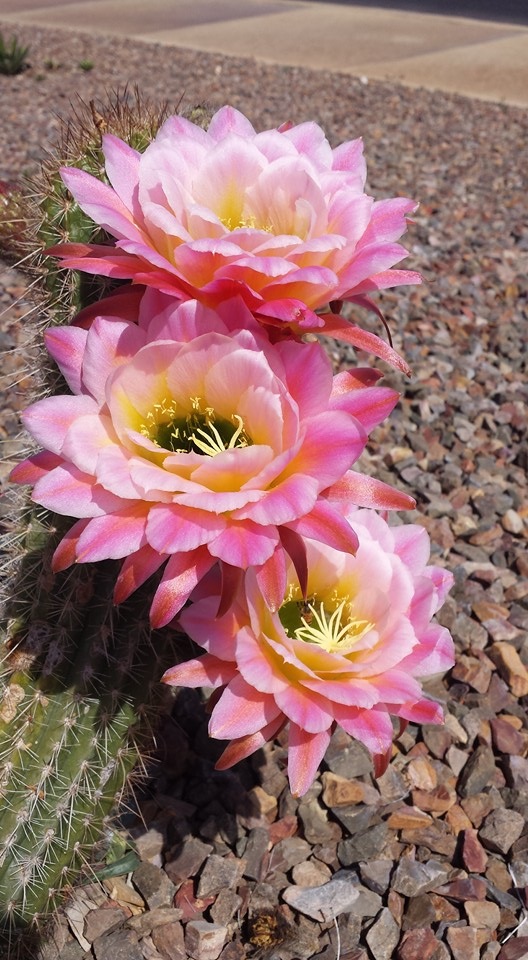
Xerophyte: a plant structurally adapted for life and growth with a limited water supply esp. by means of mechanisms that limit transpiration or that provide for the storage of water.

AC cactus 2016

Photo courtesy of Cyndie Abbott, Green Valley, Arizona, 2016


Water is essential for growth and survival—of plants and animals alike. So how is it that some plants can not only survive, but thrive and even reproduce, with so little water?  On top of that, they also provide beauty, habitation, and even sustenance for others.  Their short-lived flowers splash color onto monochromatic landscapes.  Regional animals are adapted to live nestled among some xerophytes’ barbs.  Survival programs tell us to seek these plants as a source of essential hydration when stranded in the dessert.

Humans share many of these tough flora’s adaptive qualities. We evolved as omnivores, able to eat most things that grow in nature.  Our big forebrains allowed us to cultivate plants to eat.  We learned to capture, then herd, animals for our own use.  We have come so far as to alter and control our environments, in order to live in places where nature may never have intended.

But the more interesting parallel between xerophyte plants and Xerophyte People is resilience.  If we consider metaphorical water for human life, many things come to mind: joy, security, connection, purpose, meaning, love.  Think of all the people who live with little or none of these things.  Think of those who once had these things, and then had them forcibly taken away, often indefinitely—by war, abuse, illness, death.  In medicine, we witness this kind of suffering regularly.  Our hearts break alongside those of our patients and their families.  But it’s not always forever.  In primary care, where I have the privilege of knowing patients over long periods, I have also celebrated remarkable reversals.  New relationships, revelations, births, treatment innovations—you never know what will happen to turn the tide.

So what keeps us hanging on? Like plants, maybe we figure out ways to prevent further loss—limit transpiration.  Thick skin and prickly spines keep us protected.  Only the very persistent or the specially equipped can penetrate our defenses.  But more important, we have adapted to store what we need.  Even if we cannot readily identify or articulate it, something keeps us going.  Maybe it’s hope, remembrance, or some core value or aspiration we have yet to realize—some inner pilot light that never goes out.  Some might call it the human spirit.  Whatever it is, I stand in reverence of its mystery, its utterly saving presence.

To all the Xerophyte People in our world, I say as Glennon Doyle Melton does:  Carry On, Warriors.

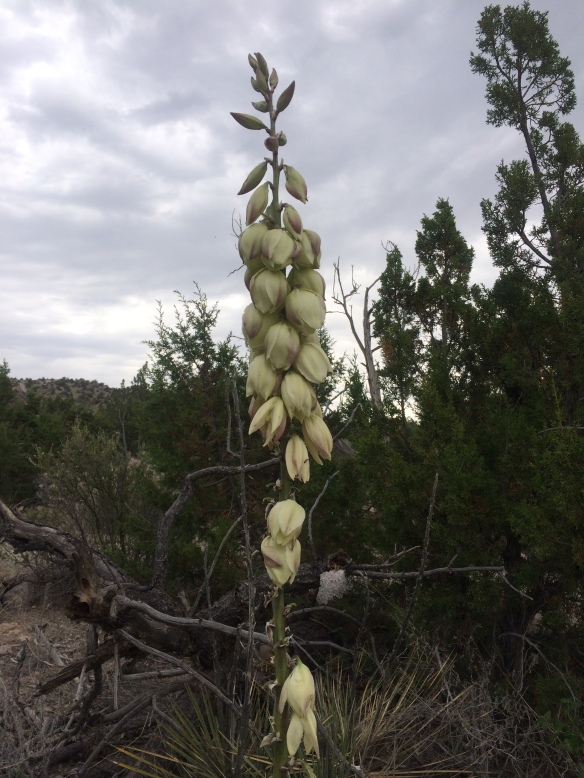
IMG_1680.JPG

Tent Rocks National Monument, New Mexico, June 2015

#AtoZChallenge: Withhold Judgment

403532_3541039079225_1032738700_n

My brain is so tired. All month I have racked it trying to figure out what to write next, how to render it most authentically, and finally get it out looking close enough to how I intended.  On top of that, I have also engaged in multiple exchanges on Facebook around gender identity, public restroom use, vaccine rationale, and presidential politics.  It really has been shang nao jin, as we say in Chinese—literally wounding the mind.  I realize these are all activities that I choose, and none of them have significant bearing on the world at large.  And, I would do it all again.  My mental exhaustion is the hurt-so-good kind, like the muscle soreness after a particularly strenuous workout, when I know I have pushed myself to my limit and maybe extended it a little.  The writing and conversations are ways that I engage with my world and practice what I preach—open-mindedness, curiosity, and cultivating connection.

After all of this exploration, conversation, debate, research, and observation, once again I conclude that one of the most important practices for inner peace is to Withhold Judgment. Not all judgment, and not indefinitely, but much and for a while.  Here are some illustrations from the past week:

I shared this post on my Facebook page on Saturday.  I agree with the author’s sentiments, basically that discrimination is wrong and we should open our minds and bathrooms to all people.  I also thought her writing was cogent and forceful.  One of my friends pointed out her name calling, as she labeled supporters of the North Carolina HB2 legislation, and people who boycott Target as a result, as hateful.  He then asserted that the left “can’t argue a point without calling people who disagree with them hateful,” or at least they choose not to. At once I see both sides generalizing in ways that preclude any possibility of meaningful mutual understanding.

After this I became more sensitive to name calling in articles I read. Even ones with relevant data and useful information can be tainted, as I found here, in which the writer calls bigots the same people that the previous author called hateful.  Why must we stereotype and label like this?  Is it just to get published, for attention?  Can we not convey our message just as effectively without all this vitriol?

Finally I read and shared this article, in which the author does not call anyone names directly, but writes a brilliant and searing piece of satire that also inflames and incites.  I suppose that is the point of satire, after all?  It was the comments on this last article that really drove home to me the perilous state of assumptions and judgment that drive many of our interactions these days.  If you support this law, you’re hateful.  If you oppose it, you’re irresponsible.  Perform one act that is, superficially, inconsistent with your professed beliefs, you are forever a hypocrite.  Commit one lapse in judgment and you are instantly unworthy of respect, now or in the future.  Snap judgments can degenerate our encounters to a series of sound bites of rhetoric and aggression.  They seriously inhibit, if not completely destroy, our connections, and they consign us to echo chambers of isolation.

The doctor who rushes me through my 15 minute appointment for a sinus infection, after making me wait 30 minutes already, is uncaring and just wants to make more money. Actually, she just spent the last 45 minutes telling her patient of 10 years that he has metastatic cancer and answering his questions, and she is anxious to get to her son’s school play tonight, his first lead role.

The woman who yells at the receptionist and makes a scene with the nurse is just another angry, entitled patient. Actually, her son was killed by a drunk driver last year, she lost her job and her home, and her mother is dying.

Fellow blogger and talented artist Jodi posted this beautiful piece today, including these words:

Skip the religion and politics,

head straight to the compassion.

everything else is a distraction.

— talib kweli

It really spoke to me, because compassion lives at the core of human connection. If we can remember compassion for one another more often, no matter our circumstances and state of mind otherwise, we can probably also remember to Withhold Judgment and listen for the rest of the other person’s story.  Listening more, yelling less, moving slower to the keyboard, showing up in person, asking more questions for understanding—these are the practices of Withholding Judgment.  Please, let us make the effort; it may save us all.