
Hopey, Changey Hero Making

IVY Litt 11-8-17

NaBloPoMo 2017: Field Notes from a Life in Medicine, Day 8

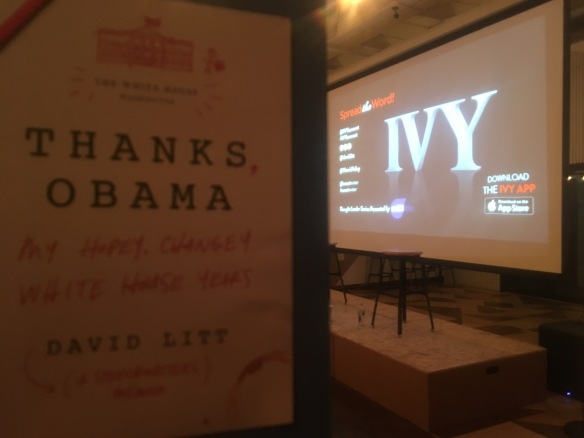
Funny how I just wrote last night about connecting new dots to old dots.  It just happened again tonight!  A couple of weeks ago I responded to an online ad for an IVY Ideas Night with David Litt, author of Thanks Obama: My Hopey, Changey White House Years, entitled, “How to Inspire, Persuade, and Entertain.”  Litt was a senior speechwriter for President Obama, so I thought I could learn new tips for presentations, and feel a little closer to the president whom I miss so much.

I’ve done public speaking since eighth grade, when our speech teacher first taught us abdominal breathing and I discovered the thrill of holding the attention of a room full of people with only my words.  I work at an academic medical center and I hold zero publications, but my CV documents over 10 years of professional presentations to various audiences.  I thought I was pretty good at this speaking thing.

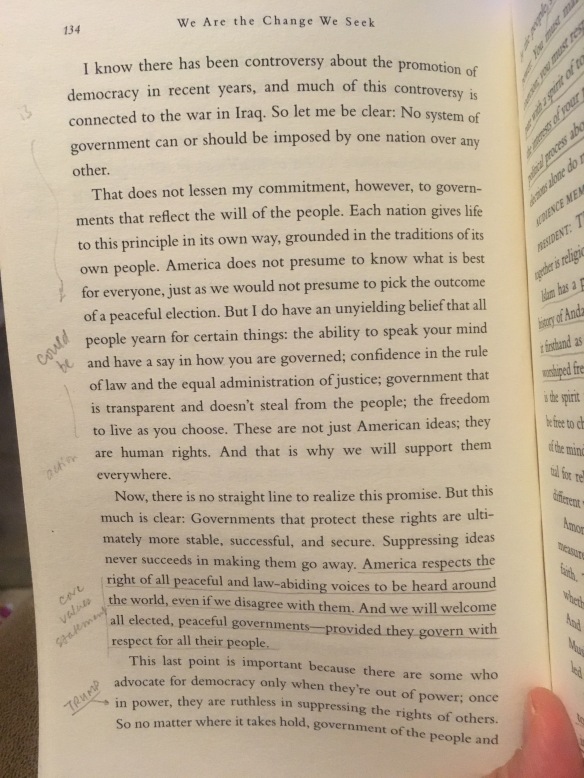
Three years ago I came across this TED talk by Nancy Duarte, whose ‘secret structure’ of great presentations I have used since I subsequently read her book, Resonate.  Essentially, she recommends that we invite audiences on adventure stories, create active tension between what is and what could be, and most importantly, make the audience the hero.  I have done this better and worse since then, but I always recognize the framework when I see it.  Those familiar with this blog know that I am also a fan of Simon Sinek, whose central message is that we perform at our best when we are crystal clear about our Why.  “People don’t buy what you do, they buy Why you do it,” he says.  Barack Obama employs both authors’ principles with eloquence and finesse, which I noticed reading We Are The Change We Seek, a collection of his speeches as president.  The best speeches delivered in this construction create audiences who are inspired, motivated, and empowered to hail a meaningful call to action.
Obama is could be core values

That’s basically what David Litt conveyed tonight.  When asked what advice he was given that served him best, he said, “Imagine someone in your audience will tell their friend tomorrow about your talk.  What is the one thing you want them to say about it?”  What is the Why of your talk?  Even though he no longer writes speeches for the most powerful person in the world, he expressed a desire to continue inspiring, empowering, and promoting personal agency in all whom his work touches. Make each and every audience member their own hero.

It turns out, however, that this approach applies to much more than public speaking.  On my 50 hour, 500 mile, aspen-pursuing weekend in Colorado last month, I described to my dear friend my favorite moments at work.  At the end of a patient’s day-long physical, after I have spent 90 minutes listening to their stories of weight gain and loss, work transitions and complex family dynamics, and reviewing their biometrics and blood test results, I meet with them for an additional 30 minutes to debrief.  This is when I present an integrated action plan compiled by the nutritionist, exercise physiologist, and myself.  It is a bulleted summary of our conversations throughout the day, centered on the patient’s core values and self-determined short and long term health goals, and crafted with their full participation.  I get to reflect back to my patients all that I see them doing well, and shine light on areas for potential improvement.  It’s an opportunity to explore the possible—to Aim High, Aim Higher, as the United States Air Force exhorts.  I often present the plan with phrases like, “Strong work!” “You’ got this,” and “Can’t wait to see what the coming year brings!”  My friend turned to me as we wound through autumn gold in the Rocky Mountains, a bit tearfully, and said, “You make them the hero of their own story.”  Yeah, I do, I thought, and I got a little teary, too.

Words are powerful.  They are our primary tool for relating to each other, for making another person feel seen, heard, understood, accepted, and loved.  You don’t have to be a public speaker or a presidential speechwriter to make a positive difference with your words.  At work, in your family, with your friends, with people on the street and in the elevator—what is the one thing you want someone to remember from their encounter with you?


Eat What You Kill

IMG_6023

NaBloPoMo 2017: Field Notes from a Life in Medicine

Sounds like a mantra from a survival reality show, right?  Akin to “Eat or be Eaten,” “Kill or Be Killed.”  It’s also a common reference to the prevailing business model in our American scarcity-minded, competition-driven, fee-for-service healthcare culture.  How ironic, the application of these words to this profession.  It was explained to me essentially as, “Every man for himself, and you’re a minion.  You are expected to be ‘productive’ in this business to justify your compensation and contribute to the bottom line.  We measure productivity by number of patients seen and accompanying collections.  Pull your own weight or there will be consequences.”

Of course, from a capitalist business standpoint, this makes sense.  I provide a service that others require.  I should offer it widely, accommodate customer expectations and demands, expand my suite of offerings early and often, and charge for everything.  The more I can get customers to consume and pay, the better off my business.  I have a fundamental problem with this approach when the practice of medicine focuses on business first and patient care second.  Nobody admits to this attitude, of course it’s about patients first, everybody says.  Then my colleague makes a suggestion for patient care improvement, or I express concern about conveyor belt medicine burning doctors out.  Inevitably, the primary response from leadership is something along the lines of ‘that costs too much,’ and ‘that’s the only way to keep the lights on.’  I understand the math.  I despise the premise.

Medicine and healthcare delivery should always transcend the detached, transactional, and ruthless nature of the free market.  Chris Ladd, a conservative thinker and writer, describes this idea eloquently here.  It occurred to me today, replying to Stacey Holley’s comment on my post about spending time with patients, that even those who profit from our flawed American system are also terminally distressed by it.  Insurers, hospitals, pharmaceutical companies and their executives live in a constant state of fight-or-flight defensive posturing, fearing for their livelihoods in market share, revenue, solvency, and survival.  How tragically ironic.

Personally, I have difficulty envisioning a single-payer, government run healthcare program as the primary delivery system in the United States.  Our culture is simply far too individualistic, too fundamentally ingrained with ‘every man for himself.’  However, I think we can still work with the concept of universal healthcare, wherein all people have access to basic preventive and catastrophic care, regardless of income or status, without risk of bankruptcy.  A strong argument can be made that the only entity who could or should be truly invested in the health and well-being of all of us, throughout our lifespan, is our government, particularly in the realms of prevention and health maintenance.  We just need to loosen our societal grip on ‘that’s just how it works,’ and ‘I need to get mine,’ and allow ourselves to be led more by our collaborative, altruistic, and humanitarian leanings.  In my experience, diverse groups of intelligent and energetic people, working toward ambitious and aspirational goals, generate synergy.  This kind of cooperation fosters passion, joy, inspired creativity,  and magnificent innovation.  Who knows what novel solutions we may invent, if we only put down our spears and work together?  And isn’t that the hallmark of American ingenuity?

Medicine and health should be a heartening, collaborative, communal effort wherein we all do our best to help ourselves and each other reach our highest potential.  We are better than our current system, in which truly everybody suffers more than necessary.  I refuse to accept ‘Eat What You Kill’ as any kind of descriptor for my work or that of my colleagues.  We can do better, imagine and create more for ourselves and one another, than this primitive notion.  I know there’s a healthier mantra inside me somewhere…

What can you think of?

No Substitute for Time

DSC_0401

NaBloPoMo 2017: Field Notes From a Life in Medicine

Day 3

How much time do you spend with your doctor each time you see them?  Is it enough?  If they had more time to spend with you, how would you use it?  Would it be better?

I’m too tired and it’s too late tonight to discuss the myriad factors that erode the patient-physician relationship, and thus our medical system in general.  But time comes to mind often for me, and I wonder if patients are as frustrated about it as I am.

Where I work now, I pretty much have as much time as I want with people.  It’s a sweet gig.  I can ask them about their work, their families, their interests.  I have time to listen to the answers, and even connect those with my observations about their health.  The most interesting parts of my interviews are the social history.  What do they spend their days doing at work?  What problems do they solve, who do they interact with, and what brings them meaning at the place where they spend the majority of waking weekday hours?  Then what do they do for fun, what’s life like outside of work?  I get to know my patients as individual, whole people, which I love, and that makes me look forward to every day at work with joy.

But time is not just good for me, for my professional fulfillment.   It’s good for patients, too.  When I spend time asking the important questions, putting together pieces of a person’s symptom puzzle, and do a directed exam, I’m more likely to come to a correct diagnosis and make an appropriate and specific care plan.  When I take the time to explain my rationale, decision process, and possible outcomes and follow up, my patients are more likely to feel seen, heard, and reassured.  They are more likely to stick with the plan and contact me if things change.  The next time they need help, they are more likely to call me and we have another chance to know each other better.

When the physician-patient relationship flourishes, we’re all healthier.

I love this article on The Health Care Blog, which essentially validates the time I take to talk to my patients.  My favorite line:  “More information about the value of a physician-patient encounter will always be found in the content of their communication than in what they ultimately do. The difference in… physicians’ behaviors will not be found in any database, electronic medical record, or machine-learning algorithm. I have yet to see data on the contextual information from a history of the present illness in any data set or quality improvement initiative.”

You may also be interested in this article, describing the origin of the 15 minute clinic visit, and why it really doesn’t make sense.

What do you think about physicians and patients advocating together to change this aspect of our flawed medical system? I know it’s complicated, requiring a hard look at our billing and compensation processes, as well as our productivity-driven, fee-for-service medical culture.  I still think it’s worth pursuing.  There is no substitute for time.  We must protect and defend it; our health depends on it.