The Expert and the Student

What do you take for granted that you know and do?
How do your conversations with colleagues differ from those with ‘laypeople’?
How does your specific expertise emerge and manifest outside of its own domain?

Friend recently told me about the time his friend offered their Adderall (a stimulant used to treat attention deficit and hyperactivity disorder) for his full body, multi-system allergic reaction to food (which technically constitutes anaphylaxis and should be treated with epinephrine, or at least a strong antihistamine like cetirazine [Zyrtec] or diphenhydramine [Benadryl]). I had immediate, strong, and mixed feelings and thoughts: What? Oh, your friend was trying to be helpful.. and that is absolutely not the right thing.. and omg, what badness could have happened? ANTIHISTAMINES FOR ALLERGIES! And this is why everybody needs an accessible primary care doctor, FFS. Okay, okay, self-regulate. Friend has lived with his allergies for however long, he has apparently handled it fine thus far; this is not my business. Unsolicited medical advice is not often welcome, Chenger, so zip it! And GAAAAAAH, my dear friend, the next time you have an exposure, I pray please for you to have more knowledgeable folks around you! OH that self-restraint really challenges me sometimes.
I share this story as an example of how my doctor mind is always present, always assessing. I felt caring, protective, and concerned when Friend told me, and not at all dismissive or condescending, so I hope that is not how it comes across. All I want is for Friend to be well, to have all he needs for that, and to help if I can, within appropriate boundaries. I hope I respected his boundaries well that day, while still conveying how much I care.

Opioids, anti-inflammatories, corticosteroids, Tylenol–they all address pain, and by different mechanisms, with different side effects, and can be combined and not in certain ways–I know these things. Blood count, chemistries, lipid profiles, iron, B12, CRP, sed rate, TSH–I have ordered and interpreted these and other ‘routine’ blood tests for almost thirty years now. I see patterns for fluctuations, correlates to behaviors, and advise accordingly. Pain, headache, dizziness, nausea, rash, shortness of breath, diarrhea, and myriad other things–I know what’s common and how to treat. I know what to do when I don’t know what’s happening. I know who to call for help. I know how to sit with you, my patient, when things are uncertain and you feel acute distress. I know how to listen beyond the objective answers to my questions. I see you, or at least I do my best. And the longer we know each other, the better I know how to help you, no matter what’s going on. I am an expert at primary care internal medicine.

“Routine,” Orthopod said to me before my knee surgery. I imagine he saw me as a fellow physician and assumed I understood the technical aspects of procedure risk and outcome expectations–which I did. And I was the patient in that scenario, anxious despite my expert medical knowledge, and possibly in part due to it, because I also know how things can go unexpectedly sideways in any operating room. “Routine for you,” I replied. I trusted him, the surgical expert, with my knee and my health. No longer a medical student, and still a learner in a different role, I felt vulnerable and safe. I think we both had a little a-ha moment then.

Jacob, watch, please? Where does the movement start, again? What is the difference doing it this way versus that way?” In the gym, I am absolutely still a student, though I have been an athlete since adolescence. I have passed the prerequisites of anatomy and physiology. I understand force, mass, and acceleration. And every session, there is still no shortage of new knowledge, experience, and practice to acquire. This is what brings me back so enthusiastically–the more I learn, the more confident I get, and the better I can perform. I make steady progress because my teachers are both knowledgeable and approachable, generous and creative with their instruction.
I wonder what/where/how I might be more willing to study if I had such teachers?
How lucky that throughout my life, I have benefited from so many amazing guides, mentors, and coaches.

In preparation for this post, I listed things at which I am expert, proficient, and novice. Obviously the novice list is longest–humbling and inviting! The proficiency list is gratifying, actually, as I can stand justifiably confident in a variety of diverse skill domains–yay! And when I’m honest, the expert list is remarkably short, which is as it should be.

So it makes me think: How wonderful to be a student of everything, including in my own areas of expertise! Medical knowledge has doubled at least twice since I started training 29 years ago, and that rate continues to accelerate. There is simply too much for any generalist to know, even though we still know a lot and continue to learn about everything. Every time I connect with a specialist colleague, I walk away or hang up smarter and a better doctor for my patients. Bless my colleagues, all!

When I describe my interest in leadership to people, I say that I ‘study’ it. To some, I may seem like an expert. And though I do consider myself advanced in my leadership education, I will always consider myself a student, because every leadership role is unique and fluid. I will never be in a position to not learn and improve. I value humility; when I see it in experts and leaders, I trust them more immediately and implicitly. That is the kind of leader I aspire to be. Learner-leaders cultivate other learner-leaders by example. What an excellent, virtuous cycle!

Student mindset is growth mindset, a beginner’s mind. Maintaining it helps me connect more easily with others with whom I may mutually teach and learn from in loving and organic, natural and synergistic reciprocity. It keeps me open and improves, hones my overlapping, intersecting skillsets. It deepens all of my life experiences, inviting contribution from anyone I meet, anything I do. Everything blooms in brighter, more vivid color and texture; every day holds infinite possibility!

I meet experts in multiple domains every day, and I wish I had time to pick all their brains. My morning pages and brain dumps help me process and integrate all of these encounters and more. So much to gain, so many people to meet and love, so much connection in the offing, oh my goodness, it’s just too good!

My wishes for you, dear readers:
May you meet experts who enrich your life by kindly sharing their wealth of knowledge.
May you stand ready to receive their offerings with openness and curiosity.
May you share your treasures of life experience with generosity and humility.
May all of these encounters nourish you, mind, soul, and being.
And may it all make us better for ourselves and one another.

Onward!

Calling All Depolarizers! Part 2: Confident Humility


…”So what keeps our inner depolarizer in the closet when it comes to sensitive topics like abortion, immigration, religion, and politics in general? Or in family conflict and workplace politics? I posit that it has, at least partially, to do with two levels of psychological safety: intrinsic and extrinsic.” Let’s talk about the first, which can be thought of as confident humility:

Premise:  I resist/reject/assail challenges to my beliefs and positions because I worry that those challenges will change my beliefs and positions.  If my beliefs are changed, then what does that mean?  Am I weak?  A hypocrite?  Uncommitted?  What will others think of me?  Will I get kicked out of my tribe? Or, maybe I just think I’m right, and I’m simply not open to the possible value of any other perspective? Or I’m afraid that if I’m not right, then I’m just wrong, and that feels too uncomfortable and I don’t want to go there. 

Question:  When does it feel safe to reconsider or challenge some belief I have?   

Answer:  When I don’t have a strong personal investment in my belief—it isn’t material to my identity, tribal membership, or survival, real or perceived.  In his book Why We’re Polarized, Ezra Klein summarizes eloquently the psychological research suggesting that when we perceive threats to our identity (eg gender, sexuality, sports fandom, family, nationality, political party, or other), our response is primarily emotional.  The existential discomfort (experienced as real limbic threat) causes us to reject the challenge, be it information, policies, or other people, employing confirmation bias, rationalization, and other mental self-preservation tactics. 

So, does this mean that we must dilute or divest our personal identities in order to depolarize? Certainly not. I think it does, however, require some honest reflection on how we define and relate to our various identities. Why do we get emotionally agitated about certain topics and not others? Why do debates about abortion cause some people such agitation, and some people not? Why gun control? Immigration? Transgender and sexuality issues? What is it about any particular topic, and how I identify with it, that triggers me? How does it define my in- and out-groups? And how does this constellation of thought, emotion, and behavior affect my personal well-being, relationships, social standing and security? As a result, how do I contribute to divisions or affiliations in my own social circles, and society at large through my words and actions? How much do I care about that last part?

Intrinsic psychological safety means feeling solidly grounded in my core values and the practices that manifest them—it’s a sense of quiet, confident, unassailability.  To me it means cultivating a growth mindset, confident that I am at the same time rooted down and branching out- embracing and navigating the paradox of personal conviction and intellectual humility and flexibility.  Challenging my beliefs then becomes a personal practice of learning, integrating, and cultivating complexity and depth to my opinions, beliefs, and perspectives.  I stir and knead, exercise and expand my mental elasticity and range.  Rather than diluting my positions, all of this training can actually strengthen my understanding, expression, and agility in defense of them.  It gives me the confidence to seek and welcome challenges, knowing that I have enough internal clarity to maintain my core values and also integrate important nuances that may edify them. It is a product of disciplined self-development.

In confident humility mindset, I understand that my position is not, in fact, the only ‘right’ one; it is simply one of many. “Everybody’s right, and only partially,” was one of my first life coaching lessons back in 2005, and has served me well. This mindset allows us to think of ourselves and our opinions as ‘also right.’ It frees us from the burden of having to prove ourselves or exert power over others to convert them. It opens space and time to find middle paths for creativity, collaboration, and connection.

Wonderful!  Now we know how to depolarize ourselves—how to gracefully (even joyfully) integrate personal conviction and intellectual flexibility, perhaps even to move towards advocacy without alienation.  So what holds us back from practicing these skills outwardly, vocally, especially within our own tribes?  Tune in to Part 3 on Extrinsic Psychological Safety, to consider consequences and rewards of standing up and speaking out. 

Fear, Ego, and Control

DSC_0388

NaBloPoMo 2018:  What I’m Learning

In this post I will attempt to describe some exciting connections between readings from the Harvard Business Review, Dr. Anthony Suchman and colleagues, and Carol Dweck.

An HBR article landed in my inbox this week, catching my inner Imposter’s attention.  The title, “Ego is the Enemy of Good Leadership,” triggered my ‘Is that me?’ reflex.  Because much of the time, I think I’m a pretty good leader (“I’m awesome”).  But I’m forever fearful that my ego will get the best of me and make me exactly the kind of leader I loathe (“I suck”).  I saved the article to read later.

Meanwhile, I continued to Chapter 3 of Leading Change in Healthcare: Authentic, Affirmative, and Courageous Presence.  Basically this chapter deals with earning and building trust.  Chapter subsections include self-awareness, reflection, emotional self-management, clarifying one’s core beliefs, and accepting oneself and others.  In the part on core beliefs, the authors reference Dr. Suchman’s 2006 paper, “Control and relation: two foundational values and their consequences.”  In it, he differentiates between these two ‘foundational world views’:

Control

The beliefs, thoughts and behaviors of the control paradigm are organized around a single core value: that the ultimate state to which one can aspire is one of perfect willfulness and predictability. What one desires happens, with no surprises; all outcomes are intended. For the clinician, the control paradigm is expressed in the questions, ‘‘What do I want to happen here?’’ and ‘‘What’s wrong and how do I fix it?’’  Personal success or failure is judged by the clinical outcome, the extent to which one’s intended outcome was realized.

Relation

In the relation paradigm, the most valued state to which one aspires is one of connection and belonging. In this state, one has a feeling of being part of a larger whole – a team, a learning group, a dance troupe, a community, even the world itself. One’s individual actions seem spontaneously integrated with those of others to a remarkable degree, contributing to the evolution of a higher order process, i.e. one at a higher system level than that of the individuals of which it is comprised…  One asks the question, ‘‘What’s trying to happen here?’’ and, according to one’s best approximation of an answer, seeks to shape others and the world while also remaining open to being shaped oneself. This balance between control and receptivity puts one in the best possible position to recognize and make use of serendipitous events.

In Leading Change the authors write about control, “…This is a fear-based paradigm in which one trusts oneself more than others and holds tightly to power…  It predisposes leaders toward dominance, distracts them from cultivating relationships and leads them to set unrealistic expectations of control.”  And about relation, “This is a trust-based paradigm, anchored in the belief that the sources of order, goodness and meaning lie beyond one’s own creation…  It predisposes leaders to do their best in partnership with others, to attend to the process of relating and to personal experience (their own and others’) and to remain open to possibility.”

When I finally read the HBR article, the message about ego reflected the control paradigm:

Because our ego craves positive attention… when we’re a victim of our own need to be seen as great, we end up being led into making decisions that may be detrimental to ourselves, our people, and our organization.

When we believe we’re the sole architects of our success, we tend to be ruder, more selfish, and more likely to interrupt others. This is especially true in the face of setbacks and criticism. In this way, an inflated ego prevents us from learning from our mistakes and creates a defensive wall that makes it difficult to appreciate the rich lessons we glean from failure.

The ego always looks for information that confirms what it wants to believe [confirmation bias].  Because of this, we lose perspective and end up in a leadership bubble where we only see and hear what we want to. As a result, we lose touch with the people we lead, the culture we are a part of, and ultimately our clients and stakeholders.

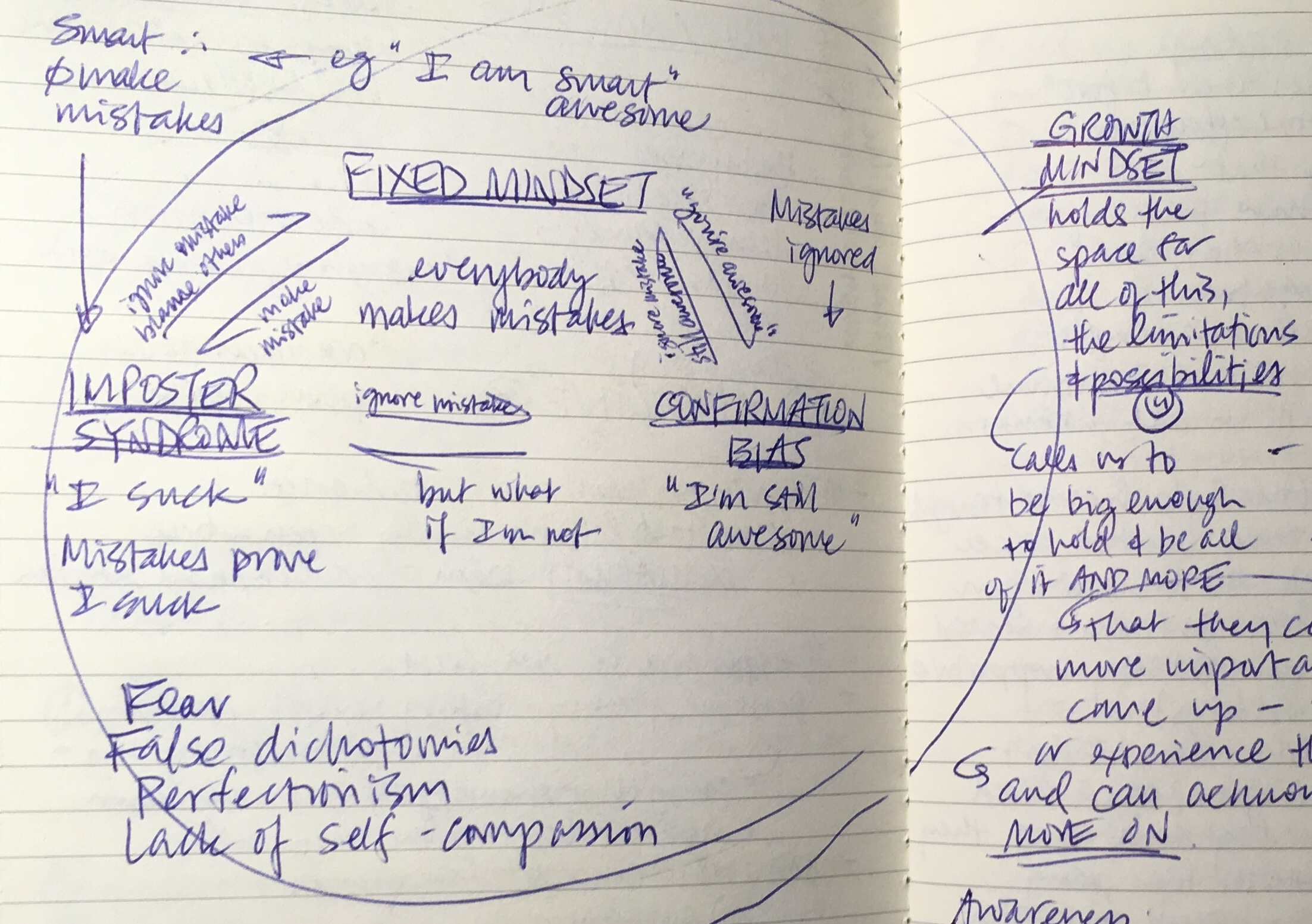
Going to bed last night, I wondered, “Is Fear actually driving when we see Ego in charge?”  I think the answer is undoubtedly yes, but it’s more complex than that.  It’s not a fear that we feel consciously, or that we are even aware of.  It’s not sweaty palm, palpitative, panic attack fear.  Rather it’s a deep, visceral, existential fear—of being found out, of not being enough—akin to imposter syndrome, if not exactly that.  Control, Fear, Ego—they all seem lump-able with/in the Fixed mindset, as described by Carol Dweck.  The simplest example of this mindset is when we tell kids how smart they are, they then develop a need to appear smart, lest they lose their identifying label.  So they stop taking risks, trying new things, risking failure.  Their experiences narrow as they, often inadvertently, learn that control of outcome and outward appearance of competence is the primary objective of any endeavor.

Back in August I listened to Dweck’s book, having heard about it and already embraced its theory in the last few years.  I had already started making the connection between fear and fixed mindset, but this day I saw a sudden, reciprocal relationship between fixed mindset, confirmation bias, and imposter syndrome.  I love when these lightning bolt moments happen—I was in my car on the way to work, and this triad came to me.  As soon as I parked and turned off the engine I tore into my bag for the journal I carry with me everywhere and scrawled the diagram as fast as I could, as if the idea would evaporate if I didn’t get it down in ink.  Later I added the comparison to Growth mindset—holding space for learning, integration, and possibility.  I held it in mind for a while, and then forgot it (which is okay—that’s why I wrote it down!).  Then today, putting together this post in my head, I remembered it with excitement.

8-31 triad update

The point of it all is that we are at our best, both individually and as groups, when we are in right relationship with ourselves and one another.  It all starts with relationship with self.  If I live in fear of being found out as flawed or imperfect, then I project that fear onto others.  I act out in an effort to control how others perceive me—when in reality I have no control over that whatsoever.  The negative perception of my ‘Ego’ by others then provokes myriad responses including fear, insecurity, false deference, resentment, disloyalty, and subversion, and the team falls into disarray.  If, on the other hand, I cultivate self-love and connection with others, I never feel that I am going it alone.  I am an integral member of a high-functioning, mutually respectful team, one in which I can admit my weaknesses and maximize my strengths.  We all feel confident that we can handle whatever adversity comes our way, and we rise to each and every occasion–together.

I’m still putting it all together, working out how it translates into daily behaviors, actions, and decisions.  For now I’m definitely paying closer attention to my feelings, especially in conflict, and taking a lot more deep breaths before speaking or replying to triggering emails.  I ask a lot more clarifying questions.  I try to make the most generous assumptions about people’s intentions, and remember always that we are on the same team—Team Humanity.

More learning happening around the clock, I say!  Hoping to articulate better in the sharing hereafter…

What do you think about all of this, does it make any sense at all??