I Just Forget

“I know what I need to do, I just don’t do it.”

I hear this from patients regularly.
Translation: I don’t want to talk to the dietician or exercise physiologist; they’re just going to tell me what I ‘should’ be doing and I’m just going to feel bad that I’m not already doing it.

My colleagues and I talk all the time about judgment and how to avoid and manage it in our practice. We are human and thus subject to social norms, pressures, and biases of weight, physical appearance, etc. And yet I know of no other group of people who practice self-awareness and self-regulation more consistently and humbly. Our objective is always to meet you wherever you are, and help you get to wherever you tell us you want to go, with realistic, sustainable suggestions and support. Still, we cannot control anybody’s response to our consults and feedback.

It feels defensive, the ‘I just don’t do it,’ and ‘I don’t want to talk about it’ responses. Maybe people judge themselves harshly, and also anticipate judgment from us? Who wants to bring that on themselves if they can help it? It makes me wonder, when I get defensive about something, what’s behind it in me? How am I filtering an otherwise benign or even benevolent message? My colleagues and I understand the myriad extrinsic barriers to ideal habits, and how thin the threshold can be between doing something healthy and not. For example, a bowl of whole fruit may sit on the kitchen island for days, untouched. Cookies and candy are much easier to grab and go. But when someone cuts the apples and peels the oranges, they disappear in minutes. Where can we each find our cut fruit equivalent for health habit (or any habit) change?

As I completed another amazing conditioning workout at Ethos this weekend, lying on my back feeling where my paraspinals were tightening and recalling some knee swelling of late, I thought back to the one stretching session I did at home in the last week. DUH, my back felt better in subsequent days. Coach Ryan taught me how to do knee CARs months ago, and it always helps. It occurred to me there, recovering on the floor, that I just forget to do these very helpful things. It’s not that I don’t want to feel better, it’s not that I don’t care about my health; it’s not that I don’t believe that stretching and rotating will reduce pain and swelling. It’s just that I haven’t yet made them into a habit. I do cat-camels and CARs before every workout at the gym and at home, just not at any other time. I might do a few standing quasi-knee CARs in the elevator on the way to the office in the morning–why it only occurs to me to do it then, I have no idea. But it occurs to me sometimes, yay!

This realization came with no shame or guilt, no self-flagellation or judgment. “Huh, that’s interesting,” was my main takeaway. And now I’m wondering how many months of aches and pains I could have saved myself before now. So as I write tonight, I consider how I might create cues to get on the floor and take care of my body in this way more regularly. I can make progress, and that’s what matters. Even once a week will be better than what I’m doing now, and I know I’ll feel better after only a few sessions.

Tomorrow when I see and talk to patients, how can I show up so we can all stand in the ‘Huh, that’s interesting’ perspective, and brainstorm together, with curiosity and possibility, how to bridge the ‘know what to do–actually do it’ gap?

We’re all here doing our best. Assessment of current state–what’s already good and what could be better–can be done without shame, guilt, judgment, or negativity. And everything doesn’t always need to be better! Satisfaction and reveling in what’s already great today has absolute value. So if someone tells me they’re good where they are, I’ll stand with them and bask in the goodness. And we can always reassess later–or not.

Off to stretch my back and rotate the knees, my friends! Have a great week!
Exercise

“There are two kinds of people: those who exercise regularly because it’s who they are and they can’t help it, and those who do it because they know they should.”

When my teacher in medical school said this, I took it as truth. I now see it as partial truth. It reminds me of what little I know of Ayurvedic doshas, an eastern medicine idea of inborn constitutions; the first kind of people above are vata dominant, always active, high energy. The second kind are the rest of us. That said, these ‘constitutions’ are not cut and dry; they exist along a multidimensional spectrum. I don’t know what Ayurvedic medicine says about maleability of constitution, but the older I get the more I think we are all a living paradox: We are who we are from a very young age (before we are even born, in my opinion), and we are constantly changing and evolving throughout our lifetimes.

“You’re an athlete, Cathy.” Wut? My trainer Melissa stated it with a tone of irrefutable certainty. We had worked together maybe four months in 2014; she had observed me try and fail at many new movements, and also make noticeable progress along the way. Before that day I would have identified more as ‘mathlete’. In high school, classes were easy. Volleyball was hard. I participated fully in practice and drills, gave full effort in the weight room, all to be an okay player on the team. I did no other sports. But I kept playing at open gyms, college and med school intramurals, anywhere and anytime I could. To this day, I can still hold my own on a volleyball court. That sunny summer day running through her neighborhood, Melissa assigned me a new distinction, one I may never have considered. I have now proudly claimed it, and today my fitness program is firmly established and thriving. Since Melissa met my Ethos coaches six months ago, I have resumed learning, practicing, and training new movements, awakening dormant muscles and integrating them with what’s already strong and stable. My weight is unchanged, yet my clothes fit better. I’m stronger. I feel better about myself.

Consistency. Results. Progress. Tribe. My exercise pattern today is the best I’ve ever experienced. I wonder what it will look and feel like with another six months of training and beyond? After tearing my ACL in 2017, I know to appreciate any session that doesn’t end in injury. So how could my fitness be better? I must stay on the path, no matter how it winds and climbs. Surgery and changes at work disrupted my personal training schedule. So I rehab’d on my own at home. COVID prevented me from joining Ethos in 2020. So sibs and I did HIIT workouts at home over Zoom for three years. I can work out by myself; I know now that I do it exponentially better and have ‘way more fun with others. So that’s the plan–stick with the group that teaches me and holds me up. If I can do that, I’ll live to be STRONG OLD LADY, not frail old lady.


How would we describe American fitness? What is our exercise identity? ‘Bipolar’ and ‘ironic’ come to mind. On one hand we positively obsess over it all. If you live in any urban or suburban setting, you can practically fall out your front door and land in a gym of some kind. Sports apparel’s new fashion (genre?), Athleisure, now accounts for nearly 20% of online clothing sales. So you can at least look like an athlete when you walk around outside of the gym. On the other hand, according to the CDC, “60 percent of US adults do not engage in the recommended of activity,” and “approximately 25 percent of Americans are not active at all.” Well duh. Let’s take a look at just two correlates:

Infrastructure. American geographic sprawl necessitates transportation in the static sitting position, in cars, trains, and buses. Neither roadways nor transit culture make cycling or other self-powered locomotion appealing or feasible to anyone but the most determined, avid, and resourced. Most of us barely walk anywhere anymore, to the point of having to track daily step counts to goad us into getting up and moving at all.

Work culture. “Moreover, more than 80% of American jobs involve mostly sedentary activities,” statistics reported in 2021. This worsened for many with the pandemic, as remote work tied to a fixed computer video screen eliminated incidental movement within and between office spaces and in transit (walking to the train station or parking lot is still walking), reducing workday steps to the distance between bedroom, bathroom, and kitchen.

How can we make this better? Some simple, though not easy, ideas:

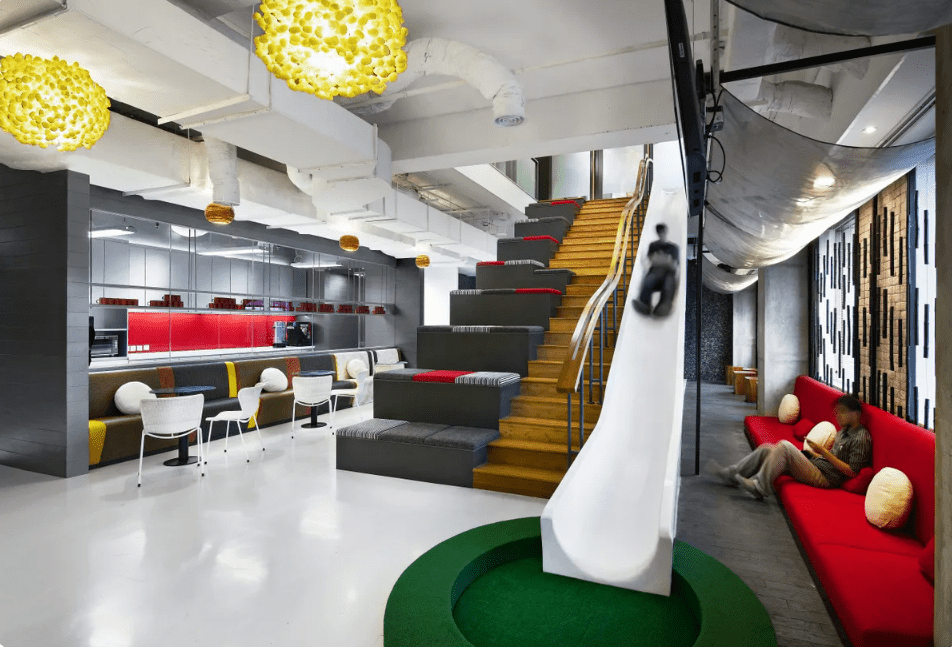
Stairs. Build them beautifully and out in the open, as centerpieces of our public spaces instead of last resort, emergency egress. Make it normal and the default to take the stairs instead of the elevator.

“5 of the best office staircase design ideas” –www.robinpowered.com

Get off camera. Do you really need that Zoom meeting? Do you need to meet at all? Whatever can be converted to a (concise!) email or voice call, do it. Hold folks accountable for preparation and brevity so all time spent meeting is valuable and productive. Then give them the time back so they can get away from their desks, accompish more tasks both personal and professional, and get more sleep, so they can be more motivated for the workouts they can now fit into their days.

Sit to stand desks. Make them standard in offices and reimburse workers to get them at home.

Give people balance boards and mini steppers as remote work onboarding gifts.

How else can we modify our systems and structures to lower the threshhold to get off our butts? What do you see around you that’s working already?

The Transformative Power of Community

AIYAAAAAH IT’S JUST TOOOOO GOOOOOOD!!!

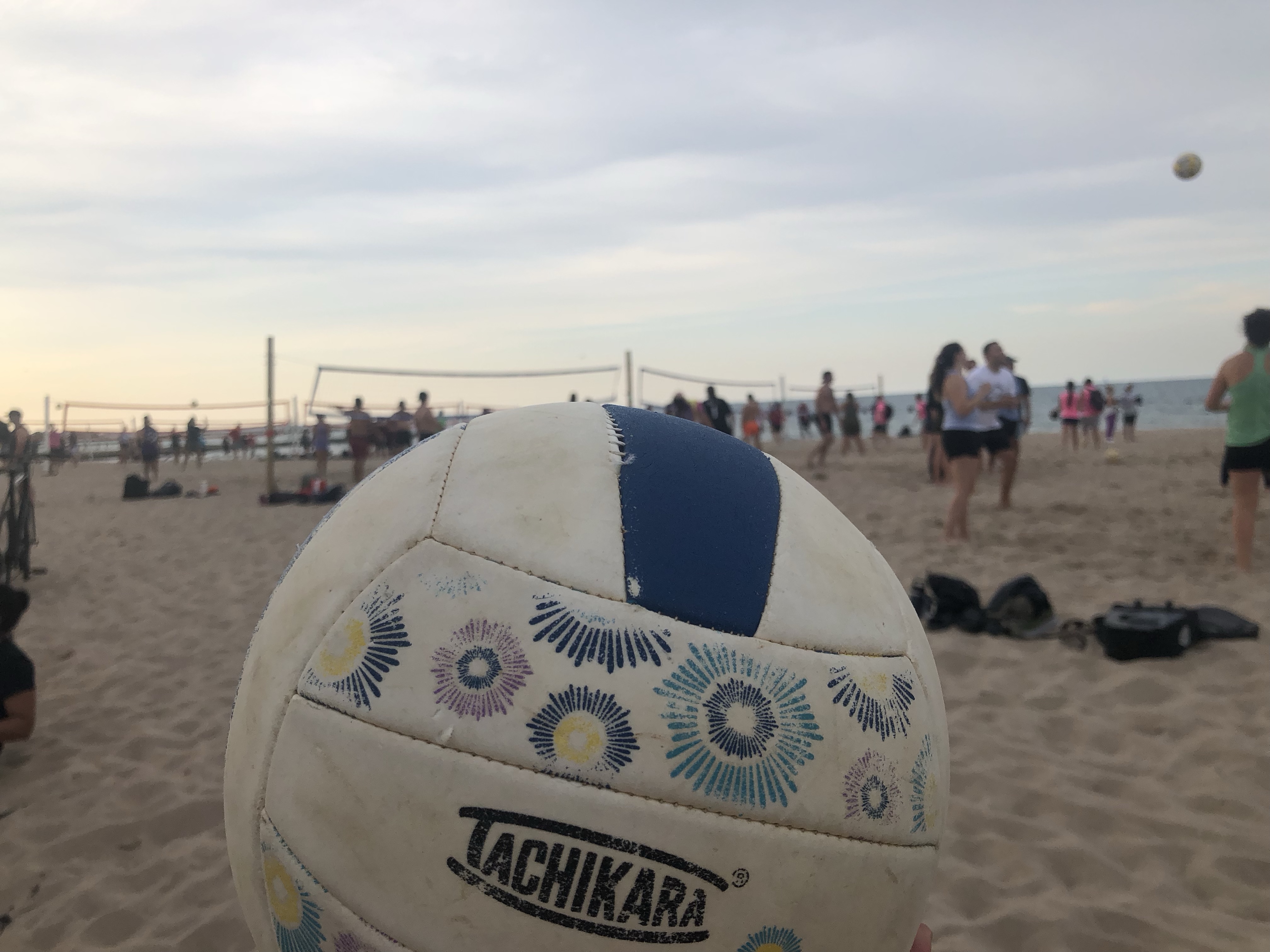
Friends, please meet my new beach volleyball teammates! We are the Ethos team at North Avenue Beach on Wednesday evenings, woohooooooo!! I have played since 7th grade, and never on sand until this summer. And I can’t think of another group I would feel safer and have more fun doing it with. How many times have I mentioned Ethos and how I love the team there? Well it keeps getting better, I just cannot say (or write) enough!

In the last four months I have increased weight from 50# to 105# on barbell back squats, 12.5# to 20# on dumbbell bench press at any angle, 35# to 70# on landmine squats, and all kinds of other personal strength and endurance records. In that time I also hit some speed bumps and potholes: left sciatic impingement (April-May), left medial meniscus aggravation (May to last week), left shoulder instability (ongoing and improving), and right brachioradialis spasm (July to present, also improving). Bottom lines: 1) I never would have tried loading weight like this on my own at home, thus my strength and form stagnated. 2) Had I injured myself working out at home, I would not have known how to modify anything to continue moving and progressing safely. But with the support and encouragement of the coaches and community at Ethos, strength, form, confidence, motivation, and joy and connection have all improved exponentially.

“There can be a fine line between rehab and performance,” Jacob told me. EUREKA! Lighten up on weight this week, focus on range of motion, Ryan advised. They taught me hip, knee, neck, and wrist CARs. Listen to my body. Take care of it with good sleep and nutrition. Be patient. No judgment. Keep coming to class, spirit buoyed by friends. Coaches continue to monitor and correct. And voila: healing and progress, competence and confidence, HALLELUJAH!

I have never, in my entire life, loved going to the gym like I do now, and it’s all because of the people. So when I heard about the beach volleyball group, it was a no brainer to join. My world expands newly after 38 years of indoor play, adjusting to various outdoor conditions (twilight/night, wet/dry and deep/shallow sand, and wind, OMG!). Lessons in team communication emerge in yet another domain. And between gym and beach, uplifting new friendships bloom. I mean does it get any better than this?? I feel positively giddy from it all!

How do your communites support, even carry you? As I thought more this weekend about belonging, connection, and mutual, synergistic uplift, meaningful examples appeared everywhere.

New Friend described his spiritual community to me and I could feel, from his facial expressions, voice, and posture, the deep stability and peace he gets from that connection. The Sheil Catholic Center has been that for me since college, not because of religion per se, but again because of the people. Shared spiritual belief and core values play a primary role in Friend’s and my belonging in these groups, and deep connection can occur around anything: Meditation, yoga, sports, volunteering, book club, work…

How many different communities include you, make you better, and benefit reciprocally from your unique presence and participation?

OMG Romance! WHODATHUNK? 11 months in and still binging strong, my friends. Since I posted initially last November, my consumption has expanded from steamy cis-het-binary-monogamous rom-coms to novels that include male-male, dark, fantasy, paranormal, mafia, dominant-submissive, and polyamorous themes! My vicarious sex and relationship education continues with momentum and ardent support–you guessed it–from the romance community! I would never have found any of these stories and experiences if not for the Shaneiaks Facebook group and guidance from the indefatiguable Suzi over at Royal Reads Services, group admin and expert in all things romance publishing. I have always been open and comfortable talking to my patients and kids about sex, and today I’m even more confident and bold. Ask me anything, tell me anything, and I will engage with a whole new level of openness now. By the way, if you also seek to broaden your horizons in this domain, I highly recommend Boyslut by Zachary Zane.

How do your communities support others?

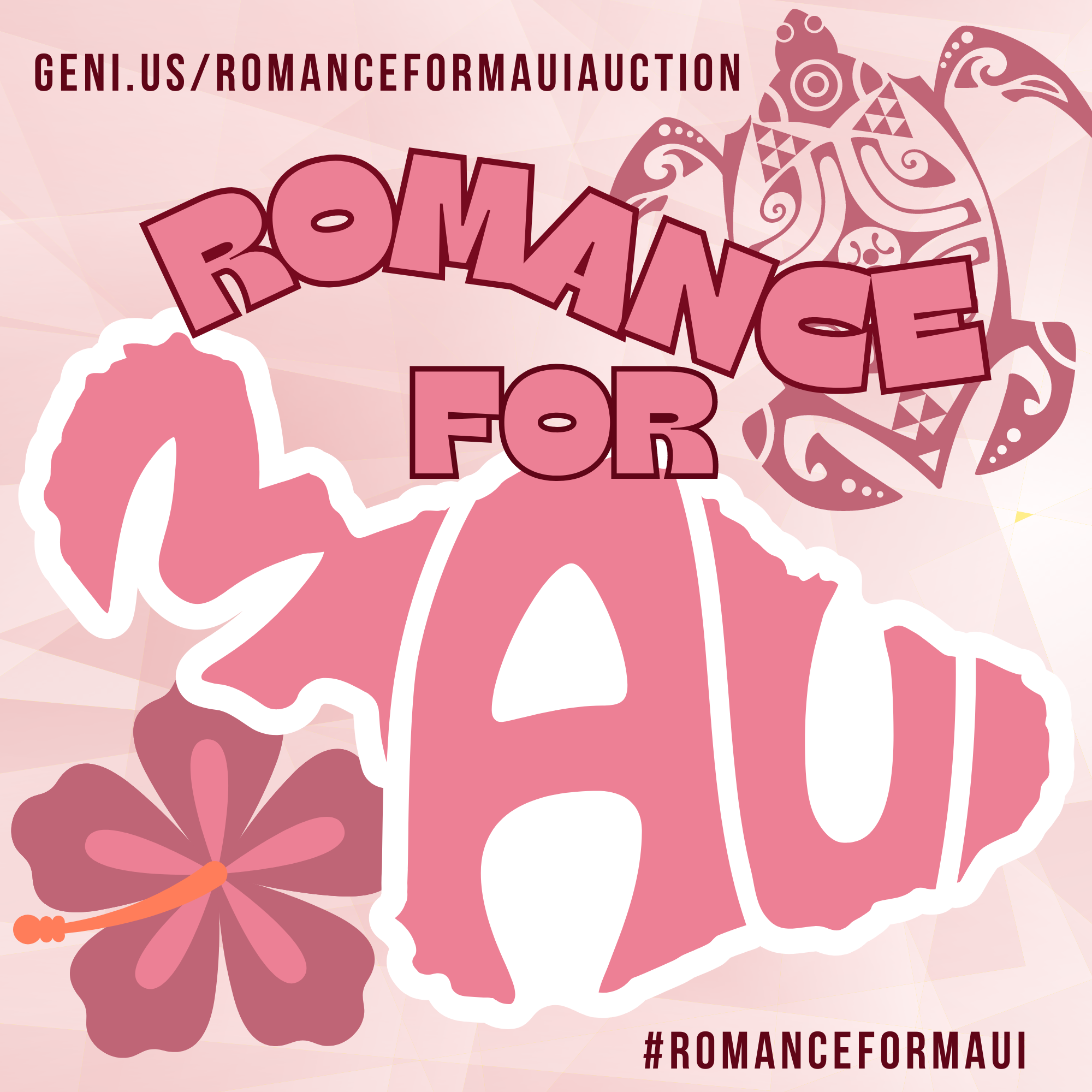
Once again, the romance community inspires me. When author Lili Valente‘s house was destroyed by recent floods in the Northeast, her fans came together to support her through direct book purchases on her website. This week author Lucy Eden has organized RomanceforMaui, an upcoming auction to raise money for those affected by the most devastating wildfires in the United States in 100 years. Check out the auction items–consider bidding for yourself, your romance fan friends, and for the people on Maui. Finally, see how romance narrators, authors, and audiobook producers come together to support their BIPOC colleagues by providing grants and services to bring their work forth through Audio in Color. Simply amazing.

I am such a better version of myself because I belong to these tribes, wow, how humbling and exciting.

It occurs to me that membership in some communities can actually transform us into worse versions of ourselves… *sigh*… More on that in later post, perhaps…

Relationships. They can kill us or save us, and so much more. Our communities of deep and meaningful belonging can enrich, expand, educate, and empower us, often to heights we could never have imagined. How can we build and grow more of these connections, strengthen them for the good of all? I have some ideas…