November 13:  Lightening Up Makes Me Better


IMG_2005

NaBloPoMo 2019

“Write without fear.  Edit without mercy.” —Unknown?

Hi, I’m Cathy, I’m a perfectionist.  I might be a control freak.  But I’m in recovery.

I kind of like that I proudly published a run-on post of a half-formed idea, then slashed it by one third and published it again.  It’s a fun paradox to inhabit pride and humility at the same time.

Other writers help.  I’ve written before about The Art of Possibility.  Phrases like, “How fascinating!” when I make a mistake make room for self-compassion and -forgiveness.   This attitude of good humor keeps me from wallowing in self-flagellation.  Because I am also accountable, I can learn and make amends more swiftly and earnestly.  The Zanders’ Rule #6: Don’t Take Yourself So Damn Seriously, is such an easy catch phrase to remember, and takes practice to live in real time.  I’m getting there!

Big Magic by Elizabeth Gilbert, full of vivid, joyful, and wondrous stories of human creativity, encourages me to take risks.  Make pretty things, she writes.  Don’t do it for us, don’t do it to help anyone.  Do it because you want to.  Your unique expression has a value all its own, so put it into the world.  Period.

Ozan says, “Do the verb”:

In many cases, we want to be the noun (a songwriter) without doing the verb (writing songs). We tell ourselves we’re going to be an entrepreneur, but we don’t build a product or service. We tell ourselves we’re going to be a novelist, but we don’t write a novel (instead, we tweet about writing a novel).

The key is to forget the noun and do the verb instead.

If you want to be a blogger, start blogging every week.

If you want to be a stand-up comedian, start doing stand-up comedy at open mike nights.

If you want to host a podcast, start podcasting.

…Doing the verb reorients you away from the outcome and toward the process. And if you plan to be a professional at anything, the process–the verb–is all that matters.

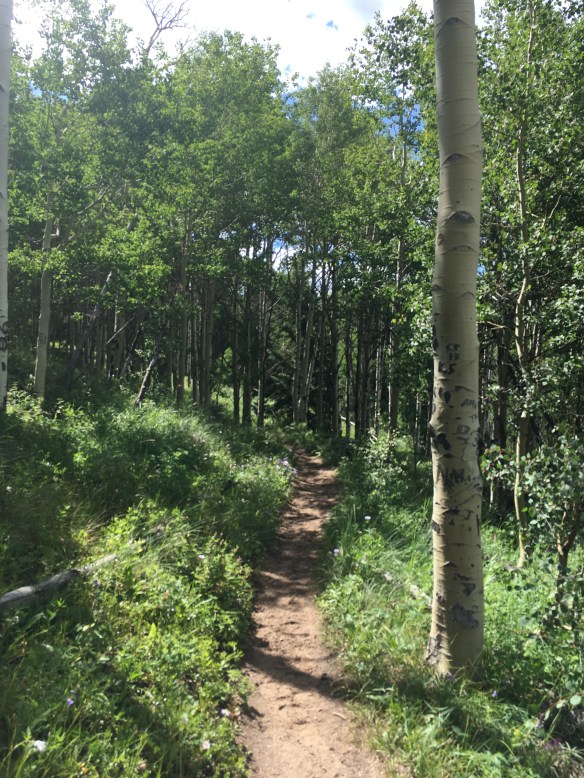
With these inspiring innovators’ help, I skip freely along on the path of writing, light on my feet.  When I trip on a rock and face plant next to some wildflowers and an earthworm, I can take off my glasses and stare a little longer from this new perspective.  I’ll likely find something to write about from it.  Sweet!

Even when I think an idea is fully formed, the act of writing expands it.  This week I have discovered deeper meaning in my stories, just by way of typing them.  More material to chew and spew, yay!

This is not brain surgery, writing a blog.  I’m not saving lives here!  But it is a challenge, a commitment, and sometimes a labor.  I hear my own voice consistently throughout almost 5 years of posts, and while my style is still consistent, I also see an evolution in the writing.  I’m gratified to continue the discipline, and taking it ever lightly definitely makes me better.

November 11:  Fierce Optimism Makes Me Better

IMG_1860

NaBloPoMo 2019

On Ozan’s Inner Circle forum today, another member posted about his admiration for Dr. Martin Luther King, Jr.  It reminded me of a favorite MLK quote, which came to mind on Saturday as I prepared for the Better Angels workshop:  “The arc of the moral universe is long but it bends toward justice.”  I have referred to this quote many times over the years, and a phrase that I often add goes something like, “Bend that arc!  Hang on it with all your might!”  Meaning the arc bends toward justice only because we make it so, by working tirelessly for it, by acting visibly in accordance with our core values, and by consistently walking the talk.

I texted my friend the morning of the workshop: “I’m 90% excited, 10% nervous…Maybe 15%…”  Then I thought about the people I know who like the idea(l) of Better Angels, but don’t want to participate.  I thought about my friends who express hopelessness at any possibility that people on opposing political sides can ever connect, that we can actually work together across our differences to get things done.  I thought about the pushback I might get, that the Better Angels mission is futile, a waste of energy and time.  I felt something akin to a tidal wave rise within me, and I texted my friend again, spontaneously, “I intend to make today a day of fierce, infectious optimism.”  At that moment I knew my goal that day was to take every example and experience of kindness, connection, empathy, openness, generosity, magnanimity, conviction, and hope, and channel it to the workshop and its participants.  Because though it was to be a skills workshop, teaching a way of doing, what we really need are all of the qualities I just listed—they are the way of being that brings the skills to bear in the most meaningful ways.

This idea marinated for a couple of hours while I pictured the venue, reviewed the workshop content, made notes about delivery.  I thought again about my friends who feel like our world is crumbling around us, that so much progress made the last century is being eroded.  I completely empathize with this perspective, and I understand how it makes us feel we have to fight, to be aggressive and confrontational, to come at the opposition full force, like a bullet train.  Do they think listening and speaking skills focused on curiosity and openness too passive and ineffective?  Does optimism, the hopefulness and confidence that things will be okay, make me lazy about the issues that matter to me?

Below are the words I texted my friend to describe what I mean by ‘Fierce Optimism’.  Normally I would not share such nascent ideas on the blog, but whatever, it’s all an experiment, who knows what better ideas may come from this early sharing?

IMG_1898

Fierce Optimism Is:

Urgency with Patience

Or should it read, “Urgency without Impatience”?  What I mean here is simply that most things worth doing take a very long time.  All important social movements occurred (and continue) over generations.  At times confrontation and revolution are necessary.  But they are not enough.  Consistent, slow, organic, grass roots change on the local level is what sustains consistent progress, keeps it from regressing.  The acute urgency I feel to address my deep concerns (for instance, the profound rifts in our relationships) drives me to action.  But when that action is directed at another person, I must attune.  I have to set realistic expectations for how much I can move this mountain today.  Pacing myself, practicing persistence with patience, conserves energy and prevents burnout.  It also allows me to look up every once in a while and adjust to my surroundings, adapt to subtle changes, like when someone starts to soften.  If I’m bulldozing with strong words and heavy dogma, I am more likely to plow over and through any crack in the door of someone’s mind that might have swung open freely had I taken a more gentle approach.

Strength with Flexibility

Better Angels does not seek to make everybody—anybody—a moderate.  Rather, the goal is to hold our positions firmly and with principle, and practice seeing why someone else may hold a different position with equally strong principle.  In doing so, two things often happen:  First, by challenging our own beliefs and values, we can reinforce them.  Telling stories about the experiences that led us to our core values reconnects us with their origins, grounds us in and strengthens our own personal truth.  Second, hearing others’ stories helps us broaden our perspective.  Most of the time we only see things from our own point of view—this is our default setting.  But when we share personal experiences, really learn about each other, the curtains open on a vast landscape of understanding that we may never have imagined.  So while I may still hold my goals and objectives firmly, I can more easily release the rigidity of my method, tolerate setbacks with less suffering.  Earlier this year I listened to The Warrior Within by John Little.  He describes Bruce Lee’s life philosophy, which included a metaphor of the bamboo and the oak.  Both are admirably strong, but under intense forces of nature, the oak may break while the bamboo simply bends, sometimes to the ground, but without breaking.  Both stay rooted where they are planted, but one is more resilient.  Listening with openness and curiosity is not weakness.  Allowing for nuance and the possibility that my mind may be changed in some ways, while holding steadfast to my core values, makes me calm, agile, adaptable, and, I think, more effective.

Conviction with Generosity

This is about the assumptions we make.  Too often we cast ‘the other’ in abstract as sinister, evil, less than.  We hold up the most extreme members of the opposing group as representative of a dull and dumb monolith.  We oversimplify and overgeneralize, and then approach any individual we identify as belonging to that group as an assembly line package, a completely known entity.  We think we know all about them already, even if we have never met them, just because they identify today as “Red” or “Blue.”  In so doing, we make ourselves small.  We become exactly as narrow minded and prejudiced as the folks we accuse on the other side.  How ironic.  Now more than ever, we need generosity.  In my mind this encompasses empathy, vulnerability, sincerity, humility and a willingness to allow the complete humanity of every other person, regardless of their political, religious, racial, cultural, or any other persuasion.  Conviction without generosity too easily becomes tyranny, for individuals as well as organizations and governments.

*sigh*

Well, like I said, these ideas were just born two days ago.  Have I expressed them at all coherently?  Have I shown you intuitively apprehensible paradoxes?  Can you feel the dynamic balance of agitation and peace?  Tension without anxiety?  Potential and kinetic energy?  If not, that’s okay.  I’ll keep working on it.  That’s the essential outcome of Fierce Optimism, after all—we keep working, steadily, to bend that arc.


IMG_2046

The Mark You Make

IMG_2633

Friends, Ozan has written another book!  I know it may seem like it, but he’s not paying me to promote his work, really!  He has offered perks for Inner Circle members, however, like an advance digital copy for preordering, and signed copies when the book is released next April.  In considering what I would ask him to inscribe to my friends in the books I will give them, I realized yet another evocative dimension of my relationships.

If you were to describe your friendships to a third party, or make a meaningful introduction in service of connecting two amazing people, what would you say?  I call it ‘connecting fellow Awesomes,’ and it’s always a pleasure and privilege to serve in this capacity.  I thought to ask Ozan to write to one friend something like, “Cathy thinks the world of you—happy to make such a positive new connection!”  Then I thought, this friend has really made a mark on me.  Then I thought of the mark Ozan has also made, in just 9 months of virtual contact.  And then my mind was blown with the realization of my cosmically marked-up self—the finger, hand, and footprints of all those whom I have contacted.

Years ago I attended the orthopaedic surgery resident graduation dinner with my husband, a happy and fun annual event.  At the end, mingling with faculty and trainees, one of the graduates looked at me and his eyes widened.  “You’re Dr. Cheng!  You were my teaching attending during my third year medicine rotation [7 years prior] at [the hospital where I used to work]!”  I was gratified that his expression was cheerful, rather than distressed or awkward, surprise.  He went on to tell me that I held the team to a high standard of discussion, and that he appreciated my presence and teaching.  I will always remember this encounter with pride and appreciation.

In the past year three patients from my past have resurfaced and told me the positive difference I made it their lives.  I remembered two of them so clearly, both their faces and their names (after 20 years and thousands of patients, I can usually only remember one or other).  Talking to each of them reminded me of all that we had been through together, and I was glad that I had done my job well.

But what about those for whom I have not been a great doctor?  I have had my fair share of patients who left me, for various reasons.  I know I have been seriously disappointing for many.  I wonder how many times I have contributed to patients’ negative overall experience of medicine, and further widened the divide between doctors and patients in our fraught and flawed healthcare system?  Sometimes I look back on my early years of practice and cringe a little—all the writing I do now on empathy, compassion, curiosity, openness, and humility results from years of lessons learned in real time, on real people.  I’m definitely much more adept at it all now than in the beginning.  And I’m still learning—I still get triggered, still fall into old, counterproductive thought and behavior patterns.  Sometimes it feels like I will never be good enough, or enough in general.

IMG_1852

I also think about the people whose marks on me were/are hurtful, dismissive, and otherwise wounding.  It reminds me of carvings I see in the trunks of the beautiful aspens I walked among this weekend.  Did the folks who made them set out to harm the trees?  If they thought the tree might die from their knife marks, would they think twice?  Maybe they were overcome with their profound experience in nature and just wanted to mark it in some way, especially if they shared it with someone they loved (so may initials with plus signs and hearts)?  Sometimes we just want or need to be right, competent, respected, and acknowledged.  So we mark our encounters with stubbornness, aggression, or even violence (in its many forms, overt and cloaked).  Like the strong and flexible aspens, I bear scars from such encounters and still continue to thrive.  Such marks have taught me how to care for myself, and also how not to be toward others.

In the end, how do I reconcile these relationship phenomena?  Sometimes we can see and know the mark we make on others.  Many times we cannot.  Nobody is perfect.  My whole life I will scrape and nick those around me, hopefully never with malicious intent.  I can only hope for their generosity and grace, and forgiveness.

Sister Brené Brown, once again, helps me continue.  In her book Rising Strong, she describes a choice, a mental attitude, that can help us all suffer less.  If you have not read or heard the book, I highly recommend it—it’s my favorite of the 5 of her books I have read.  Assume, she says (with the help of her pediatrician husband), that we are all doing the best we can.  That’s it.  We are all imperfect.  Our circumstances mess with us, our patterns mess with each other, and sometimes it can feel like a strange and inexplicable miracle that we have not all killed one another already.  But choosing to give each other this one, simple, and at times colossally difficult benefit of the doubt, could be what saves us all.

We simply cannot extricate ourselves from each other.  So we can just do your best to take care of one another.  And be prepared to apologize, early and often.

IMG_2498