I’m the Doctor, You’re the Doctor

DSC_0401

NaBloPoMo 2017: Field Notes from a Life in Medicine

“I’m the doctor, just do what I say.”  I don’t think doctors actually say this anymore, but I wonder how many of us think it?  It’s probably not even a conscious thought, but rather an attitude—paternalistic and directive, a relic from the old days when patients had no power or voice in the relationship because the doctor held all the information and all the expertise.  Today patients are empowered by culture and the internet to participate in shared decision making , and it’s a good thing.

The problem with the “I’m the doctor” attitude is that it inhibits the patient from owning their own healthcare choices.  Then if and when the care plan goes badly, they feel rightly justified blaming the doctor, because they were just following orders.  Sometimes it’s necessary, like in the case of trauma or serious surgery, where the doctor is truly in charge and must make life or death decisions according to their expertise and judgment.  Thankfully this is not my work.

In primary care, if I take this attitude, I miss an opportunity to forge a collaborative and rewarding relationship with my patients.  If I simply issue orders, people don’t feel seen or heard, and they may withhold important information that would help me make a better, more relevant diagnostic and treatment plan.  And if they defy my advice (edict), as they are more likely to do when our relationship is transactional and cookbook, and things go well, then I lose credibility and they are even less likely to follow my advice in the future.

“You’re the doctor,” on the other hand, is something I hear often.  It usually comes up when patients (and I) are faced with decisions involving competing interests or vague risks and benefits.  An example is prostate cancer screening.  Guidelines over the years have ranged from screening every man, every year, starting at age 50, for life, to don’t screen anyone ever.  Most physicians and professional societies agree currently that the best approach is to discuss risks of screening (over-diagnosis, harm from testing in patients without disease) and not screening (missing early cancer, delayed diagnosis, possibly leading to preventable negative outcome), and make decisions based on patients’ individual values and goals.

When a patient in this or a similar situation says to me, “You’re the doctor, just tell me what to do” alarms ring my mind.  What I intend to be a shared decision suddenly falls to me to make unilaterally.  In this scenario, the patient essentially cedes responsibility for the treatment plan, and if it goes badly then it’s my fault “because you told me to.”  Or the patient may choose to ignore my directive and also blame me because “you told me to but I disagreed.”  Either way a patient may then feel justified to blame me for any negative outcome, even though I gave them what they said they wanted.  I understand that this is not how the scenario necessarily plays out, but somehow I’m wary of it.

I had my teeth cleaned today.  The dentist recommends x-rays every year; I politely decline most of the time.  I just don’t understand (or accept?) the rationale and benefits of annual radiation to my face, and I’m cynical about the fee-for-service structure in which providers make more money for ordering more tests (which is a legitimate concern in medicine, also).  Without explaining why it’s recommended for me particularly (it was explained later), I heard, “Well, it’s okay if you don’t do it today, but you have to do it next time.”  [Expletive, not stated out loud.] I am emotionally triggered when people try to tell me what to do without asking me what I think about it first (see my post from 2 days ago).  So I bristle when I witness colleagues doing it, or when my patients demand it from me.

I don’t see my job as telling people what to do—I am not a surrogate.  Rather, I think of myself as consultant and guide, expert, counsel.  It’s my job to discuss, explore, explain, review, consider, negotiate, compare, assess, debate, explain and discuss again, and then make a shared decision.  This includes follow-up and contingency planning, setting expectations, and reassurance about my commitment to the person, regardless of the problem.  I’m the doctor, you’re the patient, we are a team.  We are in this together.
Hopey, Changey Hero Making

IVY Litt 11-8-17

NaBloPoMo 2017: Field Notes from a Life in Medicine, Day 8

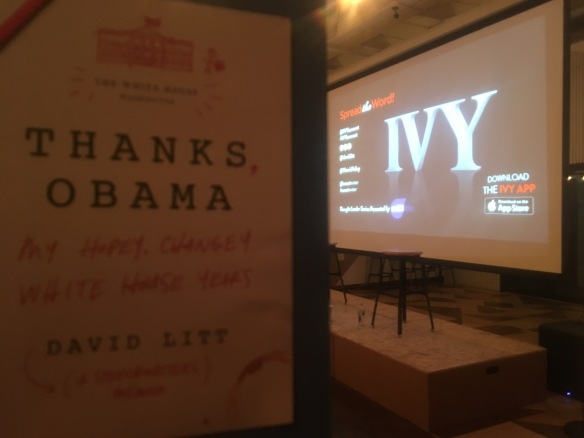
Funny how I just wrote last night about connecting new dots to old dots.  It just happened again tonight!  A couple of weeks ago I responded to an online ad for an IVY Ideas Night with David Litt, author of Thanks Obama: My Hopey, Changey White House Years, entitled, “How to Inspire, Persuade, and Entertain.”  Litt was a senior speechwriter for President Obama, so I thought I could learn new tips for presentations, and feel a little closer to the president whom I miss so much.

I’ve done public speaking since eighth grade, when our speech teacher first taught us abdominal breathing and I discovered the thrill of holding the attention of a room full of people with only my words.  I work at an academic medical center and I hold zero publications, but my CV documents over 10 years of professional presentations to various audiences.  I thought I was pretty good at this speaking thing.

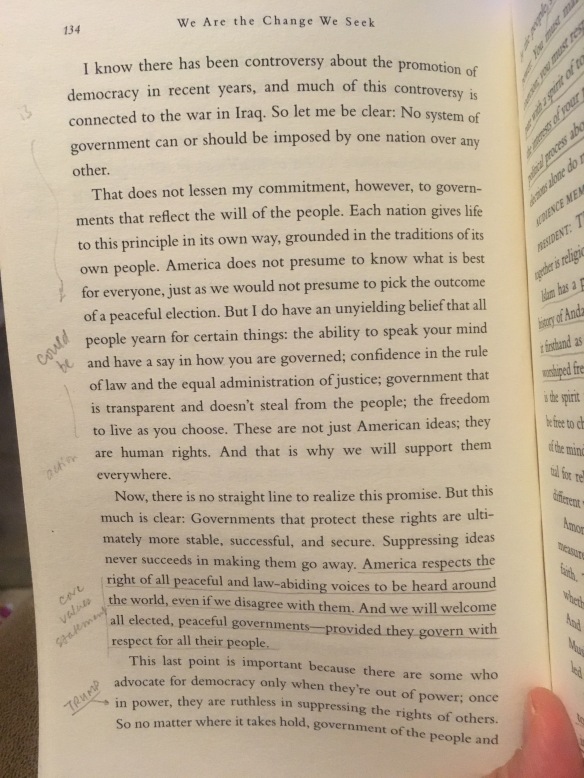
Three years ago I came across this TED talk by Nancy Duarte, whose ‘secret structure’ of great presentations I have used since I subsequently read her book, Resonate.  Essentially, she recommends that we invite audiences on adventure stories, create active tension between what is and what could be, and most importantly, make the audience the hero.  I have done this better and worse since then, but I always recognize the framework when I see it.  Those familiar with this blog know that I am also a fan of Simon Sinek, whose central message is that we perform at our best when we are crystal clear about our Why.  “People don’t buy what you do, they buy Why you do it,” he says.  Barack Obama employs both authors’ principles with eloquence and finesse, which I noticed reading We Are The Change We Seek, a collection of his speeches as president.  The best speeches delivered in this construction create audiences who are inspired, motivated, and empowered to hail a meaningful call to action.

Obama is could be core values

That’s basically what David Litt conveyed tonight.  When asked what advice he was given that served him best, he said, “Imagine someone in your audience will tell their friend tomorrow about your talk.  What is the one thing you want them to say about it?”  What is the Why of your talk?  Even though he no longer writes speeches for the most powerful person in the world, he expressed a desire to continue inspiring, empowering, and promoting personal agency in all whom his work touches. Make each and every audience member their own hero.

It turns out, however, that this approach applies to much more than public speaking.  On my 50 hour, 500 mile, aspen-pursuing weekend in Colorado last month, I described to my dear friend my favorite moments at work.  At the end of a patient’s day-long physical, after I have spent 90 minutes listening to their stories of weight gain and loss, work transitions and complex family dynamics, and reviewing their biometrics and blood test results, I meet with them for an additional 30 minutes to debrief.  This is when I present an integrated action plan compiled by the nutritionist, exercise physiologist, and myself.  It is a bulleted summary of our conversations throughout the day, centered on the patient’s core values and self-determined short and long term health goals, and crafted with their full participation.  I get to reflect back to my patients all that I see them doing well, and shine light on areas for potential improvement.  It’s an opportunity to explore the possible—to Aim High, Aim Higher, as the United States Air Force exhorts.  I often present the plan with phrases like, “Strong work!” “You’ got this,” and “Can’t wait to see what the coming year brings!”  My friend turned to me as we wound through autumn gold in the Rocky Mountains, a bit tearfully, and said, “You make them the hero of their own story.”  Yeah, I do, I thought, and I got a little teary, too.

Words are powerful.  They are our primary tool for relating to each other, for making another person feel seen, heard, understood, accepted, and loved.  You don’t have to be a public speaker or a presidential speechwriter to make a positive difference with your words.  At work, in your family, with your friends, with people on the street and in the elevator—what is the one thing you want someone to remember from their encounter with you?

No Substitute for Time

DSC_0401

NaBloPoMo 2017: Field Notes From a Life in Medicine

Day 3

How much time do you spend with your doctor each time you see them?  Is it enough?  If they had more time to spend with you, how would you use it?  Would it be better?

I’m too tired and it’s too late tonight to discuss the myriad factors that erode the patient-physician relationship, and thus our medical system in general.  But time comes to mind often for me, and I wonder if patients are as frustrated about it as I am.

Where I work now, I pretty much have as much time as I want with people.  It’s a sweet gig.  I can ask them about their work, their families, their interests.  I have time to listen to the answers, and even connect those with my observations about their health.  The most interesting parts of my interviews are the social history.  What do they spend their days doing at work?  What problems do they solve, who do they interact with, and what brings them meaning at the place where they spend the majority of waking weekday hours?  Then what do they do for fun, what’s life like outside of work?  I get to know my patients as individual, whole people, which I love, and that makes me look forward to every day at work with joy.

But time is not just good for me, for my professional fulfillment.   It’s good for patients, too.  When I spend time asking the important questions, putting together pieces of a person’s symptom puzzle, and do a directed exam, I’m more likely to come to a correct diagnosis and make an appropriate and specific care plan.  When I take the time to explain my rationale, decision process, and possible outcomes and follow up, my patients are more likely to feel seen, heard, and reassured.  They are more likely to stick with the plan and contact me if things change.  The next time they need help, they are more likely to call me and we have another chance to know each other better.

When the physician-patient relationship flourishes, we’re all healthier.

I love this article on The Health Care Blog, which essentially validates the time I take to talk to my patients.  My favorite line:  “More information about the value of a physician-patient encounter will always be found in the content of their communication than in what they ultimately do. The difference in… physicians’ behaviors will not be found in any database, electronic medical record, or machine-learning algorithm. I have yet to see data on the contextual information from a history of the present illness in any data set or quality improvement initiative.”

You may also be interested in this article, describing the origin of the 15 minute clinic visit, and why it really doesn’t make sense.

What do you think about physicians and patients advocating together to change this aspect of our flawed medical system? I know it’s complicated, requiring a hard look at our billing and compensation processes, as well as our productivity-driven, fee-for-service medical culture.  I still think it’s worth pursuing.  There is no substitute for time.  We must protect and defend it; our health depends on it.