
On Readiness

dsc_0450

NaBloPoMo 2016, Letters to Patients, Day 16

To Patients Contemplating Change:

You’ll do it when you’re ready.  And you’ll know.

My 24 hour Facebook fast is 90% complete, and I feel GREAT!!  Holy COW, I’ve been so productive, and for the most part I feel liberated and lightened.  The darkness of increasing online tension had spread over my consciousness rather insidiously, like a slime mold.  It’s not that I was totally unaware, or that I underestimated its toxic influences; I was just not ready to stop it.  The cost/benefit balance finally tipped and I was moved to act.  It’s that simple and that complicated.

Today I reviewed my notes from the physician health conference 2 months ago.  I came across an important exercise that illustrates my point.  The speaker had us make two lists: energy-depleting activities and energy-enhancing ones.  My second item on the former list was “Facebook+/-“.  It was the third item my latter list.  She then asked us: If we had 2 extra hours a day, what would we do more?  –Read, write, go outside, meditate, do stuff with kids (outside), plan road trips.  Then, if we had 2 fewer hours per day, what would we cut out?  –Facebook/news, TV/movies.

That was two months ago.  I knew I ‘should’ cut down on my Facebooking, but I was not ready.  Yesterday, finally, I crossed a threshold and the decision was easy.

I hear this all the time from patients.  “I know I should eat healthier.  I know I should exercise more.  I know I should quit smoking, cut back on the alcohol, go to bed earlier, address my relationship problems.”  And, “…I just don’t.”  Both patients and physicians can easily slide into judgment here, thinking, “If you know you should, why don’t you just do it?”  Defensiveness and self-loathing follow closely behind these words.

On the other hand, when patients return having cut out red meat, quit tobacco, and joined a basketball club, I ask them, “What happened?”  Most of the time I hear, “I don’t know.  Something just clicked and I decided it was time.  …And suddenly it was easy.”  Sometimes they identify an a-ha moment—when they first held their newborn baby, for example.  But more often there is no cloud-parting epiphany.  They simply cross the threshold of readiness to change, while walking the journey of life.

I confess I am guilty of impatience and judgment.  When I see your uncontrolled, lifestyle-related medical problems, and you resist behavior change, I feel frustrated.  I know you feel it, too.  But know that I don’t blame you.  If we all did everything we knew we ‘should,’ then—well—you fill in the blank.  The point is: we don’t make changes until we are ready.  Certainly we facilitate readiness—that’s a topic for another post.   Suffice it to say: I see you.  I know you want to live healthy.  You will know when you’re ready, and you’ll move.  Until then, I’m still here with you.

 

On What You Can Do


img_4564NaBloPoMo 2016, Letters to Patients, Day 12
To Patients Wondering What to Do:

Take this Wise Lady’s advice.

I had an inspiring conversation this week, one that lifted me up, which I sorely needed.

This incredible woman grew up in the era before women could have credit cards in their own names, before women could play organized sports, and before spousal rape was finally outlawed.  She survived brain tumor surgery and the death of her son.  She has attained advanced education, acquired innovative skills, built and sold a business.  Throughout it all she seems to have thrived.

I queried her response to adversity.  Was she born wired for resilience?  Did she acquire such effective coping skills simply by experience?  She referenced the teachings of her father.  Through her childhood, she said, he taught her to how to face difficulties.  Before she went off to college her dad had a specific talk with her:  “Here’s how you deal with problems,” he said.  “When faced with a problem, first ask yourself, ‘what can I do?’”  Not what should I do, what do others expect me to do, what would s/he/they do.  “What can I do?”  “If you can’t figure it out right away, stop.  Go outside, take a walk.  Come back and ask again, ‘What can I do?’”

Wise Lady said this one strategy got her through myriad struggles and crises in life, and she taught it to her kids the way her dad taught her.  But life flung faster, sharper arrows her way, and she had to develop additional coping tactics.  Seeking a path to clarity through the mires of crisis, she began asking herself, “What do I need to get rid of?”  And that has made all the difference since.

I will tell you, Wise Lady has a serenity about her countenance that I meet only occasionally anymore.  She has racked miles on her soul, yet I sense no cynicism or regret.  I so want to be like her!

From now on I will ask myself more often,

“What can I do?” and

“What do I need to get rid of?”


On the Second Arrow

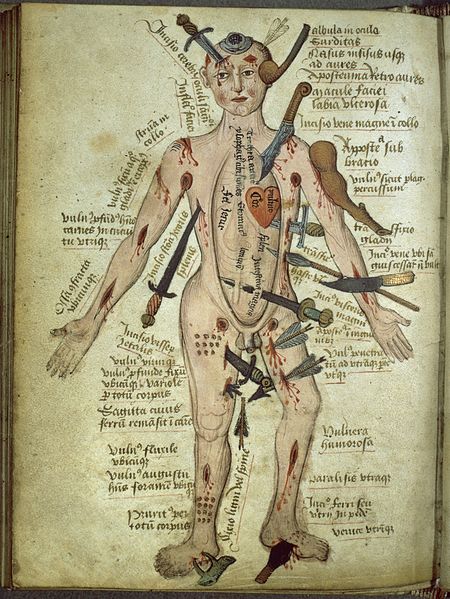
wound-man

NaBloPoMo 2016, Letters to Patients, Day 11

To Patients Who Suffer:

Which arrow causes you more pain, the first or the second?

Fellow blogger Michelle at The Green Study recently posted a piece in which she distinguished between pain and suffering.  It reminded me of a Buddhist teaching that inspires and humbles me.  Blogger and curator extraordinaire Maria Popova quotes it in this article she wrote last year, on a book by Tara Brach:

The Buddha once asked a student, “If a person is struck by an arrow, is it painful?” The student replied, “It is.” The Buddha then asked, “If the person is struck by a second arrow, is that even more painful?” The student replied again, “It is.” The Buddha then explained, “In life, we cannot always control the first arrow. However, the second arrow is our reaction to the first. And with this second arrow comes the possibility of choice.”

The first step to suffering less is cultivating awareness of the second arrow.  This takes practice, and we must resist the self-judgment that comes the moment we realize we have not only shot ourselves again, but have been twisting that second arrow deeper and deeper.  This shame and self-revulsion is, after all, another drop of poison on the second arrow’s tip.  Instead, I like to apply Ben Zander’s acclamation when he finds himself or his students doing something ‘wrong’: “How fascinating!”  Look what I did!  No judgment, just lighthearted observation.

The second step to suffering less is, of course, to avoid the second arrow.  Once we notice, learn how to remove it and tend the wound.  Breathe deeply.  Identify the sources of anger, fear, resentment, blame, contempt, shame, despair, anxiety, bitterness, envy.  Breathe again.  Loosen our desperate grip on these feelings.  Hold them more loosely, ever more loosely.  Breathe.  Breathe.  Hold also the Space, emotional, cognitive, and temporal, for them the move through and exit us.

Eventually, breathing, we can let go the negativity, pull the arrow out.  Breathe.  When assailed by another first arrow, see the second arrow coming and sidestep.  Breathe.  Keep breathing.  Practice self-compassion and forgiveness.

Life will continue hurling arrows at us.  Some will miss, others will land in our most vulnerable spots.  Mindfulness practice, centered in attention to the breath, helps us evade the wounds and anguish from our own second arrows.  The data, accumulated over the past four decades, is all but irrefutable for the benefits of mindfulness for depression, anxiety, chronic pain, burnout, and overall well-being.  Prolonged practice even changes the physical structure of the brain, and it’s never too late to learn.

If you’d like to learn more, I have included a few more links below.  You may find it worthwhile to invest in the practice.  Be patient with yourself.  And let me know how it goes!

http://www.wildmind.org/texts/the-arrow

http://www.huffingtonpost.com/susan-bernstein/dont-shoot-the-second-arr_b_5102701.html

http://www.nscblog.com/miscellaneous/avoiding-the-second-arrow/