Worthy Rivals

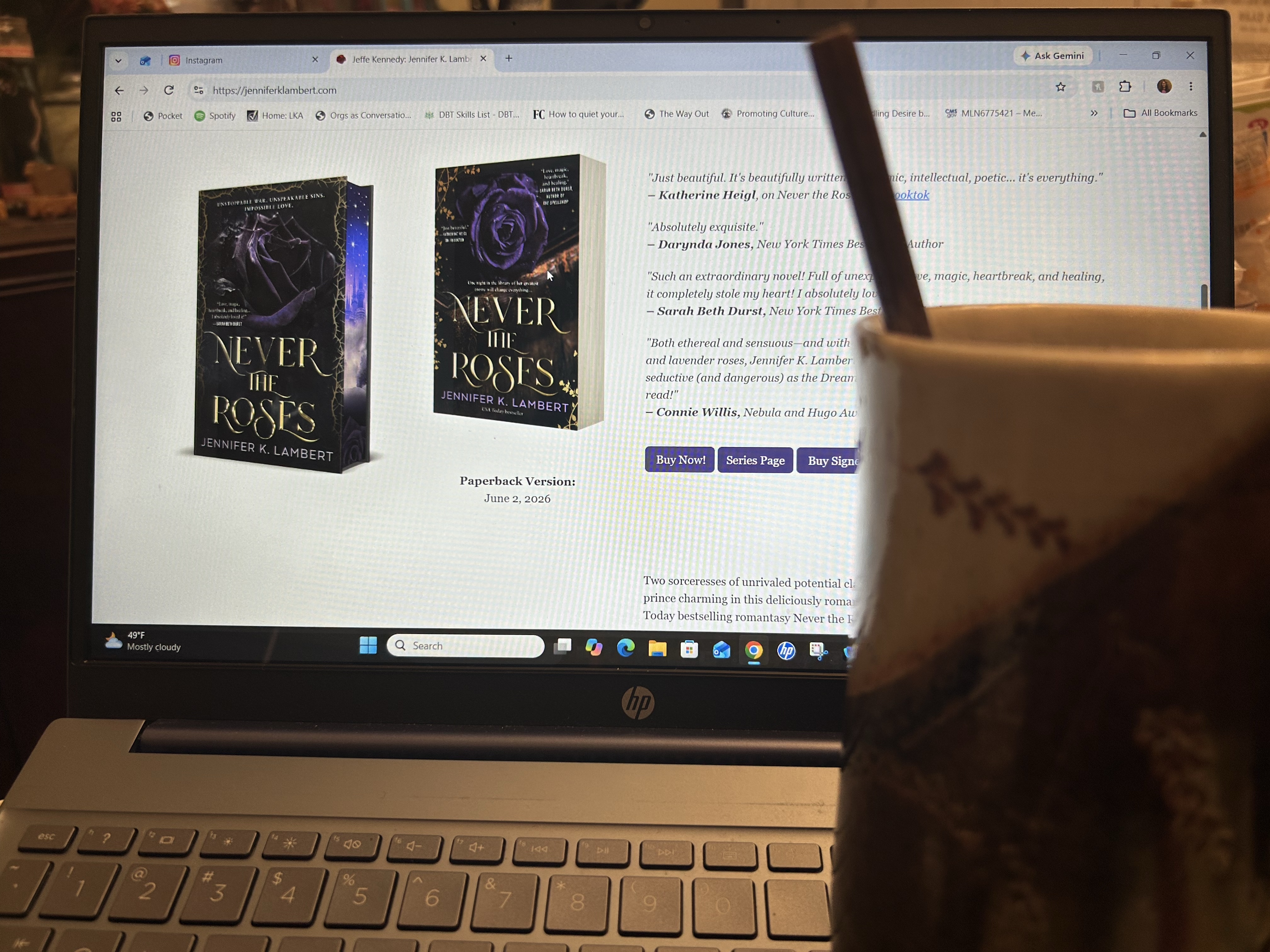
Never the Roses, Jennifer K Lambert

Who pushes you to be better, even if they don’t know or intend it?

Simon Sinek and Adam Grant.
Chris Evert and Martina Navratilova.
Apple and Microsoft.
Michael Jordan and Isiah Thomas.
Christian Dior and Yves Saint Laurent.
The University of Chicago and Northwestern.

Competitors and rivals. Each unique and outstanding in style, substance, and mission, but similar enough to be compared, contrasted, and set at odds. But each half of the pair makes the other better; they keep each other driven to stay in the game. Thus they each spur the other to learn, grow, and evolve. Their respective fields all benefit widely from their public rivalry, elevating standards and aspirations for all: win-win-win.

Oneira and Steranos, the most powerful sorceress and sorcerer, respectively, exemplify this integrated dichotomy in Jennifer K Lambert’s Never the Roses. Pitted against one another for decades of war costing fortunes, lives, and their own consciences, they finally connect in real life (as opposed to ‘remotely’, each locked away in their own respective kingdom directing warfare from afar) when Oneira retires and decides to visit Steranos’s personal library surrepticiously one night, the most serious and skillful oneiromancer who committed one of the gravest atrocities of wartime, pranking her erstwhile nemesis on an impulsive whim. Thus begins a magical slow burn, sensual yet low spice, playful yet tragic love story of two individuals for whom true understanding and full acceptance can only be found in each other. Their knowledge, skill, and power, literally unrivaled by anyone else in the world, makes them the perfect diametrical foes and exquisitely matched lovers and allies.

I adore this story becuase it makes me grateful to have in my life so many intellectual and relational equals. “Iron sharpens iron,” my friend says. When I engage you in wit, query, and debate, when we compare and exchange perspective at the highest levels of curiosity and possibility, OH how my mind positively tingles! My best insights and thought integrations occur during these sparkling conversations and I just cannot get enough. We make each other better in all the most meaningful ways, but most of all we each truly see and feel seen by the other. That sensation de-escalates the nervous system, settles it into a place of safety and acceptance. I’m starting to think there may be no substitute for this singular feeling and the benefits thereof.

How fascinating–the only people I share this relationship with whom I’d actually call rivals are my Red voting friends. Is it semantics? I am weirdly averse to the idea of competition–do I hate losing that much? …Do I meet worthy rivals in the gym? Maybe. Hmmm, this may be worth exploring more. I wonder if I have any other books to reference in the query? Maybe one will come to me by this time tomorrow. Good night, dear readers!


Romance and Self-Compassion

Alexis Hall and everything you need to know about how to engage with them

What parts of your personality are both fundamentally you and also shameful?

Maybe shameful is too strong or not the right word. But what unique and fundamental aspects of your personality also cause you to dislike yourself? Maybe they cause you to feel like a misfit among ‘normal’ people. Or so few people relate to (or even reject) this part of you that you hardly share it? Maybe it’s a behavior pattern that puts people off a little, but you can’t help it because it’s just who you are and you refuse to deny or repress your core self.

I wonder how Alexis Hall would think of what I’m about to write, but I hope they would know it’s written respectfully and out of admiration, curiosity, and exploration.

Never After, Something Extraordinary, and For Real

In the three books of theirs that I have devoured multiple times (highly recommend you do, too) and written about twice (Never After and Something Extraordinary), all of the main characters are both irrepressibly authentic and at least somewhat self-loathing. Every one of them finally comes to accept and love themselves more fully with the help of their respective love interest, often having to be told and shown multiple times, both subtly and forcefully, how valuable they are.

Hall writes so lovingly and relatably about the human condition of self-criticism, how organically it occurs, how insidiously, and how it shows up in all of our relationships, not just romantic ones. I hope every one of us has felt at least partially saved by a supportive other who shows up and loves us for our strengths and gifts before we fully perceive and celebrate them. How lucky if it was a parent or teacher early in life, or a life partner who continually reminds us? But what about those parts that we have yet to reconcile?

Self-Compassion, Kristin Neff

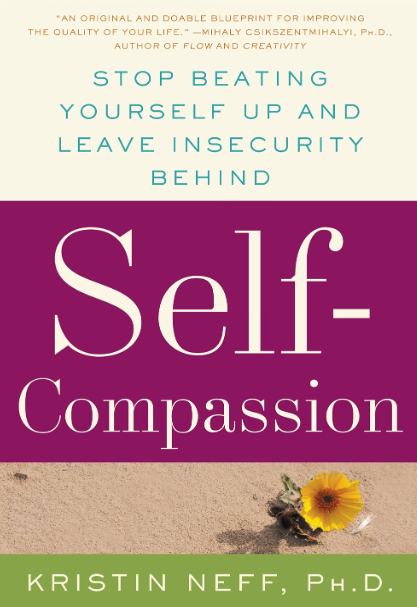
I listened to Kristin Neff’s Self-Compassion years ago and highly recommend it. She definitely leads by example and walks her talk. I think I’m still integrating the concepts and practices, and life is so much better. “With self-compassion, we give ourselves the same kindness and support we’d give to a good friend,” says the banner on the website landing page. How did society become so perfectionist and hypercritical? Such a downward spiral, the self-criticism that fuels judgment and criticism of others and manifests in harsh words and harmed relationships. [facepalm]

The Dark Side of the Light Chasers, Debbie Ford

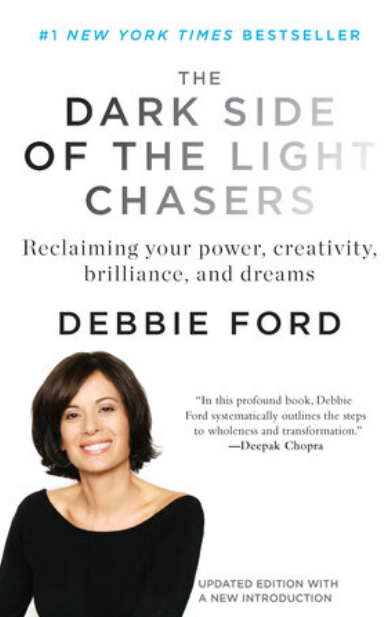
Long before taking up audiobooks or Self-Compassion, I read (or tried to read–never actually finished) The Dark Side of the Light Chasers by Debbie Ford. In her attempt to show us the parts of ourselves that we most loathe, I stepped waist deep in my inner psychological shitpile and picked a fight with Hubs that lasted two weeks. I was too afraid to open the book again then, but maybe I will now? Oh, the gift of living longer and learning about oneself…

I will be forever grateful to Book Club for teaching me the value of fiction, and how it opens us more deeply to both empathy and self-awareness. I get so much more out of the non-fiction I consume when I live vicariously through characters’ lives, feel their emotions so closely adjacent to my own.

I so admire and appreciate authors like Alexis Hall, whose prose can so deftly pierce our armor and open our hearts through lyrical expressions of characters’ utterly vulnerable and quintenssentially human fears and longings. Consuming these stories makes me more compassionate in general, to both myself and others. It reminds me that we are all here to love–to seek it, offer it, receive and share it, and thrive on it. And one of the most empowering things we can do for the world–exponentially so–is love ourselves first.

Trust

What makes you think you can trust me, your doctor?

What do we need to trust our politicians and elected officials?

Friend Anna and I spent three hours together in the pottery studio today talking about this and other things. Walk the talk, of course, we agreed. And when you fuck up, because we all do, own it. Admit ya’ done wrong. There may be a fine line between making excuses and giving ourselves grace for the circumstances that brought about our transgression, but regardless, accountability, simple and difficult, is key for earning and maintaining trust.
What else do we need to trust you?
What do our leaders need to trust us, their supporters (or opponents)?

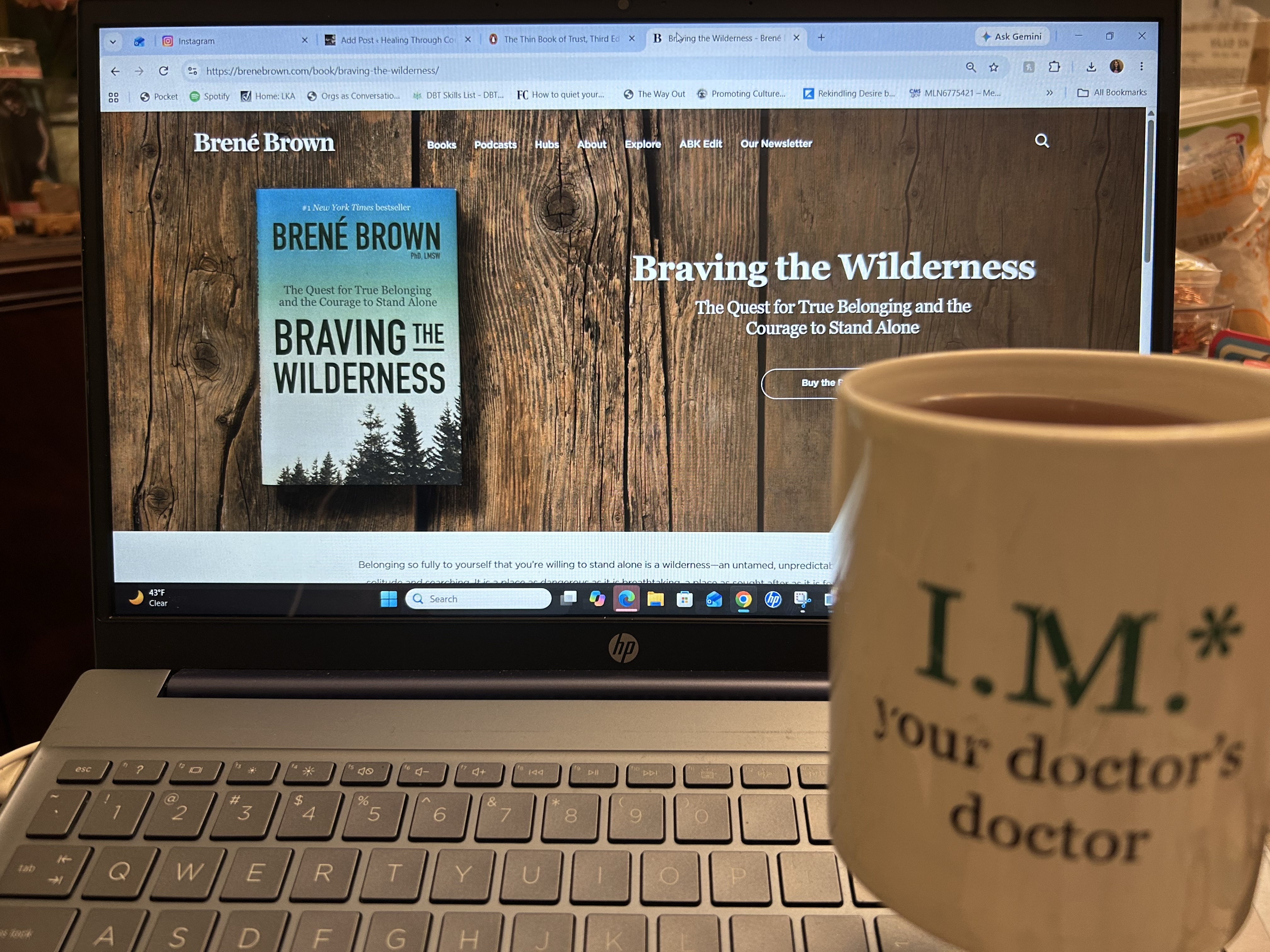
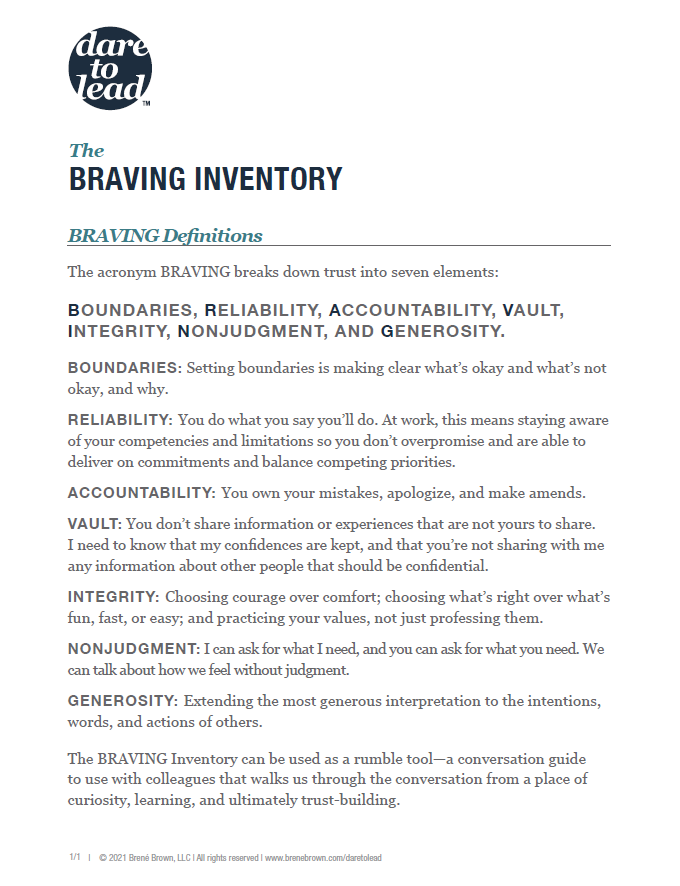
I have been a fan and follower of Brené Brown for years, and I like to think I have integrated many of her central tenets and practices in my life, professionally and personally. She introduced her BRAVING framework, the so-called anatomy of trust, in Rising Strong, and further developed it in subsequent books Braving the Wilderness and Dare to Lead.

Take a look at the seven elements of trust: Boundaries, Reliability, Accountability, Vault (confidentiality), Integrity, Nonjudgment, and Generosity. What think you?
How many and which ones could be absent and you would still trust someone?
With whom and about what do you think, speak, and act with all seven?

The BRAVING Inventory

Brown also references and incorporates tenets from Charles Feltman’s The Thin Book of Trust, in which he (per Google AI overview) “defines trust not as an abstract feeling, but as something built on four distinct assessments. In his framework, trust is the assessment that what is important to you is safe with another person’s actions, while distrust is the assessment that it is not.

“The four distinctions of trust are:

“Care: The assessment that you have the other person’s best interests at heart and will not act solely out of self-interest. It means looking out for the well-being of others and protecting what matters to them.

“Sincerity: The assessment that you are honest, say what you mean, mean what you say, and express your opinions and feelings genuinely. It is the alignment between your internal thoughts and external actions.

“Reliability: The assessment that you keep your promises and fulfill your commitments. It means your actions match your words over time, making your behavior predictable and dependable.

“Competence: The assessment that you have the specific ability, skills, knowledge, and resources to do what you say you will do or what is expected of you. Competence is situational and domain-specific.”

It is a actually very thin book, and worth reading.

On walking the talk: I have recommended Barack Obama and Ben Sasse’s memoirs this week. I think it’s important to hear and read our leaders’ own words, spoken and written out of the spotlight and in their most thoughtful and nonperformative states. But even then, it’s just talk. So I look for town hall meeting footage, images of candid moments, and assessments made by others who know them, and whom I trust. My cynical brain whispers that it could all be staged, that we never see these people’s real selves. I don’t believe that. We just have to look, listen, and think harder at them as whole people and make our assessments as honestly as possible.

Funny how honesty itself is not listed in either framework of trust, right? Maybe that’s because honesty is too hard to assess?. How does honesty manifest–how do we feel it? It’s sincerity and reliability, repeatedly.

Trust takes time and multiple instances of interaction and observation to establish and deepen. Just like high blood pressure, one measurement does not the diagnosis make. Context matters. Lifestyle matters. Measurement devices matter. We can withhold judgment about a person/leader’s character and trustworthiness until we’ve witnessed multiple real instances of expression, and not jump to conclusions after just seeing the viral click-bait instigations. Trust is also partly intuitive, and heavily influenced by our default biases. So we must also be self-aware about our default mistrusts.

I often think of trust as a great oak tree: Stable, and strong, reverent and admirable. But when branches are broken, they do not grow back and the tree remains forever altered. So while fully grown and deeply rooted trust can withstand myriad challenging forces, it must also be tended and protected to flourish long term. That’s relationship and communication.

Of the seven BRAVING elements, accountability and integrity come up most frequently in my assessments and conversations. What about you?