It Came Up In Conversation

Friends, how are you?

So many people are having a really hard time right now. I feel it all around, and it’s heartbreaking. So much pain, both first hand and vicarious; such powerlessness, leading to agitation, rage, and despair… or at least an angsty restlessness, a deep vibrational yearning for things to be very different from how they are. **deep breath** Whatever you have going on, I wish you all you need to suffer as little as possible.


During one clinical encounter this week, Patient and I sensed a vague yet deep restlessness in her. At the end of the visit I had no useful advice to give. Rather than disappointed or apologetic, though, I felt stimulated. From her low energy starting point, I felt wide space for potential, and a rapid slew of questions coming on. So I grabbed my notepad and scrawled as they emerged:

  1. How much do you want a life change?
  2. If change then how, in what way?
  3. Why–what will that give you?
  4. What are the steps?
  5. Who can help (assume you need help!)?
  6. How will you measure progress?

As I wrote, I changed “(do you need help?)” to “(assume you need help!)” and “success” to “progress” in real time.

Looking back, I’m not sure she really wanted to engage with these questions, which felt okay to me. I did not intend to pressure her into doing anything. I did, however, want to share my sense of possibility, openness, curiosity, and agency on her behalf. No urgency or requirement to answer anything, I told her. To “live the questions,” as Rilke wrote, is all we need sometimes. Turns out I ask these questions of myself pretty regularly. Maybe that’s why they came to mind so readily.

What/how do these questions move for you, if anything/at all? What other questions do they spark, if any? What else?


“What proportion of your daily routine/decisions/actions/default activities are driven by convention, social norms, or otherwise extrinsic factors?”

Yet another spontaneous question, this time arising while looking in another patient’s ears and talking about their very young kids’ multiple sports and activities, the intensity and schedules of which rival that of my high schooler. “It’s what you do,” they said.

Getting married, having kids, buying a house, climbing the corporate ladder; PTA, kids’ sports, yoga, pickleball, having an opinion on everything: How much do we do these things because “it’s what you do”? Please understand, I’m not necessarily judging any of it. Social norms have purpose; they provide structure and order in our messy human lives. I also think it’s good to consider, regularly and often, how our personal values and goals align with our myriad forceful cultural defaults.

Where do convention and personal integrity intersect for maximum benefit, fulfillment, growth, and contribution?

I really like this question, I look forward to living it for a while, and I’m grateful to my patient for helping me form it.


Hey, National Blog Posting Month (NaBloPoMo) starts November 1! My 2023 theme reveal will drop here on October 31, so stay tuned. This will be Year 9 for me, and I think it could be transformative…


OK friends, now I get to tell you about my Big Fat Hairy Project.

I pitched my first ever book proposal to a kind young agent in June and received generous encouragement in response. Over the ensuing months, I have found myself stymied by fear and imposter syndrome, possibly to the point of physical pain. Admonishing myself to simply plant BUTT IN CHAIR was not enough to make me produce any content. Things shifted recently, though, not sure how or why. Maybe it’s the season? Maybe it’s seeing body changes in both function and appearance after 7 months of regular strength training, convicing me that I can do new and hard things? Maybe it’s connecting more closely with readers and writers, an innately inclusive, generous, and encouraging tribe? Regardless, there is movement afoot. Yay!

On October 15 I committed publicly to a nightly book work discipline: Typed word count, handwritten journal page count, time spent reading/researching, etc.–whatever I did, I resolved to track and share. I knew at some point I would need to actually write editable words in larger numbers–the shittiest first draft is better than no draft at all. But it was not until yesterday that I committed to something concrete there, too: 500 words three times a week or 1500 weekly words, however I can get them out.

Friends, the first 871 wildly imperfect words of my book now exist. O. M. G. And I will add more tonight! HOLY MOLY, is that momentum I feel? I have a weekly skeleton schedule written out: no book work required on days I see patients, at least to start. And I still need to consume books for my sanity (176 titles started this year and ohmygoodness, some are so good!). *sigh* I feel good in body and mind, joyous, solid, and buoyant, in this resolve and commitment.

If you’re interested, follow me on Instagram at @chenger91. Every Sunday I will post a photo of the laptop and my inspriational writing mug. Each day of that week I will log book work in that post’s comments. See 10/15 and 10/22 on the page now!

I wonder how I will stick to this and also write 30 blog posts in 30 days? WHOOO KNOWS?? It’s okay, I get to invent and evolve my way–nothing to lose! And I resolve to have FUN. Let’s do this.

The Future of AI in Medicine

What do I know about AI?  Next to nothing.

So why would my colleagues at the American College of Physicians invite me to speak in a panel discussion on AI in primary care?  It was a mystery to me and yet I agreed, because hey, I like feeling wanted. And I trust my ACP friends.  They know me and they knew what the panel needed.

The meeting was this week.  Daughter got sick, Husband was out of town, and I chose to stay home.  I thought, ‘Nobody will miss me, I don’t know anything anyway.’  But through the wonders of technology, I was able to participate via Zoom, yay!  And I did end up contributing, as the one clinical physician panelist.  It was fun and connecting, despite my being remote.  I recognized two former colleagues during Q&A just by their voices, and another texted me from the audience after she saw me on screen.  This technology Luddite may yet be converted.

I share here a summary of my learnings and perspective on AI in medicine at this moment—I have many more thoughts about it than I realized!  I wonder how long before it all changes?  I bet not as long as I think.

Current State

Dr. Steven Lin is now my favorite clinician writer on the possibilities and pitfalls of medical AI, and in primary care, specifically.  For two excellent and concise summaries, read an internal Stanford interview from 2019 and his original article from the Journal of the American Board of Family Medicine in 2022.  Some visual highlights from the latter:

Mission: To Enhance, Not Replace, Human Care

Intelligence is complex, and none more so than the human.  We are amazing!  For simplicity’s sake let’s just divide human intelligence into cognitive and limbic—thinking and feeling.  Intuitively we probably all understand that ‘artificial intelligence’ refers to the former, activities that can be replicated using concrete and objective data and logic.  Algorithm implementation and machine learning already enhance diagnostic accuracy, clinical decision making, and risk assessment and management.  AI even delivers health coaching now, with encouraging results.  Triage, access, billing, and follow up processes will all likely improve in the coming years with AI.  I welcome the streamlining and appropriate simplification of our enragingly labyrinthine healthcare systems.

Still, patients will always need personal encounters with clinicians who provide services and care.  But when were you last able to reach your primary care provider directly and quickly?  How long do you have to wait for an appointment when you’re sick?  If you answered, ‘recently’ and ‘not long,’ you are in the vast minority.  How well does your primary care doctor know you, if you have one at all?  So many patients have given up on establishing this bedrock healthcare relationship, because the system makes it next to impossible for you to talk to me when you’re sick, my schedule is booked solid for three months so I can’t see you anyway, and when I do see you, I only have 15 minutes.  It’s like speed dating with earplugs and snorkel masks.

AI will never know and interact with humans on an emotional, relational level.  What it can do is remove the transactional, clerical, algorithmizable(!) tasks from clinicians’ plates, so we can sit and talk with you, see and know you as a whole person, and care for you in the most personalized ways.  AI can learn which of you has a lot going on medically, who needs extra time and attention. But only a human can deliver that attention in a way that truly cares for and heals you, especially if your health needs are complex.  And the more AI shows us what’s needed, I suspect we will need many, many more intellectually, emotionally, and relationally competent clinicians in all fields to answer the call, which is a whole other mountain unto itself.

Data: “Garbage In, Garbage Out

Applying populational data to individual decision making has always been both science and art.  AI can enhance this very personalized activity by making vast amounts of data easier for clinicians to access and interpret in real time patient care.  But beware big data:  How is it collected?  How do we measure and confirm its accuracy?  How is it entered, organized, aggregated, interpreted, used?  Who decides all of these things, and what interests do they have?  Who will monitor for bias, equity, and unintended adverse effects on certain populations that are inherently, if inadvertently, built into AI systems at the level of design?  This is where I really see us falling down and not even knowing, and then ignoring and dismissing those who call it out.

Governance: Honest, Transparent, and Accountable

After we answer the question of who will monitor, we must ask and answer how.  The American healthcare system is fundamentally capitalist and increasingly consumerist, an extremely high-risk combination.  Bad actors will certainly subvert the mission of individual and collective health and well-being to make more money.  But possibly more dangerous are those who honestly believe they are out to help people and who, despite their best efforts, succumb to economic and cultural pressures to put profits (or market share, or personal status, etc.) ahead of professed altruistic mission.  Short term financial and social costs of inventing, experimenting, and iterating innovation can be intolerably high, and too often those in power and regulatory positions act on primal (though well-rationalized) instincts to forgo those costs to protect and advance other interests.  At our core, we humans are emotionally driven decision makers who then justify our actions (often vociferously). Only when we accept this reality can we hope to regulate our systems honestly, transparently, and with true accountability.  I feel deeply cynical about the likelihood of us doing this at all effectively.

Agility and Evolution: Lightning vs. Glaciers, Integrated Co-Creation, and Emergence

Technology moves increasingly at lightning speed; medical knowledge doubles now about every 4 years, compared to every 50 years in 1950.  Medical culture, on the other hand, moves at a glacial pace.  I’m thinking of gender and racial equity, holistic mental health, and mind-body awareness and practice.  To avoid harms and fully benefit from the inevitably rapid evolution of AI, we must build systems that foster invention, experimentation, and iteration at local nodes (team, practice, department, hospital, health system, etc), strengthen multidimensionally integrated and transparent internodal communication structures, and maintain monitoring processes that can detect common, coincident AI benefits as they emerge, so they can be efficiently, effectively, and appropriately scaled.  At the same time, solutions must be flexible enough to adapt and iterate on a global level, as shared learning marches onward.  This open-source and resource-intensive style of collaborative innovation feels antithetical to the competitive, short term profit-driven American healthcare business culture.  I see this challenge as especially inextricable from the accountability problem of AI governance above. Yikes.

Medical Education:  Leading and Learning by Example

Sometimes I wonder if technology is making us all dumber–like maybe safety features on modern cars makes us fundamentally less mindful drivers?  We clinicians all have Google and UpToDate at our fingertips; accessible information 24/7.  Almost every day, I look things up in real time during a patient encounter—did you know some people grow more lipomas if they drink more alcohol?  There is just too much information now to keep it all in my head.  I feel comfortable thinking out loud with patients, talking through basic physiology and how it may relate to or explain their symptoms.  When I come across something novel or atypical, as long as the patient is stable, I feel a little exhilarated, like we’re going on a themed scavenger hunt for diagnosis and treatment.  This is exactly where AI can optimize care, by gleaning the vast seas of medical information and knowledge, filling the gaps in my head that will only get larger over time.  It gives me more bandwidth to ask better questions, listen longer to patients’ answers, and explain increasingly complex plans of care better. 

Having trained on the cusp of the information age, I wonder how/whether my thought processes differ from, and how that affects my relationship with, younger docs?  Medicine has always been an apprenticeship profession, and we have always felt social generation gaps that mirror society at large. I think that will not change. What has changed–narrowed–is the information/knowledge gap. 20 years ago, my teachers consistently knew exponentially more than I did about almost everything. I think those days are long gone. Any student today who just rotated through any given medical subspecialty will know more than I do about new diagnoses, drugs, and procedures. I am totally okay with this–there is so much to learn, I should get it wherever and from whomever I can.

Teachers and mentors, however, hold experience, intuition, context, and judgment that can only come with cumulative time spent in practice. This is what we have to offer our trainees–the example of curiosity and humility for lifelong professional and personal learning. As AI accelerates and infiltrates our systems, teachers must role model critical openness, mission- and relationship-centered integration, and an agile, honest, growth mindset. None of us will ever now know it all. Optimal patient care merges expert knowledge with presence, attunement, wisdom, and connection–machines cannot do or teach this, and we must all help one another figure out how best to incorporate machines into patient care.

Cautious Optimism

Primary care has the greatest potential and privilege to see, hear, and touch every other medical specialty, and all aspects of the healthcare system at large. Wow. How could I not love this work? What fascinating and rewarding polarities to navigate–tradition and innovation, conservation and progress, intellect and relationship, strategy and vocation. I have no complete (or even well-formed) answers, only reflections. I know where my values and goals live, though, and I root down to them. If we can do this as a profession and a society, then AI’s potential to make all our lives better could be limitless.

Revel Now to Fuel Your Future

Photo by Brian Gelbach, Minnesota, August 2023

When you get a head cold, do you ever wish you had appreciated better when you could breathe through your nose? 

What do you take for granted, that you’d miss and regret if it disappeared?

Our family had quite a rough patch from about 2018-2022, and this past year things really turned around.  I still have a little post-stress reactivity (a second of dread whenever I get a text or call from the kids), but it’s much better.

Then last week I had another scare, an x-ray showing what looked like a hole in bone—a lucency, as it’s called.  Despite opposite effort, I allowed myself to catastrophize.  Osteosarcoma, I thought—an uncommon and aggressive bone cancer (it would not actually present this way, I realize now, but hey, I was hijacked).  The thought cascade unfolded rapidly: urgent specialist referral and imaging, surgical biopsy, treatment—surgery, radiation, chemotherapy.  Recurring appointments, treatment side effects, and physical, psychological, and relational pain.  I’d have to cancel my vacation this week, find coverage at work (or take a leave again), maybe stop working on the book, and, gasp, stop going to the gym.  Kids’ activities and future would be affected—would they have to move/stay close to home for college?  And the absolute worst-case scenario—death—what would that be like?  Interestingly, this semi-unintentional exercise actually helped me calm down.  It reminded me of when Daughter had an anaphylactic food reaction with the babysitter.  I had to meet them at the Emergency Department without killing myself in a car accident on the way, so to center myself I imagined the worst—her death.  In a moment I realized that though it would be horrible, I would be okay—because I had to, for Son.  I breathed deeply, drove mindfully, and arrived physically and psychologically intact.  We simply do what we must do.

I have faced multiple life-threatening situations at home, in addition to witnessing all manner of death in my work.  Maybe that’s how I can balance my emotional reactions with a more rational response?  I have seen enough times how good can turn to bad on a dime, and it makes me cherish the good while it lasts—really revel in it.

Before I got confirmation that the x-ray last week was, in fact, normal, I had already come to a sense of peace about whatever may come.  I thought to myself, ‘Well, good thing I really soaked up everything awesome about life until now, saturated myself with it and shared the joy as much as I could.’  I found myself with very few regrets, which empowered me to meet uncertainty with calm, confidence, and strength, and not denial or false optimism.

It’s not that I dread the future, expect serial crises, or harbor some kind of victim mentality.  I just understand the unpredictable randomness of life and accept my total lack of control in most situations.  Reveling in the good now protects me when any hard times do come later. I feel deep satisfaction and contentment to remember all that was good before, and that I knew it at the time, truly appreciated it.  That warm, radiant energy feels stored like solid rocket fuel, stable and dense, ready to call forth for emotional and relational thrust when I need it. 

What can you revel in now, that will replenish your existential fuel for the unknown future?

Below are some of my current revels.  May you, readers and friends, feel your own daily delights emerge with light and coherence in these waning days of summer.  May you immerse in the awesomeness and feel it buoy you through whatever life brings.

Shaneiaks meet in person!

With Heather Pressman, Denver, CO
Happily hydrated at 9000 feet, 25% humidity

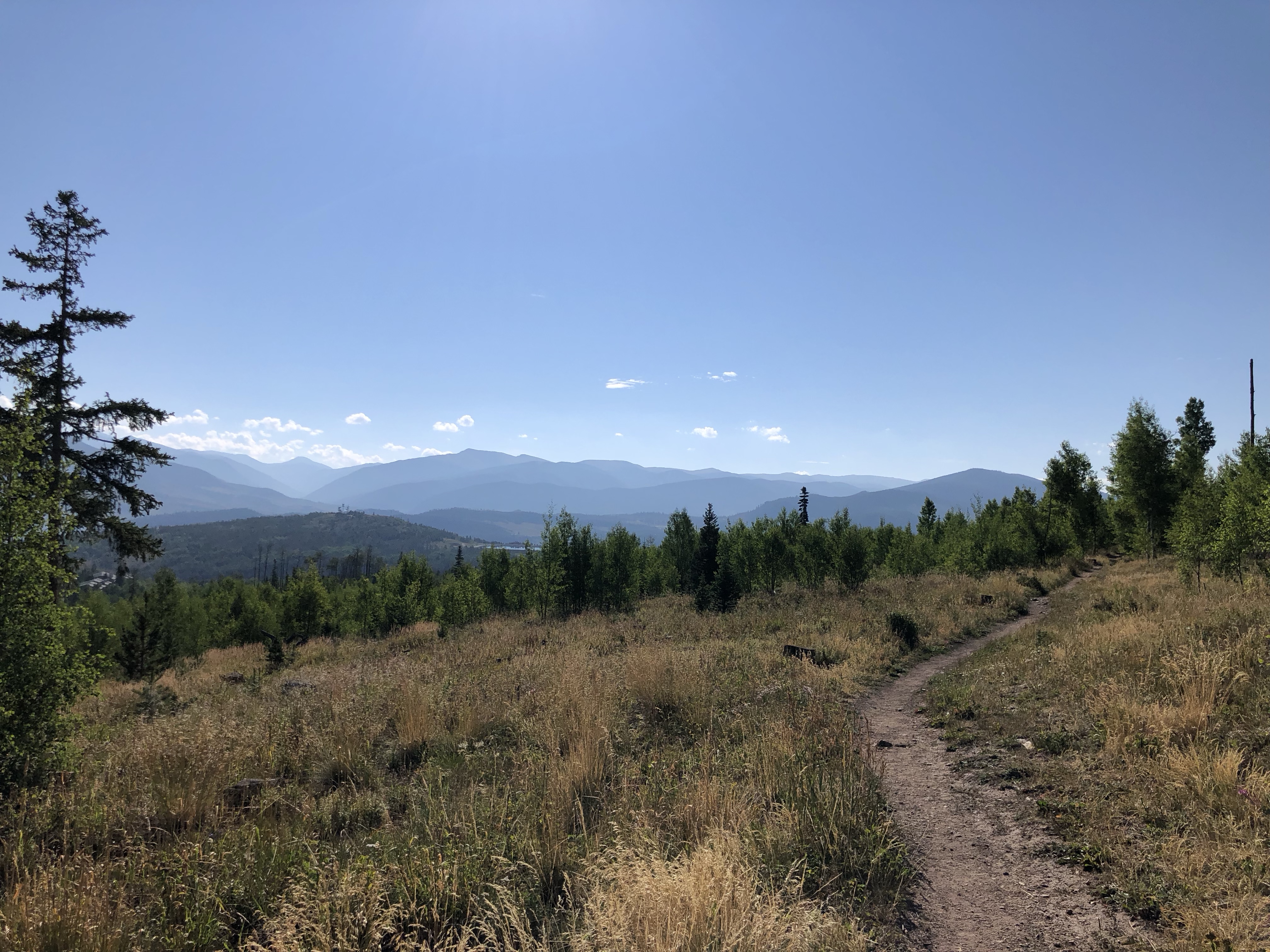
Alone time in the mountains

Breckenridge, CO
Washi tape card making–first time in many months