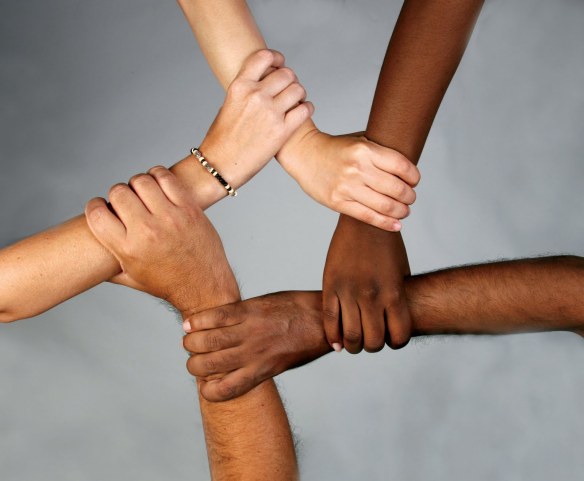
“Friendversary”

IMG_2341

It’s all worth it, hallelujah!

Those of you who read this blog regularly know that I spend inordinate amounts of time on Facebook.  I struggle with the balance–hours spent face to phone reading articles, engaging with friends over politics, healthcare, and nature photos, and also work, chores, and quality time with the family.  One of the people I interact with most meaningfully online is a high school classmate.  He and I were friendly acquaintances back then, and I assumed at graduation that I would never see him and most of my classmates again.  I will call him Al.

A while ago, through a mutual Facebook friend, I saw a post by Al saying that he wished to have civil conversations on politics with people who did not share his views.  I immediately sent a friend request, which he promptly accepted.  My rule is that I will be friends with people on FB who are already my friends, or with whom I want to actively cultivate friendships.  Al was definitely the latter, based solely on his proclaimed desire for civil discourse.  This week was our two year Facebook Friendversary.  I know because he shared the notification, which I had not received.

In the first year our exchanges could be awkward, and sometimes felt tense (on my end).  I noticed that while I often asked him to elaborate on his thoughts and positions, he rarely asked me.  I often felt unheard and lectured to.  I considered giving up on the relationship.  Why bother, I thought, we live in separate states, we disagree on everything, and it’s just too stressful—I’m not even sure he cares what I think.  A year ago I posted about a conversation we had about white male privilege.  I decided to maintain our online friendship because despite the tension and discomfort, the exchange had given me new insights into managing the tension and discomfort.

These two years we have discussed transgender bathroom legislation, affirmative action, unconscious gender bias, racism, and climate change, among other things.  We have always been civil, and conversations feel more relaxed and congenial these days.  Al types more words now than he used to, he asks me what I think about things, and has expressed more consideration for my point of view in this second year.  It moved me when he wrote that when his coworker came to work distraught and crying over the presidential election, he hugged her.  [For the record, my friend is a Republican and not necessarily a Trump supporter.]  Throughout our intereactions, I have always remembered my fundamental assumptions of this man, whom I don’t actually know that well: That he is a kind and honest person, that he wants all people to enjoy happy, healthy lives, that he has natural unconscious biases as I do (and these do not make us bad people), and that he is sincerely interested in my point of view.

Our most recent exchange almost brought me to tears because I finally felt fully seen, heard, and understood by this person who barely knew me 25 years ago, lives 800 miles away, and whose life experiences lie surely on the other end of any spectrum from mine.  I share the thread below.

So many people decry social media, and rightfully so.  It’s too easy to descend into mindless flaming and impulsive ad hominem attacks from the safety of a screen and keyboard.  And I still struggle with the time sink and distraction.  But today I feel good about my SoMe usage.  To me, this two year, ‘virtual’ friendship I have cultivated feels as real as any other.  I hope Al feels similarly.  I look forward to the next two years and beyond on Facebook, and perhaps an in-person encounter in the foreseeable future.

***

On Being Wrong

CC:  OH MY GOD YEESSS!!
If you are serious about or remotely interested in self-awareness and connecting better with your fellow humans, understanding this idea, even if only intuitively, is a fundamental requirement.

https://wwwted.com/talks/julia_galef_why_you_think_you_re_right_even_if_you_re_wrong

[Julia Galef’s TED talk on soldier vs. scout mindset, and how holding either influences how and whether we examine our beliefs]


AL:  Have you seen this?

https://www.ted.com/talks/kathryn_schulz_on_being_wrong

[Kathryn Schultz’s TED talk on embracing our fallibility]


CC:  I have not!  Will view soon!

AL:  I eagerly await your thoughts on it. It’s dang near life changing.

CC:  I watched it! And I will happily tell you my thoughts, but since you posted it and made the ‘damn near life changing’ claim, I request that you go first. And if you could also comment on the talk from the original post–feel free to go all expository–that would be great, also! I promise to reply in kind!

AL:  It was the line that feeling wrong is the same a feeling right. And the idea at how unreliable your feelings are. But I really like questioning one’s sense of rightness.

CC:  Follow up question: how has this talk changed your own approach to ‘feeling right,” or how you engage with people with whom you disagree?

AL:  I can’t say I’ve completely abandoned my feeling of rightness. It’s just so nice to feel right. But I try to loosen my grip on the feeling of rightness and make fewer assumptions.

CC:  Thank you. I hear you, it is so delicious to feel right–to feel *righteous*… And I like this, “loosen my grip on the feeling of rightness” (and righteousness?). What assumptions are you making less, may I ask?

AL:  I can’t think of general areas right off the top of my head. But more often than before I try to remind myself I don’t have all the facts and there could be something I don’t know. This has to do more with interpersonal interactions. Like I try not to act on my initial assumption of someone else’s motivations.

[I ‘loved’ this reply]


CC:  I am not sure you could ever know how happy it makes me to read this. This is all I ever want from people–to just slow down, withhold judgment *a little*, especially about one other’s motivations. It has taken me too long to learn that everybody has a unique and VALID personal story, and that elements of that story always influence how we approach any problem or circumstance, for better or worse. The more open we can be to one another in this way, the fewer and less contentious our conflicts will be, I am CONVINCED. And, it’s sooooo much easier said than done. And, the first step is an awareness of its importance. The second step is an intention and commitment to practice, no matter how many times we fail, and/or others fail. I have to go see a patient now… Maybe I’ll write more. But really, I’m almost in tears right now. I feel vindicated, in a way. Thank you.

[Al ‘loved this reply.]

Everyday Power and Influence

Wailea beach

If you wonder how physicians think and feel, about anything and everything related to medicine, healthcare, economics, parenting, relationships, and life in general, check out KevinMD, an expertly curated blog by physicians all around the world.  I recently read a heartening and important piece on gender equality in medicine.  A pediatrician husband wrote about the stark differences in assumptions about work-life balance for men and women, in “What Does Your Husband Think of You Being a Surgeon?”  Then I came across another article by a male cardiologist, whose wife is also a physician, entitled, “The Gender Gap in Cardiology Is Embarrassing.”  Both men’s wives delayed their medical training, and these husbands bore witness to our culture’s implicit gender bias against their life partners.  I strongly encourage you to read both pieces; they are short and poignant.

—- Please click on the links and at least skim the articles, before continuing here. —-

Now, consider how much more weight and influence these pieces carry, simply because they are written by men.  If you find this difficult, imagine your internal response if they had been written from the women’s perspectives.  Which position is more likely to evoke, “Hmm, interesting,” as opposed to, “What are these women whining about?”

When we consider advocacy, it’s fair think of it as those with more power and influence using these advantages to champion those who have less.  Sure, the less powerful and influential can and do advocate for themselves, but without allies among the advantaged, the message and movement stall and stutter.  Consider slavery and the Civil Rights Movement.  If it were only ever black people advocating for themselves, what would the American racial landscape would look like today?  Think about women’s rights.  There is a reason the United Nations launched the HeforShe campaign.  Self-advocacy is required, but sorely inadequate, to lift people out of oppression.  And let’s be clear: oppression takes many forms, which we often fail recognize or acknowledge.

I have a fantasy about patients advocating for physicians.

I imagine Sally and John*, two friends communing at their favorite coffee shop, one of their regular meetings of mind and soul.  The conversation veers toward healthcare, and Sally starts ranting about how physicians don’t care about patients anymore.  They’re only in it for the money, having sold out to pharma and industry, and they think of themselves as second only to God him(her)self, exercising control over patients’ lives with little regard or actual caring.  In this coffee shop scenario, I as physician have no power or influence.  If I sat there with them, trying to explain how ‘the system’ drives wedges between us doctors and our patients, about how on average doctors spend twice as much time on administrative activities as patient care activities, how 50% of us report burnout, and how our suicide rate is up to 4 times that of the general public, I estimate that I’d likely be seen as whining and making excuses.  In this scenario, facing a (rightfully) prejudiced audience, my voice counts for very little.

Although physicians still enjoy a fair amount of respect and deference in society, our struggles, personal and professional, are still poorly understood by the general public.  I think people are even less cognizant of the insidious and profound detriment that physician burnout and depression have on patient care and the economy at large.  But when doctors describe our adversities to patients, I think we still come across as whining.  Knowing that I write this as a physician, what is your reaction?  Is it closer to, “You live at the top of the food chain, what are you complaining about?” Or rather, “Wow, what’s going on that so many doctors feel so badly, and how could we all help one another?”

Lucky for doctors everywhere, John is my patient and we have a longstanding, collaborative relationship.  He empathizes with Sally’s perspective, as he knows what she has been through medically.  He has also inquired about my work, and understands the systemic frustrations that physicians face in all fields.  Because they are such good friends, John feels comfortable challenging Sally’s skewed assertions.  He describes what he has learned from me, and explains earnestly that all doctors are not, in fact, swine.  Because he is her trusted confidant, she believes him.  Her attitude opens ever so slightly, and she is more likely to acknowledge how physicians and patients alike suffer from our overall healthcare structure.  John is, in this case, the strongest advocate for me and my ilk.

Whenever one of us stands up as a member of a group, and speaks up to our peers on behalf of another group—white people for black people, men for women, Christians, Jews, and Muslims for Muslims, Christians, and Jews, liberals for conservatives, physicians for patients, and vice versa in each case—we are all elevated.  Our mutual compassion and humanity are called forth to heal our divisions.  This is how personal advocacy, how everyday power and influence, works.

As a patient, you have more power than you may realize.  I bet most people don’t necessarily feel adversarial toward doctors.  But they probably don’t necessarily feel allied, either.  What can you, as a patient, do to bridge this gap?  How else could we all, physicians and patients alike, create that essentially healing inter-tribal connection?

*Hypothetical friends

Love Letter to My Superstar Friends

IMG_0097

Dear Paul & Joanne*,

I cannot tell you how grateful I am to you both for taking the time to meet me last week.  You came out in the pouring rain, not for a lighthearted night of drinks and karaoke, but to talk charged politics with your tortured, melancholic, liberal friend.  I hope it did not feel too burdensome, and that you would do it again.

It was quite the emotional evening for me, unsettling, sometimes uncomfortable, and also dominated by love.  Joanne, we have known each other about 15 years, and I know you are not a fan of politics in general.  Paul, I know you mostly through your witty holiday cards, and your occasional Facebook posts that often touch on politics.  You lean right, it seems, about as much as I lean left.  You gently called me out when I shared a Trump supporter-shaming video, reminding me to hold myself to a higher standard of discourse on all platforms.  That is why I sought you out.  When you engage, you exemplify the attitude toward political discourse that I aspire to.

I described to Joanne over the phone how distraught I had been since November, something akin to “watching the fabric of my generation’s social progress torn to shreds by a maniacally fomenting, double-machete-wielding narcissist.”  You seemed genuinely surprised and curious—why did this election have such a profoundly tormenting effect on me?  What made millions of people pour into the streets around the world in protest?  I was incredulous at your incredulity, and yet I felt a mutual, loving acceptance between friends who only want each other to be happy and feel secure.

At dinner, I could tell that you both cared acutely about my distress, and wanted to help alleviate it.  You reassured me that the worst case scenarios are highly unlikely to actually happen.  You reminded me that hyperventilation and arm flapping are not productive energy expenditures.  You gently encouraged me about the long, jagged, often meandering, and also inevitable path of social progress, and the importance of taking the long view.

I admit that I felt a little defensive at times, as if anything I said about the origins of my distress would be met with, “You’re overreacting,” and “You’re worried about nothing, please…”  We later agreed that it is never helpful to invalidate someone’s emotional response to a stressor, regardless of whether or not we can relate.  Paul, you are so well-read and convicted about your opinions.  I did not see a point in arguing, as you did not seem interested in debate, and I left feeling disappointed that I had not presented a stronger defense of my liberal ideals.  The whole exchange felt lopsided in favor of your position.  But I did learn from your point of view, which was one of my primary objectives.

Most importantly, our conversation revived my mindfulness practice.  You’re right—energy spent catastrophizing about a hell-on-earth future is energy wasted.  As Michael J. Fox says (I paraphrase), “Don’t spend your time worrying, because if what you’re worried about actually happens, now you’ve lived it twice.”  My energy is better spent in the present, attending to what is, rather than what I fear might be.  And I feel justified in my shock and dismay at what is.  In my opinion, Donald Trump has defiled the presidency and brought our politics to a new moral low that I could never have predicted.  I don’t need to ‘go apeshit’ over the future, as there is plenty of wreckage to confront right now, not the least of which is our collective refusal to engage one another in civil discourse.  I can center, ground, and focus, breathe deeply and engage, one step, one person, or one loving couple, at a time.

Last week Dan Rather wrote my heart on his Facebook page:

The threats, the lies, the willful disregard for the rule of law should be limited to the world of Hollywood caricature. To see this played out each night on the news, to read about ramblings and inconsistencies in justifications for actions that should never have been taken, is to see a moment of great peril for our nation.

I remain, however, an optimist. I see the swellings of civic engagement and action. I hear the voices of those who demand that this subversion of our national ideals shall not stand. I have covered social movements of the past, and never have seen one where so much power and numbers lie on the side of the opposition. This is a clash for the values of our nation. Our destiny is in our hands.

Our nation’s patchy, irregular social fabric may be strained to its limits today, and even torn in some places.  But the threat of real disintegration has brought forth multitudes of weavers and quilters to repair and protect its integrity.  I can acknowledge this ‘collateral beauty’ and contribute my part, through conversations like ours, to help mend the tapestry, and bend that moral arc of the universe more toward justice.

Thank you, my dear friends, for helping me train for this marathon.  You hold me up and make me stronger.  I hope I do the same for you.

Sincerely and with love,

Cathy


*Not their real names