

#AtoZChallenge: Withhold Judgment

403532_3541039079225_1032738700_n

My brain is so tired. All month I have racked it trying to figure out what to write next, how to render it most authentically, and finally get it out looking close enough to how I intended.  On top of that, I have also engaged in multiple exchanges on Facebook around gender identity, public restroom use, vaccine rationale, and presidential politics.  It really has been shang nao jin, as we say in Chinese—literally wounding the mind.  I realize these are all activities that I choose, and none of them have significant bearing on the world at large.  And, I would do it all again.  My mental exhaustion is the hurt-so-good kind, like the muscle soreness after a particularly strenuous workout, when I know I have pushed myself to my limit and maybe extended it a little.  The writing and conversations are ways that I engage with my world and practice what I preach—open-mindedness, curiosity, and cultivating connection.

After all of this exploration, conversation, debate, research, and observation, once again I conclude that one of the most important practices for inner peace is to Withhold Judgment. Not all judgment, and not indefinitely, but much and for a while.  Here are some illustrations from the past week:

I shared this post on my Facebook page on Saturday.  I agree with the author’s sentiments, basically that discrimination is wrong and we should open our minds and bathrooms to all people.  I also thought her writing was cogent and forceful.  One of my friends pointed out her name calling, as she labeled supporters of the North Carolina HB2 legislation, and people who boycott Target as a result, as hateful.  He then asserted that the left “can’t argue a point without calling people who disagree with them hateful,” or at least they choose not to. At once I see both sides generalizing in ways that preclude any possibility of meaningful mutual understanding.

After this I became more sensitive to name calling in articles I read. Even ones with relevant data and useful information can be tainted, as I found here, in which the writer calls bigots the same people that the previous author called hateful.  Why must we stereotype and label like this?  Is it just to get published, for attention?  Can we not convey our message just as effectively without all this vitriol?

Finally I read and shared this article, in which the author does not call anyone names directly, but writes a brilliant and searing piece of satire that also inflames and incites.  I suppose that is the point of satire, after all?  It was the comments on this last article that really drove home to me the perilous state of assumptions and judgment that drive many of our interactions these days.  If you support this law, you’re hateful.  If you oppose it, you’re irresponsible.  Perform one act that is, superficially, inconsistent with your professed beliefs, you are forever a hypocrite.  Commit one lapse in judgment and you are instantly unworthy of respect, now or in the future.  Snap judgments can degenerate our encounters to a series of sound bites of rhetoric and aggression.  They seriously inhibit, if not completely destroy, our connections, and they consign us to echo chambers of isolation.

The doctor who rushes me through my 15 minute appointment for a sinus infection, after making me wait 30 minutes already, is uncaring and just wants to make more money. Actually, she just spent the last 45 minutes telling her patient of 10 years that he has metastatic cancer and answering his questions, and she is anxious to get to her son’s school play tonight, his first lead role.

The woman who yells at the receptionist and makes a scene with the nurse is just another angry, entitled patient. Actually, her son was killed by a drunk driver last year, she lost her job and her home, and her mother is dying.

Fellow blogger and talented artist Jodi posted this beautiful piece today, including these words:

Skip the religion and politics,

head straight to the compassion.

everything else is a distraction.

— talib kweli

It really spoke to me, because compassion lives at the core of human connection. If we can remember compassion for one another more often, no matter our circumstances and state of mind otherwise, we can probably also remember to Withhold Judgment and listen for the rest of the other person’s story.  Listening more, yelling less, moving slower to the keyboard, showing up in person, asking more questions for understanding—these are the practices of Withholding Judgment.  Please, let us make the effort; it may save us all.
#AtoZChallenge: VAGINA! No Fear of Words, Please.

IMG_3363

Sexuality can be hard to talk about.  I think this is true for adults far more than for children.  Children are naturally curious and nonjudgmental.  They just want to know, what is that, what’s it for, why are yours different from mine, and why does he have one of those and I don’t?  It’s we adults who squirm and dodge, deflect and bolt.  From a very early age, children learn that it’s not okay to talk about certain things because it makes the grown-ups uncomfortable.  I want to change that.

My kids have known formal names of body parts forever—breast, vagina, penis, femur.  They also know what the parts do, how they ‘go together,’ etc.  Anytime they ask a question, I try to answer as honestly as possible, in an age-appropriate way.  For instance, I have had to clarify that babies do not come out of a woman’s ‘butt.’  First I had to clarify the general use and meaning of ‘butt.’  Then I explained that men have two holes down there, and women have three, and the baby comes out of the middle one, between where pee and poop come out.  Maybe it’s because my husband and I are both doctors and science nerds—we say these words all day long and never think twice.  I think also it’s because I’m a terrible liar, and everybody can tell.  It’s just not worth telling one story now, only to recant and revise later.  Moreover, even if they don’t challenge the fib I’m telling today, their intuition that I’m not being fully forthright undermines my trustworthiness.

There are important parallels here for physicians and patients, too.  In medical school we learned how to take a sexual history.  I think most of us handled it fine, but there was some blushing and gnashing of teeth at times.  Again the key is repetition and getting comfortable with saying the words without embarrassment or judgment.  “Are you sexually active?  With men, women, or both?  How many partners do you have now?  How many in your whole life?  Ever have anal sex?  Receptive, insertive, or both?  Do you use condoms?  Every time?”  It also applies to other aspects of the social history.  “Do you or have you ever used recreational drugs, such as marijuana, cocaine, heroin?  Acid, mushrooms, PCP, MDMA?  Anything else?”  The underlying implication is, ‘tell me anything, I really want to know, and I will only judge the risks to your health, not you as a person.’  Once I get to the end of these lists, patients can see and feel that I am comfortable talking about anything related to sex, drugs, and whatever else, and I make no assumptions.  They are much more likely, then, to tell me honestly about their behaviors and experiences.  I can then make a more accurate assessment of their health risks, and give more relevant advice.  As a bonus, we often establish a deeper connection, because that sense of safety now likely extends to other things they may want to disclose.  This is often when stories about sexual assault and relationship abuse surface.

I want my children and my patients ask me about sex, drugs, cancer, death, Alzheimer’s, depression, anxiety, and all kinds of other things.  All of these topics can render us deaf, dumb, and blind so often, just by virtue of the acute discomfort they induce.  But if we as parents and physicians cannot tolerate them, despite our responsibility in these relationships, how can we expect our children and patients to navigate them successfully?  Yes, there is a plethora of information on the internet.  Much of it is actually accurate and helpful, and I Google as much as anyone.  But when it comes to such personal and emotional topics as these, people need more context and interaction than a screen can provide.  Google does not know your unique situation.  It cannot help you sort through your emotions, your family dynamics, or the implications of your decisions today on your future and the future of your loved ones.  We all need a human connection to do that—a safe, trusting, and loving connection.

When parents and physicians share freely our knowledge and expertise, in words that children and patients can understand and apply to their own experiences, we empower them to make decisions in accordance with their core values and highest goals.  We partner with them in service of their own self-determination.  Our role is supportive, guiding, ancillary.  We help demystify the process.

My goal is to help my children and patients be responsible, autonomous individuals who exercise good judgment for their own health and that of those they love.  Since words are my primary mode of communication, I cannot afford to be afraid to use any of them.


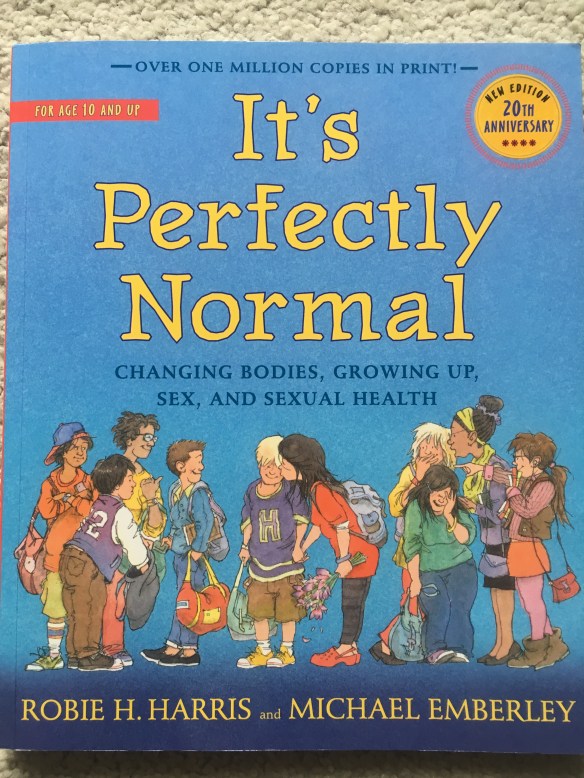
Of note:  My family and I recently discovered the book, It’s Perfectly Normal, by Robie H. Harris and Michael Emberley, and I (sing-song voice) loooove it!!  We own the 20th anniversary edition, updated to include information on sexuality for this digital, online, social media age.  This book appeals to me because it totally demystifies the body and sexuality, and does so with objectivity, openness, inclusion, and good humor.  We highly recommend it!


#AtoZChallenge: Of Trials and Tribes

IMG_2786

Since my last post, I’m thinking more about this Tend and Befriend response to stress–to Trials. When I first mentioned it in this post, I did not really understand it, though I thought I did.  I thought it was about empathy, responding to others’ stress.  Later I started calling it the ‘mama bear’ response, but this is not exactly right, either.   It is attributed to a maternal aspect of human nature, but the bear metaphor conveys too much of the ‘fight’ reflex.

As I reread this summary article, I modified my frame to the ‘mama anything’ response.  The author describes work by Michael Meaney at McGill university, that shows the ‘tend’ aspect:

“He and his colleagues remove rat pups from their nest for brief periods–a stressful situation for pups and mothers–and then return them to the nest and watch what happens. The mothers immediately move to nurture and soothe their pups by licking, grooming and nursing them. This kind of tending response stimulates the growth of the pups’ stress-regulatory system.”

Further in the article, the ‘befriend’ aspect is explained:

“Taylor and her colleagues detail evidence from rodent studies and studies in humans that when they are stressed, females prefer being with others, especially other females, while males don’t. Indeed, in humans, women are much more likely than men to seek out and use social support in all types of stressful situations, including over health-related concerns, relationship problems and work-related conflicts.”

YES! It reminds me of a post I wrote last November about Teams.  Now I’m thinking about prides of lionesses, herds of elephants, and Tribes of people.  Throughout my life, I have had Throngs (okay maybe not, but it’s a great T word!) of people to reach out to in times of need.  Off the top of my head, here are some tribes I belong to:

Mamas

Docs

Mama Docs

Mama Docs of Children With Anaphylactic Food Allergies

My Cheng Cousins

My Hwang Cousins

American Born Chinese (ABCs, the so-called second generation)

AHS Warriors

Patient care Teams (including medical assistants, nurses, receptionists, ultrasound technicians, nutritionists, exercise physiologists, and other physicians)

Northwestern University

The University of Chicago

Conscious Life Journeyers

The Counsel of Wisdom and Caring, convened on my 41st birthday


More from the article, research by Nancy Collins, PhD:

“…tend-and-befriend may be just as adaptive for men as for women in certain contexts, says Collins, whose research finds no gender differences when examining how often husbands and wives seek support from their most intimate companions–for example, each other.”

So really, as the article concludes, Fight or Flight(, Challenge,) and Tend & Befriend are just a spectrum of human stress responses.  Not mama bear, not just mamas, not even just parents, but all of us.  Tend and befriend simply describes and exemplifies the basic human need to belong—we all need our Tribes.