The Power We All Have

Thinking about power: Our power to impact others and vice versa. What if we were all more aware, even by a little, of the impact (or potential impact) we have on any/all people we meet, even in the smallest, most transient encounters? What if we were all just a little more reverent to that profound (I think it’s profound) power and potential–how would we be and do differently?

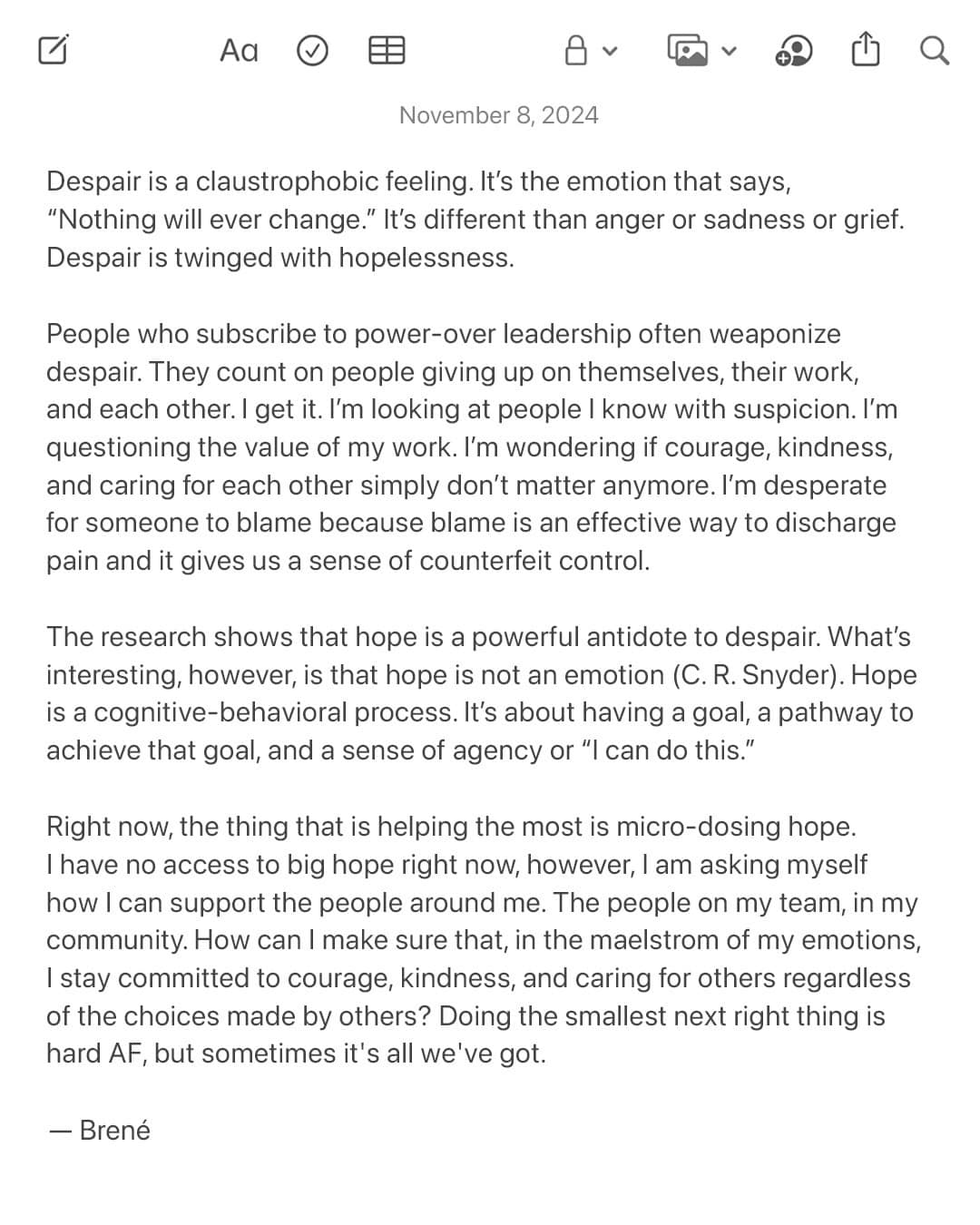
Power To, as Brené Brown says. To make someone’s day a little better or a little worse. To hold people up or cut them down. To lead by example, to foster connection, to make a difference.

Sometimes Power To becomes Power Over, when our attitudes, behaviors, words, and actions hold influence over others and cause harm, even without our intention or knowledge. This reality holds particular importance today, on Mother’s Day. As many of us celebrate moms and their awesomeness, some are reminded of less than stellar maternal-child experiences. Parents hold so much power, and too often we wield it mindlessly.

Our families of origin shape us in ways that can last our whole lives. We also have agency to walk our own paths, however challenging it may be to loosen those family ties. It often takes a fair bit of inner work, to say the least, and I’m convinced we can almost never do it alone. From childhood on, it’s our best relationships with other humans, family or not, that save us. Those who love and support us, who tell us the truth and require the same from us, who hold us accountable to our own values and integrity, and who stay by our sides despite our faults and errors, save us.

“Tell me about your emotional support network,” I ask patients every year. I’m always a little sad when someone doesn’t quite understand the question. I celebrate when someone tells me how it’s stronger now than before.

I don’t expect that we spill our deepest secrets to strangers, or that we share personal things with everyone in our circles. I just wish for us all to walk around with a little more humility, curiosity, generosity, and kindness by default. What assumptions do we make about our fellow humans on the street? We show up differently when we assume everyone is out to con or harm us, from when we think we are all here doing our best, taking care of ourselves and our families. What if we meet people remembering that we all benefit from a little more empathy and understanding, and setting a goal to provide that for one another, even in the smallest ways?

How much can and do you impact those around you?
I bet it’s more than you realize.

Holding the Work

I procrastinate writing this post. I worry how it will be received. I may anger some, offend others, and invite unpleasant backlash. But now that I write it out, as if I said it out loud, that fear abates. How fascinating–naming a fear helps dissipate it. That’s an important practice for the work we hold ahead.

“Question your own fears.” —Monica Guzman, Braver Angels, A Braver Way

Monica Guzman is my hero. Watch the video of her talking about how our fears of what’s in other people’s hearts harms and divides us. Listen and feel her passion, her struggle to stay compassionate to all people, and her distress at how people she cares for now suffer from Trump being elected. Listen to her courage in vulnerability, expressing hope that despite the deep divisions all around, we can still connect across our differences and not destroy ourselves. And know that she has a point of view–she takes a political side. She just doesn’t approach opponents as adversaries.

Monica inspires me to recommit to the work of bridging our political divides, real and perceived. I understand the election was only a few days ago and some people’s pain and distress are still raw. I know some don’t care or want to bridge anything, at least not right now. That’s okay; this post may not be for you. But I’m ready. I hear the call and I’m answering now.

From Instagram

I had a lovely conversation today with a man I’ve known for some years. Our relationship is fun, trusting, and honest. He asked me how I am with the election and I told him I’m very much not okay. He felt great about it. We each described why we feel our own ways, listening for each other’s personal experiences and impressions of the candidates, the parties, and the people around us. I live on the south side of Chicago; he in northwest Indiana. I’m in medicine; he’s in construction. I’m a 51 year-old East Asian woman; he’s a 67 year-old white man. Our life experiences and world views diverge widely. We also have no problems connecting as humans. We both lamented how so few people we know can conduct political discourse calmly and respectfully. We agreed on multiple social issues. Our conversation prompted me to seek data about maternal mortality since Roe v. Wade was overturned. I shared with him and we both learned. It was a meaningful and satisfying conversation, and we agreed to continue. I don’t intend or expect to change his political leanings. I want to understand him, and I want him to understand me. I want us to deepen our relationship, practice healthy political discourse, and bring what we gain from each other back to our own circles. This is how I will make a positive difference in our political culture and landscape.

All people who voted for the other candidate are not evil, or sheep, or whatever name we want to call them. I know how good it feels to say they are (see Brené Brown quote below), and it absolutely does not make anything better. We each get to choose how much contact we want with people who are different from us. Often they cannot be avoided, and then we still get to choose how we interact. We each have power to influence and impact any relationship we touch. Will we be connectors or dividers?

I observe that my fellow progressives are often the ones actively dividing. Cancel culture rages on the left, rife with judgment in minimal interaction, overgeneralization and oversimplification based on assumption and association. I see value in calling out overtly racist and misogynist attitudes and behavior, but public shaming does little to educate, enlighten, or alter anyone’s mind. It just drives their biases underground, only to resurface later. It alienates, inflames, and perpetuates conflict. Judging and throwing away a whole human being based on one fact about them, no matter what that fact is, feels antithetical to a progressive, inclusive ethos to me. And, it is a totally understandable human response to severe moral distress. For those of us committed to bridging, we must learn, practice, and train in self-awareness, self-regulation, and effective communication to mitigate that relationally counterproductive response. We must ground ourselves in openness, curiosity, humility, generosity, empathy, and kindness. These are not mutually exclusive to holding fast to our values, convictions, and causes.

I have many days yet this month to delve into particular skills. For now I can simply sit with a renewed commitment to non-adversarial change agency. This is the Work. I have learned in safe spaces, with people who will not throw me away or belittle me for my beliefs. It’s easy when it’s easy, and it’s how I show up when it’s hard that counts. But I can’t show up competent when it’s hard unless I have practiced–done the drills, entrained the muscle memory, prepared for the harder challenges. So I embrace the test of encounters during the next administration. This is what I have trained for. So I say bring it, I can do this relational stuff better and better, and I can lead by example like Monica Guzman. I still have a lot to learn, and as we say in medicine, see one, do one, teach one–and I’d add–repeat, ad infinitum.

If you’ve read this far and you’re neither offended nor ready, thank you for holding your own space. We can each/all only do what we can, when we can, and how we can.
I Hold the Work for Us to bridge our differences for all our benefit, whatever, whenever, and however we can each make our contribution.

There is hope.

From Facebook

Holding Regret

What are your best and worst regrets? What is the difference?

If we pay attention, regret is inevitable. Living life with ‘no regrets’ is unrealistic at best, oblivious at worst. I’ve thought and written about this a lot, as evidenced by my birthday post in 2022 and the 12 (now 13) times I have tagged it subsequently.
How does regret feel? In my body it feels tight at the neck, shallow in breath. My head hangs, my lips purse. I avoid eye contact–don’t want to be seen–that’s shame, right?

“I would rather regret being too kind than not kind enough.”

I have said this for some years and now, in this moment of writing, I know why. As I realized and wrote in 2022, my worst regrets are relational–times when I have caused a rupture, especially when repair was incomplete or impossible. I could easily substitute honest, empathetic, compassionate, generous, humble, and forthright for ‘kind’. These memories still sting, and I will carry them forever. Thankfully, I pack them better now. They occupy a smaller, more condensed compartment of my life baggage, less damaging when they leak.

Holding regret well, I have learned, requires both accountability and self-compassion. Accountability makes me reflect, learn, and commit to doing better in the future. Self-compassion helps me step out of shame (I’m such a bad mom/friend/doctor/person), and stand instead in guilt (I did a bad thing). The difference: Shame seizes; guilt activates.

Brené Brown wrote yesterday on Instagram:

My research and my life have taught me that regret is one of our most powerful emotional reminders that reflection, change, and growth are necessary. In our research, regret emerged as a function of empathy. And, when used constructively, it’s a call to courage and a path toward wisdom.

The idea that regret is a fair but tough teacher can really piss people off. “No regrets” has become synonymous with daring and adventure, but I disagree. The idea of “no regrets” doesn’t mean living with courage, it means living without reflection. To live without regret is to believe we have nothing to learn, no amends to make, and no opportunity to be braver with our lives.

In our work, we find that what we regret most are our failures of courage, whether it’s the courage to be kinder, to show up, to say how we feel, to set boundaries, to be good to ourselves, to say yes to something scary. Regret has taught me that living outside my values is not tenable for me.

Regrets about not taking chances have made me braver. Regrets about shaming or blaming people I care about have made me more thoughtful.

Sometimes the most uncomfortable learning is the most powerful.

Discomfort: What actions do we take to avoid it? When does this lead to regret down the road, and which of these discomforts would we choose, if we had it to do over? Vulnerability is extremely uncomfortable–a risk of variable magnitude, depending on context. The reward, however, can be transformative. I regret causing others discomfort with my vulnerability; I’m better at attuning to that risk as I age. I regret when my vulnerability is met with dismissal, invalidation, or minimization. Still, deep human connection cannot occur without real vulnerability, risks and all. Since I live for connection, I have a very high tolerance for the discomfort of vulnerability. Expressed alongside kindness, honesty, and humility, likelihood of connection rises and regret declines. How lovely.

What regrets would you rather carry forever?

I Hold Regret for Us that shows us our core values, that keeps us honest and accountable. I also hold love, compassion, and deep connection that lightens regret’s perpetual load on us all. We walk on, my friends, all on the path, all doing our best.