Words and Actions

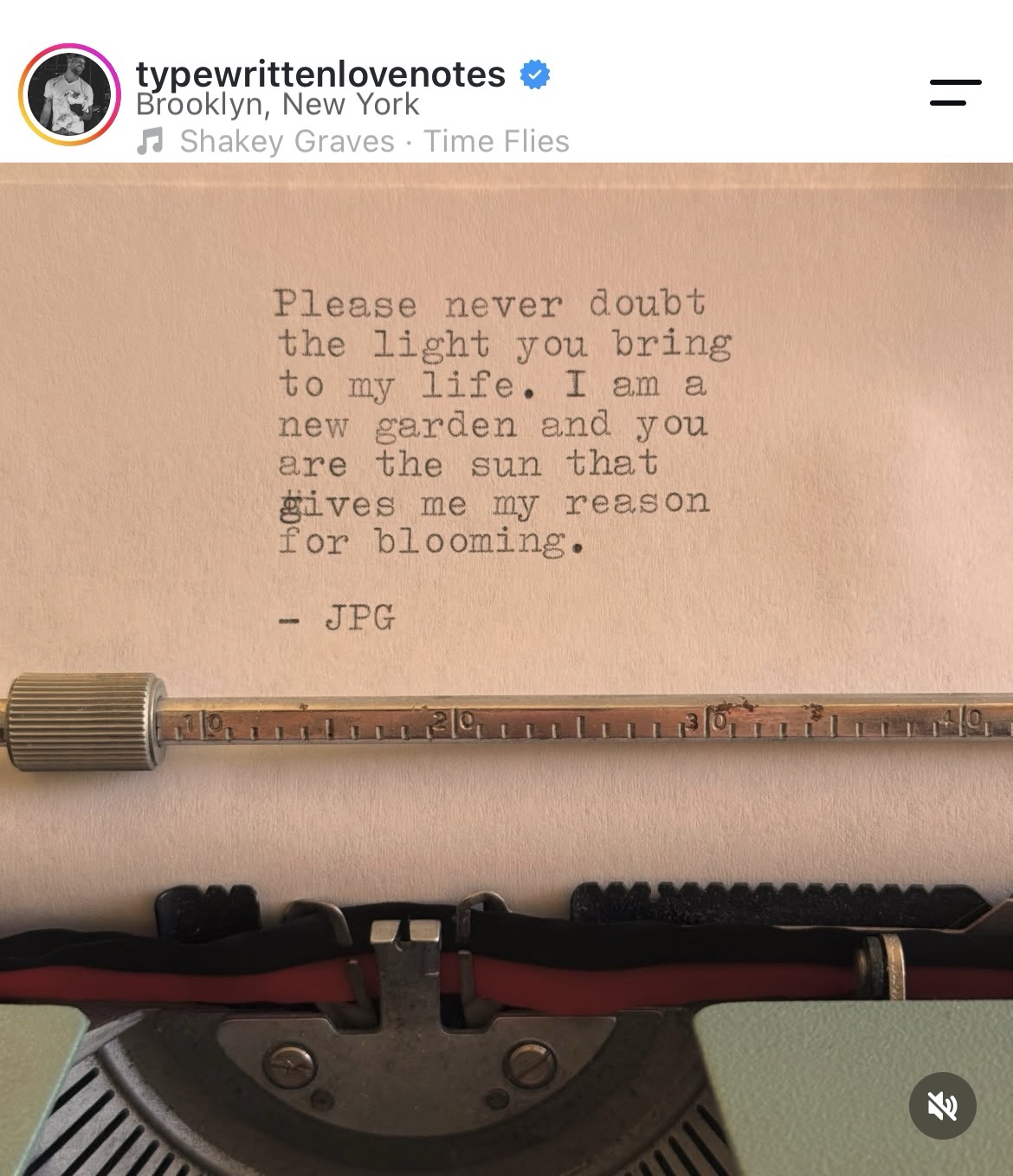
“Please never doubt the light you bring to my life. I am a new garden and you
are the sun that gives me my reason for blooming.” –JPG
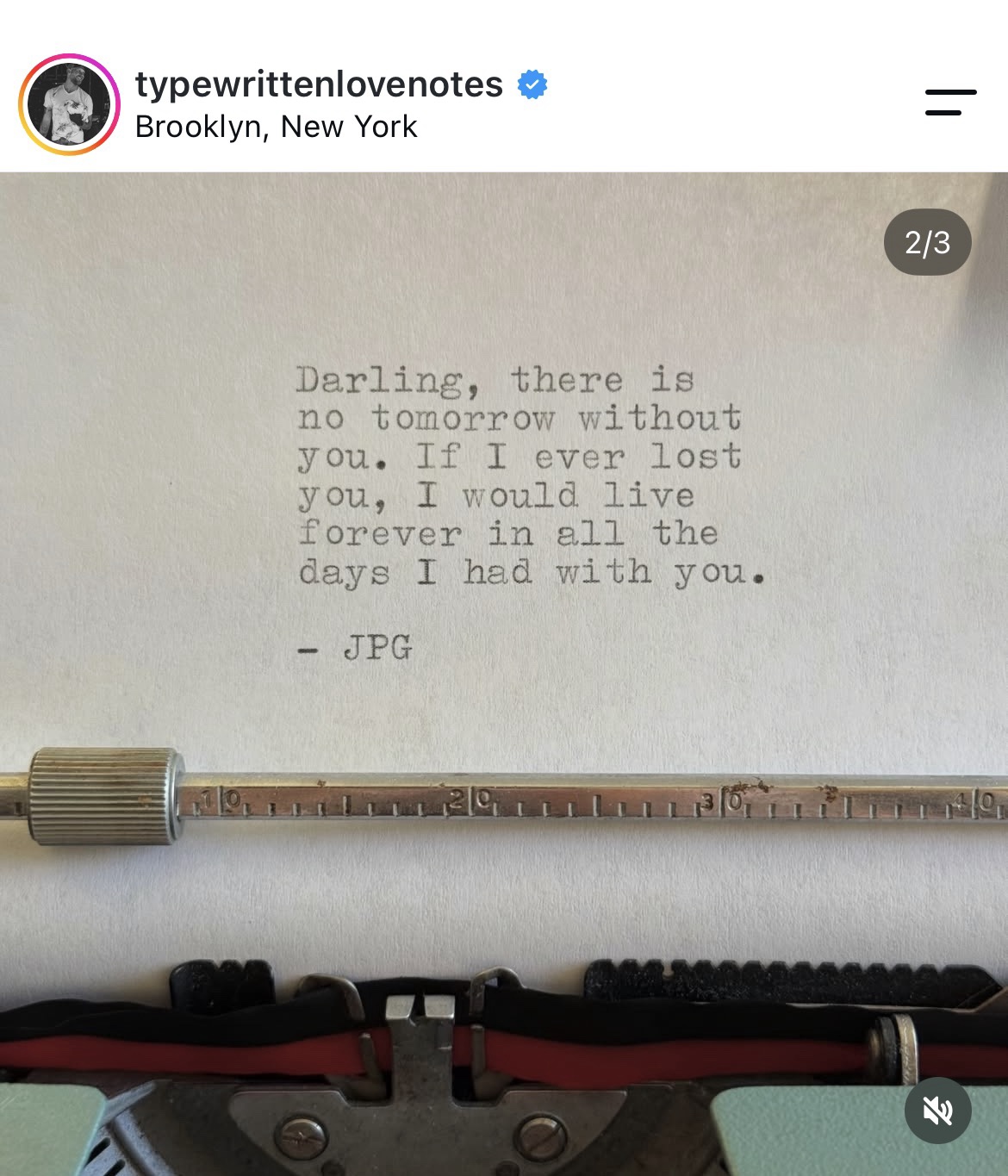
“Darling, there is no tomorrow without you. If I ever lost you,
I would live forever in all the days I had with you.” –JPG
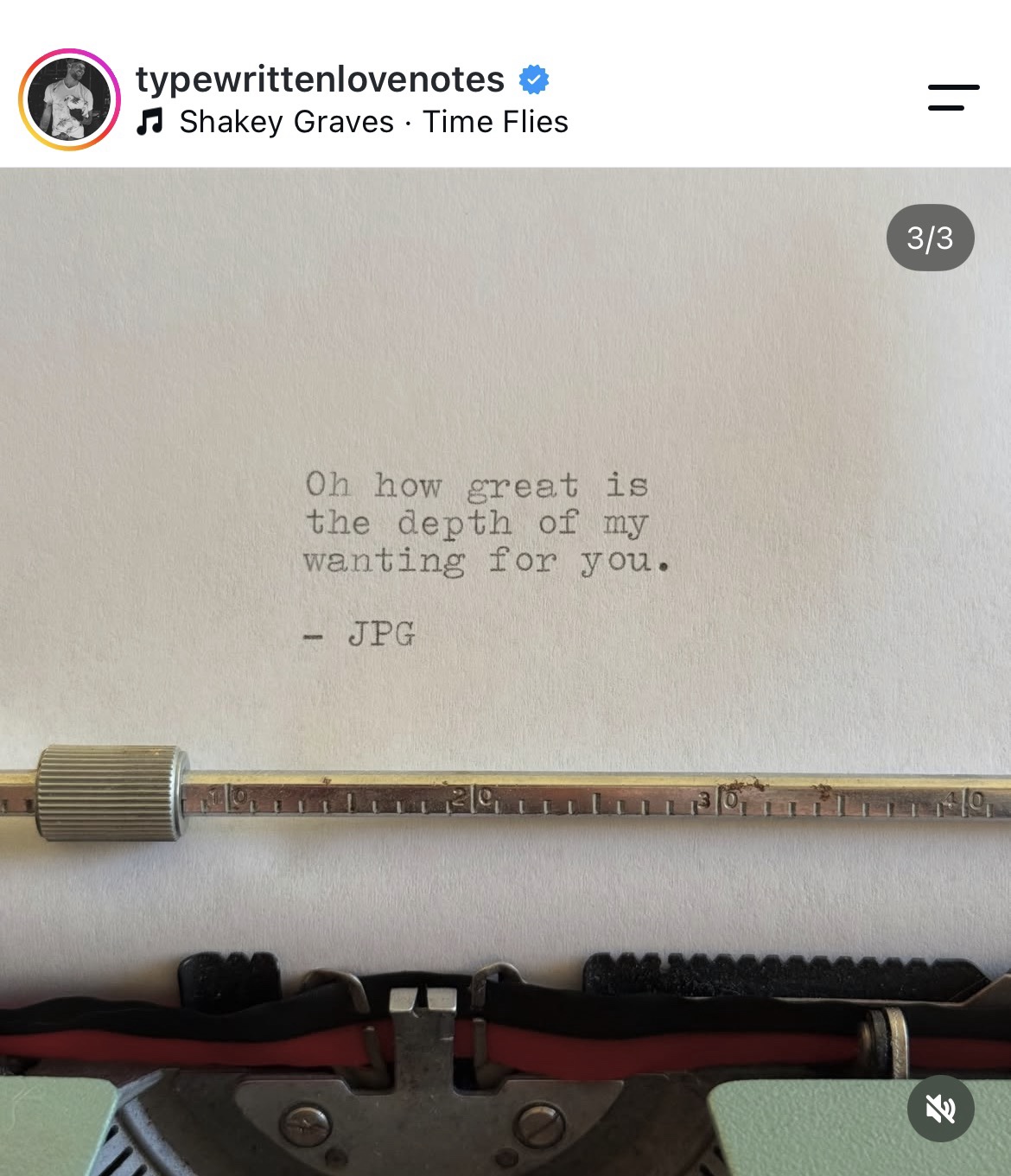
“Oh how great is the depth of my wanting for you.” –JPG

What do the words in these images do for you, friends? What do they bring forth?

If you are not already acquainted, I highly recommend finding and following Josh Greene, @typewrittenlovenotes on Instagram and on his Substack. His writing is thoughtful and evocative, keenly astute to all things human. He engages his audience with the most admirable integration of openness, earnestness, and appropriate boundaries.

I read the three expressions of his post above and commented, “Wondering… what are the day to day actions that go along with these words? It’s lovely to imagine.” Two avenues of reflection emerged from the question:

How do I walk the talk?
If I tell you how much I love you, care about you, and value you, how do I show you in our everyday interactions? What does it mean to live these words? How do I treat you such that you believe me when I say them? It makes me wonder which people in my life feel a gap between what I profess and how I behave. How do I delude myself, believing my words and actions are fully aligned when they are not? What needs to happen for those who feel the gap to tell me so I may correct, either the words or the actions?
It’s so easy (for some of us) to say the flowery words. They make everybody feel good with instant gratification. When things are harmonious it’s easy to act lovingly. How do I show up when it’s hard? Do I live up to my own standards of integrity, compassion, and self-regulation? Perfection is not possible. But how much is good enough? How do I keep myself accountable?

What words/stories drive my actions off track?
I make generous assumptions about most people most of the time; I place myself pretty far on the right side of the curve compared to the general population here. And yet, there are those for whom I hold only sparse generosity. I justify my attitude and seek validation for it. Thankfully, I have dear friends who will provide that emotional validation, remind me of my own standards of conduct, and challenge me to reconcile my actions accordingly.
I come back to the words. How do I label these people and thus prime myself for disconnection rather than connection, the exact opposite of what I always say I want most in life and relationships? It’s an uncomfortable and humbling irony, and one that I am grateful occurs only occasionally. So I am determined to suck all possible learning from each occurrence, in hopes of prevention in future. Disconnect will always happen of course, but my high dream is to look back and see that I did my best to present my best self whenever possible. What do I need for that to happen more reliably?

These questions feel important, but not necessarily urgent. I’m reminded of Rilke’s admonishment to ‘live the questions‘, to simply be alive to them, let the answers reveal themselves over time. I have trained my observation and reflection muscles well; they are tone and strong. So I don’t fear the heavy self-awareness lifts when they cross my path. I can slow down, take a breath, and assess. I get to decide whether and how to approach, detour, confront, or take other action. I’ll know when I need to know, and I am well supported with excellent counsel.

So let’s live some good questions, shall we? The world needs us all to speak and act more thoughtfully and reflectively, and be much better self-regulated.

Celebrate One Another’s Gifts

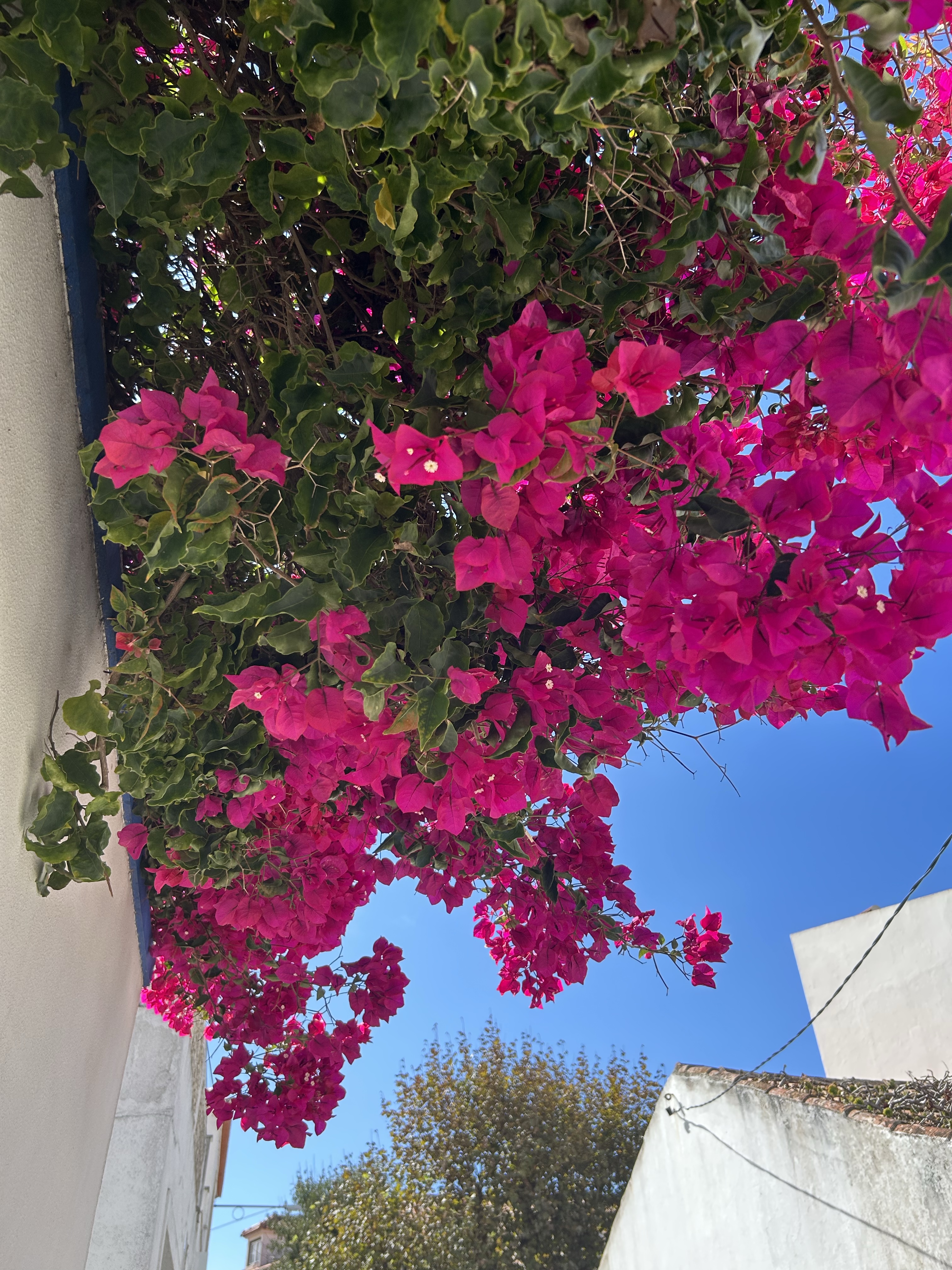
Ericeira, Portugal

Friends, I have jetlag so I will be brief:

“I think we could all encourage one another to acknowledge and articulate our gifts more. That could make the world better.”
I wrote this to JP Greene, @typewrittenlovenotes, in response to his story reel describing his gift of acute and specific memory.

I traveled to Portugal this past week to attend the wedding of two of my favorite young people. What a gift and privilege, and a memory I will treasure lifelong. Not only did I get to spend enough quality time with both bride and groom, but I got to meet their and their parents’ dear and loving friends, and came home having made a bunch of new friends myself.

The event included multiple opportunities to reminisce and reflect on the newlyweds’ roots, personalities, and relationships. The ceremony and vows represented them both so earnestly and exquisitely. Their honest and authentic natures clearly present to us all right up front and consistently, as every description of them from the best mates to parents were exactly the people we all know and love, all why every one of us was willing to fly over an ocean to celebrate their marriage.

How often do you hear from others about your gifts?
How often do you exercise them in both confidence and humility?

How often do you express your appreciation of others’ gifts to them?
How often do you notice yet stay silent?

When we reflect others’ gifts and impact back to them, specifically and in real time, we reinforce what we love most about them. We validate and strengthen their self-awareness and self-worth. When we notice someone making a positive difference in the world, acknowledging it amplifies the effect and helps us all absorb and integrate that energy better. I believe we are more likely ourselves to act in kind thereafter–it’s a win-win.

This week, I challenge us to practice.

Articulate our admiration with assertive positivity. To be clear, we must be genuine and honest–actively responsive in and to our observations. It need not be effusive, per se, just earnest and direct. If it feels uncomfortable, may we muster the boldness to overcome the discomfort (maybe explore it?) and connect despite it. Sincere compliments make us generous on the receiving end; they can someone’s day, which brightens our own day. I think we consistently underestimate the vast and beneficial ripple effects of a few kind and encouraging words.

May we make one another feel seen and appreciated, my friends. May we openheartedly point out others’ gifts to them, and help them self-acknowledge. Far from stoking egoism and arrogance, I think we will simply call forth our best selves for one another and for the world. Imagine what a better society we could build this way?

Ericeira, Portugal
Ericeira, Portugal

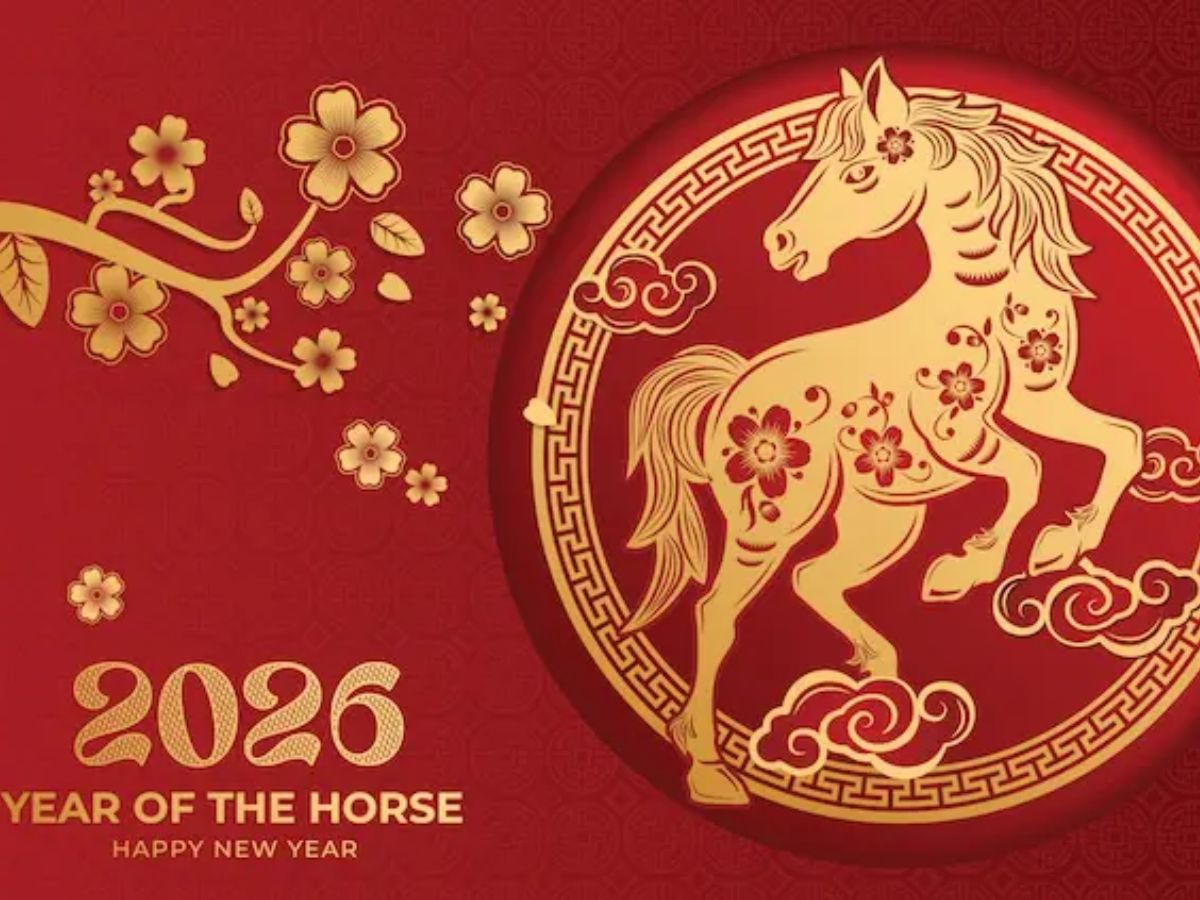
Power and Grace: Year of the Fire Horse

Image from The Sunday Guardian

The Lunar Year of the Fire Horse arrives this Tuesday, February 17.
Happy New Year, my friends.

I’ve thought about this post for a couple weeks now, reflecting on power and grace, two attributes of horses that I admire and wish to manifest in 2026 and beyond.

Power
Brené Brown and others distinguish between power to and power over. We all have power to–to act, influence, resist, etc.–to various degrees in certain contexts. But not everybody has power over, and right now in the US we witness our government exercising its power over people and systems in brutal and unconscionable ways. Consider those in authority who have exercised power over you–parents, teachers, bosses, administrators, police–we know when they wield their power abusively. It is an intuitive and visceral knowing, whether we admit it or not.

So as concerned members of society, called to stand up for our fellow humans getting traumatized on a daily basis, where does our power to lie, as individuals, groups, and communities? Peaceful protest is one. Also “grassroots guerilla support systems”, as novelist and poet JP Greene calls them. He writes further in last week’s newsletter, Stomaching the American Lie, “It looks like local butcher shops feeding people for free when SNAP benefits get cut. It looks like neighbors getting to know neighbors and community gardens and mutual aid networks and communities that guard and teach and raise up their children collectively.” Where could it lie that we haven’t noticed?

No one will be surprised when I submit that our power to also lies in connection across difference. The polarization we witness that stems from the most extreme voices on any topic feels insurmountable. Those of us on either side who recognize the nuggets of truth among our opposition’s positions may feel powerless to change the prevailing narrative on our own side that demonizes and dehumanizes the other–a narrative that benefits nobody. To dissent feels like an exercise in futility.

Connecting across difference and finding the ‘you have a point’ moments feels like giving power away, no? But concensus, however small, builds power and momentum to move and merge attitudes and then policy meaningfully. It requires patience, humility, openness, empathy, and honesty. How many of us view these traits as strong, as conferring power to those who wield them? If we think in terms of power over, then humility and empathy can feel weak. But if we wish to engage and challenge civilly, to explore, invite, and nudge people to loosen their strongly held biases and rigid positions, to change the narrative on both sides from ‘vanquish the enemy’ to ‘get to work and solve problems for real now’, then humility, patience, empathy, honesty, and integrity may be the most powerful skills we can call forth. These are the heaviest tools of power to when it comes to effecting consequential human change.

Grace
Few animals evoke a sense of gracefulness more than horses. Their anatomy and movements are a wonder to behold. How can we emulate this essence in our own being, in service to one another?
What does it mean to be graceful, and to ‘give others grace’?
What does this grace feel like in our bodies?

Consider elite ballet dancers and master diplomats, arguably the most physically and verbally graceful among us. How do they train? What traits do they present? Commitment. Discipline. Consistency. Perseverance. Core stability and strength, flexibility, and agility. Mental, physical, and relational resilience. Graceful people exude groundedness and focus. Their nervous systems are both regulated and responsive, alert and attuned, yet slow to agitation and impulsivity. Their energy de-escalates those around them. They exemplify ‘strong back, soft front‘. They move with fluidity and make it look easy, and we want to follow. To exert influence with such minimal apparent effort, to possess such efficiency of energy for impact–that is grace.

Power and grace are analogous to strong back, soft front, which is how I wish to live. Unassailable principles and core values rooted in honesty and integrity, presenting as openness and invitation to connection and relationship. The latter entails vulnerability, which requires courage, which is a form of strength and power. These qualities all intersect and mutually amplify in a personal ethical ecosystem that thrives on the exponential synergy of human connection. How inspiring!

How do we choose to move forward this Fire Horse Year, in our own lives and as a collective? Besides power and grace, what other energies do you wish to exude?
How will living this way benefit you and those around you?
When we look back at the dawn of the Fire Goat Year in 2027, how will we say we have lived?