Hopey, Changey Hero Making

IVY Litt 11-8-17

NaBloPoMo 2017: Field Notes from a Life in Medicine, Day 8

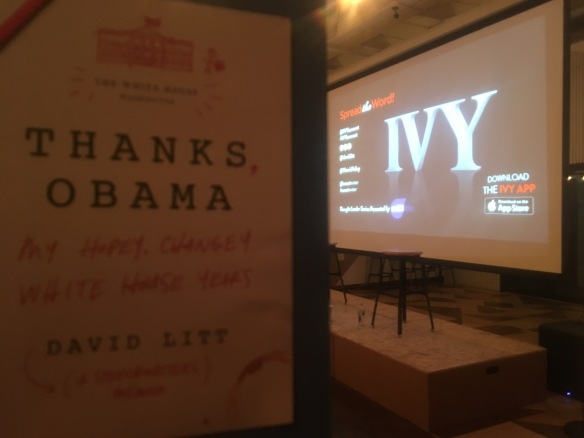
Funny how I just wrote last night about connecting new dots to old dots.  It just happened again tonight!  A couple of weeks ago I responded to an online ad for an IVY Ideas Night with David Litt, author of Thanks Obama: My Hopey, Changey White House Years, entitled, “How to Inspire, Persuade, and Entertain.”  Litt was a senior speechwriter for President Obama, so I thought I could learn new tips for presentations, and feel a little closer to the president whom I miss so much.

I’ve done public speaking since eighth grade, when our speech teacher first taught us abdominal breathing and I discovered the thrill of holding the attention of a room full of people with only my words.  I work at an academic medical center and I hold zero publications, but my CV documents over 10 years of professional presentations to various audiences.  I thought I was pretty good at this speaking thing.

Three years ago I came across this TED talk by Nancy Duarte, whose ‘secret structure’ of great presentations I have used since I subsequently read her book, Resonate.  Essentially, she recommends that we invite audiences on adventure stories, create active tension between what is and what could be, and most importantly, make the audience the hero.  I have done this better and worse since then, but I always recognize the framework when I see it.  Those familiar with this blog know that I am also a fan of Simon Sinek, whose central message is that we perform at our best when we are crystal clear about our Why.  “People don’t buy what you do, they buy Why you do it,” he says.  Barack Obama employs both authors’ principles with eloquence and finesse, which I noticed reading We Are The Change We Seek, a collection of his speeches as president.  The best speeches delivered in this construction create audiences who are inspired, motivated, and empowered to hail a meaningful call to action.
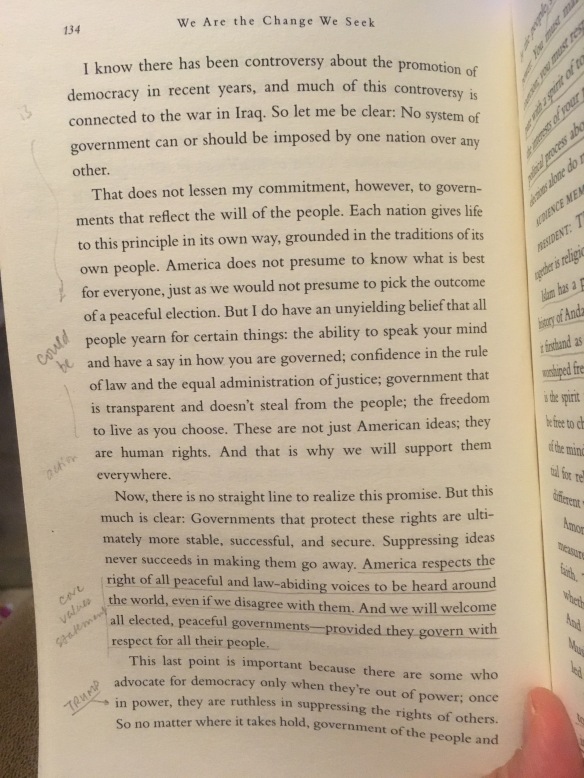
Obama is could be core values

That’s basically what David Litt conveyed tonight.  When asked what advice he was given that served him best, he said, “Imagine someone in your audience will tell their friend tomorrow about your talk.  What is the one thing you want them to say about it?”  What is the Why of your talk?  Even though he no longer writes speeches for the most powerful person in the world, he expressed a desire to continue inspiring, empowering, and promoting personal agency in all whom his work touches. Make each and every audience member their own hero.

It turns out, however, that this approach applies to much more than public speaking.  On my 50 hour, 500 mile, aspen-pursuing weekend in Colorado last month, I described to my dear friend my favorite moments at work.  At the end of a patient’s day-long physical, after I have spent 90 minutes listening to their stories of weight gain and loss, work transitions and complex family dynamics, and reviewing their biometrics and blood test results, I meet with them for an additional 30 minutes to debrief.  This is when I present an integrated action plan compiled by the nutritionist, exercise physiologist, and myself.  It is a bulleted summary of our conversations throughout the day, centered on the patient’s core values and self-determined short and long term health goals, and crafted with their full participation.  I get to reflect back to my patients all that I see them doing well, and shine light on areas for potential improvement.  It’s an opportunity to explore the possible—to Aim High, Aim Higher, as the United States Air Force exhorts.  I often present the plan with phrases like, “Strong work!” “You’ got this,” and “Can’t wait to see what the coming year brings!”  My friend turned to me as we wound through autumn gold in the Rocky Mountains, a bit tearfully, and said, “You make them the hero of their own story.”  Yeah, I do, I thought, and I got a little teary, too.

Words are powerful.  They are our primary tool for relating to each other, for making another person feel seen, heard, understood, accepted, and loved.  You don’t have to be a public speaker or a presidential speechwriter to make a positive difference with your words.  At work, in your family, with your friends, with people on the street and in the elevator—what is the one thing you want someone to remember from their encounter with you?

No Substitute for Time

DSC_0401

NaBloPoMo 2017: Field Notes From a Life in Medicine

Day 3

How much time do you spend with your doctor each time you see them?  Is it enough?  If they had more time to spend with you, how would you use it?  Would it be better?

I’m too tired and it’s too late tonight to discuss the myriad factors that erode the patient-physician relationship, and thus our medical system in general.  But time comes to mind often for me, and I wonder if patients are as frustrated about it as I am.

Where I work now, I pretty much have as much time as I want with people.  It’s a sweet gig.  I can ask them about their work, their families, their interests.  I have time to listen to the answers, and even connect those with my observations about their health.  The most interesting parts of my interviews are the social history.  What do they spend their days doing at work?  What problems do they solve, who do they interact with, and what brings them meaning at the place where they spend the majority of waking weekday hours?  Then what do they do for fun, what’s life like outside of work?  I get to know my patients as individual, whole people, which I love, and that makes me look forward to every day at work with joy.

But time is not just good for me, for my professional fulfillment.   It’s good for patients, too.  When I spend time asking the important questions, putting together pieces of a person’s symptom puzzle, and do a directed exam, I’m more likely to come to a correct diagnosis and make an appropriate and specific care plan.  When I take the time to explain my rationale, decision process, and possible outcomes and follow up, my patients are more likely to feel seen, heard, and reassured.  They are more likely to stick with the plan and contact me if things change.  The next time they need help, they are more likely to call me and we have another chance to know each other better.

When the physician-patient relationship flourishes, we’re all healthier.

I love this article on The Health Care Blog, which essentially validates the time I take to talk to my patients.  My favorite line:  “More information about the value of a physician-patient encounter will always be found in the content of their communication than in what they ultimately do. The difference in… physicians’ behaviors will not be found in any database, electronic medical record, or machine-learning algorithm. I have yet to see data on the contextual information from a history of the present illness in any data set or quality improvement initiative.”

You may also be interested in this article, describing the origin of the 15 minute clinic visit, and why it really doesn’t make sense.

What do you think about physicians and patients advocating together to change this aspect of our flawed medical system? I know it’s complicated, requiring a hard look at our billing and compensation processes, as well as our productivity-driven, fee-for-service medical culture.  I still think it’s worth pursuing.  There is no substitute for time.  We must protect and defend it; our health depends on it.

Applying the Wisdom of Atticus Finch

Atticus_and_Tom_Robinson_in_court

“You never really understand a person until you consider things from his point of view—until you climb into his skin and walk around in it.”

–Atticus Finch

To Kill a Mockingbird, by Harper Lee


How do you practice and achieve empathy?  How do you notice others doing it?

It’s been on my mind a lot these last two weeks.  Current American politics resembles an interminable abscess, oozing ever more copious and putrid gobs of pus, from ever more unforeseen tracts of deep, diseased tissue.  How can we find any Healing Connection in the midst of all this?

Here’s my answer:  Role play and storytelling.

Role Playing Game Males Lego Duplo Play Build


Role Play for the Good

I used to hate role play, and now I jump at any chance to try it!  It all changed through a 7 week teaching workshop I did during my chief resident year, and I am forever grateful for the experience.  Now I regularly use role play to teach motivational interviewing, or MI, to medical students and residents.  Put simply, MI is a counseling technique that focuses on patient autonomy, and aims to reinforce intrinsic motivation for change.  My teaching method has evolved over time, due to my own unexpected experience of ‘climbing into the skin’ of others.

In the beginning I used to play the patient, letting students take turns practicing their MI skills on me.  After a couple of sessions I realized that even though I was pretending, I really felt like the students were earnestly trying to help me change my health habits, or making me feel bad about myself, depending on their proficiency.  So to give them the benefit of this perspective, I had them take turns playing both patient and physician.  The feedback revealed a richer, more insightful experience for all.

In 2015 I attended the Active Lives conference, where my technique was further enlightened.  I got to role play four times with a partner: first as patient, then physician, doing it the ‘wrong’ way (directive, authoritative, confrontational), and again in both roles doing it the ‘right’ way (collaborative, empathetic, nonjudgmental).  I felt the immediate contrast of the four roles emotionally and viscerally.  When all I heard from the doctor was, “Yes, I know you’re busy, but you have to find time to exercise,” and “Why don’t you do this…” and, “You should… You need to… If you don’t, then…” I felt absolutely no impetus to take any of this advice.  But questions like, “How important is it to you to…  How confident are you to… What would it take…what would need to happen in order for you to…” and, “What would life be like if…” invited me to explore possibilities, helped me to imagine and create my own future.  As an authoritative physician, I felt frustrated at my patient’s resistance to my evidence-based and well-intentioned advice.  By contrast, as a collaborative doctor, I feel freed to embark on an improvisational Yes, And adventure to reveal each patient’s personal path to healthier habits.  Now I offer my students the opportunity to experience all four roles.

I remembered this insight evolution last week when I came across a 1970 video of Jane Elliott’s classroom racism experiment.  She divides the class by eye color, asserts that blue-eyed children are better than brown-eyed children on one day, then reverses the premise the next.  While she makes privilege assignments that likely would not fly today, she also debriefs with the kids, helping them identify their assumptions, feelings, actions and reactions—much more authentically and directly than I think we are willing to do today.  She does it all without judging or shaming, pointing out biases and encouraging her students to examine them for themselves.  I admire her for pioneering this exercise, and I bet it affected her students in profound and lasting ways.

storytelling


The Importance of Story

Clearly, we cannot possibly depend on such academic practices to develop everyday empathy.  Luckily we now have infinitely easier access to one another’s stories than ever before, which is the next best thing.   Lately I feel a keen new appreciation of the importance of storytelling for conveying experience and stimulating mutual understanding.  Obligingly, the universe (read Facebook) has provided me with numerous testimonies of my fellow humans’ experiences and conditions, and this week they touch me even more acutely.  Here are some of them:

  • Former white supremacists talk about the importance of upholding others’ humanity, even as we denounce their beliefs.
  • A black writer recounts multiple instances of racism over her lifetime, inviting her white high school classmate to imagine and consider how they exemplify his white male privilege.
  • The head of neurosurgery at the Mayo Clinic in Florida tells his story of illegal, then legal immigration, and a subsequent life dream realized.
  • Neil DeGrasse Tyson shares stories of genitals on fire, educators’ responsibility to the electorate, pressure from his black classmate to contribute to ‘the black cause,’ realizing that he is doing just that, and why he wants to be buried instead of cremated (he has changed my mind, by the way).
  • David Duke’s godson credits the college friends who welcomed him despite his pedigree, with helping him defy and shed it.


What’s the Point?

The overarching goal here is to intentionally thwart the abstraction and dehumanization of people who are different from ourselves.  Stepping into another person’s shoes, ‘climbing into (their) skin,’ imagining how they feel, and actually feeling it—this is the best protection against bias, prejudice, and discrimination.  Empathy forms the sticky webs of connection that stymie the hymenoptera of hatred mid-flight, or catch us in the face and remind us to look where we’re going.  Where do we want our thoughts, words, actions, and relationships to take us?

I imagine a world of colorfully flawed humans, who acknowledge our biases openly and honestly; who recognize the risks that those biases carry; who accept ourselves, warts on soles and souls and all; who commit to a lifetime of extending that acceptance to one another; and who understand that it is our relationships, all of them, that kill us or save us.

So let’s play and tell—and feel and listen.  Really,  it’ll be good for all of us.