The Doctor Becomes the Patient

DSC_0350

Grandma Has Hurt Herself.

Tonight at volleyball, I was given the perfect set, my timing was getting better, I sprang and hit the ball over the net… I think it landed in, but I was distracted by the crunching sensation and noise I felt in my left knee, and then breathtaking pain as I landed the jump.  Immediately I went rolling, writhing on the floor, lamaze breathing long and slow (nice how that comes in handy at times like this).

As I sat sidelined, the medical inventory began:  No torsive forces, just a buckle.  No ankle or hip pain, only knee.  It’s the bad knee, had similar pain landing a little jump a few months ago, though not nearly this bad.  Pain primarily posterior, deep, left of center, worse with knee extension and dorsiflexion.  Anteromedial joint line pain with weight bearing.  Immediate but mild swelling/effusion.  Hmmm, maybe medial meniscus, possibly also PCL strain/tear?  When should I get the MRI?  How long before I can start PT?  Where is that knee sleeve I got before?  600mg ibuprofen STAT.

The young people were so loving, gathered around asking me where it hurt, getting ice, helping me up, grabbing blocks to put my leg up, glancing over empathetically as I RICEd.  I felt cared for and also embarrassed.

Not just embarrassed.  I felt guilty, maybe even ashamed.  What had happened?  I’ve been training, I’m a good jumper, what did I do wrong?  Was it karmic payback?  I left home just as my kid was struggling with some homework—but nothing I thought she couldn’t handle.  Or maybe I had been getting too cocky that I could actually do this at my age?  Just yesterday I posted videos of my most recent progress on the TRX—I was openly bragging–“toot-toot!” I wrote gleefully.  Or it was an error in judgment: I have not slept enough this week, and I knew I was tired before I went tonight.  But I wanted to go meet my new friends, I wanted to play and have fun.

The frustration came all at once, and with considerable force.  Thankfully I had a friend nearby with a consoling ear and some crutches to lend.  All athletes get injured, she said.  I didn’t do anything wrong.  Yes, I’ve been training, and I was also weekend warrioring it all these months.  This has been my problem knee for at least 15 years, maybe it was going to happen anyway.  It’s still interesting to watch, almost from outside myself, the emotional lava lamp of fear, regret, anxiety, dread, catatrophization, and sorrow.

Experience and maturity, however, make me optimistic.  It’s a temporary setback, and I have resources available to me for recovery, growth, and even enhancement.  Now I get to learn how to use crutches, and I can relate much better to my patients with knee injuries.  I also get to test my newly formed theory that though we may slow down in general with age, we need not resign ourselves to inevitable and morose decline.  Patients ask me often, what should they expect to be able to do at this age or that, how can they know their limits?  For a long time I had no good answer.  But as I have regained strength, endurance, stability and mobility these last few years (tonight notwithstanding), I now tell them: It depends on what you want and how much you invest.  My 1977 Oldsmobile will not run like my 2012 Highlander.  But if I really want to drive that thing, I can put in all the special care and maintenance required and make it roadworthy.  It’s the same with our bodies.  They are incredibly resilient and adaptive, and also mortal.  So we must Fuel and Train, then Rest and Recover appropriately.

I guess I pushed past my current limits tonight.  Setback acknowledged.  I don’t regret the last five months–I made new friends and played and had fun!  I anticipate a high-learning road to recovery.  And I think I’ll get back before they forget me.


Applying the Wisdom of Atticus Finch

Atticus_and_Tom_Robinson_in_court

“You never really understand a person until you consider things from his point of view—until you climb into his skin and walk around in it.”

–Atticus Finch

To Kill a Mockingbird, by Harper Lee


How do you practice and achieve empathy?  How do you notice others doing it?

It’s been on my mind a lot these last two weeks.  Current American politics resembles an interminable abscess, oozing ever more copious and putrid gobs of pus, from ever more unforeseen tracts of deep, diseased tissue.  How can we find any Healing Connection in the midst of all this?

Here’s my answer:  Role play and storytelling.

Role Playing Game Males Lego Duplo Play Build


Role Play for the Good

I used to hate role play, and now I jump at any chance to try it!  It all changed through a 7 week teaching workshop I did during my chief resident year, and I am forever grateful for the experience.  Now I regularly use role play to teach motivational interviewing, or MI, to medical students and residents.  Put simply, MI is a counseling technique that focuses on patient autonomy, and aims to reinforce intrinsic motivation for change.  My teaching method has evolved over time, due to my own unexpected experience of ‘climbing into the skin’ of others.

In the beginning I used to play the patient, letting students take turns practicing their MI skills on me.  After a couple of sessions I realized that even though I was pretending, I really felt like the students were earnestly trying to help me change my health habits, or making me feel bad about myself, depending on their proficiency.  So to give them the benefit of this perspective, I had them take turns playing both patient and physician.  The feedback revealed a richer, more insightful experience for all.

In 2015 I attended the Active Lives conference, where my technique was further enlightened.  I got to role play four times with a partner: first as patient, then physician, doing it the ‘wrong’ way (directive, authoritative, confrontational), and again in both roles doing it the ‘right’ way (collaborative, empathetic, nonjudgmental).  I felt the immediate contrast of the four roles emotionally and viscerally.  When all I heard from the doctor was, “Yes, I know you’re busy, but you have to find time to exercise,” and “Why don’t you do this…” and, “You should… You need to… If you don’t, then…” I felt absolutely no impetus to take any of this advice.  But questions like, “How important is it to you to…  How confident are you to… What would it take…what would need to happen in order for you to…” and, “What would life be like if…” invited me to explore possibilities, helped me to imagine and create my own future.  As an authoritative physician, I felt frustrated at my patient’s resistance to my evidence-based and well-intentioned advice.  By contrast, as a collaborative doctor, I feel freed to embark on an improvisational Yes, And adventure to reveal each patient’s personal path to healthier habits.  Now I offer my students the opportunity to experience all four roles.

I remembered this insight evolution last week when I came across a 1970 video of Jane Elliott’s classroom racism experiment.  She divides the class by eye color, asserts that blue-eyed children are better than brown-eyed children on one day, then reverses the premise the next.  While she makes privilege assignments that likely would not fly today, she also debriefs with the kids, helping them identify their assumptions, feelings, actions and reactions—much more authentically and directly than I think we are willing to do today.  She does it all without judging or shaming, pointing out biases and encouraging her students to examine them for themselves.  I admire her for pioneering this exercise, and I bet it affected her students in profound and lasting ways.

storytelling


The Importance of Story

Clearly, we cannot possibly depend on such academic practices to develop everyday empathy.  Luckily we now have infinitely easier access to one another’s stories than ever before, which is the next best thing.   Lately I feel a keen new appreciation of the importance of storytelling for conveying experience and stimulating mutual understanding.  Obligingly, the universe (read Facebook) has provided me with numerous testimonies of my fellow humans’ experiences and conditions, and this week they touch me even more acutely.  Here are some of them:

  • Former white supremacists talk about the importance of upholding others’ humanity, even as we denounce their beliefs.
  • A black writer recounts multiple instances of racism over her lifetime, inviting her white high school classmate to imagine and consider how they exemplify his white male privilege.
  • The head of neurosurgery at the Mayo Clinic in Florida tells his story of illegal, then legal immigration, and a subsequent life dream realized.
  • Neil DeGrasse Tyson shares stories of genitals on fire, educators’ responsibility to the electorate, pressure from his black classmate to contribute to ‘the black cause,’ realizing that he is doing just that, and why he wants to be buried instead of cremated (he has changed my mind, by the way).
  • David Duke’s godson credits the college friends who welcomed him despite his pedigree, with helping him defy and shed it.


What’s the Point?

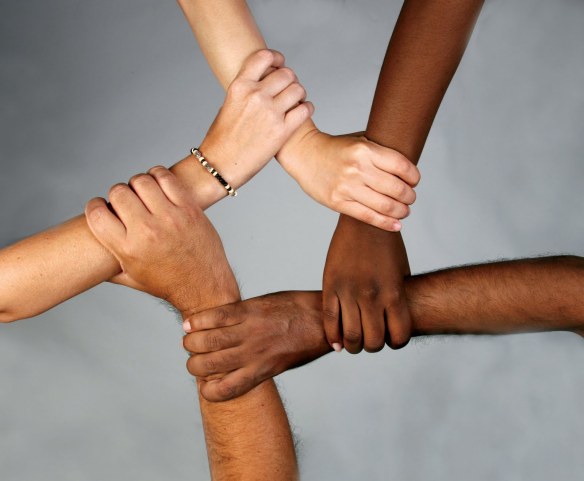
The overarching goal here is to intentionally thwart the abstraction and dehumanization of people who are different from ourselves.  Stepping into another person’s shoes, ‘climbing into (their) skin,’ imagining how they feel, and actually feeling it—this is the best protection against bias, prejudice, and discrimination.  Empathy forms the sticky webs of connection that stymie the hymenoptera of hatred mid-flight, or catch us in the face and remind us to look where we’re going.  Where do we want our thoughts, words, actions, and relationships to take us?

I imagine a world of colorfully flawed humans, who acknowledge our biases openly and honestly; who recognize the risks that those biases carry; who accept ourselves, warts on soles and souls and all; who commit to a lifetime of extending that acceptance to one another; and who understand that it is our relationships, all of them, that kill us or save us.

So let’s play and tell—and feel and listen.  Really,  it’ll be good for all of us.


Love You Into Being

IMG_4550

A couple of weeks ago I met my new medical students.  These 10-12 trainees will be my small group for the next two years.  We will meet monthly to discuss the soft stuff of medical training—hierarchy, tribalism, death and dying, medical errors, difficult patients, etc.  Some call it “third year medical student support group.”  This is my 6th year of the pleasure and privilege (I inherited my first group halfway through, when their previous preceptor moved out of state).

With each successive group I am ever more amazed at the students’ level of insight.  They articulate compassion, humility, and maturity that I don’t think I had at their level of training. Or maybe it’s because we did not have classes like this to explore such things when I came up (or maybe I don’t remember?).  More and I more I see my role as facilitator more than teacher.  I am not here to impart medical knowledge.  Rather, it is my job to stimulate exploration, conversation, and meaning.  It’s so freeing, really—there is no standardized test to teach to.  And yet I see it as my responsibility to help prepare these gifted young people to face the greatest challenge and reward of the profession: human relationships.

I feel no fear or trepidation.  We cannot ‘fail’ at this class, any of us.  Because the point of it is simply for everybody to participate, contribute, consider, and learn—myself included.  Each month the students are given questions to answer in the form of a blog post.  For example, “Recall an example of inspiring or regrettable behavior that you witnessed by a physician.  Describe the situation, and its impact on you, the team, and/or the patient.”  I read them all and facilitate discussion, tying together common themes and asking probing questions.  My primary objective is to help them maintain the thoughtfulness and humanity that led them to medicine in the first place.  Medical training has evolved in the past 20 years, for the better in some ways, not so much in others.  One way we do much better nowadays is recognizing the hidden curriculum, and shining light on its effects, both positive and negative, through classes like this.

We all have those teachers who made a difference in our lives—or at least I hope we all do.  I have multiple: Mrs. Cobb, 4th grade; Mr. Alt, 7th grade math; Ms. Townsend (now Ms. Anna), 7th grade English; Ms. Sanborn, 7th grade social studies; Mrs. Stahlhut, 9th grade geometry; Mrs. Summers, 10th grade English; Coach Knafelc, varsity volleyball; Dr. Woodruff, primary care preceptor; Dr. Roach, intern clinic preceptor; Dr. Tynus, chief resident program director.  My mom is one of these teachers, also.  She leads nursing students in their clinical rotations.  I have seen her student feedback forms—they love her.  And it wasn’t until I heard her talk about her students that I realized why they love her and what makes her so effective—she loves them first.  Teaching is often compared to parenting.  Our parents, at their best, see our potential and love us into our best selves.  They cheer us, support us, redirect us, and admonish us.  They show us the potential rewards of our highest aspirations.  If we’re lucky, they role model their best selves for us to emulate.

All of my best teachers did (do) this for me.  I’m friends with many of them to this day, and I still learn from them in almost every encounter.  I love them because I feel loved by them.  They held space for my ignorance and imperfections.  I always knew that they knew that my best self was more than the last paper I wrote, the last test I aced, or the last patient encounter I botched.  To them, my peers and I were not simply students.  We were fellow humans on a journey of mutual discovery, and they were simply a little farther along on the path.

This is my aspiration as a teacher, to live up to the example of all those who loved me into the best version of myself today.  This kind of love allows for growth and evolution, from student to colleague, to friend, and fellow educator.  This is not something attending physicians typically express to medical students, positive evolution of medical education notwithstanding.  But when I met this new group, I was overcome by love for them.  So I told them.  “If you take away nothing else from our two years together, I want you to have felt loved by me.  I wish to love you into the best doctors you can be.  That is my only job here.”  Or something like that.  It was impulsive and possibly high risk.  But it was the most honest thing I could say in that moment, my most authentic expression of my highest goal for my time with them.  I only get to see them once a month, and I want them to be crystal clear about what I am here to do.  We have lots to cover these two years, so much to learn and apply.  And love is the best thing I can offer to hold us all up through it.