#AtoZChallenge: VAGINA! No Fear of Words, Please.

IMG_3363

Sexuality can be hard to talk about.  I think this is true for adults far more than for children.  Children are naturally curious and nonjudgmental.  They just want to know, what is that, what’s it for, why are yours different from mine, and why does he have one of those and I don’t?  It’s we adults who squirm and dodge, deflect and bolt.  From a very early age, children learn that it’s not okay to talk about certain things because it makes the grown-ups uncomfortable.  I want to change that.

My kids have known formal names of body parts forever—breast, vagina, penis, femur.  They also know what the parts do, how they ‘go together,’ etc.  Anytime they ask a question, I try to answer as honestly as possible, in an age-appropriate way.  For instance, I have had to clarify that babies do not come out of a woman’s ‘butt.’  First I had to clarify the general use and meaning of ‘butt.’  Then I explained that men have two holes down there, and women have three, and the baby comes out of the middle one, between where pee and poop come out.  Maybe it’s because my husband and I are both doctors and science nerds—we say these words all day long and never think twice.  I think also it’s because I’m a terrible liar, and everybody can tell.  It’s just not worth telling one story now, only to recant and revise later.  Moreover, even if they don’t challenge the fib I’m telling today, their intuition that I’m not being fully forthright undermines my trustworthiness.

There are important parallels here for physicians and patients, too.  In medical school we learned how to take a sexual history.  I think most of us handled it fine, but there was some blushing and gnashing of teeth at times.  Again the key is repetition and getting comfortable with saying the words without embarrassment or judgment.  “Are you sexually active?  With men, women, or both?  How many partners do you have now?  How many in your whole life?  Ever have anal sex?  Receptive, insertive, or both?  Do you use condoms?  Every time?”  It also applies to other aspects of the social history.  “Do you or have you ever used recreational drugs, such as marijuana, cocaine, heroin?  Acid, mushrooms, PCP, MDMA?  Anything else?”  The underlying implication is, ‘tell me anything, I really want to know, and I will only judge the risks to your health, not you as a person.’  Once I get to the end of these lists, patients can see and feel that I am comfortable talking about anything related to sex, drugs, and whatever else, and I make no assumptions.  They are much more likely, then, to tell me honestly about their behaviors and experiences.  I can then make a more accurate assessment of their health risks, and give more relevant advice.  As a bonus, we often establish a deeper connection, because that sense of safety now likely extends to other things they may want to disclose.  This is often when stories about sexual assault and relationship abuse surface.

I want my children and my patients ask me about sex, drugs, cancer, death, Alzheimer’s, depression, anxiety, and all kinds of other things.  All of these topics can render us deaf, dumb, and blind so often, just by virtue of the acute discomfort they induce.  But if we as parents and physicians cannot tolerate them, despite our responsibility in these relationships, how can we expect our children and patients to navigate them successfully?  Yes, there is a plethora of information on the internet.  Much of it is actually accurate and helpful, and I Google as much as anyone.  But when it comes to such personal and emotional topics as these, people need more context and interaction than a screen can provide.  Google does not know your unique situation.  It cannot help you sort through your emotions, your family dynamics, or the implications of your decisions today on your future and the future of your loved ones.  We all need a human connection to do that—a safe, trusting, and loving connection.

When parents and physicians share freely our knowledge and expertise, in words that children and patients can understand and apply to their own experiences, we empower them to make decisions in accordance with their core values and highest goals.  We partner with them in service of their own self-determination.  Our role is supportive, guiding, ancillary.  We help demystify the process.

My goal is to help my children and patients be responsible, autonomous individuals who exercise good judgment for their own health and that of those they love.  Since words are my primary mode of communication, I cannot afford to be afraid to use any of them.


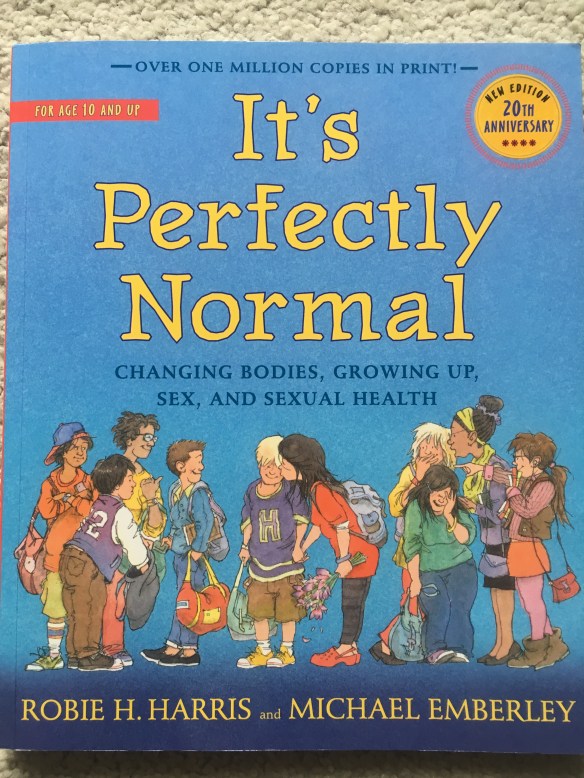
Of note:  My family and I recently discovered the book, It’s Perfectly Normal, by Robie H. Harris and Michael Emberley, and I (sing-song voice) loooove it!!  We own the 20th anniversary edition, updated to include information on sexuality for this digital, online, social media age.  This book appeals to me because it totally demystifies the body and sexuality, and does so with objectivity, openness, inclusion, and good humor.  We highly recommend it!


#AtoZChallenge: Of Trials and Tribes

IMG_2786

Since my last post, I’m thinking more about this Tend and Befriend response to stress–to Trials. When I first mentioned it in this post, I did not really understand it, though I thought I did.  I thought it was about empathy, responding to others’ stress.  Later I started calling it the ‘mama bear’ response, but this is not exactly right, either.   It is attributed to a maternal aspect of human nature, but the bear metaphor conveys too much of the ‘fight’ reflex.

As I reread this summary article, I modified my frame to the ‘mama anything’ response.  The author describes work by Michael Meaney at McGill university, that shows the ‘tend’ aspect:

“He and his colleagues remove rat pups from their nest for brief periods–a stressful situation for pups and mothers–and then return them to the nest and watch what happens. The mothers immediately move to nurture and soothe their pups by licking, grooming and nursing them. This kind of tending response stimulates the growth of the pups’ stress-regulatory system.”

Further in the article, the ‘befriend’ aspect is explained:

“Taylor and her colleagues detail evidence from rodent studies and studies in humans that when they are stressed, females prefer being with others, especially other females, while males don’t. Indeed, in humans, women are much more likely than men to seek out and use social support in all types of stressful situations, including over health-related concerns, relationship problems and work-related conflicts.”

YES! It reminds me of a post I wrote last November about Teams.  Now I’m thinking about prides of lionesses, herds of elephants, and Tribes of people.  Throughout my life, I have had Throngs (okay maybe not, but it’s a great T word!) of people to reach out to in times of need.  Off the top of my head, here are some tribes I belong to:

Mamas

Docs

Mama Docs

Mama Docs of Children With Anaphylactic Food Allergies

My Cheng Cousins

My Hwang Cousins

American Born Chinese (ABCs, the so-called second generation)

AHS Warriors

Patient care Teams (including medical assistants, nurses, receptionists, ultrasound technicians, nutritionists, exercise physiologists, and other physicians)

Northwestern University

The University of Chicago

Conscious Life Journeyers

The Counsel of Wisdom and Caring, convened on my 41st birthday


More from the article, research by Nancy Collins, PhD:

“…tend-and-befriend may be just as adaptive for men as for women in certain contexts, says Collins, whose research finds no gender differences when examining how often husbands and wives seek support from their most intimate companions–for example, each other.”

So really, as the article concludes, Fight or Flight(, Challenge,) and Tend & Befriend are just a spectrum of human stress responses.  Not mama bear, not just mamas, not even just parents, but all of us.  Tend and befriend simply describes and exemplifies the basic human need to belong—we all need our Tribes.

#AtoZChallenge: Stress Assessments in a 15 Minute Clinic Visit

IMG_4479.JPG

In my practice, I focus a lot on stress management. Over the years I have developed a series of questions that facilitate an efficient and productive assessment of stress and its impact on health.  I share this approach here.


Meaning to Stress Ratio

  1. On a scale of 0 to 10, 10 being very high, how high do you rate the overall stress of your work?
  2. What are the sources of stress?
  3. On the same scale, 0 to 10, how high do you rate the overall meaning of your work to you? I mean personally, subjectively, regardless of how you think the world perceives your work, how much fulfillment to you yourself get from your work?
  4. What are the sources of meaning?

Examples of stress sources would be volume, hours, intensity, risk, pressure to perform, and toxic relationships. Examples of meaning sources might include contribution to society, providing for the family, mentoring, supportive relationships, creativity, and intellectual stimulation.

I started asking these questions to patients about seven years ago. I remember the first time I thought to use the trusty 0 to 10 scale to assess stress.  It made the conversation instantly faster and more focused.  Most people answer the first two questions easily, especially if stress is high.  A fair few, however, find the second two much harder.  They often get pensive for a moment.  This is when I know I might be cracking open an important door in a person’s consciousness—a door that, I believe, leads to important discoveries of self and overall health.

Everybody wants high meaning, low stress. But before we idealize ‘low stress,’ let us remember that all stress is not bad, and some stress is required for motivation, challenge, and productivity.

I soon realized, both for my patients and myself, that both the absolute values of stress and meaning, as well as their ratio, play significant roles in health. Let’s take a look:

Low stress/low meaning : Boredom; disengagement.

High stress/low meaning: A different form of disengagement:  Burnout.

Low stress/high meaning: Restlessness: Lack of challenge, looking for something useful to do in service of a cause.

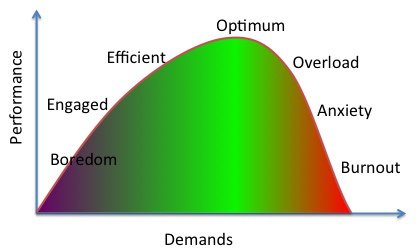
High stress/high meaning: This one is significant.  In my interviews, the people who are happiest in their jobs report this combination.  The key is that meaning must outrank stress—the meaning:stress ratio must be one or greater—and meaning itself must meet or exceed 6/10.  We can tolerate high levels of stress, even for prolonged periods, if we perceive intrinsic value in what we’re doing.  It moves the peak of the stress/performance curve to the right.  In other words, the stress has to be worth it.


The Three Awareness Questions

  1. When you are stressed or overwhelmed, where do you feel it in your body? For example, some people get headaches; others feel fatigued. Others get constipated or short of breath/palpitative. Still others notice mood swings and angry outbursts. While we all likely manifest each of these some of the time, most of us have a telltale sign or two that are specific to us.
  2. What are your existing resilience practices? What do you already do that keeps you from falling off the edge? What keeps you sane on a daily basis? We all have these practices, though it may take some contemplation to identify them. This awareness is important, though, so we may actively monitor. For so many people, exercise is a key stress reliever, and also the first thing cut out of the schedule when life gets busy.
  3. What are your de-escalation practices? When you feel yourself slipping off the cliff (the headache returns, your bowels grind to a halt), what do you do that brings you back from the edge? Examples here might be physical (running, boxing, or otherwise tantruming), verbal (journaling), or other.

When people make the connection between physical symptoms and subconscious stress, they can let go the fear and dread that often accompanies these chronic and often bothersome sensations. They can use them as smoke alarms—signals to take a step back, look around, and see what is out of balance, smoldering, or actually on fire.

Threat-Challenge-T&B Pie Graph

I previously referenced three major responses to stress here.  In summary:

  1. Threat stress: This is what we generally mean when we say ‘stress.’ It’s the fight, flight, or freeze response, when we sense a treat to survival, or we appraise that we lack the resources to cope with our circumstances. It’s mediated by cortisol.
  2. Challenge stress: We face a challenge that we feel at least somewhat qualified to tackle but it will be hard, test our limits. If we’re lucky, it’s something we care deeply about and we rise to the occasion—I’m thinking this could lead to a state of flow. This stress results in increases in DHEA and testosterone.
  3. Tend and befriend stress: This is the Mama Bear response. Under stress, we reach out and protect those around us.  We circle the wagons, bring in the kids, make sure everybody’s okay.  Oxytocin rises here.

If you were to draw a pie graph representing the proportions of these three stress responses in your work, home, or life in general, what would it look like? All three responses are natural, functional, and serve a purpose.  But when threat stress, in particular, becomes chronic and unrelenting, health suffers—we suffer.  Fortunately, there are strategies to convert threat stress to challenge stress.  Here are some resources for that, if you’re interested:

http://www.google.com/url?sa=t&rct=j&q=&esrc=s&source=web&cd=1&cad=rja&uact=8&ved=0ahUKEwjklePAq6jMAhUBZiYKHYjRAaMQFggcMAA&url=http%3A%2F%2Fwww.ascd.org%2Fpublications%2Feducational-leadership%2Ffeb14%2Fvol71%2Fnum05%2FConvert-Stress-to-Challenge.aspx&usg=AFQjCNEoBg56lNydHzXTJcXs-9WwoNxmRg&bvm=bv.119745492,d.cWw

https://www.google.com/url?sa=t&rct=j&q=&esrc=s&source=web&cd=4&cad=rja&uact=8&ved=0ahUKEwjklePAq6jMAhUBZiYKHYjRAaMQFggvMAM&url=https%3A%2F%2Fhbr.org%2F2011%2F06%2Fturning-stress-into-an-asset%3Fcm_sp%3DTopics-_-Links-_-Read%2520These%2520First&usg=AFQjCNGCm6kfdy2ElyCRFilRd__NQ3TX8w&bvm=bv.119745492,d.cWw

http://believeperform.com/performance/stress-appraisal-challenge-vs-threat/

This is now the framework with which I interview all patients about ‘stress’ and its impact on their health. It’s my favorite part of the patient encounter.  This is when I really get to know a person, and learn, from every encounter, how people experience life.  I’ve said it before and I’ll say it again: It’s a tremendous privilege to be allowed into people’s lives so intimately.  My job is to help people live their best lives.  In the hectic culture of the twenty-first century, we cannot underestimate the importance of stress management in that endeavor.