Time, Books, Bread, and Love

What is/are your love language/s?

According to Gary Chapman’s popular book The Five Love Languages, mine are, in order: quality time, words of affirmation, receiving gifts, physical touch, and acts of service. Since learning the framework, I have observed for Husband’s and Kids’ languages, and become more fluent in a few of their respective dialects. Some are easier to pick up than others! It’s humbling to think how friends and family may feel rejected by me when I respond sideways to their bids for love, because I don’t understand their intent. “Rats!” as friend Eileen would say. I can do better!

On the other hand, how wonderful when I can converse in love speech with someone in appreciation and joy? Words are definitely my currency–quality time for me means being together talking, and not just about pop culture and current events. I consider any thoughtful or personal verbal expression a gift, and especially anything via snail mail. I get positively giddy when I open the mailbox and see colored envelopes, interesting stamps, and omg stickers–it all just makes my heart sing.

Friend and fellow writer Nicole recently recommended the book Write For Your Life by Anna Quindlen. It’s a fast, easy, and heartwarming read by the veteran journalist and novelist. It validates my insatiable need to write–for myself and for sharing–and inspires me to do it with ever more abandon and joy. Quindlen reflects on the timeless relevance of Anne Frank’s diary, and our collective delight in finding old letters between lovers from the past. She wishes her parents left more words on paper, in their own hand, now that she can no longer connect with them in a tangible, tactile way. Even if you’ve never thought writing could stimulate, soothe, inspire, or connect you, this short work may convince you otherwise. Spending quality time with yourself and your thoughts, processing through pen on paper, may yield ideas, insights, and epiphanies that come no other way; and those who read them subsequently may benefit and connect to you in ways you cannot yet not imagine. So inspired was I after reading, that I bought multiple copies of WFYL and gifted them to friends. With each volume I selected a specific journal to go along. Pleather- and cloth-bound, blank, lined books invite original composition with artfully embossed covers: windblown trees; “Be the Change”; “ZEN AS F*CK”.

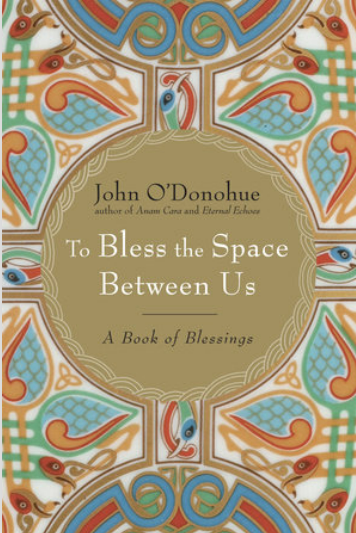
For my friend who took on a big new hairy leadership role, I included 6 additional works: The Art of Possibility, Benjamin and Rozamund Stone Zander; Switch, Chip and Dan Heath; Big Magic, Elizabeth Gilbert; Rising Strong, Brene Brown; Drive, Daniel Pink; and The Infinite Game, Simon Sinek. To the one who stands together with his wife at their respective professional crossroads, I accompanied Quindlen with John O’Donohue’s wisdom in To Bless the Space Between Us. His poems soothe, uplift, warm, and reassure, promoting reflection and also whispering, coaxing our own wisdom to emerge from within. Sharing others’ words, wiser and more eloquent than my own, is another way I love my friends.

When I can get the timing right, of course I also include some sourdough in the gift bag. Sven continues to thrive, leavening my loaves reliably for a over a year now. His heirloom flour descendant, whose products my gluten-intolerant friends can eat without consequence, has finally also developed that fruity aroma that I recognize as my starter. There is something special about giving and receiving gifts we make (or write) by hand, with our time, talent, and treasure. It’s just another level of love, expressed concretely and tangibly.

Nobody questions the value of sharing and expressing love between friends and family.

But what about between colleagues? Leaders and those they lead? Systems and their contingent members? What does it take to learn and attempt to speak anybody’s ‘love’ language? When we do personality tests at the office and find out who’s an introvert or extravert, who thinks versus feels their way to a decision, can we as leaders and coworkers make the effort to communicate–to relate–on another’s terms in addition to our own? I fail at this day after day; rats! I can do better!

In the end it’s about how we each feel seen, heard, understood, accepted and loved–why limit this essential and life-sustaining human reciprocity to ‘loved ones’? Better yet, why not include all with whom we are in any relationship among those we consider ‘loved‘? It may require quite a brave and committed redefinition of and reorientation to ‘love’, no? But how might this inspired shift in perspective, even by only a fraction of one degree, profoundly alter the course of business, healthcare, education, government–everything?
The Prosperous Heartbeat Bank

Okay friends, this is a fun post with some lighthearted existential philosophy. It also talks about sex, so consider yourself warned.

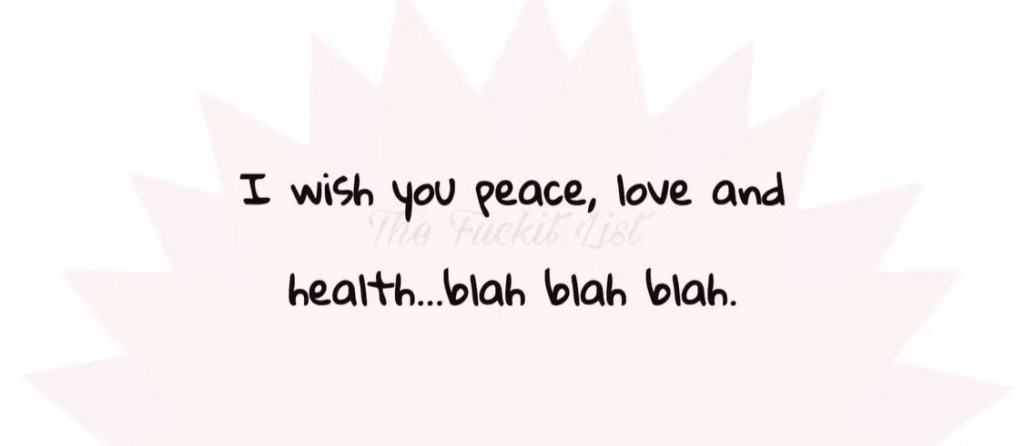
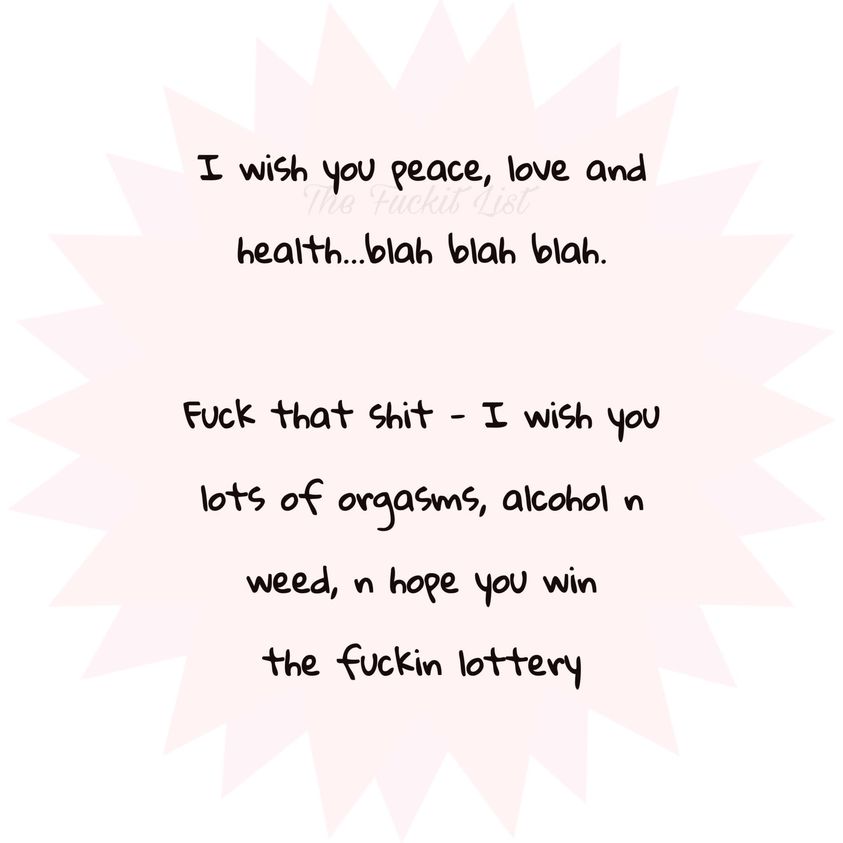
I really do wish everybody peace, love, and health (usually joy, also). People who receive emails, texts, and snail mail from me will all tell you. I also love a cheeky, irreverent expression sometimes, and this one showed up before the New Year:

From The Fuckit List page on Facebook

I shared it immediately with all my friends who would appreciate it, including a brilliant and pragmatic cardiologist. I added ‘etOH [ethanol] and weed in moderation, and the rest–yeah!’

The ensuing email thread between us:

Friend: 😂😆 no orgasms in moderation?!?!

Me: Some things you just cannot get too much of.  No risk.  😉😆

Friend: i’ve never heard a physician say “no risk” – only “low” “moderate” “high” risk. so i’m happy to go with no risk!!!!

Me: Teeheehee / It just occurred to me—YOU are the cardiologist!! IS there a risk?? 😱 / I cannot lead people astray here… / I suppose MI [myocardial infarction–heart attack] during sex does occur, right? / So shit, there is a risk! 😣

Friend: i suppose as a cardiologist, it’s always a risk-benefit ratio. risk is very very low. benefit is likely there every time. plus there’s the added cardiac benefit of ischemic pre-conditioning [training the heart with exercise] in those with significant CAD [coronary artery disesae] wherein you can develop angiogenesis [growth of new blood vessels] and collateral formation [bypass blood flow around blocked arteries] in the context of regular sexual/exercise activity. so it’s a big yes to orgasms!!!!

Me: Omg YYYAAAAAAAYYYYY!!! 💃🏻🎉🥳❤️ / And ENDORPHINS, yes? 😄

Friend: ah, yes, sympathetics. you know there is a hypothesis (totally unproven) that you are born with a certain # of heartbeats and once you use them, your life is over. if that is the case, endorphins, sympathetics and (eek) orgasms are probably no good for us. but again, that hypothesis is totally unproven and the more “exercise” you do, the slower the resting heart rate and the longer (observationally) the life. so probably, all in all, better to stick with the orgasms than to avoid them!!!

Me: Ooooo, fascinating!!  I bet there is some vague, partial and flexible truth to that theory?  Like yes, any given heart has a finite number of future beats left at any given time.  

AND, there are likely many things we can do throughout our lives that give it more or fewer remaining beats—like a bank account that we deposit to and withdraw from… 😜 OH I just LOVE this idea!!

Deposits:

Diet: fiber, healthy fats, lean protein, moderate naturally occurring sugars (Food Rules by Michael Pollan: Eat food, not too much, mostly plants)

Movement: full body, cardio/strength/mobility

SLEEEEEEP OMG 

Stress: wise mind, radical acceptance, inner peace; and FUN!!

Relationships (I would bet anything this is proportionally the DENSEST, highest value heartbeat reserve elevator): love, meaning, connection… 

Of course withdrawls are the opposites of these… I wonder whether bad sleep or toxic relationships are the greatest heartbeat extinguishers?  My money’s on relationships—maybe not even toxic ones—rather the lack of them altogether.  It makes total and complete sense to me that loneliness is a better predictor of mortality than smoking (I think it’s actually phrased that it’s a bigger mortality risk than smoking but I bet it’s a better predictor, too—if you look at the data a certain way?)…

OMG this totally aligns with my framework of the 5 reciprocal domains of health!! 😄 ❤️ ❤️

Ok so my mom told me that her dad told her that we are each born with a finite amount of prosperity in life.  So the idea is to be frugal with spending, consumption, partying etc in your youth, so you have enough to spread out over a longer lifetime.  I do like that idea.  It feels akin to humility and generosity to me…  So I wonder if there can be a pooling effect among one’s tribe—that we all spend/consume/share over a lifetime and extend/improve all of our lives?? 

OH thank you for telling me about this, I will think more (and possibly write) on it!! 😄 xo …And maybe my gong-gong’s theory is also flexible like a bank account, too. 

I think we get to invent it, since it’s all made up to help us feel better about how we choose to live life anyway! 😄

THANK YOU for stimulating such fun thinking tonight! 😄

Ok more soon, big hugs!!! xo

//

All of these thoughts and ideas poured out between us from 4:44 to 7:22pm on 12/28/2022. I’m not sure more writing is required at this point? I thought about doing the math–for each episode of exercise, how many more beats, and does it even out with a resulting lower resting heart rate over a lifetime…? Nah. It was a fun and thought-provoking conversation between two friends which, for me at least, tightened connection and elevated joy. I am definitely heart-healthier for it.

Hope 2023 is off to a peaceful, loving, and healthy start for you all, my friends, if not a moderately buzzed and high, frequently orgasmic, and suddenly wealthy one. 😉

Tribe and Fire

Another day of threaded media to reinforce my personal biases. Thought I’d share since it feels so cosmic. 😉

Often I find myself with an acute urge to connect with one or a few of my friends. I have long since learned to act joyfully on these urges; in college I wrote letters on pretty stationery and mailed them with confetti (100 in my first year alone). As life got busier that evolved to cards and postcards. And now it’s often an email or text, these days with attached memes or songs, and most recently the 8 minute phone call… I still indulge in the luxury of snail mail often, though.

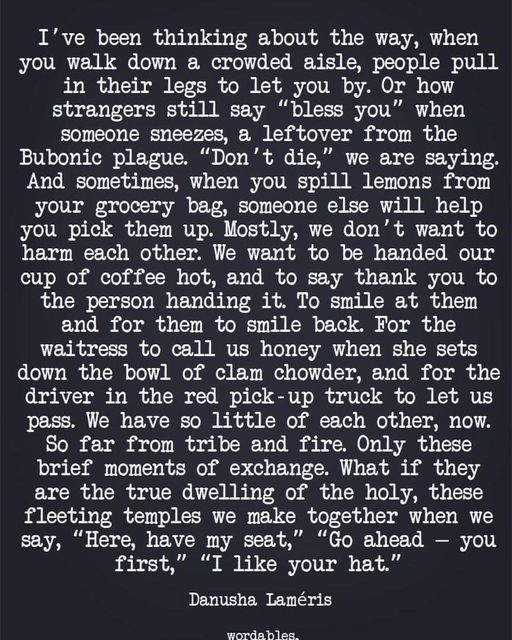
Today I looked for something touching to share. Scrolling through photos, cartoons, and memes on the phone and laptop, nothing felt quite right. Then this appeared on my Facebook feed:

So unassuming yet poignant, down to earth and still profound. Perfect. I sent via email and also saved the image for myself, before sharing on my own FB page. The more I read it the more it resonated. “Mostly, we don’t want to harm each other… We want…For the waitress to call us honey… We have so little of each other, now…” So I shared with a few more friends–ones who I know practice making the “fleeting temples” (whom I admire and wish to emulate) and ones for whom I wish to meet and feel deeply the “true dwelling of the holy.”

One of my friends then shared the image on her own page, and one of her friends commented on the significance of “So far from tribe and fire,” before referencing a recent gathering of exactly ‘tribe and fire.’ YES. Tribe members take turns tending the fire that keeps us warm, leads us home, holds us together, connects us. So I had this lovely and loving idea swirling around my consciousness all day.

Sarai left her eloquent comment on my last post, reinforcing that anchoring–tribe-and-firing–is a reciprocal activity, between ourselves and those we know, both intimately and apparently not at all, though in reality I am convinced that we all know one another on a cosmic level. “I like your hat.” I must call her soon and relight our shared fire. It’s been a long time, and I’m confident that the embers still glow.

Then I came across Daniel Pink’s post on the book The Good Life, which is now on my 2023 wish list. “Friends are medicine.”

Again, YES! I feel validated asking every patient, every year, about the strength and depth of their emotional support network. It’s not my job to help them cultivate it, the way I advise on ways to lower blood pressure and cholesterol. But I point it out so it’s on our radar, to reinforce the paramount importance of this aspect of whole person health.

A fellow physician mom posted on the FB book club group page about Chasing the Scream by Johann Hari. The Amazon page references his viral TED talk years ago on how wrong we are about addiction, which rang a bell, so I watched it again. It’s only 14:33, well worth your time and attention. We think substances themselves are the problem. Turns out, it’s context. Loneliness and disconnection are far stronger drivers of addiction–to substances and other things–than the things themselves. Hear about ‘rat park’ at 3:30 where rats with toys and friends do not prefer drug-laced water when given a choice, compared to their stimulus- and companion-deprived research counterparts. Continue watching to learn about the unintended human drug addiction study that was the Vietnam War, where only 5% of the soldiers who used heroine in company relapsed upon returning home. His lovely conclusion: “For 100 years now, we’ve been singing war songs about addicts. I think all along we should have been singing love songs to them, because the opposite of addiction is not sobriety. The opposite of addiction is connection.

Recently I started asking patients to categorize their alcohol use patterns among three overlapping motivations: social, self-medication, and habit. That middle one is a flag, though it’s often camouflaged by the other two. Identifying, accepting, and addressing our demons may be one of the scariest things we do in life. No wonder we avoid it so desperately–even more so when we feel we must do it alone.

Our relationships kill us or save us, I often say. More and more I think it’s not actually the toxic relationships that kill us, not if we have other strong, loving, thick relationships, communities, connections, and meaning to hold us up. No, it’s the lack of relationships, that absence of connection, that kills us. It doesn’t have to be many friends or connections, it just has to be enough–close enough, deep enough, tight enough.

Who’s on your mind today? Why not reach out and let them know?