Because This Is Who We Are

DSC_0508

Followers of this blog may know of my interest in and passion for physician health and well-being.  I was immersed in this world the last couple of months, with two amazing conferences and multiple conversations with fellow physicians at work.  As often happens, I was moved to articulate a vision/mission statement of sorts, mostly to solidify my own intentions and also to share with like-minded colleagues.

I love that I enter this arena from the world of executive health.  Corporate leaders, physician leaders, and physicians on the ground share so many attributes that everything I learn from patients translates seamlessly to my own professional development.  This is exactly the right space for me to inhabit today, and I am forever grateful for the integrative experience.  Physicians are care team leaders by default, and we miss opportunities to improve all of medicine when we forget or ignore this fact.  I’m interested to know your response to the words below—the more visceral the better (but please, if possible, refrain from spitting, vomiting, or defecating your own words here):

Why do we advocate for physician health and well-being? 

Because we believe we can only lead well when we are well ourselves.

Because leading can be lonely and leaders need support.

Because leaders need metrics of our own performance, both related to and independent of the performance of those whom we lead.

Because health and leadership intersect inevitably and who we are is how we lead; the more awareness and active, intentional self-management we practice, the more effective leaders we will be.

Because people follow our example, like it or not, so we owe it to ourselves and those we lead to model Whole Physician Health.

What Is Whole Physician Health?

Whole Physician Health is an approach to health and well-being which defines physician as both clinician and leader, both healer and vulnerable.  This approach focuses on the 5 Realms of Health: Nutrition, Exercise, Sleep, Stress, and Relationships.  We explore how these realms intersect and overlap, affecting the individual physician, those whom the physician cares for and leads, and the entire medical profession.  We apply principles from health and sports psychology, communication, leadership, mind-body medicine, and myriad other disciplines.  We value openness, curiosity, critical analysis, and collaboration.  Our mission is to create a resilient medical culture in which all members—physicians, patients, all caregivers and support personnel—thrive and flourish.

DSC_0555

The Whole Physician Health Advocate:

*Values self-awareness and self-exploration.

*Understands and accepts his/her position as role model and culture setter for the team.

*Wishes to broaden the skillset in cultivating positive relationships

  • With self
  • Between self and immediate colleagues
  • Between colleagues themselves
  • Between physicians and staff
  • Between teachers and learners
  • With extended family of colleagues and institutional entities
  • Between institution and the patients it serves

*Sees the physician health and well-being movement as an opportunity to learn, see from a different point of view, connect to fellow physicians, and form new tribal bonds that will hold us all up.

*Wants to contribute to the creation of a global professional vision and mission of the 4 WINS:

WIN 1–You

WIN 2–Those you lead

WIN 3–Your whole organization

WIN 4–All those whom your organization touches

Of note, one need not be a physician to advocate for Whole Physician Health.

Hopey, Changey Hero Making

IVY Litt 11-8-17

NaBloPoMo 2017: Field Notes from a Life in Medicine, Day 8

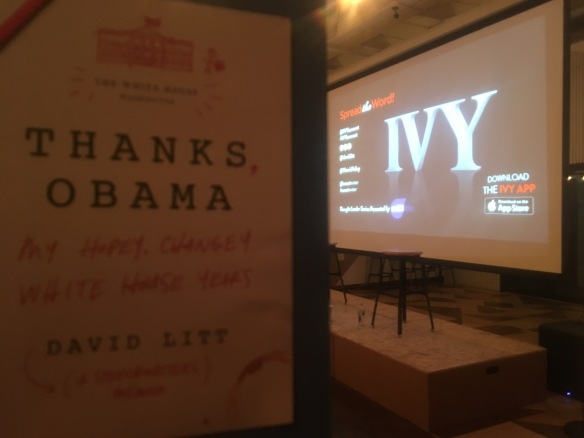
Funny how I just wrote last night about connecting new dots to old dots.  It just happened again tonight!  A couple of weeks ago I responded to an online ad for an IVY Ideas Night with David Litt, author of Thanks Obama: My Hopey, Changey White House Years, entitled, “How to Inspire, Persuade, and Entertain.”  Litt was a senior speechwriter for President Obama, so I thought I could learn new tips for presentations, and feel a little closer to the president whom I miss so much.

I’ve done public speaking since eighth grade, when our speech teacher first taught us abdominal breathing and I discovered the thrill of holding the attention of a room full of people with only my words.  I work at an academic medical center and I hold zero publications, but my CV documents over 10 years of professional presentations to various audiences.  I thought I was pretty good at this speaking thing.

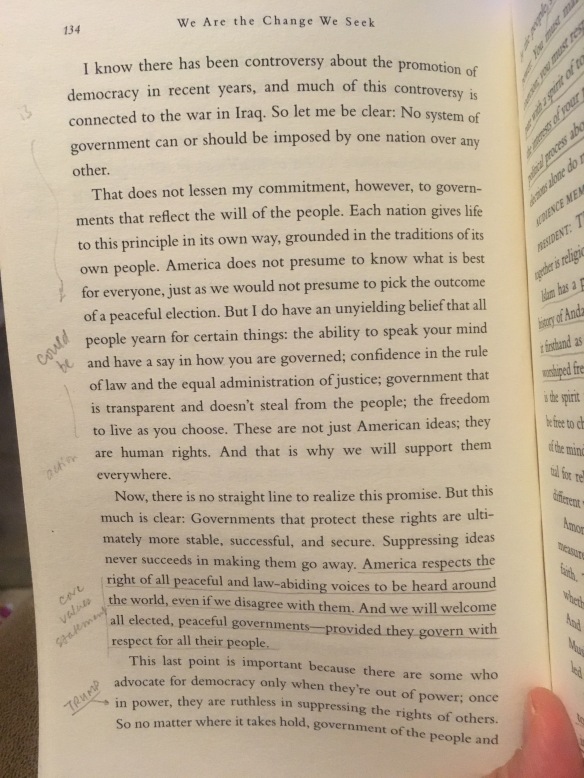
Three years ago I came across this TED talk by Nancy Duarte, whose ‘secret structure’ of great presentations I have used since I subsequently read her book, Resonate.  Essentially, she recommends that we invite audiences on adventure stories, create active tension between what is and what could be, and most importantly, make the audience the hero.  I have done this better and worse since then, but I always recognize the framework when I see it.  Those familiar with this blog know that I am also a fan of Simon Sinek, whose central message is that we perform at our best when we are crystal clear about our Why.  “People don’t buy what you do, they buy Why you do it,” he says.  Barack Obama employs both authors’ principles with eloquence and finesse, which I noticed reading We Are The Change We Seek, a collection of his speeches as president.  The best speeches delivered in this construction create audiences who are inspired, motivated, and empowered to hail a meaningful call to action.

Obama is could be core values

That’s basically what David Litt conveyed tonight.  When asked what advice he was given that served him best, he said, “Imagine someone in your audience will tell their friend tomorrow about your talk.  What is the one thing you want them to say about it?”  What is the Why of your talk?  Even though he no longer writes speeches for the most powerful person in the world, he expressed a desire to continue inspiring, empowering, and promoting personal agency in all whom his work touches. Make each and every audience member their own hero.

It turns out, however, that this approach applies to much more than public speaking.  On my 50 hour, 500 mile, aspen-pursuing weekend in Colorado last month, I described to my dear friend my favorite moments at work.  At the end of a patient’s day-long physical, after I have spent 90 minutes listening to their stories of weight gain and loss, work transitions and complex family dynamics, and reviewing their biometrics and blood test results, I meet with them for an additional 30 minutes to debrief.  This is when I present an integrated action plan compiled by the nutritionist, exercise physiologist, and myself.  It is a bulleted summary of our conversations throughout the day, centered on the patient’s core values and self-determined short and long term health goals, and crafted with their full participation.  I get to reflect back to my patients all that I see them doing well, and shine light on areas for potential improvement.  It’s an opportunity to explore the possible—to Aim High, Aim Higher, as the United States Air Force exhorts.  I often present the plan with phrases like, “Strong work!” “You’ got this,” and “Can’t wait to see what the coming year brings!”  My friend turned to me as we wound through autumn gold in the Rocky Mountains, a bit tearfully, and said, “You make them the hero of their own story.”  Yeah, I do, I thought, and I got a little teary, too.

Words are powerful.  They are our primary tool for relating to each other, for making another person feel seen, heard, understood, accepted, and loved.  You don’t have to be a public speaker or a presidential speechwriter to make a positive difference with your words.  At work, in your family, with your friends, with people on the street and in the elevator—what is the one thing you want someone to remember from their encounter with you?

Whole Physician Health: Standing at the Precipice

IMG_2340

I published the post below two years ago, and all of it applies even more so today. This week I presented to my department chairs and hospital administration leaders on the importance of addressing physician burnout and well-being. There is a growing sense of urgency around this, some even starting to call it a crisis.

Still, I feel hopeful. Darkest before the dawn, right? Reveal it to heal it, my wise friend says. Physician burnout research has exposed and dissected the problem for 20 years, and now we shift our attention toward solutions.

I will attend the American Conference on Physician Health and the CENTILE Conference next month. I cannot wait to commune with my tribe again, explore and learn, and return to my home institution with tools to build our own program of Whole Physician Health. While we focus on physician health in its own right, we must always remember that it can never be achieved without strong, tight, and fierce connections with all of our fellow caregivers. When we attain this, all of us, especially our patients, are elevated and healed.

Onward, my friends. More to come soon.

*** *** ***

Ever since my presentation to the American College of Surgeons earlier this month on personal resilience in a medical career, I cannot shake the feeling that we need to do more of this work. Physicians from different fields need to talk more to one another, share experiences, and reconnect. We also need to include other members of the care team as equals, and let go the hierarchical thinking that has far outlived its usefulness.

I do not suggest that physicians, nurses, therapists, pharmacists and others should play interchangeable roles in the care of patients. Rather, similar to the central tenet of gender equality, the unique contributions of each team member need to be respected equally for their own merits and importance. As a primary care internist, I must admit that I have seen my professional world through a rather narrow lens until now. I confess that I live at Stage 3, according to David Logan and colleagues’ definition of Tribal Leadership and culture. The mantra for this stage of tribal culture, according to Logan et al, is “I’m great, and you’re not.” Or in my words, “I’m great; you suck.”

“I’m a primary care doctor and I am awesome. I am the true caregiver. I sit with my patients through their hardest life trials, and I know them better than anyone. I am on the front line, I deal with everything! And yet, nobody values me because ‘all’ I do is sit around and think. My work generates only enough money to keep the lights on (what is up with that, anyway?); it’s the surgeons and interventionalists who bring in the big bucks — they are the darlings of the hospital, even though they don’t really know my patients as people…” It’s a bizarre mixture of pride and whining, and any person or group can manifest it.

Earlier this fall, Joy Behar of TV’s “The View” made an offhand comment about Miss Colorado, Kelley Johnson, a nurse, wearing ‘a doctor’s stethoscope,’ during her monologue at the Miss America pageant. We all watched as the media shredded the show and its hosts for apparently degrading nurses. What distressed me most was the nurses vs. doctors war that ensued on social media. Nurses started posting how they, not doctors, are who really care for patients and save lives. Doctors, mostly privately, fumed at the grandiosity and perceived arrogance of these posts. It all boiled down to, “We’re great, they suck. We’re more important, look at us, not them.” The whole situation only served to further fracture an already cracked relationship between doctors and nurses, all because of a few mindless words.

It’s worth considering for a moment, though. Why would nurses get so instantly and violently offended by what was obviously an unscripted, ignorant comment by a daytime talk show host? It cannot be the first time one of them has said something thoughtlessly. What makes any of us react in rage to someone’s unintentional words? It’s usually when the words chafe a raw emotional nerve. “A doctor’s stethoscope.” The implicit accusation here is that nurses are not worthy of using doctors’ instruments. And it triggered such ferocious wrath because so many nurses feel that they are treated this way, that they are seen as inferior, subordinate, unworthy. Internists feel it as compared to surgeons. None would likely ever admit to feeling this way, consciously, at least. But if we are honest with ourselves, we know that we all have that secret gremlin deep inside, who continually questions, no matter how outwardly successful or inwardly confident we may be, whether we are truly worthy to be here. And when someone speaks directly to it, like Joy Behar did, watch out, because that little gremlin will rage, Incredible Hulk-style.

I see so many similarities to the gender debate here. As women, in our conscious minds, we know our worth and our contribution. We know we have an equal right to our roles in civilization. And, at this point in our collective human history, we feel the need to defend those roles, to fight for their visibility and validity. More and more people now recognize that women need men to speak up for gender equality, that it’s not ‘just a women’s issue,’ but rather a human issue, and that all of us will live better, more wholly, when all of us are treated with equal respect and opportunity. The UN’s He for She initiative embodies this ideal.

It’s no different in medicine. At this point in our collective professional history, physician-nurse and other hierarchies still define many of our relationships and operational structures. It’s not all bad, and we have made great progress toward interdisciplinary team care. But the stethoscope firestorm shows that we still have a long way to go. At the CENTILE conference I attended last week, I hate to admit that I was a little surprised and incredulous to see inspiring and groundbreaking research presented by nurses. I have always thought of myself as having the utmost respect for nurses — my mom, my hero, is a nurse. The ICU and inpatient nurses saved me time and again during my intern year, when I had no idea what I was doing. And I depended on them to watch over my patients when I became an attending. But I still harbored an insidious bias that nurses are not scholarly, that they do not (or cannot?) participate in the ‘higher’ academic pursuits of medicine. I stand profoundly humbled, and I am grateful. From now on I will advocate for nurses to participate in academic medicine’s highest activities, seek their contributions in the literature, and voice my support out loud for their important roles in our healthcare system.

We need more conferences like this, more forums in which to share openly all of our strengths and accomplishments. We need to Dream Big Together, to stop comparing and competing, and get in the mud together, to cultivate this vast garden of health and well-being for all. I’ll bring my shovel, you bring your hose, someone else has seeds, another, the soil, and still others, the fertilizer and everything else we will need for the garden to flourish. We all matter, and we all have a unique role to play. Nobody is more important than anyone else, and nobody can do it alone.

We need to take turns leading and following. That is how a cooperative tribe works best. It’s exhausting work, challenging social norms and moving a culture upward. And we simply have to; it’s the right thing to do.