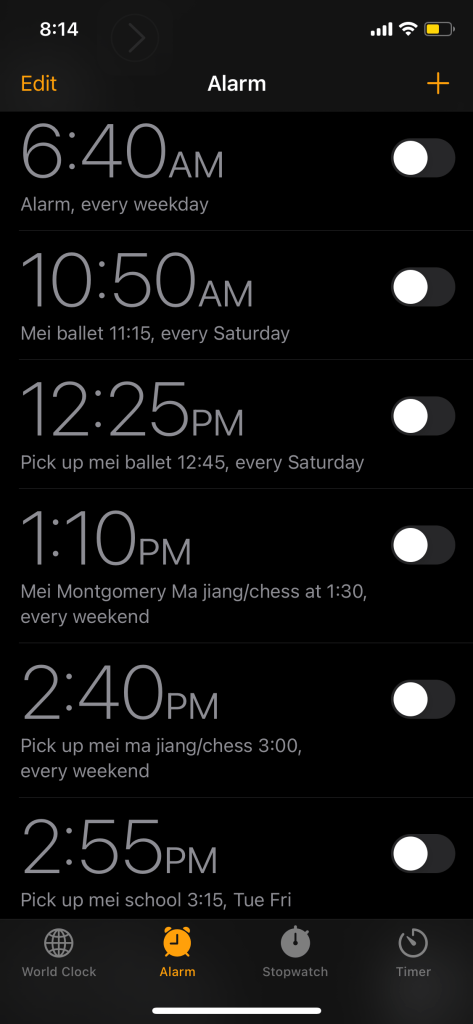
These are the alarms I get to silence as we go on spring break.
There will be much movement and stress while traveling in the coming week. I must call forth every skill for self-awareness, self-regulation, and effective communication I have ever learned. Oh and some self-compassion and good humor will also help.
But at least I can put down the phone for longer intervals, and enjoy some quality time with the family.
I’ve downloaded some new romance audiobooks and packed lots of pretty paper and colored pens. I will sleep in every day if possible. I’m ready!!
Wishing you all a beautiful, peaceful, and connecting start of spring. See you on the other side of jet lag!
Where were you on February 25, 2020? What was happening around you? What were you doing, planning, looking forward to, worried about?
What day did COVID change your life?
On New Year’s Eve, 2019, my niece declared that everybody was overreacting to the infection sweeping across Wuhan, China. It won’t be a big deal, she said. I specialize neither in infectious disease nor public health, but I knew then that what was coming would be a big. fucking. deal.
This morning, stepping out into the bright sun and crisp air at the end of another unusually mild Chicago winter, Daughter and I recalled 3 years ago. We had just spent a long weekend in Seattle, just for fun. Son had said then that he could see himself living there ‘after school,’ and lo, he ended up there for school. Little did we know then that COVID had already landed, right there, where we were.
Within weeks, whole organizations and governments mobilized and immobilized; life mutated irrevocably around us everywhere. COVID hit me in the face by cracking one of my friendships early on. The week of March 9, I begged off of a gathering, and my friend was angry. I respected and admired her, and loved her family–still do. She subsequently railed at the prospect of lockdown and social distancing, citing economic fallout, apparently dismissing my alarm at the risk to our healthcare system, and my own colleagues, if we deferred such drastic measures. It took me by surprise, floored me, and I was hurt. I wanted to talk more about it, talk through it. But these three years, every time we approach our differences here, she respectfully declines to continue. I respectfully agree. We hit a boundary in our friendship then, which I accept. I can engage with difference elsewhere; there is no shortage of opportunities. Over this time I believe I have both sharpened and softened my communication skills around disagreement and dissent, and I’m still grateful for every chance to practice, learn, and improve.
Facebook showed me what I posted three years ago today. I don’t know which leader moved me to profess my appreciation on social media, but I bet it was one of two, so I emailed them both today with the screen snip of the post. “…recalling 3 years ago, watching and waiting for the pandemic wave to hit us, standing in a state of novel awe and uncertainty. I also remember feeling confident, though; I understood the medical and public implications and trusted my immediate professional and personal circles to think and act rationally and thoughtfully… Our organization has its challenges, both intrinsic and extrinsic. Each day, though, I’m still convinced and proud that everybody’s doing their best for the greater good. So Happy Saturday, and thank you for you leadership. 🙂” Having led a small practice through the first 14 months of the COVID morass, I suspect any sincere expression of acknowledgement and appreciation, at anytime, even now, boosts any leader’s spirits. We are all still going through it, and we still need to hold one another up.
This is the 42nd post that appears on a “COVID” search of this blog. I process by writing. Reading back, I apparently felt more fear and anxiety at the outset than I may remember. Memory is complex! Today I recall vividly the acutely discordant and uncomfortable conversations with my friend, while minimizing the overall stress of the time and circumstances? How fascinating. We would all do well to ‘remember’ this paradox of recollection as we continue to navigate, negotiate, and collaborate hereafter.
“We write to taste life twice, in the moment and in retrospect.” Anna Quindlen includes this quote by Anais Nin in her book, Write For Your Life. Have you anything to review from three years ago–emails, letters, photos with captions, blog posts? What does any of it show you about your feelings, thoughts, actions, and relationships back then? How has your life evolved and transformed in the short and profound time since? How have your relationships moved? I’m gratified to take some time today to recall and reflect, and to have concrete evidence of myself to do it with.
Surf & turf and a side of asparagus, lobster bisque, smashed potatoes, and an unlimited bread basket, with cocktails and wine, and tiramisu if there’s room.
Most people don’t eat like this all the time, but how many restaurants are filled every night with rooms full people eating exactly this? Many of my patients may eat like this (or something very similar) multiple times a week.
If you want to drastically increase your risks for gout, acid reflux, severe sleep disruption, brain fog, stress intolerance, high cholesterol, high blood pressure, weight gain, and diabetes, there could hardly be a better recipe than the typical business dinner. Here’s the physiology: 1. Red meat, shellfish, alcohol and asparagus are high purine foods that elevate uric acid levels in the blood, increasing the risk of gout, a painful inflammation of joints, especially the first joint of the big toe. 2. High volume, high fat, and alcohol: All of these delay gastric (stomach) emptying, and may loosen the lower esophageal sphincter, making it easier for stomach acid to escape upward, causing heartburn, chest pain, even shortness of breath. 3. Late and prolonged eating: with an already sluggish stomach, finishing a meal within two hours of going to bed makes it even more likely that the stomach will still be relatively full when lying down, sloshing acidic stomach contents right up against that loosened sphincter in the horizontal position, causing painful night time waking, disrupting sleep and negatively affecting mood. 4. Alcohol itself causes neurologic changes that interfere with sleep, even though it may feel initially sedating. It also increases nocturia (getting up at night to pee), can worsen sleep apnea, and is a mood depressant in itself. Taken together, the compounding consequences of the business dinner make it a formidable enemy of health for many executives.
Now add frequent and often international travel with chaotic jetlag, the stress of high pressure, high stakes business transactions, responsibility for whole workforces of people, and disconnection from family, plus emails, voicemails, text messages, and all manner of 24/7 media demanding attention, energy, and time, all finite and precious human resources. It’s a wonder I don’t witness more heart and panic attacks than I do.
Despite these risks and challenges, though, many of my patients actually do and feel fine. They report high meaning in their work, enjoyment from connecting with colleagues (though nobody tells me they love those dinners). They find time to exercise on the road and at home, manage healthy eating, and get good enough sleep in other ways.
Or so we all thought, until the pandemic hit.
My practice closed along with the rest of the country for about 2.5 months in spring of 2020, and the rest of the year and beyond, most of my patients worked from home. Not surprisingly, and also a little shockingly, many of them showed marked improvements in standard objective biometrics when they came for their annual exams that year. BMI, body fat, blood pressure, and cholesterol fell, often precipitously. All of a sudden healthy behaviors that required heroic effort became almost as easy as rolling out of bed. With their long daily commutes eliminated, people could now make–had–time to exercise…and they wanted to because they weren’t mentally exhausted all the time. They could pace about their home office while on Zoom, maintaining energy and engagement. No more international travel, no more business dinners. Their environment and circumstances suddenly and significantly eliminated all kinds of friction on the path to healthy habits. And more importantly, they felt so much better, because they were sleeping more and better, rushing less, and spending more quality time with people they loved. It’s not rocket science–they had their lives back. [Note: I understand that I’m writing about an extremely privileged population. Please know that this awareness is not lost on either my patients or me, and we talk about it candidly.]
Today, frequency and distance of business travel approaches prepandemic levels. Typical work practices are resuming, with some consideration as to their net benefit, but maybe not a lot of action to experiment with or create new, more optimal models of workflow and interaction. In my office, I see patients’ stress levels rising again, weight coming back on, and an overall sense of bewilderment and resignation at it all.
As I write this, I feel a dense tangle of frustration, exasperation, empathy, impatience, protectiveness, and an urge to throw or slam something. Really I feel kind of rageful, actually. Existing disparites of access to resources, autonomy, security, and overall health and well-being widened and intensified dramatically through the pandemic. It makes me ashamed of humanity. How is it that my patients and I–people with agency, autonomy, knowledge, and power–can feel, and actually be, so powerless to change the systems that make us all, privileged and not, so f*ing unhealthy??
I have no concrete or actionable suggestions for how to make things better.
Sometimes I fantasize about going to these business dinners with my patients, like a chaperone. But rather than policing their choices, the point would be to make it safe for everybody to admit that they don’t necessarily want to be there, doing this conventional thing that social norms dictate. Based on years of conversations in the privacy and intimacy of the physician-patient interview, I feel peer pressure operating at the same intensity, and with just as high social consequences, as when we were all adolescents. It’s fascinating and depressing, like a black cloud that everybody feels, nobody acknowledges, and everybody suffers from in collective isolation.
What would it take for these deeply rooted cultural norms, ones that harm us all, to shift even a little? It’s a question I ask myself every day, in multiple domains. I get agitated and hyperventilate at the glacial pace of change. And then, usually, I can take a deep breath. I call on wiser voices than mine to get through.
I know there are people out there bucking the norm, challenging the status quo. I look for that spark in my patients, and I try to fan it, ignite it further. That’s the little good I can do, I guess. Maybe our little fires will one day light the way to bigger change.




 Healing Through Connection