Onward from 2019: Learnings and Intentions

IMG_3635

Friends!  WHAT a year, no?  How are you feeling here at the end?

In this post:  3 key learnings, 3 high intentions, and my 6 recommended life readings.

What resonates with you?

What would you add?

For a thoughtful and inspiring look on the coming year, check out Donna Cameron’s post from yesterday.

IMG_3222

3 Key Learnings of 2019

Complexity

“When we try to pick out anything by itself, we find it hitched to everything else in the Universe.”  –John Muir

“All that you touch, you change.  All that you change, changes you.” –Octavia Butler

We all live in inextricable connection, like it or not, know it or not, want it or not.  Every interaction has potential for benefit and harm, and the scale is exponential.  Some may find this idea daunting, overwhelming, or untenable.  I find it reassuring.  The idea that some cosmic life thread connects us all, that we are made of the same stuff today as that which existed at the dawn of the universe—this gives me peace.  It encourages me that everything I do in good faith could make a difference.  You really never know how far a small gesture or sharing will reach for good.

The 3 Tenets of Relationship-Centered Leadership

Not so much learnings as a synthesis from LOH training, these are the current foundation statements of my personal and aspirational leadership tenets (iterations likely to evolve over time):

  1. Founded on curiosity, connection, and fidelity to a people-centered mission
  2. Attendant to the relational impacts of all decisions, local and global
  3. Respectful of norms and also agile and adaptive to the changing needs of the system

Having defined these ideals for myself, I am now fully accountable to them.  And I hold them as a standard for those who lead me.

Being >> Saying or Doing

Saying and doing compassionate, empathic, and kind things are necessary and noble.  And they are not enough.  These actions ring hollow without honest sincerity behind them.  People feel us before they hear our words.  Our authentic presence, positive or negative, originates from within.  It manifests in posture, facial expression (overt and subtle, intentional and subconscious), movement, and tone and cadence of voice.  Fake it ‘til you make it—saying and doing things because we know we ‘should’—only gets us so far.  We humans possess a keen sense of genuineness—it’s a survival instinct.  If we accept that a meaningful, productive life and effective leadership in particular, require strong, trusting relationships, then we must cultivate true compassion, empathy, and kindness.  That means suspending judgment, managing assumptions, and holding openness to having our perspective changed by all that we encounter (see first key learning above), among other things.  This may be life’s penultimate challenge—our role models include Mother Theresa and the Dalai Lama.

IMG_3446

3 High Intentions for 2020

  1. Continue to ask more and listen better for people’s personal and unique meaning making—not just patients but all people—attend to souls
  2. Let go perfection
    1. All relationships are not great, and it’s not all my fault
    2. Some people/relationships and circumstances challenge my best self and skills more than others
    3. It’s the honest, sincere, good faith effort, and the learning from imperfection and failed attempts that matter
    4. Some relationships are better ended
  3. Guard against judgment, arrogance, and cynicism

IMG_3501

6 Recommended Life Readings—the 6 most personally impactful books I have read in the last decade:

The Art of Possibility by Rosamund Stone Zander and Benjamin Zander.  Scarcity thinking, competition, and looking out for number one hold us all back.  Stepping fully into our central selves, claiming our full collective agency for creativity and collaboration, and manifesting all the good we are capable of—that is the discovery of this book for me.

Start With Why by Simon Sinek.  In my opinion, the most eloquent and resonant writing on the purpose-driven life.  The freedom and creativity that flows forth therefrom—it all just gives me goosebumps.  Sinek’s The Infinite Game may eventually make this list too, once I have integrated its content and learnings more fully.

Rising Strong by Brené Brown.  Strength and vulnerability, confidence and shame, individuality and belonging—these are the essential human paradoxes that Sister Brené reconciles with gritty aplomb through real life stories as well as grounded theory research.

Big Magic by Elizabeth Gilbert.  Be you, all you, all in.  Love thyself—flaws, failures, and falls all included.  Make things.  Because that is what we are put here to do, for ourselves and for one another.

Leadership and Self-Deception by The Arbinger Institute.  Perhaps no book explains the profound importance of being better in order to do better, better than this.  And it took me almost all year to really comprehend, and then begin to apprehend, the concept.

Being Mortal by Atul Gawande, MD.  I started and finished this one on vacation this past week.  Dr. Gawande is my favorite physician writer.  I consider this book required reading for all physicians for sure, but really for all people .  “The death rate from life is 100%,” a wise patient once told me.  In modern western society and culture, multiple intertwined and complex forces hamstring our ability to live and die well and at peace.  This book is a brilliant compilation of heartrending personal and professional stories, neatly folded with history, research, and practical information for improving this sad state of things.  It is also a guide to the hard conversations that we all should really have—now.  It has both validated what I already do in my practice, and profoundly changed how I will do things hereafter.  Thank you, Dr. Gawande.

*****

Best wishes for Peace, Joy, Love, and Connection to all.

IMG_3595

November 19:  Board Review Makes Me Better, For Sure

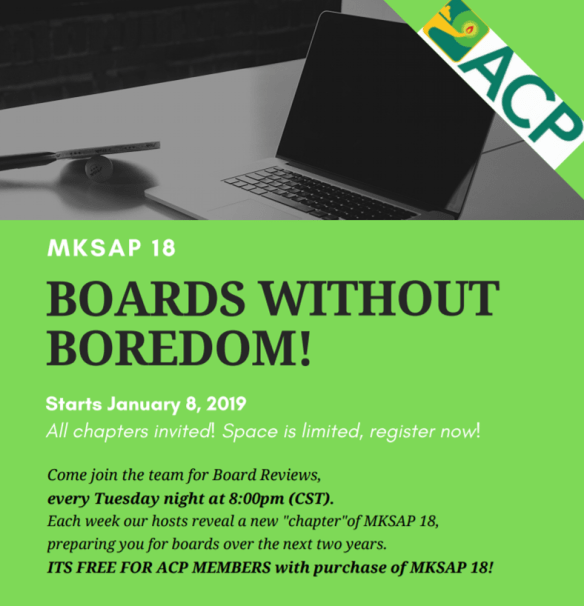
MKSAP flyer

NaBloPoMo 2019

Are you required to do continuing education for your work?

Since 2013, the Illinois Chapter of the American College of Physicians has run a weekly internal medicine board review webinar, MKSAP Live Online Study Hall.  We use questions that ACP publishes through the Medical Knowledge Self-Assessment Program, covering topics in general medicine and its subspecialties, including cardiology, pulmonary, infectious diseases, and rheumatology.  Every Tuesday night at 8pm Central time, two of us moderators and one webinar organizer get online and review about 14 questions, SAT-style.  We interact with audience members through a chat function on GoToWebinar, and we poll some of the questions each session.

I love this program for multiple reasons.

First, I was there when it started.  Gathered around then Governor Dr. Marie Brown’s dining room table, a handful of local ACP members brainstormed and created what is now an international, comprehensive internal medicine board review webinar series.  After some playful, off-topic, post-prandial banter between Dr. Sean Greenhalgh and me, our colleague across the table said wryly, “I’d watch that for an hour.”  Hence the dual-moderator, morning radio DJ style webinar was born.  That was in the fall of 2012, and the Study Hall is now halfway through its third two-year cycle.

Second, I get to hang out with my doctor friends online.  Besides Marie and a couple others, I did not know any of the dozen folks involved in the project before that night at her house.  We did improv workshops at the beginning to form our team and ease our communication skills.  Since then we have all become friends—a clique, even.  We have followed kids’ graduations, births of babies and grandbabies, and some personal challenges as well, all while getting together every few weeks to talk shop for an hour online.  We have even become celebrities of sorts—first at Illinois Chapter meetings and now sometimes at ACP National, people come up to us to say how much they like the program.  We’ve become a fixture in some colleagues’ lives.  We feel pretty proud and special about that.

The best thing about the Study Hall, though, is that just in the space of one hour on a Tuesday night, I am consistently humbled by the sheer volume of knowledge there is to absorb, just in internal medicine.  This is only one specialty of the whole medical profession!  And it’s not just the volume—it’s the complexity, the context, and the ever-evolving research, diagnostic and treatment development, and guidelines.  MKSAP publishes a new set of comprehensive questions every two years, and I do not envy the writers their colossal task of keeping us all up to date.  Without fail, every session I learn something that I will use the following week in clinic.

As this month of daily posts progresses, I feel increasing awe and gratitude for all of the people and opportunities in my life.  Thanks to all my colleagues, leaders, family and friends who make this life so full and loving.

November 18:  Relentless Curiosity Makes Me Better

IMG_4440

NaBloPoMo 2019

“Be patient toward all that is unsolved in your heart and try to love the questions themselves, like locked rooms and like books that are now written in a very foreign tongue. Do not now seek the answers, which cannot be given you because you would not be able to live them. And the point is, to live everything. Live the questions now. Perhaps you will then gradually, without noticing it, live along some distant day into the answer.”
― Rainer Maria Rilke

Tonight, in the month of gratitude, I feel deeply thankful for Coach Christine.  I might have been a curious person all along, but it was not until I got a life coach that I learned the vast and profound value of curiosity in every realm.  As I wrote earlier this month, standing always in curiosity liberates my mind.  It relieves me of unnecessary urgency for an answer.  I can exercise professional creativity in forming better and better questions, and the answers (often multiple, intertwined, and intriguing) emerge more easily and artfully than if I chase them demandingly.

The business of medicine is to solve problems, to heal, to cure.  So we assume that the faster we get to answers, the better.  And they had better be the right ones, because lives are at stake here!  It’s always interesting to me when patients talk about my work as ‘saving lives.’  I can’t remember a time when I could actually make that claim, at least at all directly.  But to my colleagues—emergency medicine and critical care docs, trauma surgeons, suicide hotline counselors—thank you, you really do save lives every day!

I love primary care because I usually have the luxury of ‘(living) the question.’  When patients present with new problems, as soon as I know they are stable, I get really excited.  I’m liberated to get deeply curious, ask as many questions as they will tolerate, paint the big picture together.  I follow the standard physiologic and diagnostic process initially, which often yields a straight forward answer and plan of care.  But life and work would be pretty boring if that were always the case.  When the usual suspects are all acquitted and the mystery persists, that’s when things get fascinating.  This is when I really get to know a person.  When I ask truly open, honest questions—the questions I don’t know the answers to and that are not meant to lead anywhere—I never know where the conversation will go.  And I always learn something new and relevant, something that helps me connect.  This is the information that makes a person memorable, because it is truly unique to them.

One of my favorite moments in a patient encounter is when I have to pause a few seconds to form a really good question.  What do I really want to know, what am I after, what will really break open this conversation?  It happens regularly, and wow, what a rush.  OH, I just never know what I will learn!  You’d think people would get impatient and grumpy with such prolonged, sometimes meandering interrogation.  But I find that they often lean in, look me in the eye.  They get on the train with me and look as eagerly as I around the next bend.  What will we find?  Let’s explore together!

Relentless Curiosity.  It’s the funnest part of my work.  I love it.  And as we all know, loving our work makes us better.