Magnetize Thyself

“Your vibe attracts your tribe.”

What is my vibe, I wonder? How do others experience me? What moves us each to approach one another?

It’s been six months since I wrote about feeling liberated to be more authentically and fully expressive of my thoughts and observations. I feel freed to take up more space, be all me, all in, whatever I’m doing. As a result, my encounters and interactions with many people, patients especially, are that much deeper and more meaningful. In this time, I also seem to have attracted and strengthened connections with a number of like-minded and like-hearted folks. It feels joyfully cosmic.

I met the team at Ethos Training Systems three years ago, and stayed on their periphery. I officially joined the community this April, moved by some immutable force, and made fast friends with the coaches. I also feel right at home among my gym classmates. I rejoined Instagram a few weeks ago in order to see the workout videos, and found Coach Jacob’s page. To see posts of a thoughtful, generous, humble, and loving young man, or if you just want some uplift one day, hop on over and read his reflections, watch his videos. I learn so much from Jacob, in more domains than fitness. It reinforces for me the value of making friends with people much younger than myself. The generation ‘gap’ invites attention and exploration, an ebullient mutual bridging. I am convinced we each have something important to offer the other.

Last month I reconnected with Steve, one of my favorite people in high school. Looking back, he was one of the first people with whom I could do joyfully deep philosophical banter, and also talk science. He went to college on a physics scholarship, and now flourishes as a tenured philosophy and religion professor. We met for lunch after over 30 years, and it was as if no time had passed. We humans are who we are from a very young age, and we also continually change and evolve throughout our lives. It’s such a lovely paradox, and I’m finding folks left and right who embrace it like I do–the connections reminding me of formative atomic collisions.

Colleague introduced me to Hilary, an energetic and effusive somatic psychotherapist. It took us a while to connect in person, yet we both persisted in the effort. I felt pulled–called to gather with her. We both feel first hand as well as vicariously, the immense pressure and burnout borne by our fellow healthcare workers. We understand intuitively that COVID was just an oceanic tremor; the myriad recurring tsunami waves of consequences are yet to hit, and we brace for it, personally and professionally. Meanwhile, we both ascribe to Isaac Asimov’s words: “I continue to try and I continue, indefatiguably, to reach out. There’s no way I can single-handedly save the world or, perhaps, even make a perceptible difference–but how ashamed I would be to let a day pass without making one more effort. …I have to make my life worthwhile to myself, if to no one else and writing these essays is one of the chief ways I can accomplish this task.” Like me, Hilary sees and feels her potential in multiple domains at once, gets excited about them all, and must self-regulate. She chooses to embark now on a writing journey. I think I was placed on her path to walk in solidarity with her, while we share, support, and learn from each other. We agree to buy Colleague a drink for bringing us together, right here and right now, just when we both needed.

“People don’t buy what you do, they buy why you do it,” Simon Sinek says. It’s about resonance. My Why grows ever clearer, and I manifest it with increasing power and momentum (and hopefully without too much ego). I am definitely attracting my tribe, finding people with whom my Why vibrates strongly. I compare myself to a magnet more often every month–one with rising energy. The tribe grows, maybe approaching critical mass for effecting positive change through relational leadership. But even if not, the coalescence feels profoundly meaningful.

Useful Repulsion

If I am a magnet, then there are elements (people) I will repel, and/or will repel me. I can name, with some regret, friends who have exited my life. Sometimes my bids for initial connection with people I admire get rejected, which doesn’t feel good. Why don’t they like me? Others approach me, and I feel neither spark nor interest, so I politely keep my distance, eventually falling out of orbit. It’s limbic, visceral, irrational, and organic. I have learned to take it all in stride. Not all friendships, relationships, and connections are meant to be, or to last forever. Neither, though, are separations. You just never know. So I resolve to stay open to shifts in whatever polarities are at play, for repulsion now to become attraction later, and vice versa. Anything is possibile.

I have a few longstanding relationships, however, which I will not exit and that yet feel consistently repulsive in one way or another–dissonant, counter, antithetical. How do I reconcile this? What is the cosmic purpose here? I have decided to see it as a form and source of movement, as with Maglev trains or levitating globes. My counterparts and I, like these magnetic objects, are held in sustained proximity by both attractive and repulsive forces of the relationships themselves, based on the positions and polar orientations of our respective magnets. As a result, I am impelled forward, I like to think in personal growth. Or I’m held in place, suspended in stability within which I may spin and bounce–there is security here, even if movement is restricted in some dimensions. Anyway, it’s a fun and encouraging way to think of myself–as a magnet that naturally both atrracts and repels, creating both potential and kinetic energy.

As I continue to step into and stand straight and strong in my core values and life purpose, I understand and accept that my relationships will self-organize accordingly. As I attract some, I will necessarily repel others. Sometimes the latter is painful. Still, the rewards of magnetizing myself this way far outweigh the costs.

One Perfect Day

“What would constitute a ‘perfect’ day for you?”

Some of you may recognize this as one of “36 Questions That Lead to Love,” a popular and oft-cited article by Daniel Jones in the New York Times in 2015, based on Arthur Aron’s study published in 1997. I could never generate a plausible answer, thinking superficially. And every time I read the article, I think of Nigel Marsh’s description of his ideal day–see 4:50 of his 2011 TED Talk. Basically he spends quality time with family, works about 6 hours, hangs out with friends, exercises, and has sex four times.

Coming across the question again in You’re Not Listening by Kate Murphy yesterday, I realized how close to perfect my day off was this week. Here’s how it went, with brackets inserted that would have made it truly ideal:

Wake up after 7 hours of sleep, in a fantastic mood, giddily looking forward to the day.
Move through morning routine easily, no rush or urgency.
Talk to Mei on the way to school, discussing her musings on anything that comes to mind.
Eat a light and tasty breakfast, sweet and salty, carb and protein, and coffee–oh yes, pour over coffee, nice and slow.
Consume a book and/or articles: on audio, digital, and/or print, romance and/or other, in the kitchen and car.

Ethos class! Challenged, educated, strengthened, and energized through coaching and community. I am now quoted on their social media:

Lunch with Dear Friend #1, communing over gorgeous salad, an Arnold Palmer, and shared ideals of leadership, friendship, and inner work.
[Find squishy armchair in a bookstore coffee shop, where I journal my reflections from lunch, reveling in the time and space to meet my friend and feed my soul.]

Browse bookstore, purchase artistic yet understated journal for Dear Friend #2, because everybody deserves pretty paper to write on.
Run into Dear Friend #3 on the way to meet DF2, reconnecting after many months and checking in–yay!
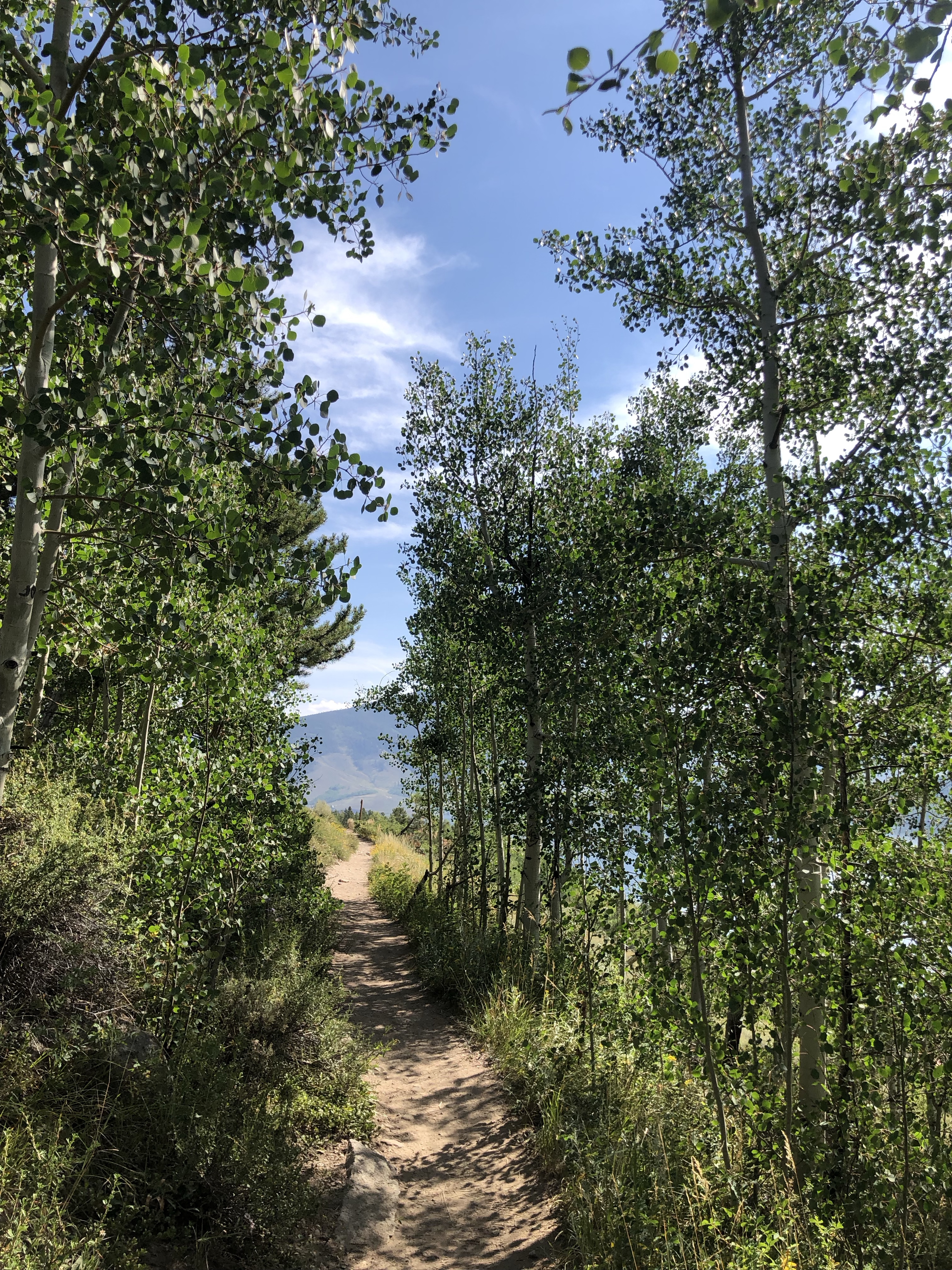
Walk and talk with DF2 [on wooded trails of Summit County–or] near Lake Michigan, stopping to photograph beauty that catches our eyes.
We discuss culture and relational leadership, exchange perspectives, and brainstorm ways to help systems and their people flourish.

[Find a shady bench, near spring blooms and urban wildlife, to sit and journal again, recording ideas, plans, aspirations, BHAGs.]

Pick up Mei from school, she’s energized more than stressed.
Pull fresh ingredients from fridge, audiobook or Agape music in the ears while chopping and stir frying.
Have a light and easy dinner, somebody else cleans up.
Mill around enjoying the house and its memories [it’s clean and neat, all plants watered and thriving].
Complete a relaxed night time routine, including pleasant smelling skin treatments.
More writing [and reading] in bed, all leftover words effused [and/or absorbed] for the day.
Lights out, burrowed in the covers, some intimate connection, sated in all 5 reciprocal domains of health.
Still high the next day and beyond, absolutely buoyed.

So what makes this day so perfect? What makes me so unreasonably and residually happy from it?
The ingredients:
Time
Autonomy
Good sleep
Movement
Communion with people I care about and who care about me
Good food
Alternating rhythm between activity and rest; among input, processing, and output
Nature, especially sunlight
Social, emotional, and intellectual connection, both intra- and inter-.

Would I want to live this day every day? I think not, even if it were possible… Although I could easily imagine repeating it a few times over a languid vacation.

When I cannot/will not get a whole day like this at a time, how can I incorporate something perfect into each day? This question excites me with potential. It wouldn’t take much of any/each of the ingredients above, in any combination, to make any day a little more ideal. Some advance planning, mindfulness, and real time gratitude could go a long, long way. By this time next year, regardless of what’s happening around me that I cannot control, my life in general—all days—could be a lot closer to perfect, even more excellent, than they already are.

Proud of You

“I bet your mom’s proud of you.”

I sat in the car at the last intersection before entering the parking garage, on a typically cloudy spring morning in Chicago, just another ordinary day of work. A young man crossed the street in front of me: average height and build, light brown hair, clean shaven; neutral expression, walking with intent, apparently familiar with his route, a well-worn work bag slung across his chest–student? Office worker? I can’t say why I noticed him, as he was not the only pedestrian in the area. But as I watched him continue on his way, apparently oblivious to me, I started to wonder: Does your mom know where you are right now? Is she thinking of you? Is she confident that you are safe? I bet she’s proud of you–no matter what you’re doing, whom you’re with, what you will do today–I bet she smiles when she thinks of you.

This was years ago; Son and Daughter were still little kids. My thoughts surprised me, overcame me with something akin to nostalgia over the future? Out of nowhere, my imagination had cast me to sometime close to today, when my own son lives out of state. I don’t know where he is or what he’s doing at any given moment, and I do always smile when I think of him. I am proud of him, irrationally (though justifiably) so, just because I’m his mom.

On this day each year we drown in myriad writings, images, and expressions about Motherhood and Mothers’ Love, etc etc, ad nauseum. So let me make my contribution! It’s a complicated ‘holiday’. May you feel respected and validated, however you experience it. Personally I find it ambivalent and a little awkward, like an earned Valentine’s Day and birthday combined. Thank you to Sister for sharing this sardonic piece on the irony of Mother’s Day, and to Ellen over at The Examined Life for sharing this more contemplative perspective on all that women hold.

I think about Son, Daughter, Husband, myself… Of Ozan and Shane, Friend, Friend, Friend, Tribe. I know in some cases, and assume without question in others, that our parents are indeed proud of us. Some of it may stem from what we do–our accomplishments, status, etc. But cultural standards and social norms notwithstanding, I think true parental pride blooms when we see who our children are. Outside the distorting lens of evolutionary drive for progengy survival and intrinsic, self-perpetuating narcissism, who better than our parents see everything about us–our strengths, quirks, triggers, and regrets? Who else witnesses the full panoramic mural of our character, built brick by laborious brick, painted in layers of pigment and divergent media, over our lifetime, starting in our mothers’ wombs? The most fortunate of us benefit from the love and guidance of multiple supportive adults throughout our development. But parents, and moms in particular, hold that special place–that vantage of deep observation and knowledge of the whole of us–or at least the full potential of it.

As usual, when I experience some profound sensation or insight, I feel a need to discharge it. I need to put it somewhere, do something useful with it.

So what about the people for whom I have a hard time imagining proud parents? They are the ones I perceive as uncaring, arrogant, mean, belligerent, and harmful to those around them. How do their moms see them?

Now there’s a fascinating thought experiment. Can I imagine their mom? What does she know that I don’t, how would she respond similarly to and differently from me, witnessing the same behavior in her child? Could she and I, in the best circumstance, help each other understand her child better, more wholly? After all, parents are human; we have biases (see intrinsic narcissism) that blind us to certain realities about our children. It helps us to hear and see outside perspectives, if/when offered in love and compassion.

What makes us say, “…only a mother could love” about someone or something? How cutting and dehumanizing, no? Yikes. We must do better. What tools, frames, mantras, and mindsets can we access, to make more generous assumptions about one another, even/especially about those for whom our default narrative is ‘enemy’ or such? Not much that’s generative or productive emerges when we stand and live in that perspective.

When I see you, talk to you, hear you, experience you, what if I try to take your mother’s best perspective of you, and look harder for her sources of pride in you? Maybe I’ll try this experiment this week. I bet I learn a lot.