Holding Gentleness

“…A kinder, gentler nation.” –George HW Bush

President Bush the First came to my high school during his campaign for a second term in 1991. I got to speak on behalf of Students Against Driving Drunk (SADD–which I just learned is now Students Against Destructive Decisions) and sit next to him on stage. Decades later my classmate would tell me that the photo of that event which hung in the main office is actually a Getty Image. I’m convinced they put me in that chair so people could get a good view of him–he was at least a foot taller than me. He was also such a decent man. I so admired him, and Barbara, too–I read her memoir in college. I know there are many decent, kind, and gentle people all around. That is what I hold tonight, no matter what anybody says.

Clouds and rain glowered over Chicago today, though temps were still very mild for November. Other than the hour when I PR’d my bench press (6 reps, 80#, all me!) at Ethos this morning, my energy has felt dim and slow. These last couple days I wonder if I’m more anxious about the election than I realized. Huh. Good opportunity to practice some body scan meditation and breath work. As I write this, the usual states have shown their usual colors. I will post this and go to bed, and deal with it all tomorrow.

So how can we all cope with things in the morning and beyond?

Gently is the best word I can muster tonight.

My conservative friend in Alabama went to work the day after the election in 2016 [note: I have corrected this post. The prior version stated he voted for Trump in 2016; he did not]. He did not gloat. His colleague arrived in tears and he held her in a hug. I hope this kind of interaction happens all over the country, tomorrow and onward. Hugs. Gentleness in both triumph and grief. I hope we’ll eventually be able to say both, “See, it’s not as bad as some of us thought it would be,” and also, “Yeah, it’s not the utopia that some of us had assumed.” Because things are rarely all bad or all good like we imagine or expect. What we must do, however, is to admit these things to one another, honestly and humbly. And it’s only safe to do this if we are gentle with ourselves and others, both in person and in rhetoric.

Our threshholds for distress and self-care practices vary. Let us be patient with ourselves and one another. Some will withdraw and cocoon, others will need tighter, brighter connections and out loud processing. Yet more of us will react in new, unfamiliar ways. We will all benefit from one another’s soft words and touch, our respective strengths and generosity in complementary presentation. This is how we save ourselves from political and interpersonal toxicity.

A kinder, gentler world, indeed.
The more we believe it’s possible, the more we will act to make it so.

I Hold Gentleness for Us all, as we approach our shared future. Whatever it is, we will all suffer less if we can be more gentle with ourselves and our fellow humans.

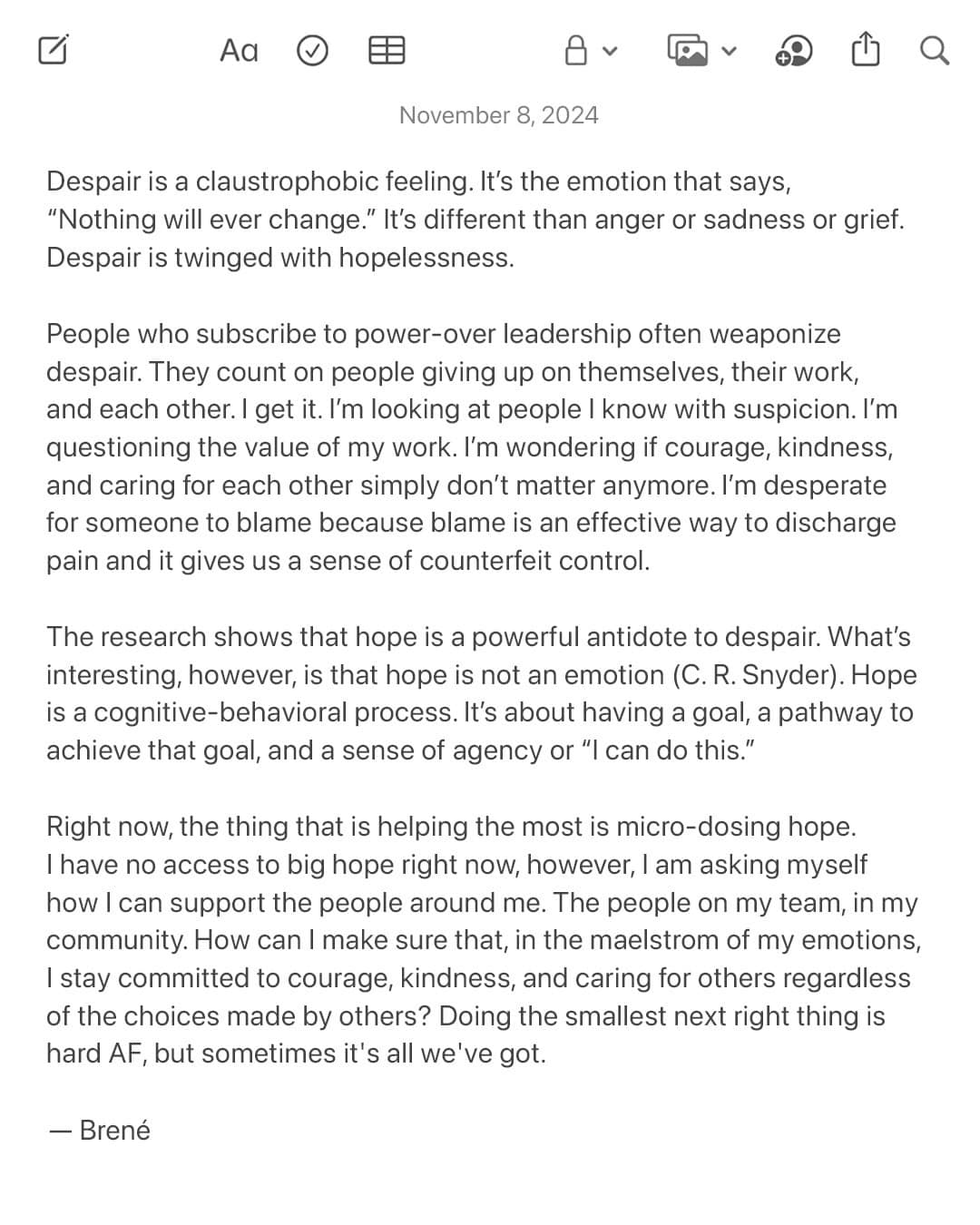
Take a look at the Instagram panels below. Let us consider them for ourselves and in our like-minded groups. How can we set down the adversarial spikes toward others and take up the tools to rebuild our connections? Gently, gently, ever gently.

Screenshot
Screenshot
Screenshot
Screenshot

Questions for Connection

What excellent question have you asked or been asked lately? How did it affect your relationship with the person asked/asking?

Ever since I started working with my life coach in 2005, I have practiced asking more and better questions in any encounter, in all life domains. The returns on this investment of presence and curiosity–idea generation, heightened conversation, and deepening connection, among others–far outweigh the costs of occasional awkward pauses and uncomfortable deflection.

I wonder, however, if I give enough time or energy to answering the interesting quesitons I ask?

Why, for instance, do I behave so differently with people in and out of my family? I feel like the same person in both contexts, and everybody knows the same me; yet I know I show up not the same at home as outside. Fascinating.

Today was Day 190 of my morning pages practice. Looking back, much of the journaling consists of lists, plans, recollections, and reflections. The same questions arise recurrently, mostly centered around behavior and relationships, and I attempt to answer overtly about half the time. Also fascinating! I feel comfortable with this state of things, as the simple act of writing them down and letting them sit on and below my consciousness day to day allows me to consider them slowly. Persistent questions point me to my core values, purpose, and goals. I feel no rush to formally answer these existential, identity-related, philosophical inquiries. I tell the story that simply marking their re/o-ccurrence pins them to some level of awareness where I can return regularly, like periodically adding brushstrokes to paintings that live in various rooms of my mind, heart, and life, when I happen to walk by. These rooms are bright and airy, each equipped with a sturdy easel, thick canvas, rich color palette, and full set of implements to create and revise, ad lib. I feel calm and focused, reassured that whatever is happening on any given day, I have time and energy set aside to process and digest, coming to clarity organically and as needed, all in good time. My morning pages facilitate insights and understanding regularly, and I see this practice sticking for the foreseeable future.

What I really relish, however, is engaging in questions, exploration, and discussion with other people! I wonder if this is how I make friends, actually? It does not matter if I just met you or I’ve known you my whole life; if you’re willing to dive with me like humanities nerds in a submersible to plumb the depths of open and honest questions and wild ideas of possibility–about anything from language to muscle physiology, human nature to politics, phylogeny to music–I might soon profess my undying love for you and chase you for more of that energizing connection. It is most often with friends, in those small, relaxed, meandering, sometimes calorie-laden gatherings, where nascent and novel answers to delightful questions so beautifully emerge and bloom. I carry my journal everywhere, to capture these pearls when they drop, as though gifts from the gods of sentience and relationship.

People crave deeper connection desperately now, in our increasingly chaotic, impersonal, and globalized world. I see references to the 2015 New York Times article “36 Questions That Lead to Love” regularly (that’s probably the algorithm, right?). If you cannot access it, see the original research article by Arthur Aron et al, “The Experimental Generation of Interpersonal Closeness: A Procedure and Some Preliminary Findings” with the questions listed at the end. Organized into three sets of increasing intimacy, the exercise invites us to ask our conversation partners questions such as, “What would constitute a perfect day for you?” “What is your most treasured memory?” and, “Complete this sentence: ‘I wish I had someone with whom I could share …'” From NYT: “The idea is that mutual vulnerability fosters closeness. To quote the study’s authors, ‘One key pattern associated with the development of a close relationship among peers is sustained, escalating, reciprocal, personal self-disclosure.’ Allowing oneself to be vulnerable with another person can be exceedingly difficult, so this exercise forces the issue.” I have the article bookmarked on my phone, and have yet to invite anyone to answer with me–maybe I’ll set an intention to do so on my upcoming friend dates? Part of me thinks I’m doing fine connecting on my own, and you never know, this could be truly next level.

Renowned psychologist Esther Perel created a similar game in 2021, Where Should We Begin, now in its 2nd edition. This query is how she historically initiates therapy sessions with clients. Questions in the game include, “I can’t believe I got away with…” “My latest crush is…” and, “My favorite love story to tell…” The box includes questions that range from lighthearted to serious, to sexual and beyond, which positively tickles me–because it’s all just life. In this age of polarization and easy mutual disdain and disconnection, games like this can help us all recognize our shared humanity.

I have purchased yet a different box of questions for connection, How Deep Will You Go? Its creators describe it as “a game of deep conversation without worrying what to ask, to feel closer in a way you never felt before.” Three levels of questions are labeled Ice Breakers (“What motivates you in life?”), Confessions (“Why have you kept going?”), and Getting Deep (“What is something you don’t tell most people?”). Reading the cards, I imagine with whom I’d want to delve. It depends on the question(s), of course, and also context and mood. I can picture a small friend group setting for the playful ones, and core belief/value ones as actual ice breakers for purposeful group work, such as a Braver Angels workshop. For the more intimate questions, though, I picture a one on one meeting, with plenty of preface and mutual agreement to actively engage in deepening personal connection.

Of course, interpersonal closeness is an iterative process: Other than the most superficial queries, the willingness to ‘go deeper’ requires some level of established trust and safety. That can take a while, depending on a multitude of factors. But once that foundational rapport is achieved, subsequent connection facilitated by these questions, one by one, may unfurl like the slow and steady inflation of a hot air balloon from the ground, lifting us gently together to affinity and affection we could never achieve where we started.

Connection decks like Where Should We Begin and How Deep Will You Go? make me so optimistic. I have loved and tried to ask questions like this for years, and now I feel validated. What if we all opened up to one another just a little bit more, just a little more often? What if we held one another’s hopes, joys, struggles, regrets, dreams, and confidences with a little more respect and reverence? What if we approached one another, friends and strangers alike, with the assumption of caring and mutual well wishes, looking to hold one another up, rather than with suspicion and wariness? And what if we rewarded such unearned generosity of spirit with reciprocal kindness?

The practice of mindfully asking deeper, more personal, loving, and intimate questions could go a long way to bridging our seemingly insurmountable differences; we all need this right now. It’s not appropriate in every encounter, of course. We must attune to context and opportunity, and act (ask) with confidence and humility. And that’s also the point, isn’t it?

The more present we are to one another’s vibrations, our moods and energies, the more likely we are to connect in earnest, regardless of what questions we choose to ask or not.

Understanding, validation, belonging, closeness, intimacy–we humans thrive when we feel these often and deeply. I still have hope that we can do it better.


Perspective

“Tribe.”

What is your perspective on this word? I’m feeling a little defensive tonight, and also holding mind space to consider different perspectives, while clarifying my own in the process. I have used the word to describe my ‘found family,’ people with whom I share a deeply meaningful bond, my innermost circle and closest confidants. Including unpublished drafts, a search of ‘tribe‘ on this blog yields 105 posts.

Recently I have heard that using the word ‘tribe’ could be offensive to Native Americans. My initial reaction is divergent. Yes, I can see why. And, really? Does this group hold the exclusive right to use this word to describe something meaningful to them? Is its use in other contexts offensive to all indigenous people? Has it always been?

Four sources of perspective:

On the etymology of the word ‘tribe’: “In the Biblical sense, which was the original one in English, the Latin word translates Greek phyle “race or tribe of men, body of men united by ties of blood and descent, a clan” (see phylo-). Extension to modern ethnic groups or races of people is from 1590s, specifically “a division of a barbarous race of people, usually distinguishable in some way from their congeners, united into a community under a recognized head or chief” [Century Dictionary], but colloquially of any aggregate of individuals of a kind. also from mid-13c.

“What is a Tribe?” “True, “tribe” is a troublesome word, bearing the weight of decades of anthropological study that privileged Western civilization over all other traditions. But let us rescue it here, pare it down to its simplest meaning, as a name for the first human communities that formed beyond the primal bonds of kinship — the beginnings of the great experiment we call society, which taught us to be human.”

“A teen recently told me that using the phrase “find your tribe” or using the word “tribe” is offensive to Native Americans.” “For Indigenous people, tribal identity is important. So when non-Native people say “find your tribe” or “tribe” to describe groups of shared interest, it is offensive because it erases the significance of Tribal sovereignty, identity, and people. Instead, we can use words like: group, crew, friends, or circle.”

Tribal Leadership, Dave Logan et al. From a sociological point of view, using the word as a reseach group defines it academically: “The success of a company depends on its tribes. The strength of its tribes is determined by the tribal culture, and a thriving corporate culture can only be established by an effective tribal leader.” This book has influenced my perspective on leadership and culture very deeply, hence my reluctance to stop using the word altogether.

How do I do perspective well already?
–My perspective taking skills are strong. This has to do with empathy, attunement, effective question formation and expression, and active listening. I have trained to be slow to judgment and opposition. I can engage with openness, calm, and patience.
–I understand that my Asian-American cis-het-monogamous-married woman physician parent identity gives me a certain perspective that is not shared by everyone I meet. I try to remember this, especially when I engage with people whose identities do not overlap much with mine.

How could I do it better?
–It’s easy to feel confident and competent about my skills when I only practice in easy situations. I can look for situations and practice when it’s hard–really train my openness and curiosity. I don’t mean to pick fights with people, rather simply attune to divergent opinions and perspectives around me, and choose more mindfully to engage with that divergence, even if it’s only in my own head.
–Also do it out loud, or in writing. Tonight’s post was prompted by my Facebook post and its comments. I plan not to engage in a complex exchange on social media, and this post will not be my last writing on perspective.

How does society to perspective well already?

Information. This is a tricky one. We can basically find ardent examples of and support for any perspective we want on the internet. So on one hand, it’s really easy to find a diversity of perspectives to explore, process, and deepen understanding and connection. On the other hand….

Groups who lead by example. See the November 9 post on polarity management; organizations like Polarity Partnerships, Braver Angels, and the Aspen Institute all have programs to help us open our minds to broader perspective taking, more effective communication, and better relationships.

How could we do better?

Long form: Conversations and reading. My friend, intending to be helpful, dropped the link for the third perspective piece above as a comment on my Facebook post tonight. There was no accompanying writing or explanation. So far there has been a brief exchange in which she suggests that since the word may be offensive to some people, I should avoid using it (in the context of my post). It made me think more, but rather than engage there, I decided to write out my thoughts here. I’m grateful to her for prompting me to search and read more. Depending on the topic and participants, social media may not be the best place to exchange perspectives, but we can always use it ourselves as a springboard for our own inner and outer work. That work, in my opinion, requires more words, more time, and more real, in person connection.

“Count higher than two”. This article introduced me to David Blankenhorn, co-founder of Braver Angels, a group I admire deeply for its efforts to help people from opposing American political groups de-escalate political discussions. “Sometimes an important phenomenon actually does divide naturally into two and only two parts or sides, between which one all-or-nothing choice must be made. But in most cases, this way of thinking about the world is not only polarizing, it is highly simplistic and leads mainly to pseudo-disagreements as opposed to real ones.” This idea reminds me of the ABC exercise (Adversity-Belief-Consequence), which basically asks us to tell multiple plausible stories to explain adversity to unglue ourselves from our most kneejerk and often dysfunctional assumptions and their subsequent thoughts, words, and actions.

For tonight, I have decided that I can still use the word ‘tribe’ mostly as I have been–with reverence. I am now more aware, however, of the potential drawbacks of using it casually, the impact that may have on people for whom the word has specific and deep meaning. This perspective exercise tonight reminds me to continue practicing mindfulness, respect, and intention in my language. And when I offend someone inadvertently, I can own and correct my ignorance while discerning what’s mine to account for and what’s not.

Here on day 16 of NaBloPoMo 2023, we could choose to see these posts as banal and redundant. I’m feeling more that they mutually reinforce some central tenets of effective relationship, which is my WHY. My net of interconnected practices, their importance, and their mutually upholding properties, strengthens and tightens with each post. My motivation to write it all more coherently and inspiringly in the BFHP also grows daily. AND I’m still gettng to bed on time most nights! HALLELUJAH, FRIENDS!

Ooooo, Leadership tomorrow. Bring it.