On You, Team Captain and Tribal Leader

img_4052

NaBloPoMo 2016, Letters to Patients, Day 29

To Patients Who Think What You Do Doesn’t Matter:

Think again.

Yesterday I described You, the Elite Athlete.  All great athletes know they do not succeed alone.  They also appreciate the unique contribution they make to their teams.  What teams do you serve?  How do you lead?  It doesn’t matter whether you have a title or designation.  One of my favorite ideas is that no matter our instrument in the orchestra, according to Ben Zander, we can lead from any chair.

For now, think of yourself as Team Captain, or Tribal Leader.  You have invested in yourself by fueling and training, resting and recovering, managing your stress, and cultivating excellent relationships.  Now you can take the returns and reinvest in those around you:

Appraise:  Prioritize self-care

  • Like on an airplane: “Put your own mask on first.” Tribal leaders know that to effectively care for others long term, they first need to be healthy themselves.
  • Practice awareness and management of your emotions, and prevent emotional hijacking, so as to be emotionally available to our teammates and tribe members.

Empathize:  Speak the team’s language(s)

  • Think of your favorite teachers and coaches—they were able to relate to learners at all stages of development and team morale—and lovingly lift us all up.
  • “People don’t care how much you know until they know how much you care.” –T. Roosevelt

Inspire:  Lead by example

  • Effective leaders reject victim mentality, take responsibility for our actions, and model accountability for fellow tribe members.
  • When we captains can take our own mistakes in stride, as learning opportunities rather than shameful horrors, we make it safe for our teammates to do the same.
  • Everybody is then free to take more risks, voice more ideas, offer more of their authentic selves as a contribution to the whole,
  • Because they see us, their leaders, the ones who set the tone for the group, doing it, too.
  • Key here also is leading out loud—excellent captains articulate and coach the methods of self-awareness and self-management that help us all succeed.
  • By inspiring individuals to pursue personal excellence, leaders create a supportive milieu for collaboration and collective achievement.

Motivate:  Empower team members

  • Effective captains (coaches, leaders) recognize team members’ strengths and potential, as well as areas for improvement.
  • Rather than shaming teammates for mistakes or deficiencies, good tribal leaders provide feedback and encouragement, and more opportunities for practice and development.
  • They take into account each team member’s personal goals, and help to align them with those of the collective—excellent captains connect individuals to the whole.

If your actions cause others to

Dream more, learn more,

Do more and become more,

You are a leader.

–John Quincy Adams

What would happen if you treated yourself like a true leader?

On You, the Elite Athlete

wheaties-m-ali

NaBloPoMo 2016, Letters to Patients, Day 28

To All Patients:

What would happen if you thought of yourself as an elite athlete?

I present tonight the first phase of the presentations I have given this fall to physicians, corporate executives, and tomorrow, a corporate design team.  See how it applies to you:

***

What makes you exactly the same as Pat Summit, Martina Navratilova, Michael Jordan, Dana Torres, Peyton Manning, Serena Williams, Wayne Gretzky, and Walter Payton?  You are an elite athlete.  You have a specific skill set which you spent years training and honing.  You continue, through practice and discipline, to refine it.  It’s an upward striving, just like an Olympian—Higher, Faster, Stronger!  And, you’re part of a team.

So how should you take care of yourself—your very valuable, elite athlete self?

Fuel & Train

  • “Regular people diet and exercise. Athletes fuel and train.” –Melissa Orth-Fray
  • Our bodies are our vehicles. Elite athletes’ vehicles require premium fuel and meticulous maintenance.
  • We all struggle with the same challenges—time, motivation, discipline.
  • Each day we have an opportunity to walk the talk, and practice what we preach. Every good lifestyle choice, no matter how small (apple instead of candy, stand rather than sit), is a step of intention toward health.

Rest & Recover

  • Chronic sleep debt increases risks for diabetes, obesity, impaired immune function: GET MORE SLEEP.
  • Rest and recovery are integral for sustaining long term performance and injury prevention—ie burnout. This applies for both physical and mental exertion.
  • Take your allotted vacations and really disconnect.  The world will still function (temporarily) without you.
  • Broaden your methods: 15 minute walk, 10 minute meditation, 5 minutes of journaling—unwind, unload.

Manage your stress

  • How do you know when you are ‘stressed?’ How/where does stress manifest in your body?
  • What are your existing resilience practices? How quickly do you abandon them when things get busy?
  • Exercise mindfulness: Live in the moment; breathe deeply; speak and act intentionally, not incidentally.
  • We are no different from toddlers—easily emotionally hijacked when tired, hungry, over-extended.
  • Elite athletes use the disciplines above to manage their emotions and stay focused.

Cultivate positive relationships

  • Coaches, teammates, trainers, psychologists, equipment managers—no athlete succeeds alone.
  • We thrive when we feel seen, heard, understood, accepted, loved, and safe.
  • It is only when our relationships are strong and we feel connected, that we can truly care for ourselves and our teams.
  • Who is your support network, and how do they hold you up?
  • Who do you support, and why/how does this fulfill you?


What is your sport?  Who is your team?  How does caring for yourself benefit those around you?  And finally, what can you do today, tomorrow, next week, next month, and in the next year, that will elevate your own health and well-being, and that of your team?  Please share your ideas in the comments!

On the Full Body CT Scan: Don’t Do It.

caduceus

NaBloPoMo 2016, Letters to Patients, Day 27

To Patients Considering Full Body CT Scans:

Please reconsider.

Forgive me for putting on my preachy doctor hat for this post.  I will also break my NaBloPoMo 500 word limit for this one.

As we approach the end of the calendar year, many of you may have met your health insurance deductibles.  Maybe now would be a good time to get in some tests to ‘check under the hood,’ as some of you have said.  I share below some of my screening  recommendations, along with rationale.

Keep in mind that for this article, I define ‘screening’ as looking for a disease in a person with a) average risk for developing the disease and b) no symptoms.

Please also know that the opinions I express here are my own only and do not necessarily represent those of my colleagues, employer, or professional societies.


  1. Full body CT scan: This is not recommended by any clinical guideline or medical professional society as a screening test for anything.  As I will describe below, specific screening tests are recommended for specific diseases, and the best ones obtain actual cells or tissue, rather than imaging alone.  In addition, a full body CT exposes you to significant radiation, the long term consequences of which are still not fully understood.  Lastly, CT scans inevitably detect incidental abnormalities that have no clinical consequences, but that often lead to invasive tests that can cause real harm, such as bleeding, pain, infection, and anxiety.  This article from the FDA and this one by a radiologist at Harvard explain pretty clearly how the risks of this test far outweigh the benefits.
  2. Colonoscopy (colon cancer): This is the one test that nobody argues.  It is both diagnostic (can see signs of early disease) and therapeutic (can take it out).  Start at age 50, and repeat every 10 years if normal, barring new symptoms.  Read the full guideline from the US Preventive Services Task Force (USPSTF) here.  I know the prep is a pain, and I know you have to take a day off of work to have it.  But on the whole, the returns here are well worth the investment.
  3. PSA and digital rectal exam (prostate cancer): This is perhaps the most personal decision of all cancer screening. Population-wise, we have yet to show mortality benefit from screening of any kind, such that the USPSTF now recommends against screening until better tests become available.  But it’s not really that simple, because prostate cancer affects so many men, and is the second leading cause of cancer deaths in men in the US.  The most important thing here is to decide which risks you are more comfortable with: potential serious harm from screening and unnecessary treatment, or finding cancer at a later, potentially more high-risk stage.  This article from the New York Times may help, and this one from the National Cancer Institute.cancer-cases-and-death-2016
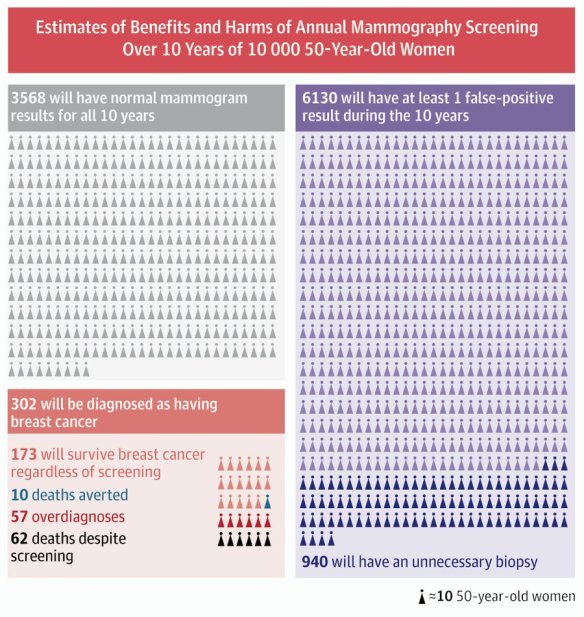
  4. Mammogram (breast cancer): It’s hard to walk back from more screening to less; people fear loss of security. When I started my training over 20 years ago, the recommendation was to screen every woman every year, starting at age 40.  Since then epidemiologists have kept track, and similar to prostate cancer screening, the mortality rate from breast cancer has not decreased proportionally to the amount of screening done.  Diagnosis has increased dramatically, due to early detection.  Again, screening increases the risk of certain harms:  anxiety (so much, for so many), pain, deformity, infection (from invasive biopsies), and then commitment to repeated testing (a vicious potential cycle of imaging, needling, more imaging, and more needling), while likely not saving your life.  Here is the USPSTF guideline, and a helpful infographic .  Like prostate cancer screening, this is one you have to decide for yourself, with the help of your doctor.mammo-infographic
  5. Pap smear (cervical cancer): Again, former guidelines called for annual screening. Today, if your test is repeatedly normal and your sex habits are low risk, the interval can be lengthened to 3 to 5 years, and can start later in life (over 21).  Cervical cancer is highly correlated to exposure to human papilloma virus, or HPV, which is sexually transmitted.  Positive pap results, which range from mild to severe, occur far more often in younger women, and of those, many will revert to normal without progression to cancer in a woman’s lifetime.  The main risk of over-screening, again, is unnecessary procedures when true disease not present.

In summary, these are the most common conversations I have with patients about screening.  You may rightly infer that my personal bias is minimalist:  Primum non nocere.  Unfortunately, we have no good screening tests for some diseases, such as pancreatic cancer, ovarian cancer, and liver cancer, and the screening guidelines in other countries (eg Taiwan screens adults regularly for liver cancer) do not apply here because prevalence rates differ so widely.

This is why I think it’s important to establish care with a primary care physician and get regular check-ups.  That fatigue you feel is likely just life and chronic sleep deprivation.  You’re probably constipated because you eat too few stems/stalks/leaves and don’t move enough.  You and your doctor can review your general health together, and if there is suspicion for some underlying health risk, it can be addressed personally and specifically.

To look up USPSTF guidelines yourself, I recommend searching Google for “USPSTF (disease) guidelines” and look for the hit that starts with “Final Recommendation Statement…”  I have no financial or professional interests in Google or the USPSTF.  Other respected sources for screening recommendations include the National Cancer Institute, the American Cancer Society, and the American Medical Association.  As an internist, I recommend the American College of Physicians.

I hope this piece has helped illuminate the complex decision-making behind screening and diagnostic testing.  I have only scratched the surface; the links contain the data and full rationale.  Please take the time to read through them and discuss them with your doctor.