You Can’t Pee!

DSC_0294

NaBloPoMo 2017: Field Notes from a Life in Medicine

When my son was little we lived in an apartment where the kitchen was a separate room, with only a small window through which I could see what he was doing in the living room while I cooked.  Once when he was about five months old, I looked out and he was lying on the mat in the middle of the floor, playing happily with the toys dangling from arches overhead.  I swear I only turned around for a minute, and when I looked back he was gone.  Empty mat, toys still dangling, no kid, no sounds.  I can’t remember what I was doing, but it felt like a slow motion eternity getting out of that damn kitchen to find him.  Something heavy must have fallen on him or he was otherwise suffocating or dying, for sure.  …He had just learned to roll over, and he had rolled and rolled and rolled himself into the space under the air conditioning unit near the window.  He was turning over a dried jasmine leaf he’d found on the floor.  Not long after that I decided I had to buy food preparation gloves.  Just in case my kid needed me anytime I was handling raw meat, this would save me the infinitude of time it would take to wash my hands—I could just pull the gloves off and bolt!  Because you know, 30 seconds could mean life or death for a toddler in his own living room.

Please laugh—I did today when I told the story to a friend.  It came up as we explored the phenomenon of moms putting everything for their kids before themselves.  We compared notes on how long we had ever held our urine.  What mom has not done this?  You can’t pee!  Because you never know which minute you’re not with your children will be the one during which your neglect will kill them.  Thankfully children grow and become more independent, and we can free our bladders again eventually.

It’s not just moms, though.  One of my teachers in the hospital gave herself a urinary tract infection as a resident.  She had so much to do every day, so many patients who needed her that she felt guilty taking time to pee.  I did the same thing in clinic for many years.  I could not justify making patients wait another minute when I was already 15 (usually more) minutes late seeing them. I don’t do this anymore.  In a fit of efficiency last week, I stepped into the restroom after I set my lunch to microwave for 2:00.  It literally takes only a minute to pee.  I don’t usually run late these days, but even if do, now take care of my needs first.  It’s better for me, and better for my patients, whose doctor is not distracted by preventable physical discomfort and dying to end the interview or exam to get some relief.

Our culture still expects moms, doctors, nurses, teachers, and many others to sacrifice selflessly in service of our charges.  UTIs are the least important consequence.  Over 50% of physicians in the US report at least one symptom of burnout, and 400 doctors kill themselves annually.  That is the equivalent of my entire medical school, dead, every year.  It’s not all because of the job, but the obligatory selfless-giver mentality in medicine definitely contributes.

So whatever helping profession you are in, please take time to take care of yourself.  We need you whole and healthy to take care of the rest of us and our children.

Go pee.  I will wait.

Hopey, Changey Hero Making

IVY Litt 11-8-17

NaBloPoMo 2017: Field Notes from a Life in Medicine, Day 8

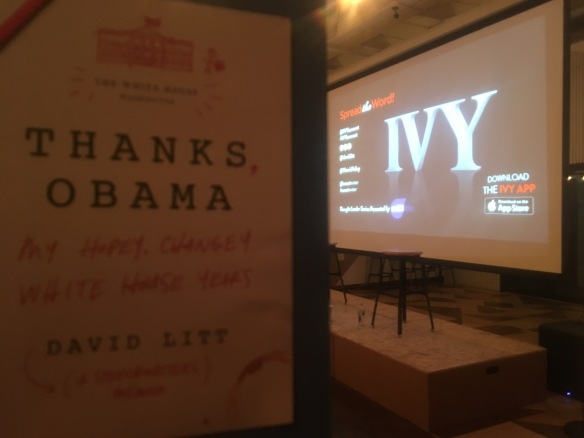
Funny how I just wrote last night about connecting new dots to old dots.  It just happened again tonight!  A couple of weeks ago I responded to an online ad for an IVY Ideas Night with David Litt, author of Thanks Obama: My Hopey, Changey White House Years, entitled, “How to Inspire, Persuade, and Entertain.”  Litt was a senior speechwriter for President Obama, so I thought I could learn new tips for presentations, and feel a little closer to the president whom I miss so much.

I’ve done public speaking since eighth grade, when our speech teacher first taught us abdominal breathing and I discovered the thrill of holding the attention of a room full of people with only my words.  I work at an academic medical center and I hold zero publications, but my CV documents over 10 years of professional presentations to various audiences.  I thought I was pretty good at this speaking thing.

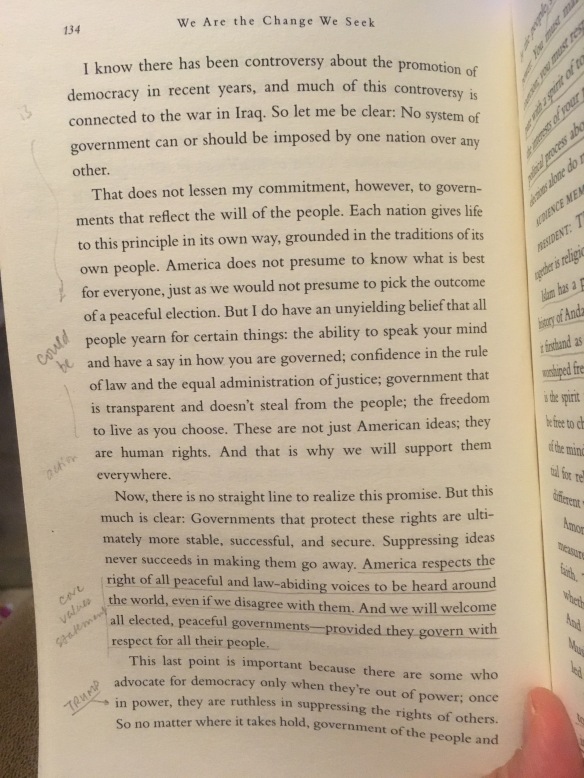
Three years ago I came across this TED talk by Nancy Duarte, whose ‘secret structure’ of great presentations I have used since I subsequently read her book, Resonate.  Essentially, she recommends that we invite audiences on adventure stories, create active tension between what is and what could be, and most importantly, make the audience the hero.  I have done this better and worse since then, but I always recognize the framework when I see it.  Those familiar with this blog know that I am also a fan of Simon Sinek, whose central message is that we perform at our best when we are crystal clear about our Why.  “People don’t buy what you do, they buy Why you do it,” he says.  Barack Obama employs both authors’ principles with eloquence and finesse, which I noticed reading We Are The Change We Seek, a collection of his speeches as president.  The best speeches delivered in this construction create audiences who are inspired, motivated, and empowered to hail a meaningful call to action.

Obama is could be core values

That’s basically what David Litt conveyed tonight.  When asked what advice he was given that served him best, he said, “Imagine someone in your audience will tell their friend tomorrow about your talk.  What is the one thing you want them to say about it?”  What is the Why of your talk?  Even though he no longer writes speeches for the most powerful person in the world, he expressed a desire to continue inspiring, empowering, and promoting personal agency in all whom his work touches. Make each and every audience member their own hero.

It turns out, however, that this approach applies to much more than public speaking.  On my 50 hour, 500 mile, aspen-pursuing weekend in Colorado last month, I described to my dear friend my favorite moments at work.  At the end of a patient’s day-long physical, after I have spent 90 minutes listening to their stories of weight gain and loss, work transitions and complex family dynamics, and reviewing their biometrics and blood test results, I meet with them for an additional 30 minutes to debrief.  This is when I present an integrated action plan compiled by the nutritionist, exercise physiologist, and myself.  It is a bulleted summary of our conversations throughout the day, centered on the patient’s core values and self-determined short and long term health goals, and crafted with their full participation.  I get to reflect back to my patients all that I see them doing well, and shine light on areas for potential improvement.  It’s an opportunity to explore the possible—to Aim High, Aim Higher, as the United States Air Force exhorts.  I often present the plan with phrases like, “Strong work!” “You’ got this,” and “Can’t wait to see what the coming year brings!”  My friend turned to me as we wound through autumn gold in the Rocky Mountains, a bit tearfully, and said, “You make them the hero of their own story.”  Yeah, I do, I thought, and I got a little teary, too.

Words are powerful.  They are our primary tool for relating to each other, for making another person feel seen, heard, understood, accepted, and loved.  You don’t have to be a public speaker or a presidential speechwriter to make a positive difference with your words.  At work, in your family, with your friends, with people on the street and in the elevator—what is the one thing you want someone to remember from their encounter with you?

Just Do It My Butt

DSC_0367

Happy late Monday, all!

Continuing my critical analysis of our American medical system…  This is not what I set out to do on November 1, I swear, and I have other more interesting prompts to expound on after today, I promise.  For now, thank you for indulging me in this rant of sorts:

My friend posted this article today, explaining how most methods of trying to get people to take their medications do not work.  It cited this meta-analysis, which concluded that “Current methods of improving medication adherence for chronic health problems are mostly complex and not very effective, so that the full benefits of treatment cannot be realized.”  It also reviewed findings from another study, concluding that, “A compound intervention integrating wireless pill bottles, lottery-based incentives, and social support did not significantly improve medication adherence or vascular readmission outcomes for AMI [acute myocardial infarction—heart attack] survivors.”  The piece basically asserts that behavioral economics, or the art and science of ‘nudging,’ will not by itself heal what ails our behaviors, despite what Thaler and Sunstein suggest.

The discussion on my friend’s page then centered around ideas like motivational interviewing, coaching, and the like—methods that have been shown to improve likelihood of overcoming addiction, obesity, and other behavioral maladies.  It occurred to me that this is the best part of my work: asking the important questions to help patients identify meaning and intrinsic motivation for behavior change, and collaborating in such a way that they own the plan because they have an authentic hand in crafting it.   And even then it can take years for new, healthier habits to entrain, because we are complex beings each with myriad influences affecting our actions at any given time.  When I can sit and listen to what makes meaning for my patients (if they know—if they don’t then it can get really interesting or really not, it’s hit or miss), and talking about what the future might look and feel like with a few relevant changes, I bask in my professional heaven.

But who can actually do this in the modern American healthcare system??  It takes time, and as we all know, time is money.  It also takes training and resources.  We are not born knowing how to perform motivational interviewing and cognitive behavioral therapy, and even today, these skills are not necessarily mainstream medical school curriculum (well if we’re being honest, communication skills in general are still given short shrift, which boggles me).  Physicians can and do learn these skills. But they don’t necessarily have to.  Medical systems which include dieticians, exercise physiologists, and health psychologists can deploy these team members to support patients in their health journeys.  But does your doctor’s office have this kind of set up?  Does your insurance pay for these services?

Most likely the answer is no.  It’s shocking and dismaying, because this approach is proven to be successful in important ways.  I refer here to the Diabetes Prevention Program.  This study was published 15 years ago, on February 7, 2002, in the New England Journal of Medicine.  From the link, here is the study design summary:

“…Participants from 27 clinical centers around the United States were randomly divided into different treatment groups. The first group, called the lifestyle intervention group, received intensive training in diet, physical activity, and behavior modification. By eating less fat and fewer calories and exercising for a total of 150 minutes a week, they aimed to lose 7 percent of their body weight and maintain that loss.

“The second group took 850 mg of metformin twice a day. The third group received placebo pills instead of metformin. The metformin and placebo groups also received information about diet and exercise but no intensive motivational counseling.

“All 3,234 study participants were overweight and had prediabetes, which are well-known risk factors for the development of type 2 diabetes. In addition, 45 percent of the participants were from minority groups-African American, Alaska Native, American Indian, Asian American, Hispanic/Latino, or Pacific Islander-at increased risk of developing diabetes.”

What do you think happened?

“Participants in the lifestyle intervention group-those receiving intensive individual counseling and motivational support on effective diet, exercise, and behavior modification-reduced their risk of developing diabetes by 58 percent. This finding was true across all participating ethnic groups and for both men and women. Lifestyle changes worked particularly well for participants aged 60 and older, reducing their risk by 71 percent. About 5 percent of the lifestyle intervention group developed diabetes each year during the study period, compared with 11 percent of those in the placebo group.

“Participants taking metformin reduced their risk of developing diabetes by 31 percent. Metformin was effective for both men and women, but it was least effective in people aged 45 and older. Metformin was most effective in people 25 to 44 years old and in those with a body mass index of 35 or higher, meaning they were at least 60 pounds overweight. About 7.8 percent of the metformin group developed diabetes each year during the study, compared with 11 percent of the group receiving the placebo.”

Lifestyle modification surpassed medication alone in preventing progression to overt diabetes in these high risk patients—almost double the benefit.  Well duh, you say, we all knew that.  We just need to eat less and move more.  But did these people ‘Just Do It?’  As if we can wake up one day and open a shiny new box of motivation that suddenly removes all of our circumstantial, emotional, and habitual barriers to optimal health?  No.  These patients were intensely supported by a dedicated, multidisciplinary team, day in and day out, for the long haul.  Every week patients reject my team’s offers to explore strategy for habit change, saying, “I know what I need to do, I just have to do it.”  Seriously, if it were that easy we’d all be doing it already (she screams as she pulls her hair out in knotted handfuls).

So, if this unequivocal study came out a decade and a half ago, why have we not implemented its procedure in primary care practices across the country?  I’ll wait while you think it over…

It’s money, of course, right?

It’s not that people in charge of healthcare spending don’t care about patients.  It’s that the financial returns of such an investment occur too far in the future to make for a good P&L calculation today.  Most insurance companies do not cover patients for the long run, so why should I expend all these resources to get you healthy today, so you can be healthy later and cost Medicare less many years from now?  The more I think about it, the more it makes sense to me to have a single payer system that can truly invest in our health, as a population of individuals, from birth to death.  And since habits and behaviors are established at very early stages of development, doesn’t it also make sense to have the medical/healthcare system integrated with the education system?  If we are a nation dedicated to the health and well-being of children so they can become healthy and well adults, why would we allow junk food in our schools and cut physical education?  What private, for-profit entity in its right capitalist mind would want to take that on?

Well, I trust you get my point.  It’s late and I have committed to writing every day this month, so I must stop here tonight.  Thank you again for your indulgence as I strode into the weeds on this one.

Hope to see you back tomorrow!