On Thanksgiving–Meh

img_2758

NaBloPoMo 2016, Letters to Patients, Day 24

To Patients Who Feel Lukewarm About Thanksgiving:

I’m with ya.

Not that I have anything against Thanksgiving…  I just have difficulty pouring forth a great gush of gratitude every fourth Thursday of November for a national holiday.  I thought this week it was just because of the tensions of the year, but looking back, I’ve never really loved this day.  I feel sheepish to write it, like people will think less of me.  Then again, something tells me I might not be the only one?

Yesterday I shared the most eloquent treatise on gratitude I have ever read, and I believe every word.  I try to live the premise every day—to pay attention and feel gratitude at the deepest cosmic level, connected to everything in the universe.  I marvel every day at all that I have, all that I am privileged to witness and do—to live this life, so full of learning and connection.  Today I’m supposed to summon and articulate all that moves me to thankfulness…  Why do I resist?

I imagine many would read this and think, “Wow, she is so ungrateful,” or maybe un-American?  I think most people who know me would disagree.  And those who know and love me best would hold the space with me to explore the curiosity of it all, without judging me for it or trying to ‘fix’ it.  And I’m ever so grateful for them, because I’m not sure it’s something that needs to be ‘fixed.’

I think it’s okay to feel not particularly grateful today, no more than any other day.  I also think it’s okay to feel especially grateful on this day, significantly more than any other day.  What’s not okay—what I see causing so many people to suffer—is when we shame others for thinking and feeling differently from us.  We physicians do this more than we realize, I think.  When patients don’t seem to take blood pressure, diabetes, obesity, or flu as seriously as we do, we can get very judgmental.  When they have different ideas about what will make them better (natural supplements, unusual diets, acupuncture, shamanic journeying, homeopathy), we can become positively hostile.  This is rarely helpful.

So if you, like me, are not particularly into Thanksgiving, and/or if you don’t subscribe to all conventional wisdom around certain things medical, I will try to withhold judgment.  I am indeed grateful for the chance to gather and enjoy one another’s company this week.  I don’t advertise my apathy for the holiday, as that would diminish others’ joy—and that would be antithetical to my core values.  I also appreciate the freedom to celebrate modestly rather than exuberantly.  I respect your right to choose therapies according to your values and beliefs, as long as your choices do not harm others.

I’ll continue to explore my relative indifference toward Thanksgiving.  Thank you for not trying to make me feel bad for it.
On What Helps

598672_4331811328037_1344124821_n

NaBloPoMo 2016, Letters to Patients, Day 22

To Patients Preparing for Uncomfortable Holidays:

Seek what helps.

What did I write recently about staying off of Facebook and minimizing my social media exchanges?  How fascinating, look what I just did—spent the last two hours on Facebook!  I also write about trying, falling down, and trying again…  So this is me both falling down (in my attempt to stay off) and trying again (to engage meaningfully).

The holidays are coming, yay!  …And, not so yay!  The conversations we have with friends and family in the next 6 weeks or so have enormous potential—for division as well as connection.  Personally, I feel optimistic.  I plan to evoke my core values of open-mindedness, empathy, and integrity.  I want to look back on the gatherings with gratitude and deeper connection.  So today I share with you all the things I have read (today—see?  I endure Facebook for your benefit! teeheehee) that have helped me.  These pieces validate, challenge, reassure, alarm, question and motivate me to Hold the Space, Stay on the Path, and Seek Love.  Please share yours, also!

A fellow physician’s acknowledgement of the humanness of bias, its potential for harm in caring for patients, and a reminder for self-awareness and –management.

Posts by Michelle at The Green Study, reminding us that internal conflict is normal in the face of world events such as ours, with concrete suggestions for actions that align with core values:  “We cannot strengthen our character unless it is tested. We cannot defend our freedoms unless they are threatened. We cannot become better writers or artists or humans unless we have obstacles to overcome.”

An article from The Guardian that points me to reputable sources of alternate points of view, so I may understand better.

A call out from the Wall Street Journal—to help me own my shit before I call out others on theirs.

A gentle message from fellow blogger John Pavlovitz: “Friend, however you choose to navigate these holidays, know that it’s the right way. Give yourself permission to pretend or confront or abstain as you need to, and forgive yourself later if you decide you chose poorly. You’re probably going to get it wrong or at least feel like you did.

“But remember too, to save a little of that mercy for those who sit across the table from you or those who choose not to. They’ll be doing the best they can too.”

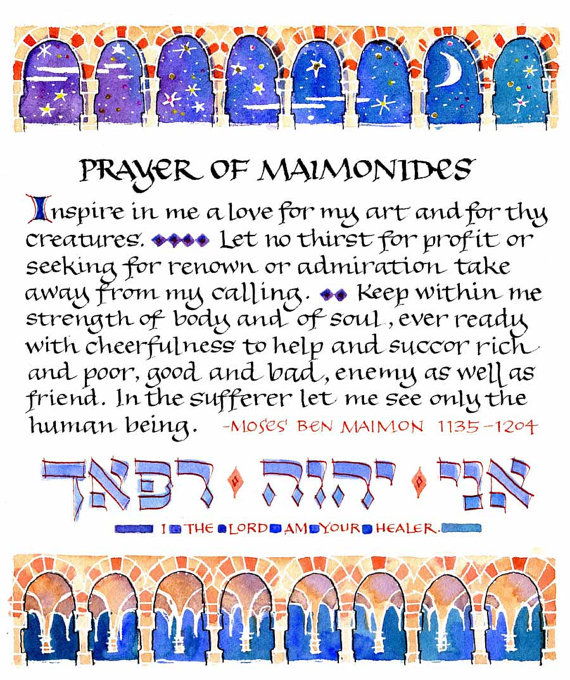
And finally, the Prayer of Maimonides, the twelfth century physician and philosopher:

prayer-of-maimonides

These holidays, wish me persistence and ‘stubborn gladness,’ as Liz Gilbert calls it.  I wish you all the same!

On Expanding Our Potential

10-growth-mindset-thought-conversionsNaBloPoMo 2016, Letters to Patients, Day 20

To Patients Whose Identity is Fixed:

Why not adopt a Growth Mindset?

Have you already read Carol Dweck’s book Mindset?  I first learned about the premise of a growth mindset several years ago, in the context of parenting.  Basically we should praise kids’ efforts more than their attributes: “Way to keep at it!” instead of “Wow, you’re so smart!”  When I think of myself primarily as ‘smart,’ I am less likely to try new things or take risks, for fear of appearing ‘not smart’ and ruining my reputation, or worse, my self-image.  That is what Dweck calls a ‘fixed mindset.’  A growth mindset, in contrast, allows room for experimentation and, well, growth.  I could still think of myself as ‘smart,’ but it means something different—rather than all-knowing, I am smart because I am an avid and effective learner.

Now I see it in broader terms, and it applies to people of all ages, in all phases of life.

From now into January, I have committed to moderate a weekly board review webinar on infectious disease (‘ID’).  I review questions, prepare a slide deck with explanations of correct and incorrect answers, and go online Tuesday nights with a partner to teach fellow practicing internists.  I really enjoy the webinars, but the topics sometimes not so much.  My fixed mindset at the outset this time: “I hate ID.”  Last week’s slide prep session may have been the longest two hours in recent memory.  I answered 6 of 8 questions wrong.  “I hate ID!”

Then I thought of Dweck’s premise.  I started to think of my patients who see themselves decisively as non-exercisers.  Or who hate vegetables.  Or who say they are ‘all or nothing’ folks who simply cannot moderate their eating, alcohol intake, or anything else.  They say, “That’s just who/how I am/it is; nothing I can do.”  Until now I have accepted these self-assessments without question or challenge.

fixed-growth-mindset-2

And now I wonder:  If I allow for a different assessment of my relationship with infectious disease, how much better could I learn the material?  If I open my mind to the possibility that I could actually remember all those (damned) drug names and mechanisms, the myriad tick-born diseases and their cardinal symptoms, and all the rest, could I actually have fun?  And then, how much better could I teach it?

If we all saw in ourselves just a little more possibility, or redefined our attributes to allow for unrestricted growth and evolution, what more could we achieve?  How liberated could we feel to explore diverse aspects of our personalities?  What novel ideas could we exchange with others, to create and innovate around interpersonal, communal, and political life?

From now on I will recite a new mantra for the ID webinars:  “There’s a lot to learn here.  I can get better at this.  Bring it.”  Yup, feels good.  Hmmm, I wonder where else I could grow my mindset?