
On the Second Arrow

wound-man

NaBloPoMo 2016, Letters to Patients, Day 11

To Patients Who Suffer:

Which arrow causes you more pain, the first or the second?

Fellow blogger Michelle at The Green Study recently posted a piece in which she distinguished between pain and suffering.  It reminded me of a Buddhist teaching that inspires and humbles me.  Blogger and curator extraordinaire Maria Popova quotes it in this article she wrote last year, on a book by Tara Brach:

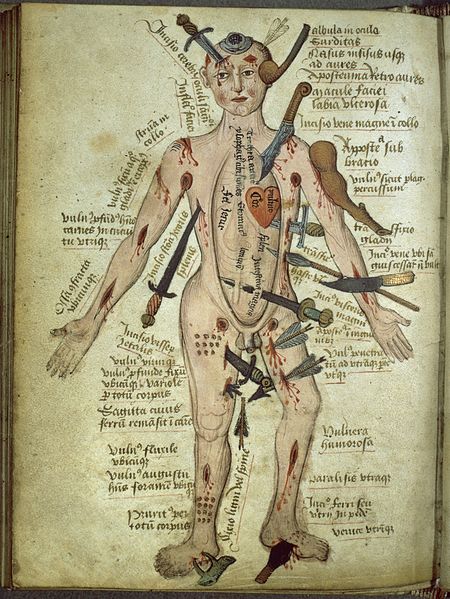
The Buddha once asked a student, “If a person is struck by an arrow, is it painful?” The student replied, “It is.” The Buddha then asked, “If the person is struck by a second arrow, is that even more painful?” The student replied again, “It is.” The Buddha then explained, “In life, we cannot always control the first arrow. However, the second arrow is our reaction to the first. And with this second arrow comes the possibility of choice.”

The first step to suffering less is cultivating awareness of the second arrow.  This takes practice, and we must resist the self-judgment that comes the moment we realize we have not only shot ourselves again, but have been twisting that second arrow deeper and deeper.  This shame and self-revulsion is, after all, another drop of poison on the second arrow’s tip.  Instead, I like to apply Ben Zander’s acclamation when he finds himself or his students doing something ‘wrong’: “How fascinating!”  Look what I did!  No judgment, just lighthearted observation.

The second step to suffering less is, of course, to avoid the second arrow.  Once we notice, learn how to remove it and tend the wound.  Breathe deeply.  Identify the sources of anger, fear, resentment, blame, contempt, shame, despair, anxiety, bitterness, envy.  Breathe again.  Loosen our desperate grip on these feelings.  Hold them more loosely, ever more loosely.  Breathe.  Breathe.  Hold also the Space, emotional, cognitive, and temporal, for them the move through and exit us.

Eventually, breathing, we can let go the negativity, pull the arrow out.  Breathe.  When assailed by another first arrow, see the second arrow coming and sidestep.  Breathe.  Keep breathing.  Practice self-compassion and forgiveness.

Life will continue hurling arrows at us.  Some will miss, others will land in our most vulnerable spots.  Mindfulness practice, centered in attention to the breath, helps us evade the wounds and anguish from our own second arrows.  The data, accumulated over the past four decades, is all but irrefutable for the benefits of mindfulness for depression, anxiety, chronic pain, burnout, and overall well-being.  Prolonged practice even changes the physical structure of the brain, and it’s never too late to learn.

If you’d like to learn more, I have included a few more links below.  You may find it worthwhile to invest in the practice.  Be patient with yourself.  And let me know how it goes!

http://www.wildmind.org/texts/the-arrow

http://www.huffingtonpost.com/susan-bernstein/dont-shoot-the-second-arr_b_5102701.html

http://www.nscblog.com/miscellaneous/avoiding-the-second-arrow/



On Community

img_4595

NaBloPoMo 2016, Letters to Patients, Day 10

To Patients Who Feel Alone Sometimes:

Who holds you up?

Day 2 post-election, it is still positively surreal.  Monday night I saw Facebook friends post passionate, emotional, sometimes desperate pleas, urging their friends to vote one way or another.  I also saw friends acknowledging the long, strange trip, looking forward to the next chapter, expressing both relief and trepidation.  A cloud of separation hung over my heart as I read some of my friends’ words then. 

Something inside urged me to contact a high school classmate.  We did not know each other well back then, and we didn’t always like each other.  But I always felt a mutual respect.  She does not post about politics; I do…a lot.  I know we differ in many of our positions and views.  I also know her to be thoughtful, kind, ethical, and just.  I know she has a lot going on in her life right now.  Our Facebook friendship has grown the past few years, and more and more I feel a cosmic connection.  I am meant to know this person again and better, in this later phase of life.  So I messaged her privately, just to tell her I was thinking of her.  I sent hope, and wishes that we could sit down over tea, somewhere cozy, and share our lives—slowly, thoughtfully, kindly, lovingly.  Turns out my little message helped hold her up yesterday.  On this day of anxiety and tension, hope and uncertainty, this long-distance connection gives me strength and peace.  It reminds me of a recent article by the Dalai Lama on our need to be needed.

I’ve said and written so often that I’m so grateful for my tribe(s), the communities that surround and support me in everything I do.  When I see patients, I make it a point to ask about emotional support networks. They don’t have to be vast or deep.  They just need to be strong and reliable.  No matter what our station, our illness, our cultural origin, or our political leaning, we live longer, healthier, happier, and easier when we connect with others.  It can be many, often, and deep.  It can be few and intermittent.  It just has to be meaningful and enough.

Lastly, supportive relationships function best when they are also reciprocal.  I don’t mean quid pro quo.  I mean mutual, shared, communal, uncalculated support.  I ask patients, “Do you have enough people you know you can turn to, people who will be there for you, in times of personal crisis?”  I want so much for you to answer without hesitation, “Yes, definitely, no question.”  Then I can relax about your health.  You (all) got this.

On Mutual Respect

img_4415

NaBloPoMo 2016, Letters to Patients, Day 5

To Patients Who Abuse Medical Staff:

Let me be clear: That is not okay.

Let’s define some terms first:  By staff, I mean clinic receptionists, medical assistants, nurses, phlebotomists, schedulers, hospital nurses, housekeepers, pharmacists, food service workers, billing and medical record staff, social workers, case managers, and anyone else who contributes to your care.

By abuse I mean insulting, yelling, name calling, intimidating, swearing, threatening, and otherwise conveying hostility and aggression toward others.

I have very specific behaviors in mind here.  I’m not talking about the inevitable frustrations that we all face in over-scheduled clinics and understaffed hospitals.  Exasperation, disappointment, and even anger are appropriate emotions we all share.  We understand that you may make surly faces and splutter a little when your expectations are not met.  Most medical staff are trained and expected to handle such interactions with patience, compassion, and calm.  They are frequently also given only narrow parameters within which to convey information, and almost no decision-making authority or autonomy.  Believe me, they feel terrible when they cannot help you, and often there really is nothing they can do in the moment.  But they can always ask for help, so I respectfully request that you give them the time and space to do so.

The medical community has a lot of work ahead to integrate our care teams.  We serve you best when all team members are empowered to exercise their best judgment, within their scope of practice, to move care forward toward your best health.  We are all here doing our best.  Physicians play a crucial role in both local and global medical culture.  But we are only recently stepping up as actively collaborative leaders, rather than authoritarians and paternalists.  You may see us physicians abusing our own staff, so let me be clear again: That is also definitely not okay.  Never mind that it undermines morale.  It can also endanger patients.  I hope in my lifetime to see an end to this contemptible behavior.

If I witness you abusing my staff, be sure that I will call you out.  I will do it respectfully, even lovingly, especially when I know you’re going through a hard time.  I understand how hard it is to control our emotions when we’re unwell and frightened.  It’s good for all of us, however, to know exactly where the boundaries of acceptable behavior and language lie.  Expect that if you cannot abide them, I will ask you to leave.

If you witness me or my colleagues abusing our staff, we need you to call us out, too.  Relationships are never one direction.  In medicine and health, the webs of connection are inextricable—one person’s mood and attitude can rapidly infect a group—and the stakes can be high.  I expect myself and my staff to conduct ourselves professionally.  We expect you to behave humanely.

Thank you for your cooperation!