Tribal Pride and Tribalism

DSC_0347

NaBloPoMo 2017: Field Notes from a Life in Medicine

What tribes do you belong to?  How do they serve you, and you them?  How not?

I think of this today as I have traveled out of state to speak to a Department of Surgery on physician well-being.  I wonder how often they have internists present at their Grand Rounds?  What a tremendous honor, I’m so excited to be here!  I hope my talk will be useful and memorable, as I represent my field and my institution, in addition to myself.  In the talk I describe the central tenets of Tribal Leadership and culture, and how to elevate ours in medicine.

So I’m thinking tonight about tribal pride and tribalism—the benefits and risks of belonging.

We all need our tribes.  Belonging is an essential human need. To fit in, feel understood and accepted, secure—these are necessary for whole person health.  And when our tribes have purpose beyond survival, provide meaning greater than simple self-preservation, our membership feels that much more valuable to us.  But what happens when tribes pit themselves against one another?  How are we all harmed when we veer from “We’re great!” toward “They suck”?

Of course I’m thinking now of intra-professional tribalism:  Surgery vs. Medicine vs. Anesthesia vs. OB/gyne vs. Psychiatry.  Each specialty has its culture and priorities, strengths and focus.  Ask any of us in public and we will extol each other’s virtues and profess how we are all needed and equally valuable.  Behind closed doors, though, internists will call orthopods dumb carpenters; surgeons describe internists’ stethoscopes as flea collars, and the list of pejoratives goes on.  Maybe I’m too cynical?  My interactions with colleagues in other fields are usually very professional and friendly—until they are not.  I have experienced condescension and outright hostility before.  But can I attribute it to tribalism—that general, abstracted “I’m better than you because of what I do” attitude—or to individual assholery?  Or maybe those docs are just burned out?  As with most things, it’s probably a combination.  Based on what my medical students tell me, negative energy between specialties definitely thrives in some corners of our profession.  Third year medical students are like foster children rotating between dysfunctional homes of the same extended family—hearing from each why all the others suck.

So what can we do about this?  Should we actively police people’s thoughts and words in their private moments?  I mean part of feeling “We’re Great!” kind of involves comparing ourselves with others and feeling better than, right?  Isn’t some level of competition good for driving innovation and excellence?  Should we even embrace this aspect of tribal pride?  It certainly does not appear to be diminishing, and I have a feeling it’s just human nature, so probably futile to fight it.

I wonder why we have this need to feel better than.  Is it fear?  A sense of scarcity?  As if there is not enough recognition to go around?  Like the pie of appreciation is finite, and if you get more I necessarily get less?  Intellectually we recognize that we are all needed, we all contribute.  But emotionally somehow we still feel this need to put down, have power over, stand in front.  And it’s not just in medicine.  I see it in men vs. women, doctors vs. nurses, liberals vs. conservatives, and between racial and ethnic groups.  It makes me tired.

But maybe we can manage it better.  Maybe we can be more open and honest about our tribal tensions, bring them into the light.  Yes, I think surgeons can be arrogant.  And that’s okay to a certain extent—it takes a certain level of egotism to cut into people, and when things start going wrong in the OR, I think that trait can help make surgeons decisive and appropriately commanding when necessary.  I imagine surgeons get impatient with all the talking we internists engage in.  So many words, so little action, they might think.  And yet they understand that words are how we communicate with patients, how we foster understanding and trust.  Maybe we can all do a better job of acknowledging one another’s strengths and contributions out loud and in front of our peers (and learners).  The more we say and hear such things, the more we internalize the ideals.

Tomorrow I get to spend a morning with surgical attendings and residents.  I hope to contribute to their learning during my hour long presentation, but I really look forward to my own learning, to expanding my understanding and exposure to parts of my profession that I don’t normally see.  I’m humbled at the opportunity, and I will look for more chances to bring together colleagues from divergent fields.  If we commit, we can connect our tribes and form a more cohesive profession.  That is my dream for future generations of doctors—to be freed from infighting and empowered to collaborate at the highest levels, for the benefit of us all.


 

Ode to My Dawn Simulator

DSC_0136

NaBloPoMo 2017: Field Notes from a Life in Medicine

Did you notice the photo on my post Gratitude Again?  That was the view out my office window around 5:30pm last week.  These days I appreciate the winter dusk a lot more than years past, mostly because the physically hardest years of training and my kids’ lives (for me) are over.  My intern year I rotated in the medical intensive care unit (MICU, or MICK-you, or just ‘the unit’ for short) in November.  Usual days started by 6am, and finished whenever my patients were stable enough for me to leave, usually past 7pm.  I really never saw the sun that whole month—not from outside, anyway.  Every third night on call, my resident and I covered the whole place.  The longest I ever spent in the hospital was 5am until 10pm the following night—41 hours straight, only to be back again the next morning at 6.  And that was nothing compared to the generation of doctors who trained before me.  Thinking back on it now, I can still feel the saturating fatigue, the utter hopelessness of ever seeing the call room, let alone lying down on a bed.  Thank GOD those days are over.  They weren’t all bad, though.  Residency was one of the hardest things I’ve done, and it was also intensely rewarding.  The friendships I made those years, the unique shared experiences—I carry these with me also.  They made me strong and gave me confidence.

But if I thought getting up in the dark during intern year was hard, somehow doing it as an attending with two little kids was even harder—go figure.  The sleep deprivation of working motherhood is a completely different animal from that of residency, its toll multiplied on family.  The blaring alarm clock, the utter blackness of the bedroom, the contrast of cozy warmth under the blankets with the cold still air above.  They all conspired to make me peevish, sullen, and supremely unpleasant to be around every morning—an additional cost to my soul every time I lashed out at the kiddos out of my own exhaustion.  To borrow a phrase from Vee over at Cute Kids, I might well have died of a bad mood or something worse if that situation continued.

So Husband staged an intervention: He bought me a dawn simulator for Christmas.  It’s an ingeniously simple device: An alarm clock with a built-in light dimmer that comes with its own full-spectrum light bulb.  All you have to do is connect it to a bedside lamp.  Then you set sunrise time, as well as duration of rise (I set mine to 6:45, 15 minutes).  Every morning for the past 7 years I wake up naturally from a steadily brightening, gentle and warm glow from one corner of the room.  It’s infinitely more pleasing; no blaring involved.  Of course now I have my iPhone ‘by the seaside’ alarm as back up, especially for this month as I stay up too late writing blog posts.  And I’m not a morning person in general, so no Mary Poppins songs bursting forth with domesticated mechanical birds on my windowsill.  But life is infinitely more tolerable between Halloween and Easter each year now—for all of us.

Thanks, Husband.  Ya done good.

Dr. Jerkface In Context—Healing the Patient-Physician Relationship

DSC_0507

Excuse me, I took an unintended break for Thanksgiving!  Hope you all had a wonderful holiday!

NaBloPoMo 2017: Field Notes from a Life in Medicine

For the past year or so, maybe more, I have increasingly tried to engage my friends in discussion around allied advocacy for physician health and well-being.  Inevitably, however, I’m met with anecdotes from my friends about asshole doctors.  It is a strikingly common experience, I’m sad to report.  And it makes sense:  If a patient has a bad experience with a doctor, ie the doctor behaves badly or the patient feels dismissed, ignored, disrespected, or mistreated, the normal response is to blame the doctor and assume that s/he is an asshole.  In each of these interviews with friends, it took a while for them to come around to the idea that the doctor him/herself may be suffering and therefore not behaving/performing their best.

But the next question is this: Do patients care about doctors’ suffering?  If they knew how the system harms physicians, would they have compassion for us?  What about if they knew how physician burnout and dissatisfaction directly affects their quality of care, all of it negatively?  What would move patients to stand up with and for doctors?  This is my goal for the indefinite future: to help us, patients and physicians, the end users of our medical system, stand up with and for one another, for positive systems change.

Right now I see it as a very personal, grassroots endeavor.  Outside of a one-on-one patient-physician relationship, ‘patients’ and ‘physicians’ in general are abstract groups to us all, and it’s hard to feel compassion for and connection with an abstraction.  “Patients are too demanding, entitled, and ignorant.”  “Doctors are arrogant, dismissive, and profit-driven.”  We carry these overgeneralized internal narratives and others into our encounters, often unknowingly and unintentionally.  Even when we think we see and know the person right in front of us, these underlying assumptions still color our experiences with them.  So whatever conversations we may undertake will take many repetitions to finally reach true mutual understanding.

I have been a member of my church since 1991.  Many others in the community have been there much longer than that.  There are other physicians, and we are all patients, ranging in age from infants to octogenarians.  I have proposed to host a focus group to discuss patient-physician relationship, especially as it relates to the effects of physician burnout on patient care.  The plan is to do it once, with whomever is interested, and see what happens after that.  I picture 10-20 people, patients and physicians alike, seated in a circle.

The objectives will be stated:

  1. Hold an open discussion about people’s experiences in the patient-physician encounter, and explore the context of forces that influence those experiences. Such forces include visit duration, documentation requirements, workflow inefficiencies, patient expectations, insurance status, and clinical setting (hospital, outpatient clinic, etc.).
  2. Participants leave with improved mutual understanding of one another’s experiences in the medical system and more likely to feel empathy and compassion toward their counterparts in the next encounter.

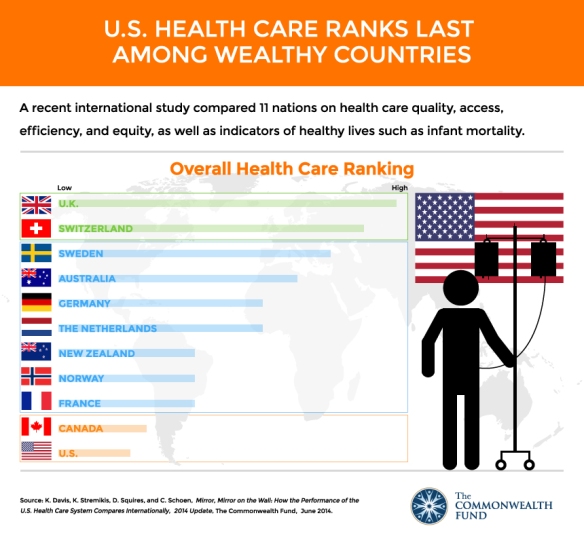
In the long term, I wish for patients and physicians to form a unified platform from which to advocate for policy change.  We, patients and physicians, are the end-users of the healthcare system, the largest combined demographic in the system, and I believe we are the ones who benefit the least from the system.  Health outcomes for American patients are dismal compared other developed countries, despite our exorbitant expernditures.  Physicians kill ourselves at more than twice the rate of the general population.

It’s not enough for medical professional societies to write co-authored, open letters to Congress.  It’s not enough for individual patient constituents to stand up at town halls and berate their representatives.  We must orient ourselves as resistors in series, rather than in parallel.  I think the movement will grow most effectively out of existing connections and relationships, through which we can find shared interests, common goals, and a strong, unified voice for change.

I seek your feedback:

  1. How do you picture this meeting going?
  2. How interested are you in learning about physician burnout and how it affects patients?
  3. If you were invited to such a meeting, what would you think and feel about it?
  4. What would make you more likely to participate?
  5. Would you want to host such a meeting in your community? How would you do it?

Thank you for considering, and see you tomorrow!